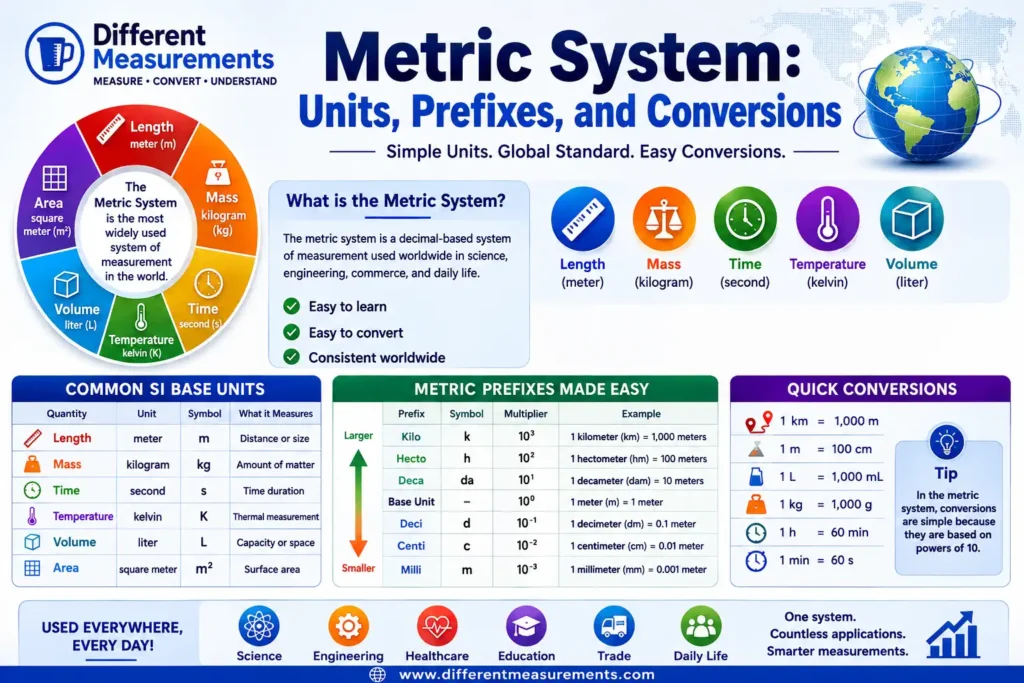
The metric system is the measurement framework most of the world relies on for everyday life, science, and industry. From reading a food label in grams to checking the weather in Celsius, metric units are woven into daily routines. This guide explains what the metric system is, how it works, its most common units and prefixes, how to perform metric conversions, and how it relates to the modern SI system.
What Is the Metric System?
The metric system is a decimal-based system of measurement built around units that relate to each other through powers of ten. Instead of using unrelated conversion factors, metric units scale up or down consistently, which makes calculations and conversions much simpler than in non-decimal systems.
This decimal structure is what sets the metric system apart. Because everything scales by ten, converting between units mostly involves moving a decimal point rather than multiplying by awkward, unrelated numbers.
Simple examples show this in action:
- 1 kilometer = 1,000 meters
- 1 meter = 100 centimeters
- 1 kilogram = 1,000 grams
- 1 liter = 1,000 milliliters
It is worth clarifying an important distinction: “metric system” is a broad, historical, and everyday term, while the International System of Units (SI) is the modern, internationally standardized version of the metric system, with formally defined base units, derived units, and rules. In practice, most metric units people use daily are either SI units themselves or units accepted for use with SI.
History of the Metric System
The metric system originated in France in the late 18th century, during a period of major scientific and political reform. Before this, measurement units varied widely from region to region, making trade and scientific communication difficult.
During the French Revolution, reformers pushed for a rational, unified system built on decimal principles. This led to the creation of the meter, originally defined as a fraction of the distance from the North Pole to the equator, and the kilogram, based on the mass of a specific volume of water.
Over the following decades, the metric system spread beyond France as other countries adopted it for trade, science, and government use. In 1875, the Metre Convention formalized international cooperation on measurement standards. This groundwork eventually led to the development of the modern SI system in 1960, which refined and standardized the metric system into the structured framework used worldwide today.
How Does the Metric System Work?
The metric system’s core strength is its decimal structure. Prefixes attached to base units represent specific powers of ten, allowing the same unit to describe very large or very small quantities.
| Prefix | Meaning | Value |
|---|---|---|
| kilo | one thousand times | 1,000 |
| hecto | one hundred times | 100 |
| deka | ten times | 10 |
| (base unit) | one | 1 |
| deci | one tenth | 0.1 |
| centi | one hundredth | 0.01 |
| milli | one thousandth | 0.001 |
Because each step represents a power of ten, moving between metric units typically involves multiplying or dividing by 10, 100, 1,000, or another power of ten, rather than using an irregular conversion factor. This is very different from systems like Imperial measurement, where converting feet to inches or pounds to ounces requires memorizing separate, unrelated numbers.
Common Metric Units
The metric system covers a wide range of physical quantities. Below is a concise overview of the units most commonly encountered.
Length
- kilometer (km)
- meter (m)
- centimeter (cm)
- millimeter (mm)
Mass
- metric ton or tonne (t)
- kilogram (kg)
- gram (g)
- milligram (mg)
Volume
- liter (L)
- milliliter (mL)
Cubic metric units are also used for volume:
- cubic meter (m³)
- cubic centimeter (cm³)
It is important to note that the liter is not an SI base unit. It is, however, officially accepted for use alongside SI units because of how widely it is used in daily life and commerce.
Temperature
- degree Celsius (°C)
- kelvin (K)
Celsius is the everyday metric temperature unit, while kelvin is the SI base unit for thermodynamic temperature. The two scales share the same size increment but start at different zero points.
Area
- square meter (m²)
- square kilometer (km²)
- square centimeter (cm²)
Speed
- meter per second (m/s)
- kilometer per hour (km/h)
Pressure
- pascal (Pa)
- kilopascal (kPa)
Energy
- joule (J)
- kilojoule (kJ)
Density
- kilogram per cubic meter (kg/m³)
- gram per cubic centimeter (g/cm³)
Metric Units and Symbols
| Measurement | Metric Unit | Symbol | Common Use |
|---|---|---|---|
| Length | kilometer | km | Road distances |
| Length | meter | m | Room dimensions, height |
| Length | centimeter | cm | Small object measurements |
| Length | millimeter | mm | Precision engineering |
| Mass | tonne | t | Vehicles, industrial materials |
| Mass | kilogram | kg | Body weight, groceries |
| Mass | gram | g | Food portions, small items |
| Mass | milligram | mg | Medication dosages |
| Volume | liter | L | Beverages, fuel |
| Volume | milliliter | mL | Small liquid amounts |
| Temperature | degree Celsius | °C | Weather, cooking |
| Temperature | kelvin | K | Scientific temperature measurement |
| Area | square meter | m² | Floor space, land area |
| Volume (cubic) | cubic meter | m³ | Large volume measurements |
| Speed | meter per second | m/s | Scientific speed measurement |
| Pressure | kilopascal | kPa | Tire pressure, weather |
| Energy | kilojoule | kJ | Nutrition, physics |
Unit symbols follow standardized formatting. They are not pluralized, so “5 kg” is correct while “5 kgs” is not, and correct capitalization matters, since “M” and “m” represent very different prefixes (mega and milli).
Metric Prefixes
Metric prefixes allow a single base unit, such as the meter or gram, to represent an enormous range of values, from the vastness of astronomical distances to the tiny scale of atomic measurements.
| Prefix | Symbol | Factor | Scientific Notation |
|---|---|---|---|
| quetta | Q | 1,000,000,000,000,000,000,000,000,000,000 | 10³⁰ |
| ronna | R | 1,000,000,000,000,000,000,000,000,000 | 10²⁷ |
| yotta | Y | 1,000,000,000,000,000,000,000,000 | 10²⁴ |
| zetta | Z | 1,000,000,000,000,000,000,000 | 10²¹ |
| exa | E | 1,000,000,000,000,000,000 | 10¹⁸ |
| peta | P | 1,000,000,000,000,000 | 10¹⁵ |
| tera | T | 1,000,000,000,000 | 10¹² |
| giga | G | 1,000,000,000 | 10⁹ |
| mega | M | 1,000,000 | 10⁶ |
| kilo | k | 1,000 | 10³ |
| hecto | h | 100 | 10² |
| deka | da | 10 | 10¹ |
| deci | d | 0.1 | 10⁻¹ |
| centi | c | 0.01 | 10⁻² |
| milli | m | 0.001 | 10⁻³ |
| micro | µ | 0.000001 | 10⁻⁶ |
| nano | n | 0.000000001 | 10⁻⁹ |
| pico | p | 0.000000000001 | 10⁻¹² |
| femto | f | 0.000000000000001 | 10⁻¹⁵ |
| atto | a | 0.000000000000000001 | 10⁻¹⁸ |
| zepto | z | 0.000000000000000000001 | 10⁻²¹ |
| yocto | y | 0.000000000000000000000001 | 10⁻²⁴ |
| ronto | r | 0.000000000000000000000000001 | 10⁻²⁷ |
| quecto | q | 0.000000000000000000000000000001 | 10⁻³⁰ |
Most Common Metric Prefixes
While the full prefix list is extensive, most everyday and technical use relies on just a handful:
| Prefix | Symbol | Example |
|---|---|---|
| kilo | k | kilometer, kilogram |
| mega | M | megawatt |
| centi | c | centimeter |
| milli | m | milligram, millimeter |
| micro | µ | microsecond |
| nano | n | nanometer |
These prefixes appear constantly, whether in road signs measured in kilometers, medication doses measured in milligrams, or electronics described in nanometers.
Metric Conversion Chart
Length
- 1 km = 1,000 m
- 1 m = 100 cm
- 1 m = 1,000 mm
- 1 cm = 10 mm
Mass
- 1 tonne = 1,000 kg
- 1 kg = 1,000 g
- 1 g = 1,000 mg
Volume
- 1 L = 1,000 mL
- 1 L = 1 dm³
- 1 mL = 1 cm³
Area
Area conversions require squaring the linear conversion factor. For example, since 1 m = 100 cm:
1 m² = 100 cm × 100 cm = 10,000 cm²
Volume (Cubic Units)
Volume conversions require cubing the linear conversion factor. For example, since 1 m = 100 cm:
1 m³ = 100 cm × 100 cm × 100 cm = 1,000,000 cm³
This distinction matters because area and volume do not convert the same way as simple length measurements. A common mistake is applying the linear conversion factor directly to square or cubic units, which produces an incorrect result.
How to Convert Metric Units
Converting between metric units follows a consistent process:
- Identify the starting unit, such as kilometers or grams.
- Identify the target unit, such as meters or milligrams.
- Determine the difference between the prefixes, meaning how many powers of ten separate them.
- Multiply or divide by the appropriate power of ten, depending on whether you are converting to a smaller or larger unit.
- Write the correct unit symbol for the new value.
- Check whether the answer is reasonable by considering the relative size of the units involved.
For a broader look at conversion techniques across all measurement types, see measurement conversions.
Metric Conversion Examples
Example 1: Kilometers to Meters
Convert 5 km to meters.
Since 1 km = 1,000 m:
5 km × 1,000 = 5,000 m
Example 2: Centimeters to Meters
Convert 250 cm to meters.
Since 1 m = 100 cm:
250 cm ÷ 100 = 2.5 m
Example 3: Kilograms to Grams
Convert 4.5 kg to grams.
Since 1 kg = 1,000 g:
4.5 kg × 1,000 = 4,500 g
Example 4: Grams to Milligrams
Convert 2 g to mg.
Since 1 g = 1,000 mg:
2 g × 1,000 = 2,000 mg
Example 5: Liters to Milliliters
Convert 3.5 L to mL.
Since 1 L = 1,000 mL:
3.5 L × 1,000 = 3,500 mL
Example 6: Meters to Centimeters
Convert 2.4 m to cm.
Since 1 m = 100 cm:
2.4 m × 100 = 240 cm
Example 7: Square Meters to Square Centimeters
Convert 2 m² to cm².
Since 1 m² = 10,000 cm² (the linear factor of 100 is squared):
2 m² × 10,000 = 20,000 cm²
The conversion factor must be squared because area involves two dimensions, length and width, each scaled by the same factor.
Example 8: Cubic Meters to Cubic Centimeters
Convert 1 m³ to cm³.
Since 1 m³ = 1,000,000 cm³ (the linear factor of 100 is cubed):
1 m³ × 1,000,000 = 1,000,000 cm³
The conversion factor must be cubed because volume involves three dimensions, length, width, and height, each scaled by the same factor.
Metric Length Units
Common metric length units, from largest to smallest in everyday use, include:
- kilometer (km): road distances, geographic measurements
- meter (m): room dimensions, height, general-purpose length
- centimeter (cm): small object measurements
- millimeter (mm): precision engineering and manufacturing
- micrometer (µm): microscopic measurements
- nanometer (nm): wavelengths of light, nanotechnology
A simple conversion hierarchy applies: 1 km = 1,000 m = 100,000 cm = 1,000,000 mm. For a deeper exploration of length units and their conversions, see length measurement.
Metric Mass Units
Common metric mass units include:
- tonne (t): vehicles, shipping containers, industrial materials
- kilogram (kg): body weight, groceries, general use
- gram (g): food portions, small household items
- milligram (mg): medication dosages
- microgram (µg): vitamins and trace substances
It is important to distinguish mass from weight. Mass describes the amount of matter in an object and is measured in kilograms, while weight is a force influenced by gravity. The kilogram is the SI base unit of mass, not the gram. For a full explanation of this distinction, see weight vs mass.
Metric Volume Units
Common metric volume units include:
- liter (L): beverages, fuel, everyday liquid measurement
- milliliter (mL): small liquid amounts, medicine dosing
- cubic meter (m³): large volumes, construction and shipping
- cubic centimeter (cm³): small precise volumes, often used in science and medicine
Liters and cubic units are closely related: 1 milliliter equals exactly 1 cubic centimeter (1 mL = 1 cm³). Volume can be expressed using either liters or cubic metric units depending on context, with liters more common in everyday use and cubic meters more common in technical and construction contexts. See volume measurement.
Metric Area Units
Common metric area units include:
- square kilometer (km²): large land areas, geography
- square meter (m²): floor space, property dimensions
- square centimeter (cm²): small surface areas
- square millimeter (mm²): precision measurements
Area conversions involve squared factors rather than simple linear scaling. Since 1 m = 100 cm, it follows that 1 m² = 10,000 cm², not 100 cm². For a complete guide to area units and formulas, see area measurement.
Metric Temperature Units
The two metric-related temperature units are:
- Celsius (°C): the everyday metric temperature scale, widely used for weather, cooking, and general purposes
- Kelvin (K): the SI base unit for thermodynamic temperature, used primarily in science
The relationship between the two scales is:
- K = °C + 273.15
- °C = K − 273.15
Celsius and Kelvin share the same size increment, meaning a change of 1 °C equals a change of 1 K, but the scales use different starting points. For a full comparison including Fahrenheit, see temperature measurement.
Metric Speed Units
Common metric speed units include:
- meter per second (m/s): used in physics and scientific contexts
- kilometer per hour (km/h): used for vehicle speeds and everyday travel
These units convert directly:
1 m/s = 3.6 km/h
For more detail on speed measurement across different systems, see speed measurement.
Metric Pressure Units
Common metric pressure units include:
- pascal (Pa): the SI derived unit of pressure
- kilopascal (kPa): commonly used for tire pressure and weather readings
- megapascal (MPa): used in engineering and materials science
The bar is also frequently encountered in metric-related contexts, particularly in weather reporting and some industrial applications. The bar is not an SI unit, but it is a widely used metric-associated pressure unit, roughly equal to atmospheric pressure at sea level. For more on pressure units, see pressure measurement.
Metric Energy Units
Common metric energy units include:
- joule (J): the SI derived unit of energy
- kilojoule (kJ): commonly used in nutrition and physics
- megajoule (MJ): used for larger-scale energy measurements
These units scale predictably:
1 kJ = 1,000 J
For more on energy units and how they are applied, see energy measurement.
Metric Density Units
Common metric density units include:
- kilogram per cubic meter (kg/m³): used for large-scale density measurements, such as air or building materials
- gram per cubic centimeter (g/cm³): commonly used for smaller samples, such as metals and liquids
- gram per milliliter (g/mL): used interchangeably with g/cm³ for liquids
These units relate directly:
1 g/cm³ = 1,000 kg/m³
Density is calculated as mass divided by volume, which is why its units always combine a mass unit with a volume unit. For a full explanation, see density measurement.
Metric System vs SI
The metric system and SI are closely connected but not identical. The metric system is the broader, historical, and everyday term for decimal-based measurement, dating back to 18th-century France. SI, the International System of Units, is the modern, internationally standardized and formally regulated version of the metric system.
SI is built on seven precisely defined base units (meter, kilogram, second, ampere, kelvin, mole, and candela) along with a structured set of derived units and prefixes. Many commonly used metric units, such as the meter, kilogram, and pascal, are official SI units. Others, like the liter and tonne, are not formally part of SI but are accepted for use alongside it.
In short, every SI unit is a metric unit, but not every metric unit is formally part of SI. For the complete breakdown of the SI system, see SI units.
Metric System vs Imperial System
The Imperial system is a separate measurement system historically used in the United Kingdom, based on units that do not follow a consistent decimal structure.
| Metric Units | Imperial Units |
|---|---|
| meter | foot, yard |
| kilometer | mile |
| kilogram | pound |
| liter | gallon |
| Celsius | Fahrenheit |
Imperial units rely on conversion factors that vary from one unit to the next, such as 12 inches per foot or 3 feet per yard, rather than consistent powers of ten. This makes metric conversions generally more straightforward than Imperial conversions.
Metric System vs US Customary Units
US customary units form the measurement system most commonly used in the United States. They share historical roots with the Imperial system but are not identical to it, particularly in certain volume measurements.
Metric examples:
- kilometer
- kilogram
- liter
- Celsius
US customary examples:
- mile
- pound
- gallon
- Fahrenheit
Because most scientific, industrial, and international contexts use metric or SI units, conversion between metric and US customary units is common in trade, travel, engineering, and manufacturing.
Metric vs Imperial vs US Customary
| Quantity | Metric Unit | Imperial Unit | US Customary Unit |
|---|---|---|---|
| Length | meter | foot | foot |
| Mass/Weight | kilogram | pound | pound |
| Volume | liter | gallon (imperial) | gallon (US) |
| Temperature | Celsius | Fahrenheit | Fahrenheit |
Advantages of the Metric System
The metric system’s widespread adoption comes down to several practical advantages:
- Decimal-based structure, which simplifies calculations
- Easy conversion between units using powers of ten
- Scientific consistency, supporting accurate research and reproducible results
- International use, making trade and communication easier across borders
- Simple, logical prefixes that apply consistently across different quantities
- Compatibility with SI, connecting everyday measurement to the formal scientific standard
- Practical calculations in engineering, medicine, and manufacturing, where precision matters
Where Is the Metric System Used?
The metric system is used extensively across many fields and contexts:
- Science, where consistent units are essential for accurate results
- Education, where the decimal structure makes early math and measurement easier to teach
- Engineering, where precision and standardization are critical
- Manufacturing, where parts and materials must meet exact specifications
- Medicine, where dosages and measurements require consistency and accuracy
- Construction, where metric units support accurate planning and building
- International trade, where standardized units simplify cross-border transactions
- Transportation, where speed and distance are measured in metric units in most countries
- Weather reporting, where temperature and pressure are commonly expressed in metric terms
- Everyday measurement, from cooking to shopping to home improvement
Actual usage varies by country and application. Some nations, including the United States, primarily use customary units in daily life while still relying on metric units in science, medicine, and certain industries.
Common Metric Conversion Mistakes
- Moving the decimal in the wrong direction. Converting to a smaller unit should increase the number, while converting to a larger unit should decrease it.
- Confusing kilo and milli. These prefixes represent opposite ends of the scale, one representing one thousand and the other one thousandth.
- Confusing centimeters with square centimeters. A linear measurement and an area measurement are not interchangeable.
- Treating area conversions as linear conversions. Area conversions require squaring the conversion factor, not applying it directly.
- Treating volume conversions as linear conversions. Volume conversions require cubing the conversion factor.
- Confusing liters with cubic meters. While related, these units are not the same size, and converting between them requires the correct factor.
- Confusing mass with weight. Mass is measured in kilograms and describes matter, while weight is a force affected by gravity.
- Using incorrect unit symbols, such as inconsistent capitalization or invented abbreviations.
- Confusing SI with the broader metric system. SI is the standardized subset of the metric system, not a separate system entirely.
- Mixing metric and non-metric units without converting them first, which leads to calculation errors.
Common Questions About the Metric System
The metric system is a decimal-based system of measurement in which units relate to each other through powers of ten, making calculations and conversions simpler than in non-decimal systems.
Metric units are standardized measurement units, such as the meter, gram, and liter, that follow the decimal structure of the metric system.
The most commonly used basic metric units include the meter for length, the gram or kilogram for mass, and the liter for volume.
Metric prefixes are terms like kilo, centi, and milli that are added to base units to represent multiples or fractions based on powers of ten.
The metric system works by scaling units up or down using powers of ten, so converting between units typically involves multiplying or dividing by 10, 100, 1,000, or similar values.
Metric prefixes are terms like kilo, centi, and milli that are added to base units to represent multiples or fractions based on powers of ten.
The metric system works by scaling units up or down using powers of ten, so converting between units typically involves multiplying or dividing by 10, 100, 1,000, or similar values.
Not exactly. SI is the modern, internationally standardized version of the metric system, with formally defined base units and rules, while “metric system” is a broader, more general term.
Metric units use a consistent decimal structure based on powers of ten, while Imperial units use varying, non-decimal conversion factors, such as 12 inches per foot.
Metric units are decimal-based and used internationally, while US customary units, used primarily in the United States, rely on different, non-decimal conversion relationships.
There are 1,000 meters in a kilometer.
There are 1,000 grams in a kilogram.
There are 1,000 milliliters in a liter.
The primary metric unit of length is the meter.
The primary metric unit of mass is the kilogram, with the gram commonly used for smaller quantities.
The primary metric unit of volume is the liter, with the cubic meter also used, particularly in scientific and technical contexts.
The metric system uses powers of ten because it makes calculations and conversions simpler and more consistent, avoiding the irregular conversion factors found in non-decimal measurement systems.
Final Thoughts
The metric system provides a practical, logical, and widely used framework for measuring length, mass, volume, temperature, and more. Its decimal structure makes conversions straightforward once the underlying pattern of powers of ten is understood. While closely related to the modern SI system, the metric system remains the broader, everyday term that most people encounter in daily life, education, and many professional fields.