Measuring a box sounds simple until you’re standing in front of a stack of flattened cardboard, unsure which size will actually fit your product. Get it wrong, and you end up with a box that’s mostly empty air around a rattling item, or one so tight the product barely fits once you add any padding.
A correctly sized box protects your product, keeps shipping costs down, and avoids wasted material. This guide walks through exactly how to measure a box’s length, width, and height, how to calculate its volume, the difference between internal and external dimensions, and how box size directly affects what you pay to ship it.
The Three Dimensions of a Box
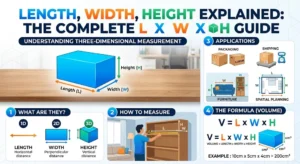
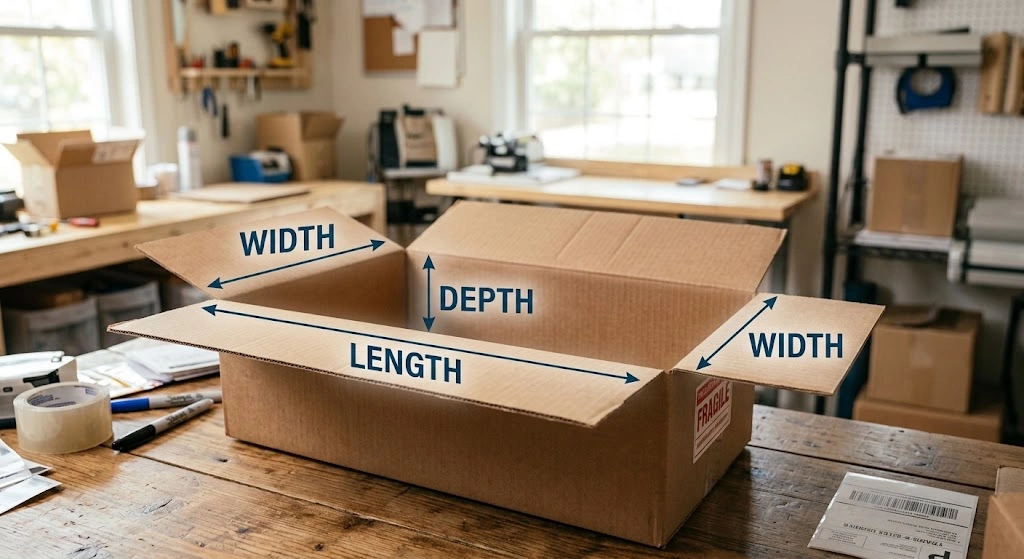
Every box is measured using three dimensions: length, width, and depth (also commonly called height). Different companies use “depth” and “height” somewhat interchangeably, but the standard order for recording or reading these measurements stays consistent: Length x Width x Depth (L x W x D), or equivalently, Length x Width x Height (L x W x H).
- Length: The longest side when looking down at the top of the box.
- Width: The shorter side when looking down at the top of the box.
- Depth (Height): The side perpendicular to both the length and width.
For a tall, upright box, depth becomes the most prominent dimension, with length and width both smaller by comparison. For a long, low box, the opposite is true: length dominates, while width and depth stay comparatively small. Regardless of the box’s shape, knowing exactly which side is which before you start manufacturing or ordering packaging is essential.
Step-by-Step: How to Measure a Box
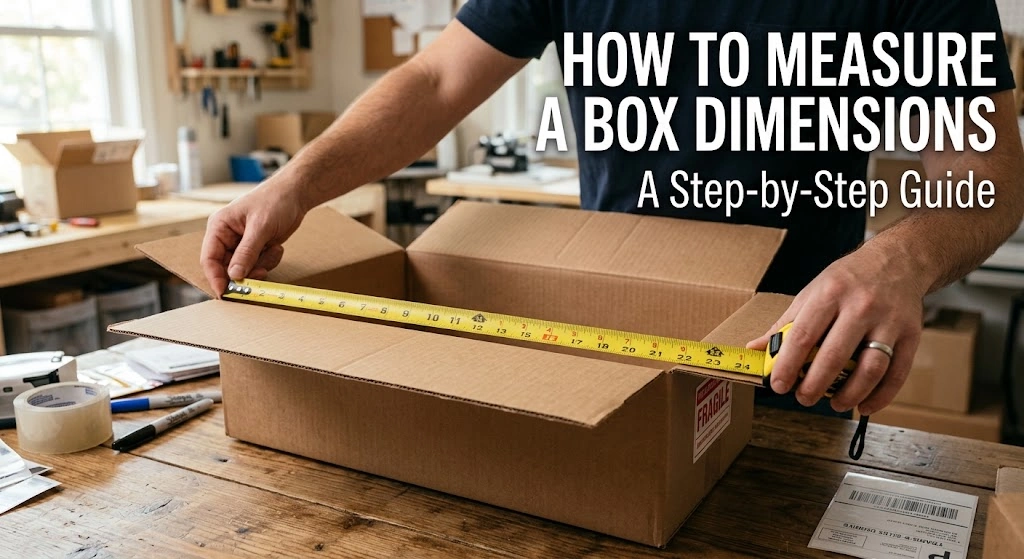
- Measure your product first. Before you can choose or measure a box, know the exact size of what’s going inside it, including any padding or wrapping you plan to use.
- Use a tape measure on a flat surface. Lay the box (or the flattened blank) on an even surface before taking any readings.
- Measure the length. This is the longest side viewed from the top.
- Measure the width. This is the shorter side, perpendicular to the length.
- Measure the depth or height. This runs from the base to the top, perpendicular to both length and width.
- Round to the nearest whole unit, and if your measurement falls between two marks, round up rather than down. It’s better to have slightly more room than a fit that’s too tight.
- Write down each measurement as you go, and label clearly whether each number is an internal or external reading.
Stick to one unit throughout, inches or centimeters, and be consistent and precise rather than approximating. Most measurements in the United States use inches, while most other countries default to centimeters.
Calculating the Volume of a Box
Once you have all three measurements, multiply them together to find the box’s volume:
Length x Width x Depth (Height) = Volume
For example, a box measuring 16 inches by 12 inches by 12 inches has a volume of 2,304 cubic inches. This number matters for more than just curiosity: it tells you how much space your product and any padding will actually take up, which directly affects material costs, shipping rates, and how efficiently boxes stack in a warehouse or delivery truck.
To figure out roughly how many items a box can hold, calculate the total volume of everything you want to pack, then divide the box’s volume by that number. A box with 2,160 cubic inches of space and items that each take up 81 cubic inches could theoretically fit about 27 of them, though you’ll still need to leave room for bubble wrap, flaps, seams, and small air gaps between items in practice.
Measuring Odd-Shaped Objects and Boxes
Not everything is a simple rectangular box. Cylinders, spheres, and pyramid-shaped packaging all need their own volume formulas:
- Cylinder: Volume = πr²h, where “r” is the radius of the circular end and “h” is the cylinder’s height.
- Sphere: Volume = (4/3)πr³, where “r” is the radius at the sphere’s widest point.
- Square-based pyramid: Volume = (1/3)Bh, where “B” is the area of the square base and “h” is the pyramid’s height.
If you’re packing several oddly shaped items together, it can help to mentally group them into more uniform shapes first, which makes measuring and fitting them into a box considerably easier. After calculating volume for any of these shapes, remember to leave additional room for protective padding, since the math alone won’t account for cushioning material.
Internal vs External Dimensions: Why It Matters
This is the single most important distinction in accurate box measuring, and it’s worth understanding thoroughly before you order or build any packaging.
Internal dimensions describe the usable space inside the box, the measurement that determines whether your product actually fits. The packaging industry standard relies on internal measurements specifically for this reason: they’re what’s accurate for both the manufacturer and the product itself.
External dimensions describe the box’s total outer size, including the thickness of the material. Carriers, warehouses, and shipping calculations depend on external dimensions, since that’s the real footprint the box occupies during transit or storage.
The gap between the two can be larger than you’d expect. Picture a box made from 1/4-inch-thick cardboard that measures 8 x 6 x 4 inches on the outside. Because of that quarter-inch wall thickness on every side, the interior only measures roughly 7.5 x 5.5 x 3.5 inches, which means an 8-inch-long product genuinely will not fit, despite the box’s outer dimensions suggesting otherwise.
| Use Case | Which Dimensions to Measure |
|---|---|
| Confirming a product fits inside | Internal |
| Meeting a carrier’s size or shipping requirements | External |
| Calculating material needed to build the box | External |
| Designing custom-fit inserts or padding | Internal |
This distinction matters most with corrugated boxes. Corrugated cardboard is made from a fluted layer sandwiched between two flat paperboards, which adds real thickness, often several millimeters, to every side. Measuring only the outside of a corrugated box, without accounting for this fluting, is one of the most common ways people end up with packaging that doesn’t actually fit their product.
How to Measure a Cardboard Box Specifically
Because corrugated cardboard varies in thickness depending on the material grade, always calculate both the internal and external dimensions separately rather than assuming one from the other.
When measuring a flat, unfolded box blank, don’t include the flaps in your reading. Picture what the box will look like once it’s been folded and taped into its final shape, then measure that finished shape’s length, width, and height for the most accurate external dimensions.
Tips for Measuring Box Dimensions Accurately
- Always measure on a flat, even surface.
- Write down each measurement immediately, rather than trying to remember several numbers at once.
- Label every reading clearly as internal or external.
- Use the same measuring tool and the same unit throughout the entire process.
- Factor in protective packaging materials like bubble wrap, foam, or dividers, since even thin padding adds up quickly once layered around multiple items.
Common Mistakes to Avoid
- Confusing internal and external measurements, or mixing the two together without labeling which is which.
- Ignoring the thickness of padding materials, even when they seem thin individually.
- Rushing through the process. Measure everything more than once to catch errors before they become expensive.
- Switching tape measures or units partway through, which introduces small inconsistencies that compound into real sizing problems.
- Forgetting to double-check final numbers before placing a custom order or committing to a specific box size.
Understanding Dimensional Weight and Shipping Cost
Shipping carriers charge based on whichever is higher: a package’s actual weight, or its dimensional weight (also called DIM weight). Dimensional weight reflects how much space a box takes up rather than how heavy it is, which means an oversized, mostly empty box can cost more to ship than a smaller, denser one, even if the actual product inside is lightweight.
To calculate dimensional weight, divide the box’s volume (length x width x height) by a carrier-specific “DIM divisor” number, then round up to the next whole pound or kilogram. Different carriers use different divisor values, so it’s worth checking directly with whichever service you’re using.
Here’s a worked example using two different box sizes for the same 10-pound shipment, with a carrier DIM divisor of 139:
- Box 1, measuring 25 x 15 x 10 inches: 25 x 15 x 10 / 139 = 26.98, rounded up to a 27-pound billed weight.
- Box 2, measuring 15 x 10 x 5 inches: 15 x 10 x 5 / 139 = 5.40, rounded up to a 6-pound billed weight.
Even though both boxes contain the same 10-pound shipment, the larger box gets billed at nearly 5 times the weight of the smaller one, purely because of its size. Right-sizing your boxes to closely match your product, rather than defaulting to a larger box “just in case,” can meaningfully reduce shipping costs over time, especially for businesses shipping in volume.
Frequently Asked Questions
Boxes are three-dimensional, so you need three measurements: length (the longest side), width (the shorter side, perpendicular to length), and height or depth (from base to top). Multiplying all three together gives you the box’s volume.
Start by measuring the product you’re shipping, including any padding. Once you know the wrapped product’s size, choose a box whose internal dimensions closely match it, leaving a small margin for cushioning without excessive empty space.
Measure internal dimensions to confirm a product will fit securely inside. Measure external dimensions to check carrier size limits or calculate dimensional weight for shipping costs. Ideally, record both.
Dimensional weight is a shipping-cost calculation based on a box’s volume divided by a carrier-specific number, rather than the package’s actual weight. Carriers bill based on whichever figure, actual or dimensional, is higher, so an oversized box can genuinely cost more to ship even when it’s lightweight.
Use the appropriate volume formula for the shape: πr²h for a cylinder, (4/3)πr³ for a sphere, or (1/3)Bh for a square-based pyramid. For irregular items, it can help to mentally break them into simpler shapes and measure each separately.
The difference comes from the thickness of the box material itself. A quarter-inch-thick cardboard wall, for example, removes half an inch from each internal dimension compared to the box’s external measurement, which becomes especially significant with thicker corrugated material.
Conclusion
Measuring a box correctly comes down to three things: knowing your product’s exact size first, understanding the difference between internal and external dimensions, and being consistent and careful with every reading. Multiply length by width by height to get volume, remember that corrugated material thickness can meaningfully shrink your usable interior space, and factor dimensional weight into your shipping decisions if cost is a concern.
Taking a few extra minutes to measure carefully before ordering or shipping saves real money and prevents damaged products down the line, whether you’re packing a single item or planning bulk shipments for a growing business.