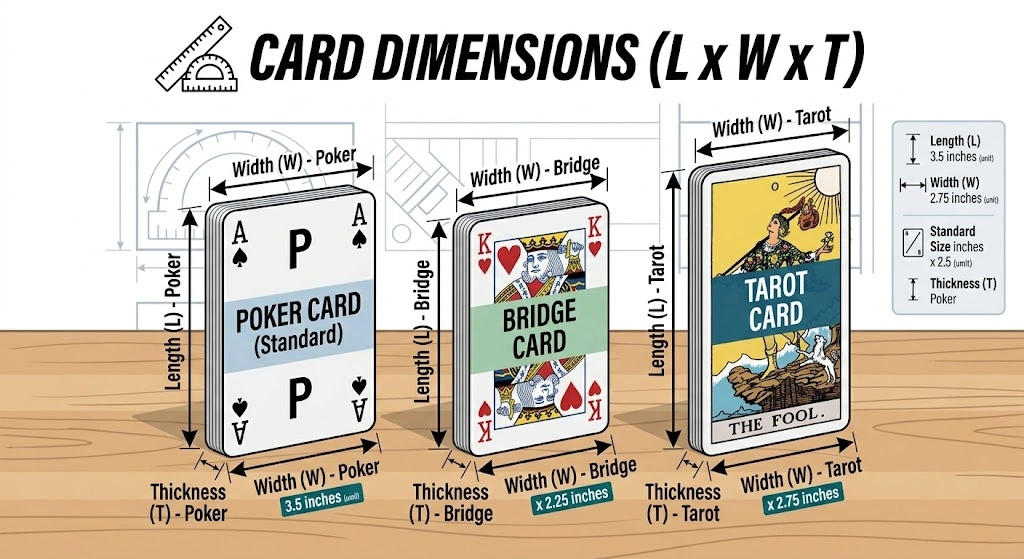
Not every deck of cards is the same size. A standard poker card measures 2.5 x 3.5 inches, but Tarot cards run noticeably longer at 2.75 x 4.75 inches, and Bridge cards are narrower still, at 2.24 x 3.49 inches. Once you add kids’ games, Oracle decks, and mini travel cards into the mix, “playing card size” turns out to have quite a few different answers.
This guide breaks down the exact dimensions for every common card type, in inches, millimeters, and centimeters, along with typical box sizes, card thickness, and a few practical facts about materials and finishes.
Quick Answer: Standard Playing Card Size
| Card Type | Card Size (inches) | Card Size (mm) |
|---|---|---|
| Poker (standard) | 2.5 x 3.5 in | 63.5 x 88.9 mm |
| Bridge | 2.24 x 3.49 in | 57 x 88.8 mm |
| Tarot | 2.75 x 4.75 in | 69.85 x 120 mm |
Need to convert any of these measurements to another unit? Try our inches to cm converter for instant results.
How Many Cards Are in a Deck?
A standard adult deck contains 52 cards. Tarot decks are the notable exception, running to 78 cards. Most children’s card games also stick to 52 cards, with a handful of exceptions depending on the specific game.
A full 52-card deck has a combined thickness of roughly 0.75 inches, though this varies slightly depending on the card stock and finish used.
Do All Playing Cards Have the Same Shape?
The vast majority of playing cards are rectangular, but a few unconventional shapes do exist:
- Circular decks, typically used for novelty items or casino promotional giveaways.
- Polygonal cards, cut into hexagons, triangles, or other geometric shapes for a distinctive look.
- Novelty cut shapes, custom-cut into shapes like a heart, a surfboard, or a brand logo.
Standard Dimensions by Card Game
Every card game tends to settle on its own standard size, shaped by decades of convention and practical handling. Here’s a full breakdown of the most common types.
Poker Cards
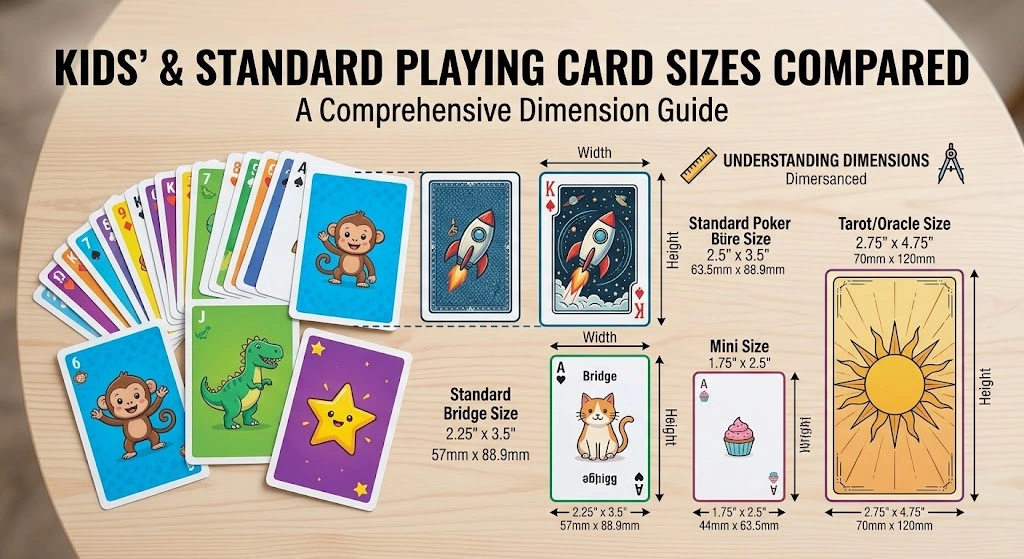
The standard poker card measures 2.5 x 3.5 inches (63.5 x 88.9 mm, or 6.3 x 8.8 cm). This is the most widely recognized playing card size in the world, used for standard decks, casino games, and most trading card games. A typical box for a poker-size deck measures around 7 x 6 x 2 inches (177.8 x 152.4 x 50.8 mm).
Tarot Cards
Tarot cards run larger, at roughly 2.75 x 4.75 inches (69.85 x 120 mm, or 6.9 x 12 cm), though exact sizing can vary somewhat by publisher. A typical Tarot box measures about 3.5 x 5.5 x 1.5 inches (88.9 x 139.7 x 38.1 mm).
Bridge Cards
Bridge cards are narrower than standard poker cards, measuring 2.24 x 3.49 inches (57 x 88.8 mm, or 5.7 x 8.8 cm). This narrower width is designed to make it easier for players to hold a large hand of cards fanned out. A bridge card box typically measures around 5.2 x 3.3 x 1.2 inches (132.08 x 83.82 x 30.4 mm).
European-Style Cards
European-style cards measure approximately 2.4 x 3.8 inches (61 x 97 mm), a modest but noticeable difference from standard American sizing once you hold one directly. This category is distinct from Magic-style trading cards, which typically match standard poker dimensions at 2.5 x 3.5 inches.
Magic: The Gathering Cards
Magic: The Gathering cards use essentially the same dimensions as a standard poker card, at 2.5 x 3.5 inches. The distinctive artwork and finish are what set these cards apart visually, not the physical size, which makes them compatible with standard poker-size sleeves and card boxes.
Oracle Cards
Oracle decks come in a wider range of sizes than most other card types, since different publishers favor different formats depending on the artwork and intended use. Here are the five common Oracle sizes:
| Oracle Size | Card Dimensions (in) | Card Dimensions (mm) | Typical Box Size (in) |
|---|---|---|---|
| Traditional | 2.7 x 4.7 in | 70 x 120 mm | 4.72 x 2.74 x 0.75 in |
| Tall | 3.5 x 5.7 in | 89 x 146 mm | 4.95 x 6.5 x 2.25 in |
| Wide | 3.2 x 4.7 in | 85 x 120 mm | 4.25 x 5.5 x 0.75 in |
| Large | 3.5 x 5 in | 89 x 127 mm | 4.5 x 5.75 x 1.7 in |
| Mini | 2.4 x 3.4 in | 63 x 88 mm | 3 x 4.2 x 0.89 in |
Mini and Travel-Size Cards
Compact travel decks, designed to be pocket-friendly, typically measure around 2.63 x 1.85 inches (67 x 47 mm), noticeably smaller than a standard poker card. A box for mini cards usually measures about 2.82 x 1.87 x 0.69 inches (71.7 x 47.7 x 16 mm).
Kids’ Playing Card Dimensions
Card games designed for children are generally sized smaller than adult decks, since a smaller card is easier for smaller hands to hold, shuffle, and fan out.
| Game | Card Dimensions (in) | Card Dimensions (mm) | Typical Box Size (in) |
|---|---|---|---|
| Traitors Abroad | 2.26 x 3.5 in | 57.5 x 89 mm | 3.15 x 1.97 x 1.18 in |
| Slap Jack | 4 x 2.75 in | 101.6 x 69.85 mm | 9.25 x 8.1 x 0.6 in |
| Old Maid | 3.4 x 2.4 in | 86.36 x 60.9 mm | 3.9 x 3.0 x 0.3 in |
| Crazy 8s | 2.5 x 3.5 in | 63.5 x 88.9 mm | 3.75 x 4.5 x 2.72 in |
Most kids’ card games keep their cards under 5 inches in any single dimension, since a larger deck becomes genuinely difficult for smaller hands to manage comfortably.
Card Thickness Explained
Thickness plays a real role in how a card handles and how long it holds up to repeated shuffling.
A single playing card typically measures around 0.0078 inches thick (roughly 0.22 mm, or 0.022 cm), a size chosen specifically so that a full 52-card deck can be stacked, shuffled, and handled without excessive bulk. Individual card thickness across the industry generally falls somewhere between 0.17 mm and 0.35 mm, depending on the card stock and finish used.
A complete deck, all 52 cards stacked together, comes out to roughly 0.75 inches thick (about 19.05 mm, or 1.9 cm), which is also the thickness most standard card boxes are designed around.
| Measurement | Inches | Millimeters | Centimeters |
|---|---|---|---|
| Single card thickness | 0.0078 in | 0.22 mm | 0.022 cm |
| Full 52-card deck thickness | 0.75 in | 19.05 mm | 1.9 cm |
Materials and Finishes
Most playing cards are made from either 100% plastic or paper-based cardstock, each offering a different balance of durability, feel, and cost. Cardstock decks are more common for everyday and casual use, while plastic decks are favored for durability in settings like casinos, where cards see heavy repeated handling.
Beyond the base material, a coating or finish is typically applied to the surface to improve texture, durability, and visual appeal:
- Lamination, most commonly a matte finish, which adds a smooth, slightly textured surface that resists fingerprints.
- Embossed or textured finishes, which create a raised pattern across the card surface for a more premium feel.
- Liquid finishes (varnishes), applied as a coating that adds shine and additional wear resistance.
Frequently Asked Questions
The standard size for poker cards is 2.5 x 3.5 inches (63.5 x 88.9 mm).
Yes. Tarot cards measure approximately 2.75 x 4.75 inches, noticeably longer than a standard 2.5 x 3.5 inch poker card.
Most kids’ card games use dimensions under 5 inches in any direction. A card close to 3 x 5 inches or smaller tends to work well for younger hands.
A single playing card typically measures between 0.17 mm and 0.35 mm thick. A full 52-card deck comes to roughly 0.75 inches thick.
A standard poker card measures approximately 63.5 x 88.9 mm. Exact millimeter dimensions vary depending on the specific card game or type.
American standard playing cards measure around 2.5 x 3.5 inches, the same size used for standard decks, casino games, and most trading card games.
Tarot cards run larger on both dimensions. Standard Tarot cards measure about 2.75 x 4.75 inches (70 x 120 mm), compared to a standard poker card’s 2.5 x 3.5 inches (63.5 x 89 mm). The difference is modest on paper but noticeable when holding the two side by side.
Conclusion
“Playing card size” turns out to have several correct answers, depending on the game. A standard poker card measures 2.5 x 3.5 inches, Bridge cards run slightly narrower to make fanning a hand easier, and Tarot decks are noticeably larger to make room for detailed artwork. Kids’ games trend smaller across the board, while Oracle decks span the widest range of all, from mini to large formats.
Whether you’re buying a deck, designing custom cards, or just curious about the size difference between game types, these standard dimensions give you a reliable reference point across every common card format.