Measurement systems are an essential part of everyday life. Whether you are measuring furniture, checking body weight, preparing a recipe, or planning a trip, understanding different units helps you avoid mistakes. Two commonly used measurement systems are the metric system and the imperial system. Although both measure the same quantities, they use different units and conversion methods.
In this guide, we will explain the differences between metric and imperial units, explore common conversion formulas, and show how online conversion tools can make calculations easier.
What Is the Metric System?
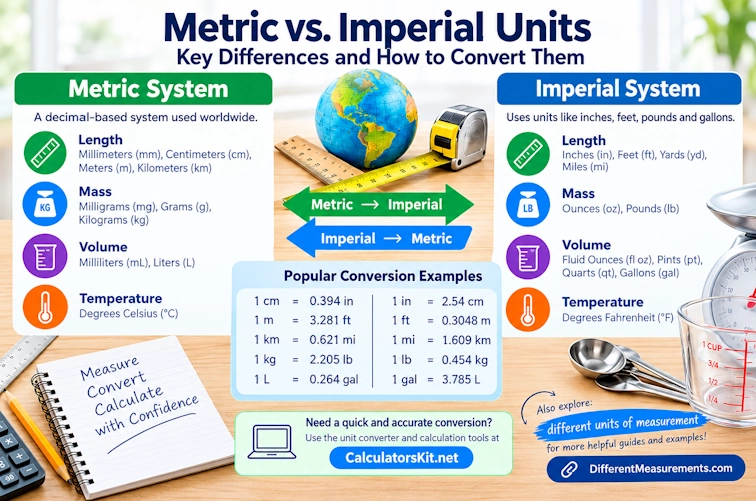
The metric system is a decimal-based measurement system used in most countries worldwide. Its units are organized around powers of ten, making calculations and conversions relatively simple.
Common metric units include:
- Length: Millimeters, centimeters, meters, and kilometers
- Mass: Milligrams, grams, and kilograms
- Volume: Milliliters and liters
- Temperature: Degrees Celsius
For example, one meter equals 100 centimeters, while one kilometer equals 1,000 meters. These consistent relationships make the metric system useful in science, education, engineering, construction, and everyday activities.
To understand measurement categories and their applications, explore this guide to metric and imperial measurement units.
What Is the Imperial System?
The imperial system originated in Britain and uses units such as inches, feet, yards, miles, ounces, pounds, and gallons. It remains relevant in everyday life and certain industries, particularly in the United States, where US customary units are commonly used.
Some frequently used imperial units include:
- Length: Inches, feet, yards, and miles
- Weight: Ounces and pounds
- Volume: Fluid ounces, pints, quarts, and gallons
- Temperature: Degrees Fahrenheit
Unlike the metric system, imperial conversions follow different relationships. For example, one foot contains 12 inches, and one yard contains three feet. This means users must remember specific conversion factors to calculate measurements correctly.
It is also important to distinguish British imperial units from US customary units because certain measurements, especially gallons, differ between the two systems.
Metric vs. Imperial Units: Key Differences
The main difference between these systems is how their units are organized. The metric system follows a consistent decimal structure, while the imperial system uses different conversion relationships for different quantities.
Here are some common metric-to-imperial conversions:
| Metric Unit | Imperial Equivalent |
| 1 centimeter | Approximately 0.394 inches |
| 1 meter | Approximately 3.281 feet |
| 1 kilometer | Approximately 0.621 miles |
| 1 kilogram | Approximately 2.205 pounds |
| 1 liter | Approximately 0.264 US gallons |
These examples demonstrate why using the correct conversion factor is important when working with measurements from different countries.
How to Convert Metric Units to Imperial Units
Converting metric measurements into imperial units generally involves multiplying or dividing by a specific conversion factor. The correct method depends on the units involved.
1. Converting Centimeters to Inches
To convert centimeters to inches, divide the number of centimeters by 2.54.
Formula:
Inches = Centimeters ÷ 2.54
For example, 30 centimeters divided by 2.54 equals approximately 11.81 inches.
This conversion is useful when measuring furniture, clothing, electronic screens, and product dimensions.
2. Converting Kilograms to Pounds
To convert kilograms into pounds, multiply the kilogram value by approximately 2.20462.
Formula:
Pounds = Kilograms × 2.20462
For example:
5 kg × 2.20462 = 11.02 lb
Therefore, five kilograms is approximately 11.02 pounds.
3. Converting Kilometers to Miles
To convert kilometers into miles, multiply the distance by approximately 0.621371.
Formula:
Miles = Kilometers × 0.621371
For example:
10 km × 0.621371 = 6.21 miles
This conversion is helpful when comparing road distances, running routes, and travel information.
How to Convert Imperial Units to Metric Units
Imperial-to-metric conversions use the same general principle, but the conversion factor changes depending on the measurement.
Inches to Centimeters
Multiply the number of inches by 2.54.
For example:
12 inches × 2.54 = 30.48 centimeters.
Pounds to Kilograms
Multiply the number of pounds by approximately 0.453592.
For example:
20 pounds × 0.453592 ≈ 9.07 kilograms.
Fahrenheit to Celsius
Temperature conversions require a formula because the Celsius and Fahrenheit scales have different starting points.
Formula:
°C = (°F − 32) × 5/9
For example, 68°F equals 20°C.
Understanding these formulas helps you interpret weather forecasts, cooking instructions, and scientific measurements more accurately.
Benefits of Using an Online Unit Converter
Manual calculations are useful for learning conversion methods, but they can become time-consuming when you need to convert multiple values. An online unit converter can perform calculations quickly and reduce the effort required.
Some important benefits include:
- Faster calculations: Convert measurements without performing every calculation manually.
- Fewer arithmetic mistakes: Use consistent conversion factors for common units.
- Convenient comparisons: Compare product dimensions and weights across measurement systems.
- Everyday applications: Convert measurements for cooking, travel, shopping, and household projects.
- Easy verification: Check your manual calculations against a conversion tool.
Online converters are especially useful when working with unfamiliar units or converting several measurements in succession. However, always check whether a tool uses US customary or British imperial units when converting volumes.
Common Measurement Conversion Mistakes
Even straightforward conversions can produce inaccurate results if the wrong formula or unit is used. Here are several mistakes to avoid.
Using the Wrong Conversion Factor
Always confirm the starting and target units before performing a calculation. The factor for converting centimeters to inches is different from the factor for converting meters to feet.
Confusing US and Imperial Gallons
A US gallon is smaller than a British imperial gallon. Using the wrong gallon definition can lead to inaccurate results in cooking, fuel calculations, and liquid measurements.
Rounding Too Early
Keep sufficient decimal places during calculations and round the final result according to your required level of accuracy.
Forgetting Temperature Offsets
Celsius and Fahrenheit conversions require an offset of 32 degrees in addition to multiplication or division. Simply multiplying a temperature by a conversion factor will not produce the correct result.
Ignoring Unit Labels
Always write the appropriate unit alongside each number. Clearly identifying centimeters, inches, kilograms, and pounds helps prevent confusion.
Conclusion
The metric and imperial systems both provide practical ways to measure length, mass, volume, and temperature. The metric system is generally easier to calculate with because it uses powers of ten, while the imperial system relies on different conversion relationships.
By learning common conversion factors and understanding the correct formulas, you can handle everyday measurements more confidently. When calculations become complicated or you need to convert multiple values, online conversion tools can save time and help you work more efficiently.