
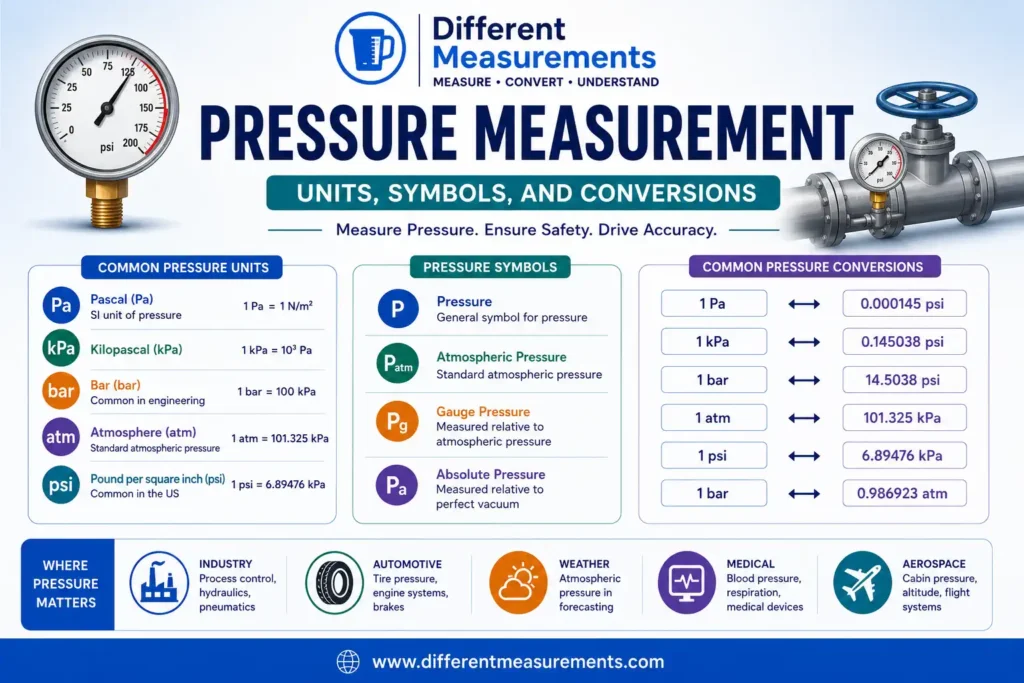
Pressure shows up in more places than most people realize, from the air in a car tire to the reading on a weather report. Understanding what pressure actually measures, and how the many units used to express it relate to one another, makes it much easier to interpret specifications, gauges, and forecasts correctly. This guide explains pressure in plain language, covers the major pressure units and symbols, and shows how to convert between them accurately.
What Is Pressure?
Pressure describes the amount of force applied over a given area. The same force spread across a small area creates more pressure than that same force spread across a large area.
The basic relationship is:
Pressure = Force ÷ Area
Everyday examples of pressure include:
- Air pressure inside a tire, keeping it firm enough to support the vehicle’s weight
- Water pressure in a pipe, which determines how forcefully water flows from a faucet
- Atmospheric pressure, the weight of the air above pressing down on everything at ground level
- Pressure in hydraulic systems, used to lift heavy loads with relatively small input force
- Pressure inside a gas cylinder, which must be carefully controlled for safe storage and use
What Is Pressure Measurement?
Pressure measurement is the process of determining how much force is being applied over a specific area, expressed using a standardized unit such as the pascal, bar, or psi. Standardized units matter because pressure readings need to be understood consistently across different tools, industries, and countries.
Pressure measurement plays a role in many fields:
- Weather: tracking atmospheric pressure to forecast storms and changing conditions
- Automotive systems: monitoring tire pressure and engine oil pressure
- Plumbing: ensuring water pressure is strong enough for household use without damaging pipes
- HVAC: managing refrigerant and airflow pressure in heating and cooling systems
- Manufacturing: controlling pressure in molding, forming, and packaging processes
- Engineering: designing structures and systems that safely withstand expected pressure loads
- Medicine: measuring blood pressure and pressure in respiratory equipment
- Aviation: using atmospheric pressure to calculate altitude
- Science: studying gas behavior and other pressure-dependent phenomena
- Industrial equipment: operating compressors, boilers, and hydraulic machinery safely
Pressure Formula
The formula for pressure is written as:
P = F / A
Where:
- P = pressure
- F = force
- A = area
A simple example helps illustrate this. Imagine pressing a finger flat against a table, then pressing with the same force using just the tip of a pin. The force applied is the same in both cases, but the pin concentrates that force over a much smaller area, resulting in far greater pressure. This is why a pin can puncture skin with relatively little force, while a flat hand cannot.
Pressure, Force, and Area
Pressure, force, and area are closely related, and the basic formula can be rearranged depending on which value needs to be calculated.
- Force = Pressure × Area
- Area = Force ÷ Pressure
For example, if a hydraulic piston needs to apply 500 newtons of force and the system operates at a known pressure, the required piston area can be calculated using the rearranged formula. Similarly, if the force and area of a surface are known, the pressure being applied can be calculated directly.
It is important not to confuse pressure with force. Force is a push or pull measured in newtons, while pressure describes how that force is distributed across a surface. Two objects can apply the same force yet produce very different pressure, depending on the area involved.
SI Unit of Pressure
The SI unit of pressure is the pascal (Pa). One pascal is defined as one newton of force applied over one square meter of area.
1 Pa = 1 N/m²
The pascal is a derived SI unit, meaning it is built from two base SI units, the newton for force and the square meter for area, rather than being a base unit itself. Because a single pascal represents a very small amount of pressure, larger multiples such as the kilopascal and megapascal are commonly used in practical applications.
Common Pressure Units
Several pressure units are used around the world, depending on the industry, region, and application.
- Pascal (Pa): the SI base pressure unit, used in scientific and engineering contexts
- Kilopascal (kPa): commonly used for tire pressure, weather, and general engineering
- Megapascal (MPa): used for high-pressure applications such as material strength testing
- Bar: widely used in Europe for tire pressure, weather, and industrial systems
- Millibar (mbar): primarily used in meteorology for atmospheric pressure
- Pounds per square inch (psi): the standard pressure unit in the United States for tires, tools, and plumbing
- Standard atmosphere (atm): used as a reference point based on average sea-level pressure
- Torr: used in scientific and vacuum-related contexts
- Millimeters of mercury (mmHg): used in medicine and some atmospheric pressure readings
- Inches of mercury (inHg): used in aviation and some weather reporting, particularly in the United States
Pressure Units and Symbols
The table below summarizes common pressure units, their symbols, their relationship to the pascal, and where each is typically used.
| Unit | Symbol | Relationship to Pascal | Common Applications |
|---|---|---|---|
| Pascal | Pa | 1 Pa | Science, engineering |
| Kilopascal | kPa | 1 kPa = 1,000 Pa | Tire pressure, weather, engineering |
| Megapascal | MPa | 1 MPa = 1,000,000 Pa | Material strength, high-pressure systems |
| Bar | bar | 1 bar = 100,000 Pa | Weather, industrial pressure, tires |
| Millibar | mbar | 1 mbar = 100 Pa | Meteorology |
| Pound per square inch | psi | 1 psi ≈ 6,894.76 Pa | Tires, tools, plumbing (US) |
| Standard atmosphere | atm | 1 atm = 101,325 Pa | Reference pressure, science |
| Torr | Torr | 1 Torr ≈ 133.32 Pa | Vacuum measurement, science |
| Millimeters of mercury | mmHg | 1 mmHg ≈ 133.32 Pa | Medicine, atmospheric pressure |
| Inches of mercury | inHg | 1 inHg ≈ 3,386.39 Pa | Aviation, weather (US) |
Pascal (Pa)
A pascal represents a very small amount of pressure, equal to one newton of force spread over one square meter. Because this is such a small unit, single pascals rarely appear in everyday readings.
1 Pa = 1 N/m²
The pascal is used extensively in scientific research and engineering calculations, where precise, standardized units are essential. For larger, more practical pressure values, engineers and technicians typically switch to kilopascals or megapascals instead of working with raw pascal figures.
Kilopascal and Megapascal
Kilopascals and megapascals scale the pascal up to more usable sizes for everyday and industrial contexts.
- 1 kPa = 1,000 Pa
- 1 MPa = 1,000,000 Pa
Kilopascals commonly appear on tire pressure labels, weather reports, and general engineering specifications. Megapascals are used for higher-pressure applications, such as measuring the strength of concrete or the pressure ratings of industrial hydraulic systems.
Bar and Millibar
The bar is a metric pressure unit widely used outside the United States.
1 bar = 100,000 Pa
The millibar, equal to one thousandth of a bar, is primarily used in meteorology.
1 mbar = 100 Pa
Bar and millibar appear frequently in weather forecasting, industrial pressure gauges, and some tire pressure specifications, particularly in Europe.
Pounds per Square Inch (psi)
Psi stands for pounds-force per square inch, a unit of pressure commonly used in the United States. Despite its name, psi measures pressure, not mass, since it refers to pounds of force rather than pounds of weight or matter.
Common uses of psi include:
- Car and bicycle tire pressure
- Air compressors and pneumatic tools
- Hydraulic system specifications
- Plumbing and water pressure ratings
It is worth being careful not to confuse psi with pounds used as a unit of mass, since the two describe entirely different physical quantities despite sharing the word “pound.”
Atmosphere (atm)
The standard atmosphere is a reference pressure unit based on the average atmospheric pressure at sea level.
1 atm = 101,325 Pa
Because atmospheric pressure at sea level is relatively consistent, the atmosphere serves as a useful reference point in science, particularly when comparing pressure conditions at different altitudes or in different environments, such as high-altitude locations or pressurized cabins.
Torr and Millimeters of Mercury (mmHg)
Torr and mmHg both originated from early pressure measurement using columns of mercury, and the two units are extremely close in value.
1 Torr ≈ 133.32 Pa1 mmHg ≈ 133.32 Pa
While Torr and mmHg are often treated as equivalent in everyday use, they are defined slightly differently at a technical level, since mmHg is based on a physical column of mercury under standard gravity, while Torr is defined as a precise fraction of a standard atmosphere. For most practical purposes, this difference is negligible, but it is worth noting in highly precise scientific contexts.
These units remain common in vacuum measurement, some scientific instruments, and certain medical readings.
Inches of Mercury (inHg)
Inches of mercury is another mercury-column-based pressure unit, commonly used in the United States for atmospheric pressure and aviation contexts.
1 inHg ≈ 3,386.39 Pa
Inches of mercury is frequently seen in weather reports and aviation instruments, where it is used to indicate barometric pressure and to help pilots calculate altitude accurately.
Pressure Unit Comparison
The table below shows the approximate relationship of common pressure units to the pascal, for quick reference.
| Unit | Approximate Value in Pascals | Exact or Approximate |
|---|---|---|
| 1 Pa | 1 Pa | Exact |
| 1 kPa | 1,000 Pa | Exact |
| 1 MPa | 1,000,000 Pa | Exact |
| 1 bar | 100,000 Pa | Exact |
| 1 mbar | 100 Pa | Exact |
| 1 psi | 6,894.76 Pa | Approximate |
| 1 atm | 101,325 Pa | Exact (by definition) |
| 1 Torr | 133.32 Pa | Approximate |
| 1 mmHg | 133.32 Pa | Approximate |
| 1 inHg | 3,386.39 Pa | Approximate |
Types of Pressure
Pressure can be described in several different ways depending on the reference point used for the measurement.
Atmospheric Pressure
Atmospheric pressure is the pressure exerted by the weight of the air in Earth’s atmosphere. It varies with altitude and weather conditions, decreasing as elevation increases. Barometers are used to measure atmospheric pressure, and changes in this pressure over time help meteorologists predict incoming weather patterns.
Gauge Pressure
Gauge pressure is pressure measured relative to atmospheric pressure, rather than relative to a total vacuum. Most everyday pressure gauges, such as a tire pressure gauge, report gauge pressure. A tire reading of 32 psi means the pressure inside the tire is 32 psi above the surrounding atmospheric pressure.
Absolute Pressure
Absolute pressure is measured relative to a perfect vacuum, where there is no pressure at all. The relationship between absolute and gauge pressure is:
Absolute Pressure = Gauge Pressure + Atmospheric Pressure
This relationship assumes both values are expressed in the same pressure unit. Absolute pressure is commonly used in scientific and engineering calculations where a true zero reference point is required.
Differential Pressure
Differential pressure is the difference between two separate pressure measurements, rather than a measurement relative to atmospheric pressure or a vacuum. It is commonly used to monitor conditions such as:
- Filter clogging, where pressure drops across a dirty filter compared to a clean one
- Flow rate in pipes, where pressure differences help calculate how fast a fluid is moving
- HVAC systems, where differential pressure helps balance airflow across a building
Gauge Pressure vs Absolute Pressure
| Feature | Gauge Pressure | Absolute Pressure |
|---|---|---|
| Reference Point | Atmospheric pressure | Perfect vacuum |
| Typical Applications | Tire pressure, most everyday gauges | Scientific and engineering calculations |
| Example | Tire reading of 32 psi | Total pressure including atmosphere |
| Relationship | Gauge = Absolute − Atmospheric | Absolute = Gauge + Atmospheric |
A tire pressure gauge reports gauge pressure because drivers care about how much pressure the tire holds beyond the surrounding air, not the total pressure including the atmosphere itself. This makes gauge pressure more practical and intuitive for everyday use.
How Is Pressure Measured?
Pressure is measured using a variety of instruments, each suited to different ranges and types of pressure.
- Manometer: measures pressure using the height of a liquid column
- Barometer: measures atmospheric pressure specifically
- Bourdon tube pressure gauge: uses a curved metal tube that straightens under pressure to move a needle
- Digital pressure gauge: uses electronic sensors to display a numerical pressure reading
- Pressure transducer: converts pressure into an electrical signal for use in automated systems
- Pressure sensor: a broader term for devices that detect and report pressure, often used in embedded systems
- Vacuum gauge: measures pressures below atmospheric pressure, used in vacuum systems
Manometers
A manometer measures pressure by observing how a column of liquid, often mercury or water, is displaced by the pressure being measured. The height difference in the liquid column corresponds directly to the pressure applied, since the fluid’s weight resists the incoming pressure until it reaches equilibrium.
Manometers are valued for their simplicity and accuracy, particularly in laboratory and calibration settings where a mechanical reference is useful.
Barometers
A barometer measures atmospheric pressure specifically, rather than general pressure in a closed system.
- Mercury barometers use a column of mercury that rises or falls based on atmospheric pressure, similar in principle to a manometer.
- Aneroid barometers use a sealed, flexible metal chamber that expands or contracts with pressure changes, avoiding the need for liquid mercury.
- Digital barometers use electronic sensors to measure atmospheric pressure and display readings numerically.
Barometers are essential tools in weather forecasting, since falling atmospheric pressure often signals an approaching storm, while rising pressure typically indicates clearer conditions ahead.
Pressure Sensors and Transducers
Pressure sensors and pressure transducers are closely related, though the terms are sometimes used slightly differently depending on the industry. A pressure sensor is a general term for any device that detects pressure, while a pressure transducer specifically converts that pressure reading into an electrical signal that can be read by other equipment.
These devices are used widely in:
- Automotive systems, monitoring oil pressure, fuel pressure, and tire pressure
- Industrial equipment, tracking pressure in pipelines, tanks, and machinery
- HVAC, managing refrigerant pressure and airflow
- Medical devices, measuring blood pressure and respiratory equipment pressure
- Electronics, including altimeters and other consumer devices that rely on pressure data
Pressure Conversions
Pressure conversions allow the same physical pressure to be expressed using a different unit, since many units, such as psi, bar, and kPa, all measure the same underlying quantity on different scales. For a broader explanation of how unit conversion works across all measurement categories, see Measurement Conversions.
Common pressure conversions include:
- Pa to kPa: divide by 1,000
- kPa to Pa: multiply by 1,000
- kPa to psi: multiply by 0.145038
- psi to kPa: multiply by 6.89476
- bar to psi: multiply by 14.5038
- psi to bar: multiply by 0.0689476
- atm to kPa: multiply by 101.325
- kPa to atm: divide by 101.325
- bar to kPa: multiply by 100
- kPa to bar: divide by 100
- mmHg to kPa: multiply by 0.133322
- kPa to mmHg: multiply by 7.50062
Common Pressure Conversion Factors
| Relationship | Value |
|---|---|
| 1 kPa | 1,000 Pa |
| 1 MPa | 1,000 kPa |
| 1 bar | 100,000 Pa |
| 1 atm | 101,325 Pa |
| 1 psi | ≈ 6,894.757 Pa |
| 1 psi | ≈ 6.89476 kPa |
| 1 bar | ≈ 14.5038 psi |
| 1 atm | ≈ 101.325 kPa |
| 1 atm | ≈ 14.6959 psi |
How to Convert Pressure Units Manually
Converting pressure units follows a consistent, repeatable process.
- Identify the starting pressure unit. For example, 45 psi.
- Identify the target unit. For example, kPa.
- Find the correct conversion factor. 1 psi ≈ 6.89476 kPa.
- Multiply or divide as appropriate. Multiply 45 by 6.89476.
- Keep the correct pressure unit in the final result. The answer should be labeled in kPa.
- Check whether the result is reasonable. 45 psi is a moderate tire pressure, so a result in the low 300s kPa range makes sense.
- Round only when appropriate. Two decimal places is typically sufficient for practical use.
Worked Example: PSI to kPa Original value: 45 psi Conversion factor: 1 psi ≈ 6.89476 kPa Calculation: 45 × 6.89476 Result: approximately 310.26 kPa
Worked Example: Bar to PSI Original value: 2.5 bar Conversion factor: 1 bar ≈ 14.5038 psi Calculation: 2.5 × 14.5038 Result: approximately 36.26 psi
Real-World Pressure Examples
- Car tire pressure: typically around 30 to 35 psi, though this varies by vehicle and should always follow the manufacturer’s recommendation
- Bicycle tire pressure: often higher than car tires, commonly in the range of 40 to 100 psi depending on the tire type
- Atmospheric pressure: approximately 101.325 kPa at sea level under standard conditions
- Water pressure: household water pressure is often in the range of 40 to 60 psi, depending on the plumbing system
- Air compressor pressure: many shop compressors operate in the range of 90 to 150 psi
- Hydraulic systems: can operate at very high pressures, sometimes exceeding 3,000 psi in industrial equipment
- Gas cylinders: pressure varies significantly depending on the gas and cylinder type, often measured in hundreds or thousands of psi
- HVAC systems: refrigerant pressure varies by system type and the specific refrigerant used
- Weather systems: atmospheric pressure typically ranges from about 980 to 1,050 hPa during normal weather patterns
These values are approximate and intended to illustrate typical ranges rather than precise specifications for any single device or situation.
Pressure Measurement in Weather
Meteorologists rely heavily on atmospheric pressure readings to track and forecast weather systems. Barometers measure this pressure, which is typically reported in hectopascals (hPa) or millibars (mbar).
1 hPa = 1 mbar
This equivalence makes it easy to interpret weather reports regardless of which unit is used. A high-pressure system generally indicates clear, stable weather, while a low-pressure system is often associated with clouds, wind, and precipitation. Tracking changes in atmospheric pressure over time helps forecasters anticipate shifting conditions before they arrive.
Pressure Measurement in Tires
Tire pressure is one of the most common everyday pressure measurements, typically expressed in psi, kPa, or bar depending on the region and vehicle.
Recommended tire pressure depends on several factors, including the vehicle, the specific tire, the load being carried, and the manufacturer’s specifications, which are usually found on a sticker inside the driver’s door or in the vehicle’s manual. Because these values vary so significantly, there is no single universal recommended tire pressure that applies to all vehicles.
Pressure Measurement in Medicine
Pressure measurement plays an important role in several areas of medicine.
- Blood pressure is traditionally measured in millimeters of mercury (mmHg), expressed as two numbers representing systolic and diastolic pressure.
- Respiratory pressure is measured in devices such as ventilators, which help manage airflow pressure for patients who need breathing support.
- Medical equipment often relies on precise pressure sensors to ensure devices such as infusion pumps and monitoring equipment function safely and accurately.
This overview is intended for general educational purposes and is not medical advice. Any questions about blood pressure readings or medical pressure measurements should be directed to a qualified healthcare provider.
Pressure Measurement in Engineering and Industry
Pressure measurement is fundamental to a wide range of engineering and industrial applications.
- Hydraulic systems use pressurized fluid to generate significant mechanical force with relatively small input effort
- Pneumatic systems use compressed air to power tools and machinery
- Boilers rely on precise pressure control to operate safely and efficiently
- Pumps are rated and monitored based on the pressure they can generate or handle
- Pipelines require careful pressure monitoring to detect leaks and maintain safe operation
- Compressors increase gas pressure for storage, transport, or industrial use
- Industrial machinery often depends on specific pressure ranges to function correctly and safely
- Manufacturing processes frequently use pressure in shaping, molding, and quality control procedures
Common Pressure Measurement Mistakes
- Confusing pressure with force, when they describe related but distinct physical quantities
- Confusing psi with pounds of mass, since psi refers to pounds-force per square inch, not weight alone
- Mixing gauge and absolute pressure, which can lead to significant calculation errors if not clearly identified
- Using the wrong conversion factor, particularly between psi, bar, and kPa
- Confusing bar with millibar, which differ by a factor of 1,000
- Confusing mmHg with inHg, two different mercury-based units that are not interchangeable without conversion
- Forgetting the area component of pressure, leading to confusion between pressure and force in calculations
- Rounding too early in multi-step conversions, which can compound small errors
- Using pressure values without specifying the unit, which makes a reading meaningless or open to misinterpretation
Common Questions About Pressure Measurement
Pressure measurement is the process of determining how much force is applied over a specific area, expressed using standardized units such as pascals, bar, or psi, so that readings can be understood consistently across tools, industries, and countries.
The SI unit of pressure is the pascal (Pa), defined as one newton of force applied over one square meter of area.
Pressure equals force divided by area, written as P = F / A.
Psi stands for pounds-force per square inch, a unit of pressure commonly used in the United States for tires, tools, and plumbing.
Psi and kPa are both units of pressure, but psi is based on the US customary system while kPa is a metric unit. One psi is approximately equal to 6.89476 kPa.
There are 100 kPa in 1 bar.
There are approximately 14.5038 psi in 1 bar.
Atmospheric pressure is the pressure exerted by the weight of the air in Earth’s atmosphere, equal to approximately 101,325 pascals at sea level under standard conditions.
Gauge pressure is measured relative to atmospheric pressure, while absolute pressure is measured relative to a perfect vacuum. Absolute pressure equals gauge pressure plus atmospheric pressure.
Millimeters of mercury, or mmHg, is a pressure unit based on the height of a mercury column, commonly used in medicine and some atmospheric pressure readings.
A pascal is the SI unit of pressure, equal to one newton of force applied over one square meter of area.
Pressure is measured using instruments such as manometers, barometers, Bourdon tube gauges, digital pressure gauges, and pressure transducers, each suited to different pressure ranges and applications.
Pressure connects force and area into a single, measurable quantity that shows up throughout daily life, science, and industry. Understanding the pascal as the SI reference point, along with common units like psi, bar, and atm, and knowing the difference between gauge and absolute pressure, makes it far easier to read gauges, interpret specifications, and convert between units with confidence.