What Is Measurement Conversion?
Measurement conversion is the process of expressing the same physical quantity using a different unit, without changing the actual amount being measured. The quantity itself stays exactly the same. Only the numerical value and the unit attached to it change.
For example:
- 1 meter = 100 centimeters
- 1 kilogram = 1,000 grams
- 1 liter = 1,000 milliliters
In each case, the object or substance being measured has not changed size, weight, or volume. Only the way it is expressed has changed. This is the core idea behind every conversion, whether it involves length, weight, temperature, or any other measurement category.
Why Are Measurement Conversions Important?
Different regions, industries, and situations use different measurement systems, which makes conversion a practical necessity rather than an abstract math exercise.
- Everyday life: reading a recipe, checking a weather forecast, or interpreting a product label from another country
- Cooking: converting between cups, milliliters, and grams when following international recipes
- Construction: converting between feet and meters when working with mixed measurement drawings or imported materials
- Engineering: ensuring components designed in one system match parts manufactured in another
- Science: working almost exclusively in SI units, which often requires converting from customary measurements taken in the field
- Education: teaching students to move confidently between metric and Imperial systems
- Manufacturing: producing goods that meet specifications from international clients or suppliers
- Travel: understanding distances, temperatures, and speed limits in a country that uses a different system
- International trade: shipping goods measured in one system to markets that use another
- Health and fitness: tracking body weight, height, or nutritional information across different unit standards
- Business: pricing, shipping, and reporting data accurately across international markets
Without reliable conversion, these everyday and professional tasks would be far more error-prone.
How Does Unit Conversion Work?
Unit conversion relies on a conversion factor, a fixed numerical relationship between two units that measure the same physical quantity. Because both units describe the same underlying quantity, multiplying or dividing by the correct factor gives an equivalent value in the new unit.
There are two basic operations involved:
- Multiplication, used when converting from a larger unit to a smaller one, since more of the smaller unit is needed to express the same amount
- Division, used when converting from a smaller unit to a larger one
For example, converting 3 meters to centimeters means multiplying by 100, since a centimeter is smaller than a meter: 3 × 100 = 300 centimeters. Converting 300 centimeters back to meters means dividing by 100: 300 ÷ 100 = 3 meters.
This principle is sometimes referred to as maintaining dimensional consistency, meaning both sides of a conversion represent the same physical dimension, such as length or mass, even though the numbers and units look different. A measurement of length can never correctly convert into a unit of weight, for instance, because they describe different physical quantities entirely.
Converting Within a System vs Between Systems
Conversions fall into two general categories:
- Within the same system, such as converting centimeters to meters, or ounces to pounds. These conversions tend to be simpler, especially within the metric system, where every relationship is a power of ten.
- Between different systems, such as converting kilometers to miles, or liters to gallons. These conversions require a specific cross-system conversion factor, since metric and Imperial or US customary units were not designed around the same base structure.
Understanding which type of conversion is being performed helps avoid using the wrong factor, which is one of the most common sources of error.
Common Measurement Conversion Categories
Each type of physical quantity has its own set of units and conversion factors. The sections below summarize the most commonly needed conversions across the major measurement categories. For a broader introduction to each of these categories, see Types of Measurements: A Complete Guide to Measurement Units.
Length Conversions
Length is measured using metric units such as millimeters, centimeters, meters, and kilometers, and Imperial or US customary units such as inches, feet, yards, and miles.
Common length conversion examples:
- Inches to centimeters: multiply by 2.54
- Feet to meters: multiply by 0.3048
- Miles to kilometers: multiply by 1.60934
- Meters to feet: multiply by 3.28084
A more detailed breakdown of length units, symbols, and real-world examples is available in Length Measurement: Units, Types, Examples, and Conversions.
Weight and Mass Conversions
Weight and mass conversions cover units such as milligrams, grams, kilograms, ounces, pounds, and tons. It is worth remembering that mass measures the amount of matter in an object, while weight measures the force of gravity acting on that mass. In everyday conversion, however, the two terms are typically used interchangeably since gravity is treated as constant.
Common weight and mass conversion examples:
- Grams to kilograms: divide by 1,000
- Kilograms to pounds: multiply by 2.20462
- Ounces to grams: multiply by 28.3495
- Pounds to kilograms: multiply by 0.453592
Volume Conversions
Volume conversions involve units such as milliliters, liters, fluid ounces, cups, pints, quarts, and gallons. A key detail to keep in mind is that US and Imperial volume units are not identical. A US gallon equals approximately 3.785 liters, while an Imperial gallon equals approximately 4.546 liters, so the correct regional unit must be used for accurate results.
Common volume conversion examples:
- Milliliters to liters: divide by 1,000
- Liters to gallons (US): multiply by 0.264172
- Cups (US) to milliliters: multiply by 236.588
- Gallons (US) to liters: multiply by 3.78541
Area Conversions
Area conversions cover units such as square millimeters, square centimeters, square meters, square kilometers, square inches, square feet, acres, and hectares.
Area conversions differ from ordinary length conversions because area is a two-dimensional quantity. When converting a length-based factor to an area factor, the conversion number must be squared. For example, since 1 foot equals 0.3048 meters, 1 square foot equals 0.3048 squared, or approximately 0.0929 square meters, not 0.3048 square meters.
Common area conversion examples:
- Square feet to square meters: multiply by 0.092903
- Square meters to square feet: multiply by 10.7639
- Acres to square feet: multiply by 43,560
- Hectares to acres: multiply by 2.47105
Temperature Conversions
Temperature conversions involve Celsius, Fahrenheit, and Kelvin. Unlike most other conversions, temperature cannot be converted using a simple multiplication factor alone, because the three scales have different starting points, or zero values, not just different unit sizes.
The standard temperature conversion formulas are:
- Celsius to Fahrenheit: °F = (°C × 9/5) + 32
- Fahrenheit to Celsius: °C = (°F − 32) × 5/9
- Celsius to Kelvin: K = °C + 273.15
For example, 20°C converts to 68°F, calculated as (20 × 9/5) + 32 = 68.
Time Conversions
Time conversions cover seconds, minutes, hours, days, weeks, months, and years. Most time relationships are fixed: 60 seconds make a minute, 60 minutes make an hour, and 24 hours make a day. Months and years, however, can vary in length. A month can range from 28 to 31 days, and a year contains 365 days, or 366 in a leap year, which means conversions involving months should be treated as approximate rather than exact.
Speed Conversions
Speed conversions involve units such as miles per hour, kilometers per hour, and meters per second, and are directly tied to the underlying length and time units.
Common speed conversion examples:
- Miles per hour to kilometers per hour: multiply by 1.60934
- Kilometers per hour to miles per hour: multiply by 0.621371
- Meters per second to kilometers per hour: multiply by 3.6
Pressure Conversions
Pressure conversions cover units such as pascals, kilopascals, bar, pounds per square inch (psi), and atmospheres.
Common pressure conversion examples:
- PSI to bar: multiply by 0.0689476
- Bar to PSI: multiply by 14.5038
- Kilopascals to PSI: multiply by 0.145038
Energy Conversions
Energy conversions cover units such as joules, kilojoules, calories, kilocalories, watt-hours, and kilowatt-hours. Because energy connects to several other physical quantities, including heat and electrical power, it is important to use the specific conversion factor for the units being compared rather than assuming a general rule.
Common energy conversion examples:
- Calories to joules: multiply by 4.184
- Kilocalories to kilojoules: multiply by 4.184
- Kilowatt-hours to joules: multiply by 3,600,000
Density Conversions
Density describes mass relative to volume and is commonly expressed in grams per cubic centimeter (g/cm³) or kilograms per cubic meter (kg/m³). Because density combines two other measurement types, converting between density units usually requires converting the mass unit and the volume unit separately, then recombining them. For example, converting g/cm³ to kg/m³ involves multiplying by 1,000, since both the mass and volume components scale accordingly.
Metric, Imperial, and US Customary Conversions
Most conversion questions arise from the fact that the world uses more than one measurement system. The metric system, and its modern scientific form, SI units, are used officially in the vast majority of countries and are structured around simple decimal relationships. The Imperial system, historically used throughout the British Empire, and US customary units, used primarily in the United States, both rely on older, non-decimal unit relationships.
Although Imperial and US customary units share many unit names, such as inches, feet, and pounds, they are not identical in every category. Volume units in particular differ, with US gallons, quarts, and pints being smaller than their Imperial equivalents. This is one of the most common sources of conversion error and is worth double-checking whenever a recipe, fuel measurement, or container size is involved.
Because the United States continues to use customary units for most everyday purposes while much of the rest of the world uses metric units, converting between metric and US customary measurements remains one of the most frequently needed types of conversion, whether for travel, cooking, shopping, or international business. A full comparison of these systems is available in Measurement Units: A Complete Guide to Metric, Imperial, and US Customary Units.
Common Measurement Conversion Factors
The tables below summarize widely used conversion factors across major measurement categories.
Length
| From | To | Multiply By |
| Inches | Centimeters | 2.54 |
| Feet | Meters | 0.3048 |
| Miles | Kilometers | 1.60934 |
| Meters | Feet | 3.28084 |
Weight / Mass
| From | To | Multiply By |
| Ounces | Grams | 28.3495 |
| Pounds | Kilograms | 0.453592 |
| Kilograms | Pounds | 2.20462 |
Volume
| From | To | Multiply By |
| Gallons (US) | Liters | 3.78541 |
| Liters | Gallons (US) | 0.264172 |
| Cups (US) | Milliliters | 236.588 |
Area
| From | To | Multiply By |
| Square feet | Square meters | 0.092903 |
| Square meters | Square feet | 10.7639 |
| Acres | Hectares | 0.404686 |
Temperature
| Conversion | Formula |
| Celsius to Fahrenheit | (°C × 9/5) + 32 |
| Fahrenheit to Celsius | (°F − 32) × 5/9 |
| Celsius to Kelvin | °C + 273.15 |
Speed
| From | To | Multiply By |
| Miles per hour | Kilometers per hour | 1.60934 |
| Meters per second | Kilometers per hour | 3.6 |
Pressure
| From | To | Multiply By |
| PSI | Bar | 0.0689476 |
| Bar | PSI | 14.5038 |
Energy
| From | To | Multiply By |
| Calories | Joules | 4.184 |
| Kilowatt-hours | Joules | 3,600,000 |
How to Convert Measurement Units Manually
Converting a measurement by hand follows a consistent process, regardless of which category is involved.
- Identify the original value and unit. For example, 10 feet.
- Identify the target unit. For example, meters.
- Find the correct conversion factor. In this case, 1 foot equals 0.3048 meters.
- Apply multiplication or division. Multiply 10 by 0.3048.
- Check whether the result makes sense. 10 feet is roughly 3 meters, which matches the calculated result.
- Round appropriately when necessary. For most everyday purposes, rounding to two decimal places is sufficient.
Worked Example 1: Feet to Meters
- Original value: 10 feet
- Conversion factor: 1 ft = 0.3048 m
- Calculation: 10 × 0.3048
- Result: 3.048 meters
Worked Example 2: Kilograms to Pounds
- Original value: 5 kilograms
- Conversion factor: 1 kg = 2.20462 lb
- Calculation: 5 × 2.20462
- Result: 11.0231 pounds
Worked Example 3: Celsius to Fahrenheit
- Original value: 25°C
- Formula: (°C × 9/5) + 32
- Calculation: (25 × 9/5) + 32 = 45 + 32
- Result: 77°F
Measurement Conversion Examples
Example: Converting a recipe measurement Original measurement: 2 cups (US) Conversion factor: 1 cup = 236.588 mL Calculation: 2 × 236.588 Final answer: 473.176 milliliters
Example: Converting a road distance Original measurement: 50 miles Conversion factor: 1 mile = 1.60934 km Calculation: 50 × 1.60934 Final answer: 80.467 kilometers
Example: Converting tire pressure Original measurement: 32 psi Conversion factor: 1 psi = 0.0689476 bar Calculation: 32 × 0.0689476 Final answer: 2.207 bar
Common Measurement Conversion Mistakes
Even simple conversions can go wrong if a few key details are overlooked.
- Using the wrong conversion factor, such as confusing US and metric equivalents
- Confusing mass and weight, especially in contexts where gravity actually varies, such as space travel
- Confusing fluid ounces with ounces of mass, since they measure completely different physical quantities despite sharing a name
- Confusing US and Imperial gallons, which differ by roughly 20 percent
- Forgetting to square the conversion factor in area conversions, leading to significantly incorrect results
- Rounding too early in multi-step calculations, which can compound small errors
- Using the wrong temperature formula, particularly mixing up the Celsius-to-Fahrenheit and Fahrenheit-to-Celsius formulas
- Mixing units within the same calculation, such as adding feet and meters directly without converting first
Being aware of these common pitfalls helps ensure conversions remain accurate, particularly in professional or technical contexts where small errors can have real consequences.
Online Measurement Conversion Tools
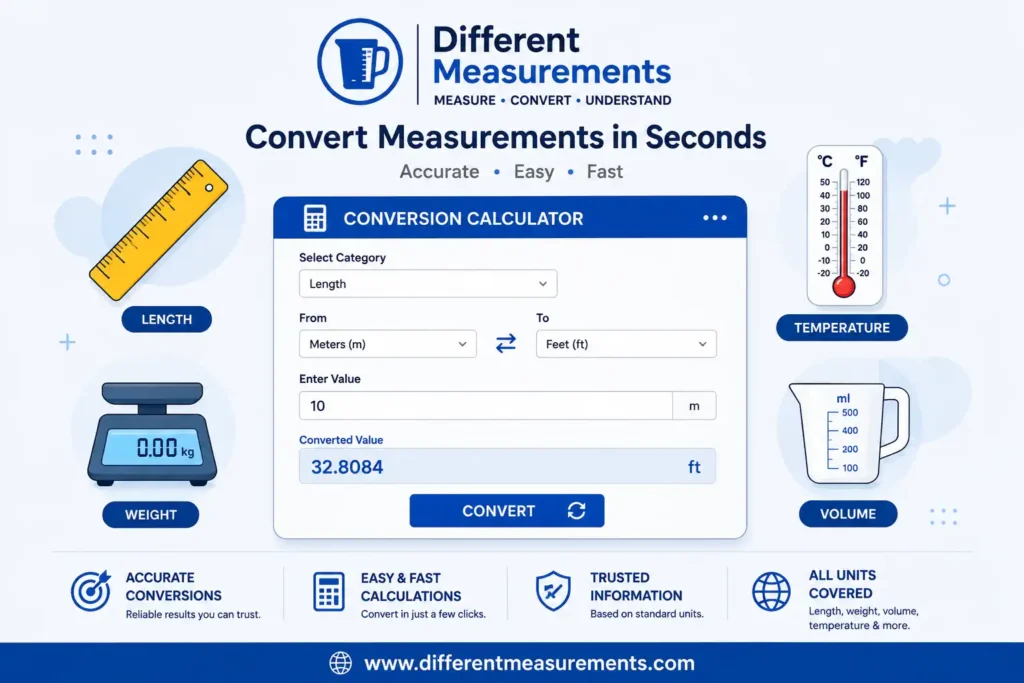
A measurement converter automates the process described above, instantly applying the correct conversion factor or formula to a given value. This offers several practical benefits:
- Faster calculations, particularly useful when converting multiple values at once
- Reduced manual errors, since the tool applies the correct factor automatically
- Multiple unit options, allowing quick comparison across several units at once
- Instant results, useful for time-sensitive tasks like cooking or on-site construction work
- Useful conversion references, helpful for learning and double-checking manual calculations
While manual conversion is a valuable skill, particularly for understanding how units relate to one another, dedicated conversion calculators for specific categories such as length, weight, volume, or temperature offer a faster and more convenient way to get accurate results for everyday tasks.
Frequently Asked Questions About Common Measurement Conversion
Measurement conversion is the process of expressing a physical quantity in a different unit while keeping the actual amount unchanged. Only the numerical value and unit change, based on a fixed conversion factor or formula that relates the two units.
Identify the original value and unit, determine the target unit, find the correct conversion factor or formula, then multiply or divide accordingly to calculate the equivalent value.
A conversion factor is a fixed numerical relationship between two units that measure the same physical quantity, used to calculate an equivalent value in a different unit.
Metric units convert using powers of ten, since the system is decimal-based. Converting meters to centimeters, for example, simply involves multiplying by 100.
Metric to Imperial conversions require a specific conversion factor for each unit pair, such as multiplying meters by 3.28084 to get feet, since the two systems are not based on the same numerical structure.
There are 100 centimeters in 1 meter.
There are 1,000 grams in 1 kilogram.
Multiply the number of liters by 0.264172 to get the equivalent value in US gallons.
Multiply the Celsius value by 9/5, then add 32, to get the equivalent value in Fahrenheit.
Multiply the number of miles by 1.60934 to get the equivalent value in kilometers.
US customary and Imperial units share a historical origin and many identical unit names, but they are not always the same. Volume units, such as gallons, quarts, and pints, differ in size between the two systems, while most length units remain the same.
Area is a two-dimensional quantity, so converting area units requires squaring the corresponding length conversion factor rather than applying it directly, since area scales by the square of a linear dimension.
Measurement conversion allows the same physical quantity to be expressed accurately in different units, whether moving between metric and Imperial systems or simply switching between larger and smaller units within the same system. Choosing the correct conversion factor or formula, and applying it carefully, is what keeps everyday tasks, professional work, and scientific calculations accurate and consistent.