Area measurement shows up constantly in everyday life, from calculating how much paint a room needs to figuring out the size of a plot of land. Yet many people are unsure why area is expressed in “square” units, how it differs from length or volume, or why converting between area units is not as simple as converting between length units.
This guide explains what area measurement means, the units used across metric, US customary, and Imperial systems, the formulas for common shapes, and how to convert between area units correctly. Area is one of several types of measurement used every day, alongside related categories like length and volume.
Quick answer: Area measurement is the process of determining how much two-dimensional surface a shape or region covers. It is expressed in square units, such as square meters or square feet, because it accounts for two dimensions, length and width, multiplied together.
What Is Area Measurement?
Area measures the amount of two-dimensional surface covered by a shape, object, or region. It answers the question “how much flat space does this take up,” rather than “how far does it extend” or “how much space does it enclose in three dimensions.”
Common everyday examples of area include:
- Floor space in a room or apartment
- Wall surface that needs to be painted
- Land measured for real estate or agriculture
- Tabletop surface for furniture sizing
- Carpet needed to cover a floor
- Garden space for planting
Area is expressed in square units because it results from multiplying two linear dimensions together, typically length and width. This is why area values always carry a squared unit label, such as square meters (m²) or square feet (ft²), rather than a plain linear unit.
Area vs Length vs Volume
Length, area, and volume represent three different levels of spatial measurement, and understanding how they relate helps clarify why each uses different units.
- Length is a one-dimensional measurement, describing distance along a single direction, such as the length of a hallway. See our full guide to length measurement for more detail.
- Area is a two-dimensional measurement, describing the surface covered when two dimensions, such as length and width, are combined.
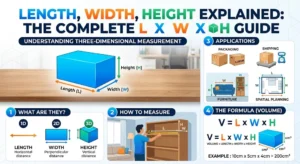
- Volume is a three-dimensional measurement, describing the space enclosed when three dimensions, such as length, width, and height, are combined, as explained in our guide to volume measurement.
A simple example shows how these connect. A room that is 5 meters long and 4 meters wide has a floor area of 5 × 4 = 20 square meters. If that same room also has a height of 2.5 meters, its volume becomes 5 × 4 × 2.5 = 50 cubic meters. The length and width alone are enough to calculate the floor area, while adding height is required to calculate the full volume.
What Are Square Units?
Area units are written with a superscript 2, such as mm², cm², m², km², in², ft², and yd². This notation reflects that area comes from multiplying two linear dimensions of the same unit together.
Common square units include:
- mm² (square millimeter)
- cm² (square centimeter)
- m² (square meter)
- km² (square kilometer)
- in² (square inch)
- ft² (square foot)
A helpful way to visualize this: imagine a square that measures exactly 1 meter on each side. That square covers an area of 1 meter × 1 meter, which equals 1 square meter. If you laid out 100 of these squares in a 10-by-10 grid, you would cover an area of 100 square meters, even though each individual side of the grid only measures 10 meters. This is the core reason area grows much faster than length as dimensions increase.
Common Area Measurement Units
Area units are generally grouped into four categories: metric units, SI units, US customary units, and Imperial units, the same systems detailed in our guide to metric, Imperial, and US customary units. Each system has its own standard units, and some units, like the acre, are shared across multiple systems with a consistent definition.
Metric Area Units
The metric system uses a consistent, base-ten structure for area units, closely tied to its length units.
- Square millimeter (mm²): Used for very small or precise measurements, such as small components or materials.
- Square centimeter (cm²): Common for measuring smaller objects, fabric, or paper.
- Square meter (m²): The standard everyday unit for floor space, walls, and general area measurement.
- Square kilometer (km²): Used for large geographic areas, such as cities or regions.
For larger land areas, the metric system also uses the hectare (ha), a specialized unit outside the standard square-kilometer progression.
Accurate metric area relationships include:
- 1 m² = 10,000 cm²
- 1 km² = 1,000,000 m²
- 1 hectare = 10,000 m²
These relationships are squared versions of the metric length relationships. Since 1 meter equals 100 centimeters, converting the corresponding area requires squaring that factor, which is why 1 square meter equals 10,000 square centimeters rather than 100.
SI Unit for Area
The SI derived unit for area is the square meter (m²). It is derived directly from the meter, the SI base unit of length, by squaring it.
This makes the square meter a natural and consistent choice for scientific and international use, since it scales predictably with the rest of the metric system. Other metric area units, such as square centimeters or hectares, are widely accepted for practical use even though the square meter remains the official SI reference unit.
US Customary and Imperial Area Units
The US customary and Imperial systems use a shared set of area units for most everyday purposes, unlike volume units, where the two systems diverge more significantly.
- Square inch (in²): Used for small objects, materials, and detailed measurements.
- Square foot (ft²): The standard unit for describing home and room sizes in the United States.
- Square yard (yd²): Common in flooring, carpet, and certain construction materials.
- Square mile (mi²): Used for large geographic areas, such as counties or regions.
- Acre: A widely used unit for land measurement, particularly in real estate and agriculture.
Common real-world uses include:
- Square feet for describing home, apartment, and room sizes
- Square yards for carpet, turf, and certain fabric or flooring materials
- Acres for residential lots, farmland, and larger land parcels
- Square miles for cities, counties, and large geographic regions
Unlike volume units, square feet, square yards, and acres are generally used consistently across both US customary and Imperial contexts, though regional preferences vary in which unit is most commonly used for a given purpose.
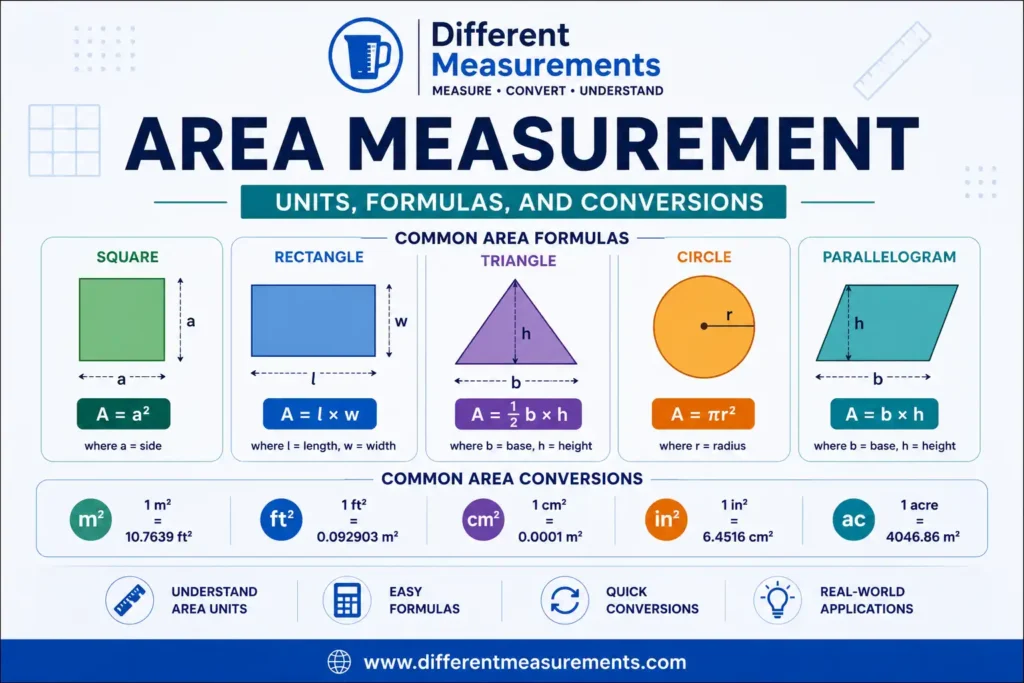
Common Area Formulas
Different shapes require different formulas to calculate area accurately. The formulas below cover the most common shapes encountered in everyday measurement.
Rectangle
Area = length × width
Used for rooms, walls, boxes, and most rectangular spaces. Multiply the length by the width, both measured in the same unit, to get the area.
Square
Area = side × side
Since all sides of a square are equal, this formula simply multiplies one side by itself.
Triangle
Area = 1/2 × base × height
The base refers to the length of one side, and the height refers to the perpendicular distance from that base to the opposite point of the triangle.
Circle
Area = π × radius²
The radius is the distance from the center of the circle to its edge, and π is a constant approximately equal to 3.14159. Squaring the radius and multiplying by π gives the circle’s area.
Parallelogram
Area = base × height
Similar to a rectangle, but the height must be measured as the perpendicular distance between the two parallel bases, not the length of the slanted side.
Trapezoid
Area = 1/2 × (base1 + base2) × height
A trapezoid has two parallel sides of different lengths. Add both base lengths together, multiply by the height, and divide by two.
Area Measurement Examples
Area of a bedroom floor Given: length 4 meters, width 3.5 meters Formula: Area = length × width Calculation: 4 × 3.5 = 14 Answer: 14 square meters
Area of a rectangular wall Given: length 6 meters, height 2.5 meters Formula: Area = length × width Calculation: 6 × 2.5 = 15 Answer: 15 square meters
Area of a square garden Given: side length 8 feet Formula: Area = side × side Calculation: 8 × 8 = 64 Answer: 64 square feet
Area of a triangular section Given: base 10 meters, height 6 meters Formula: Area = 1/2 × base × height Calculation: 0.5 × 10 × 6 = 30 Answer: 30 square meters
Area of a circular table Given: radius 0.75 meters Formula: Area = π × radius² Calculation: 3.14159 × 0.75² ≈ 3.14159 × 0.5625 ≈ 1.77 Answer: approximately 1.77 square meters
Area of a piece of land Given: length 200 meters, width 150 meters Formula: Area = length × width Calculation: 200 × 150 = 30,000 Answer: 30,000 square meters, or 3 hectares
How Is Area Measured?
Measuring area typically starts with measuring the linear dimensions of a shape and then applying the appropriate formula.
- Measuring length and width: For most rectangular spaces, measuring the two straight sides is enough to calculate area directly.
- Using a measuring tape: The standard tool for measuring rooms, walls, and larger spaces.
- Using a ruler for smaller objects: Suitable for small items, materials, or detailed craft and design work.
- Using plans or drawings: Architectural or construction plans often already include dimensions needed to calculate area without physical remeasurement.
- Using digital measurement tools: Laser measuring devices and mapping software can calculate area automatically, particularly useful for large or complex spaces.
For shapes that are not simple rectangles, additional steps are needed, which leads to the concept of measuring irregular areas.
Measuring Irregular Areas
Irregular shapes, such as an L-shaped room or an oddly shaped plot of land, cannot be measured with a single formula. Instead, several techniques are commonly used:
- Dividing the shape into rectangles and triangles: Break the irregular shape into smaller regular shapes, calculate each area separately, then add them together.
- Adding the areas of smaller sections: Once divided, sum all the individual area values to get the total.
- Subtracting unwanted sections: For shapes with a notch or missing corner, calculate the area of the full outer shape, then subtract the missing section.
- Using grids: Overlay a grid of known square size onto the shape and count the number of squares it covers for an approximate area.
- Using digital mapping or measurement tools: Especially useful for land area, where GPS-based tools can calculate irregular boundaries automatically.
Example: An L-shaped room can be divided into two rectangles, one measuring 4 by 3 meters and another measuring 2 by 2 meters. Calculating each separately gives 12 square meters and 4 square meters, which combine for a total area of 16 square meters.
Area Conversions
Area conversions differ from ordinary length conversions in one important way: the conversion factor must be squared, not applied directly.
This happens because area is derived from multiplying two linear dimensions together. When both dimensions are converted using the same linear factor, that factor gets applied twice, effectively squaring it.
For example, 1 meter equals 100 centimeters as a length conversion. However, 1 square meter does not equal 100 square centimeters. Since both the length and width dimensions are being converted from meters to centimeters, the conversion factor must be squared:
1 square meter = 100 × 100 = 10,000 square centimeters
This is one of the most important concepts to understand when converting between area units, and forgetting to square the conversion factor is one of the most common area measurement mistakes.
Common Area Conversions
- Square meters to square feet: Multiply the square meter value by approximately 10.7639.
- Square feet to square meters: Multiply the square foot value by approximately 0.0929.
- Square centimeters to square meters: Divide the square centimeter value by 10,000.
- Square meters to square centimeters: Multiply the square meter value by 10,000.
- Square kilometers to square miles: Multiply the square kilometer value by approximately 0.3861.
- Acres to square feet: Multiply the acre value by 43,560.
- Acres to square meters: Multiply the acre value by approximately 4,046.86.
- Hectares to acres: Multiply the hectare value by approximately 2.4711.
- Hectares to square meters: Multiply the hectare value by 10,000.
- Square yards to square feet: Multiply the square yard value by 9.
Common Area Conversion Factors
| Conversion | Value |
|---|---|
| 1 square meter | 10,000 square centimeters |
| 1 square kilometer | 1,000,000 square meters |
| 1 hectare | 10,000 square meters |
| 1 acre | ≈ 4,046.86 square meters |
| 1 acre | 43,560 square feet |
| 1 square meter | ≈ 10.7639 square feet |
| 1 square foot | ≈ 0.0929 square meters |
How to Convert Area Units Manually
- Identify the original area and unit. Note the exact value and the unit it is currently expressed in.
- Identify the target area unit. Determine what unit the result needs to be in.
- Find the correct area conversion factor. Confirm you are using a squared conversion factor, not a linear one.
- Multiply or divide as appropriate. Multiply when converting to a smaller unit, divide when converting to a larger unit.
- Keep the squared unit in the final answer. The result should always carry a square unit label.
- Check whether the result is reasonable. A quick sanity check helps catch factor errors.
- Round appropriately if needed. Keep more decimal places for technical work, round for everyday practical use.
Worked example 1: Convert 50 square meters to square feet. 50 × 10.7639 ≈ 538.2 square feet.
Worked example 2: Convert 2 acres to square feet. 2 × 43,560 = 87,120 square feet.
Worked example 3: Convert 3 hectares to square meters. 3 × 10,000 = 30,000 square meters.
Land Area Measurements
Land is commonly measured using a distinct set of larger area units, since square meters or square feet quickly become impractical at that scale.
- Square meter: Occasionally used for small plots or detailed property measurements.
- Square kilometer: Used for very large regions or geographic areas.
- Acre: Common for residential lots, farmland, and property listings, particularly in the United States and other countries using customary land measurement.
- Hectare: Widely used internationally, especially in countries using the metric system, for agricultural and land-area measurement.
- Square mile: Used for large geographic regions, such as cities, counties, or states.
Accurate relationships for land measurement include:
- 1 hectare = 10,000 m²
- 1 acre ≈ 4,046.86 m²
The acre is commonly used for land measurement in the United States and other countries following US customary or related conventions, while the hectare is the standard land-area unit across most of the metric-using world, including much of Europe, Asia, and international agricultural reporting.
Area Measurement in Everyday Life
Area measurement plays a practical role across many industries and daily tasks:
- Real estate: Property listings rely on square footage or acreage to describe home and land size.
- Construction: Builders calculate area to estimate materials such as flooring, roofing, and drywall.
- Interior design: Room area determines furniture layout and space planning.
- Flooring: Carpet, tile, and hardwood are purchased based on the area they need to cover.
- Painting: Wall area determines how much paint is needed for a project.
- Landscaping: Garden and yard area guides planting layout and material quantities like mulch or sod.
- Agriculture: Farmland is measured in acres or hectares to plan crops and estimate yields.
- Land measurement: Property boundaries and land parcels rely on accurate area calculations.
- Architecture: Building plans use area calculations for space allocation and code compliance.
- Manufacturing: Material usage, such as sheet metal or fabric, is often calculated by area.
- Property planning: Zoning and development decisions depend on accurate land area figures.
Common Area Measurement Mistakes
- Confusing area with perimeter: Area measures the surface inside a shape, while perimeter measures the distance around its edges, and the two are calculated differently.
- Confusing area with volume: Area accounts for two dimensions, while volume accounts for three, and mixing them up leads to significant errors.
- Forgetting square units: Omitting the squared unit label makes an area value ambiguous or incorrect.
- Using length conversion factors directly for area: Applying an unsquared conversion factor to an area value produces a result that is off by a large margin.
- Using the wrong formula: Applying a rectangle formula to a triangle, or a circle formula to an oval, produces an inaccurate result.
- Measuring the wrong dimensions: Using a slanted side instead of a perpendicular height in shapes like parallelograms leads to incorrect area calculations.
- Mixing units in the same calculation: Combining meters and feet in a single formula without converting first produces a meaningless result.
- Rounding too early: Rounding intermediate values before completing a full calculation can introduce avoidable error.
- Confusing acres and hectares: Since these units represent different quantities, using one where the other is intended leads to a significantly incorrect land area.
Area vs Perimeter
Area and perimeter both describe properties of a shape, but they measure fundamentally different things.
- Area measures the surface inside a shape, expressed in square units.
- Perimeter measures the total distance around the outside edges of a shape, expressed in regular linear units.
Example: A rectangular room measuring 5 meters by 4 meters has an area of 5 × 4 = 20 square meters. Its perimeter, calculated by adding all four sides, is 5 + 4 + 5 + 4 = 18 meters. The same dimensions produce two completely different values because area and perimeter measure different properties of the shape.
Common Questions About Area Measurement
Area measurement is the process of determining how much two-dimensional surface a shape or region covers, expressed in square units such as square meters or square feet.
The SI derived unit of area is the square meter (m²).
Area comes from multiplying two linear dimensions together, such as length and width, which is why the resulting unit is squared.
The SI derived unit of area is the square meter (m²).
Multiply the rectangle’s length by its width to find its area.
Multiply π by the square of the circle’s radius to find its area.
Area measures the surface inside a shape, while perimeter measures the total distance around its outer edges.
There are approximately 10.7639 square feet in one square meter.
There are approximately 0.0929 square meters in one square foot.
There are 10,000 square meters in one hectare.
Area conversions require squaring the linear conversion factor, since area results from multiplying two dimensions rather than measuring a single one.
Area measurement describes how much two-dimensional surface a shape or region covers, and it depends on understanding both the correct formula for a given shape and the correct squared conversion factor when switching between units. Whether calculating floor space, land size, or material needs, applying the right formula and unit relationship makes area measurement straightforward and accurate.