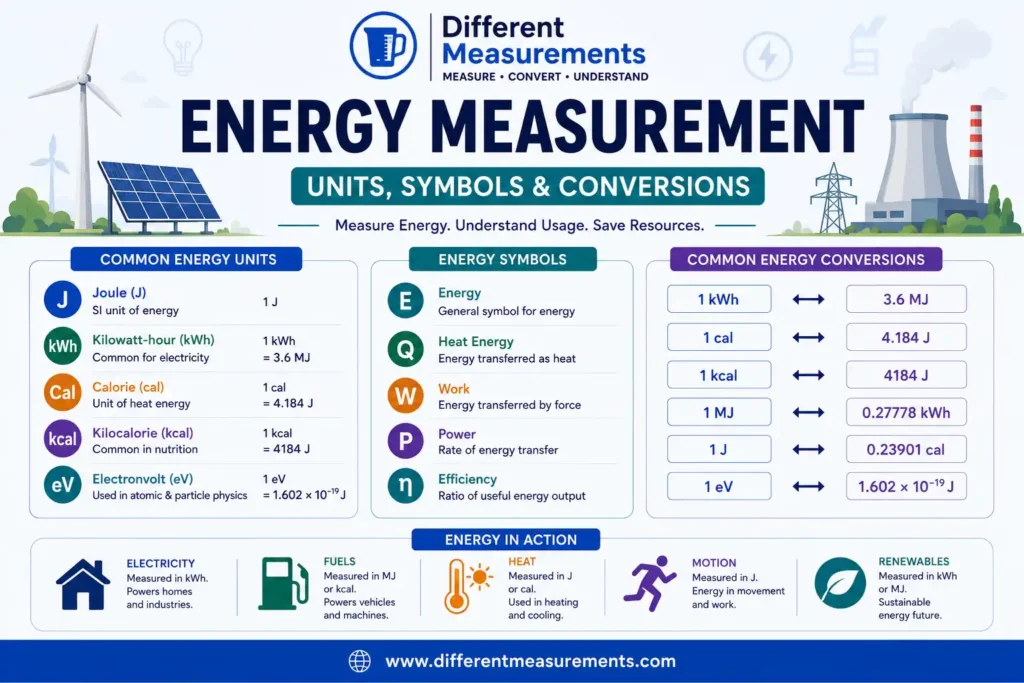
Energy powers nearly everything people interact with daily, from the food that fuels the body to the electricity that runs a household. Despite being such a familiar concept, energy is often measured using several different units depending on the context, whether that is a science classroom, an electricity bill, or a nutrition label. This guide explains what energy is, how it is measured, the most common energy units and symbols, and how to convert between them accurately.
What Is Energy?
Energy is the capacity to do work or cause physical change. Anything that moves, heats up, glows, or powers a device involves energy being transferred or transformed from one form to another.
Everyday examples of energy include:
- A moving object, such as a car or a thrown ball, carrying kinetic energy
- Heating water on a stove, which involves transferring thermal energy
- Charging a phone, which stores electrical energy in a battery
- Running household appliances, which convert electrical energy into motion, heat, or light
- Fuel in a vehicle, which stores chemical energy released during combustion
- Food, which stores chemical energy the body converts into usable energy
- Electricity flowing through a circuit, delivering energy to power devices
Energy itself is never created or destroyed. It simply changes form, moving from one type of energy to another as it does work or causes change.
What Is Energy Measurement?
Energy measurement is the process of quantifying how much energy is present, transferred, or consumed, expressed using a standardized unit such as the joule or the kilowatt-hour. Standardized units allow energy values to be compared accurately across different systems, industries, and countries.
Energy measurement is central to many fields:
- Physics: studying motion, heat, and the behavior of physical systems
- Engineering: designing systems that generate, transfer, or consume energy efficiently
- Electricity: tracking how much power a home or facility consumes over time
- Transportation: measuring fuel and battery energy in vehicles
- Nutrition: expressing the energy content of food
- Manufacturing: monitoring energy use in industrial processes
- Renewable energy: measuring the output of solar, wind, and hydroelectric systems
- Construction: evaluating the energy efficiency of buildings and materials
- Household energy use: understanding electricity bills and appliance consumption
- Scientific research: quantifying energy at scales ranging from atomic particles to entire power grids
SI Unit of Energy
The SI derived unit of energy is the joule (J). One joule is defined as the amount of work done when a force of one newton moves an object one meter in the direction of that force.
1 J = 1 N·m
This relationship connects energy directly to mechanical work, which is the product of force and distance. Because a single joule represents a relatively small amount of energy, larger multiples such as the kilojoule and megajoule are commonly used for practical, everyday values.
Energy Units and Symbols
The table below summarizes the most common energy units, their symbols, what they represent, and where they are typically used.
| Unit | Symbol | Description | Common Use |
|---|---|---|---|
| Joule | J | SI base energy unit | Science, engineering |
| Kilojoule | kJ | 1,000 joules | Nutrition labels, engineering |
| Megajoule | MJ | 1,000,000 joules | Large-scale energy, industry |
| Watt-hour | Wh | Energy delivered at 1 watt for 1 hour | Small electronics, batteries |
| Kilowatt-hour | kWh | 1,000 watt-hours | Household electricity billing |
| Calorie | cal | Small unit of heat energy | Chemistry, physics |
| Kilocalorie | kcal | 1,000 calories | Nutrition (food energy) |
| British thermal unit | BTU | Heat energy unit used in the US | HVAC, heating and cooling |
| Electronvolt | eV | Very small energy unit | Atomic and particle physics |
The erg is an older, much smaller energy unit from the CGS system, largely replaced by the joule in modern scientific use, though it may still appear in some historical or specialized physics contexts.
Joule (J)
A joule represents a relatively small amount of energy. It is the SI unit of energy because it connects directly to the base SI units for force and distance, making it consistent with the broader SI framework used throughout science and engineering.
1 J = 1 N·m
Since a joule equals one newton of force applied over one meter of distance, it directly represents mechanical work. Joules are used extensively in physics and engineering calculations, particularly when precision and consistency with other SI units matter.
Kilojoule and Megajoule
Kilojoules and megajoules scale the joule up to more practical sizes for real-world use.
- 1 kJ = 1,000 J
- 1 MJ = 1,000,000 J
Kilojoules commonly appear on nutrition labels, particularly outside the United States, and in general engineering contexts. Megajoules are used for larger-scale energy values, such as the energy content of fuel or the output of industrial equipment.
Watt-Hour and Kilowatt-Hour
Watt-hours and kilowatt-hours are units of energy, not power, even though they include the word “watt,” which is a unit of power. A watt-hour represents the amount of energy delivered when one watt of power is sustained for one hour.
1 Wh = 3,600 J
Since a kilowatt-hour is 1,000 watt-hours:
1 kWh = 3,600,000 J
Kilowatt-hours are the standard unit for household electricity consumption because they conveniently represent the relatively large amounts of energy used by homes and businesses over time. Practical examples include:
- Home appliances: a refrigerator might use a few kWh per day depending on its size and efficiency
- Electricity bills: utility companies charge based on the number of kWh consumed each billing period
- Solar energy systems: solar panel output is typically measured and reported in kWh generated
- Battery storage: home battery systems are often rated by how many kWh of energy they can store
Energy vs Power
Energy and power are related but distinct concepts, and confusing the two is one of the most common mistakes people make when reading specifications or bills.
Energy is the total amount of work done or energy transferred, while power is the rate at which that energy is transferred or used.
Power = Energy ÷ Time
Since a watt is defined as one joule of energy transferred per second:
1 watt = 1 joule per second
A simple example illustrates the difference. A 100-watt light bulb uses 100 joules of energy every second it is switched on. If that bulb runs for one hour, it consumes 100 watt-hours of energy, which is 0.1 kilowatt-hours. The power rating, 100 watts, describes how fast energy is being used, while the watt-hour figure describes the total amount of energy consumed over that period.
Calorie and Kilocalorie
Calories and kilocalories are commonly used to describe heat energy and, particularly, the energy content of food.
1 kcal = 1,000 cal
An important clarification applies here: the “Calorie” listed on food nutrition labels, typically written with a capital C, generally refers to a kilocalorie, not a small calorie. This distinction is a frequent source of confusion, since the two terms sound identical in casual conversation.
The approximate relationship between kilocalories and kilojoules is:
1 kcal ≈ 4.184 kJ
This conversion explains why some nutrition labels display both kcal and kJ values side by side, particularly in countries that use the metric system more strictly for food labeling.
British Thermal Unit (BTU)
A British thermal unit, abbreviated BTU or Btu, is a unit of heat energy historically defined as the amount of energy needed to raise the temperature of one pound of water by one degree Fahrenheit.
The approximate conversion to joules is:
1 BTU ≈ 1,055 J
This value is commonly rounded for everyday use, though the precise figure can vary slightly depending on which specific definition of the BTU is being used. BTUs are widely used in the United States for:
- Heating and cooling system ratings
- HVAC equipment specifications
- Energy and appliance efficiency ratings, particularly for air conditioners and furnaces
Electronvolt (eV)
An electronvolt is an extremely small unit of energy, defined as the amount of energy gained by a single electron when accelerated through an electric potential difference of one volt.
1 eV ≈ 1.602176634 × 10⁻¹⁹ J
Because this value is so small, the electronvolt is primarily used in atomic, nuclear, and particle physics, where energy values involving individual particles would be impractically small if expressed in joules. Electronvolts allow physicists to work with more manageable numbers when studying phenomena at these tiny scales.
Types of Energy
Energy takes several distinct forms, each associated with different physical processes.
Kinetic Energy
Kinetic energy is the energy an object has due to its motion. Faster-moving or heavier objects carry more kinetic energy.
KE = 1/2 mv²
Where:
- m = mass
- v = velocity
For example, a car moving at highway speed carries significantly more kinetic energy than the same car moving slowly through a parking lot, since kinetic energy increases with the square of velocity.
Potential Energy
Potential energy is stored energy that depends on an object’s position or configuration. Gravitational potential energy, one of the most common forms, depends on an object’s height above a reference point.
PE = mgh
Where:
- m = mass
- g = gravitational acceleration
- h = height
A book held above a table has gravitational potential energy relative to the table’s surface, which converts into kinetic energy if the book is dropped.
Thermal Energy
Thermal energy relates to the microscopic motion of particles within a substance. Higher temperatures generally correspond to faster particle motion and greater thermal energy. This form of energy underlies everyday experiences like feeling heat from a stove or noticing a warm object cool down over time.
Chemical Energy
Chemical energy is stored within the bonds between atoms and molecules. This energy is released or absorbed during chemical reactions.
Common examples include:
- Food, where chemical energy is released during digestion
- Fuels, such as gasoline, where combustion releases stored chemical energy
- Batteries, which store and release chemical energy as electrical energy
Electrical Energy
Electrical energy is energy transferred through electrical systems, such as circuits and power grids.
Electrical Energy = Power × Time
This relationship directly connects to watt-hours and kilowatt-hours, since multiplying a power rating in watts by the time in hours gives the total electrical energy consumed in watt-hours.
Other Forms of Energy
- Nuclear energy: stored within the nucleus of atoms, released during nuclear reactions
- Radiant or electromagnetic energy: carried by light and other electromagnetic waves
- Elastic energy: stored in stretched or compressed materials, such as a spring or stretched rubber band
Energy Formulas
| Quantity | Formula | Variables |
|---|---|---|
| Work | W = Fd | F = force, d = distance |
| Kinetic energy | KE = 1/2 mv² | m = mass, v = velocity |
| Gravitational potential energy | PE = mgh | m = mass, g = gravitational acceleration, h = height |
| Electrical energy | E = Pt | P = power, t = time |
How Is Energy Measured?
Energy can be calculated using formulas, as shown above, or measured directly using specialized instruments, depending on the type of energy involved.
- Mechanical work is often calculated using force and distance measurements rather than measured directly
- Electrical energy meters, such as those used by utility companies, track kilowatt-hour consumption over time
- Calorimeters measure heat energy released or absorbed during physical or chemical processes
- Fuel energy is typically determined through standardized combustion testing and expressed per unit of volume or mass
- Battery energy is measured in watt-hours or kilowatt-hours, based on voltage and stored charge
- Thermal measurements often rely on temperature changes combined with known material properties to calculate energy transfer
Energy Conversion
Energy conversion allows the same amount of energy to be expressed using a different unit. This changes only the numerical representation of the value, not the actual amount of energy involved. For a broader explanation of how unit conversion works across all measurement categories, see Measurement Conversions.
Common energy conversions include:
- Joules to kilojoules: divide by 1,000
- Kilojoules to joules: multiply by 1,000
- Joules to kilowatt-hours: divide by 3,600,000
- Kilowatt-hours to joules: multiply by 3,600,000
- Calories to joules: multiply by 4.184
- Kilocalories to kilojoules: multiply by 4.184
- BTU to joules: multiply by approximately 1,055
- Electronvolts to joules: multiply by approximately 1.602176634 × 10⁻¹⁹
Common Energy Conversion Factors
| Relationship | Value |
|---|---|
| 1 kJ | 1,000 J |
| 1 MJ | 1,000,000 J |
| 1 Wh | 3,600 J |
| 1 kWh | 3,600,000 J |
| 1 kcal | 4,184 J |
| 1 kcal | 4.184 kJ |
| 1 BTU | ≈ 1,055 J |
| 1 eV | ≈ 1.602176634 × 10⁻¹⁹ J |
How to Convert Energy Units Manually
- Identify the original energy unit. For example, 2,500 J.
- Identify the target unit. For example, kJ.
- Find the correct conversion factor. 1 kJ = 1,000 J.
- Multiply or divide as appropriate. Divide 2,500 by 1,000.
- Keep the correct energy unit in the final answer. The result should be labeled in kJ.
- Check whether the result is reasonable. 2,500 J is a modest amount of energy, so a result of 2.5 kJ makes sense.
- Round appropriately. Two or three decimal places is usually sufficient for practical purposes.
Energy Conversion Examples
Example 1: Convert 5,000 J to kJ Conversion factor: 1 kJ = 1,000 J Calculation: 5,000 ÷ 1,000 Result: 5 kJ
Example 2: Convert 2 kWh to joules Conversion factor: 1 kWh = 3,600,000 J Calculation: 2 × 3,600,000 Result: 7,200,000 J
Example 3: Convert 10 kJ to kcal Conversion factor: 1 kcal ≈ 4.184 kJ Calculation: 10 ÷ 4.184 Result: approximately 2.39 kcal
Example 4: Convert 500 kcal to kJ Conversion factor: 1 kcal ≈ 4.184 kJ Calculation: 500 × 4.184 Result: 2,092 kJ
Example 5: Convert 1,000 J to Wh Conversion factor: 1 Wh = 3,600 J Calculation: 1,000 ÷ 3,600 Result: approximately 0.278 Wh
Energy Measurement in Electricity
Electrical systems rely on a clear distinction between power and energy to make sense of consumption and billing.
- Watt (W) measures power, the rate at which energy is used
- Watt-hour (Wh) measures energy, the total amount used over time
- Kilowatt-hour (kWh) measures larger amounts of energy, standard for household billing
- Electricity meters track cumulative kWh usage over a billing period
- Energy consumption is calculated by multiplying a device’s power rating by the time it operates
For example, a 1,000-watt appliance running for one hour consumes exactly 1 kWh of energy, since 1,000 watts times 1 hour equals 1,000 watt-hours, or 1 kilowatt-hour. This simple relationship underlies how utility companies calculate electricity bills.
Energy Measurement in Food and Nutrition
Food energy is commonly expressed in Calories, kilocalories, or kilojoules, depending on regional labeling standards.
Many nutrition labels, particularly outside the United States, display both kcal and kJ values side by side, since different countries have different conventions for food energy labeling. This guide focuses on how these units relate to one another rather than offering dietary guidance, since nutritional needs vary significantly from person to person.
Energy Measurement in Transportation
Energy measurement plays a central role in transportation, whether fuel-based or electric.
- Gasoline and diesel store chemical energy that is released through combustion to power a vehicle
- Electric vehicles rely on stored electrical energy, typically measured in kWh, to determine driving range
- Batteries in electric and hybrid vehicles are rated by their total energy capacity in kWh
- Fuel efficiency is often expressed in terms of distance traveled per unit of energy consumed
- Charging an electric vehicle involves transferring a measurable amount of energy, typically tracked in kWh, into the vehicle’s battery
Energy Measurement in Renewable Energy
Renewable energy systems rely heavily on kilowatt-hours to describe how much electrical energy they generate or store.
- Solar power systems report energy production in kWh generated over a given period, such as a day or a month
- Wind power output is similarly measured in kWh, based on turbine performance and wind conditions
- Hydroelectric power generation is measured in kWh, reflecting the energy captured from moving water
- Battery storage systems used alongside renewable energy sources are rated by how many kWh they can store and later discharge
Kilowatt-hours are used consistently across these systems because they provide a practical, comparable unit for tracking real-world electrical energy production and consumption.
Real-World Energy Examples
- Household electricity use: a typical home might consume around 25 to 30 kWh per day, though this varies widely based on household size, climate, and appliances
- Food energy: a typical meal might provide several hundred kilocalories, depending on portion size and content
- Battery energy: a smartphone battery might store around 10 to 15 Wh, while an electric vehicle battery can store tens of kWh
- Fuel energy: a gallon of gasoline contains a substantial amount of chemical energy, generally measured in the tens of megajoules
- Heating: home heating systems are often rated in BTUs per hour to describe their heat output capacity
- Mechanical work: lifting a heavy object involves converting muscular energy into gravitational potential energy
- Solar energy production: a residential solar system might generate several kWh per day, depending on panel size and sunlight conditions
These values are approximate and intended to illustrate general scale rather than precise figures for any specific device or situation.
Common Energy Measurement Mistakes
- Confusing energy with power, treating a rate of energy use as if it were a total amount of energy
- Confusing watts with watt-hours, since one describes a rate and the other describes an accumulated quantity
- Confusing calories with kilocalories, particularly when interpreting food energy values
- Using the wrong conversion factor, especially when converting between kcal, kJ, and BTU
- Forgetting that kWh is a unit of energy, not power, despite including “watt” in its name
- Confusing joules and watts, which measure different physical quantities entirely
- Mixing units within energy formulas, such as combining metric and imperial values without converting first
- Rounding too early in multi-step conversions, which can introduce small but meaningful errors
- Treating approximate conversion values as exact, particularly with BTU, where the precise value depends on the specific definition used
Common Questions About Energy Measurement
Energy measurement is the process of quantifying how much energy is present, transferred, or consumed, expressed in standardized units such as joules, kilowatt-hours, or calories, allowing energy values to be compared consistently.
The SI unit of energy is the joule (J), defined as the work done when a force of one newton moves an object one meter.
A joule is the SI unit of energy, equal to one newton of force applied over a distance of one meter, written as 1 J = 1 N·m.
Energy is measured using formulas based on force, distance, mass, and velocity, or directly using instruments such as electrical energy meters, calorimeters, and battery capacity ratings.
Energy is the total amount of work done or energy transferred, while power is the rate at which that energy is transferred, calculated as energy divided by time.
There are 3,600,000 joules in 1 kilowatt-hour.
There are approximately 4,184 joules in 1 kilocalorie.
A British thermal unit, or BTU, is a unit of heat energy commonly used in the United States for heating and cooling systems, approximately equal to 1,055 joules.
An electronvolt is an extremely small unit of energy used in atomic, nuclear, and particle physics, equal to approximately 1.602176634 × 10⁻¹⁹ joules.
A kilowatt-hour measures energy, specifically the amount of energy used when 1,000 watts of power is sustained for one hour.
No, a watt is a unit of power, representing the rate at which energy is used or transferred, equal to one joule per second.
A kilocalorie equals 1,000 calories. The “Calorie” listed on food nutrition labels generally refers to a kilocalorie, not a small calorie.
Energy measurement connects a wide range of everyday experiences, from electricity bills to food labels, back to a shared set of standardized units. Understanding the joule as the SI reference point, recognizing the difference between energy and power, and knowing how units like kWh, kcal, and BTU relate to one another makes it far easier to read specifications, bills, and labels with confidence.