Mass and weight are two of the most commonly confused concepts in everyday measurement, and both belong to the broader family of measurement units used across science and daily life. Most people use the words interchangeably, and in casual conversation that causes no real problem. In science and engineering, however, mass and weight describe two different physical quantities, measured with different units and different instruments.
This guide explains what mass is, what weight is, how they relate to each other through gravity, and which units apply to each. It also covers common conversions, common misconceptions, and the everyday language habits that make this topic confusing in the first place. Mass and weight sit alongside other core measurement categories, such as length measurement, within the broader types of measurement used every day.
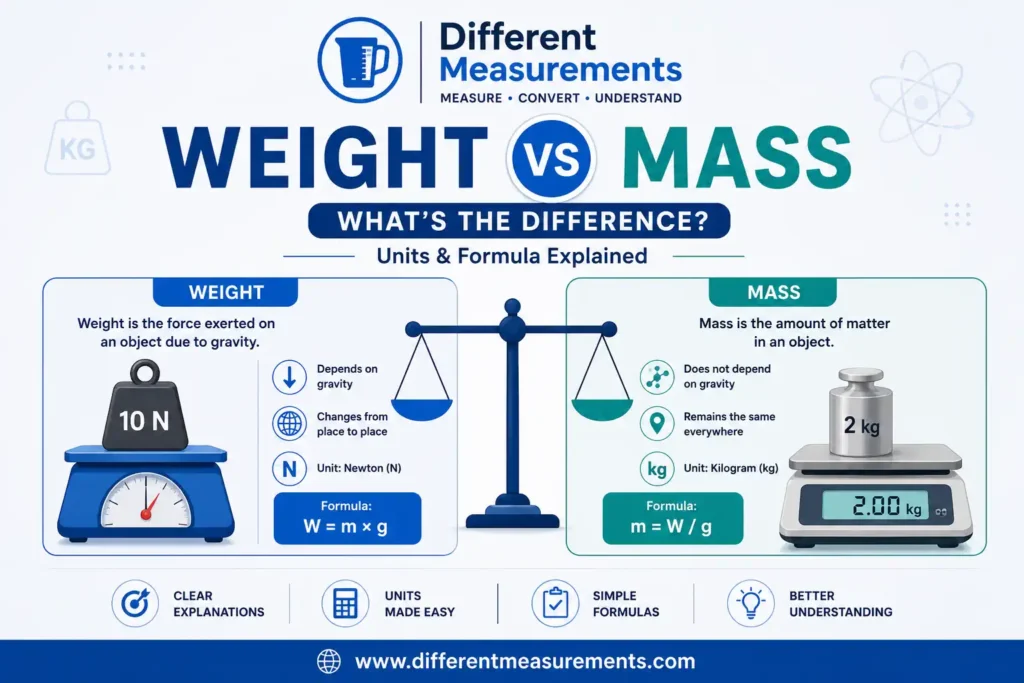
Quick answer: Mass is the amount of matter contained in an object, and it stays the same no matter where the object is located. Weight is the force that gravity exerts on that mass, so it can change depending on the strength of gravity acting on the object. A person has the same mass on Earth and on the Moon, but a much smaller weight on the Moon.
What Is Mass?
Mass is a measure of how much matter an object contains. It is a fundamental physical property, meaning it does not depend on outside forces, location, or the surrounding environment. A rock has the same mass whether it sits on a table, floats in space, or rests on the surface of Mars.
Mass also determines an object’s resistance to a change in motion, a property known as inertia. A heavier truck is harder to speed up or slow down than a small car because it has more mass, not because it weighs more in a particular location.
Everyday examples of mass include:
- The amount of flour in a bag, typically labeled in grams or kilograms
- A person’s body mass, often recorded at a doctor’s office
- The mass of a smartphone, usually listed in grams by the manufacturer
- The mass of a shipping container, used for freight and logistics planning
Because mass does not depend on gravity, it remains constant even if the object travels to space or to another planet.
What Is Weight?
Weight is the force exerted on an object due to gravity. Unlike mass, weight depends on the local gravitational field, which means the same object can have different weights in different locations.
On Earth, gravity pulls objects toward the ground with a fairly consistent acceleration, so weight and mass tend to track closely together in everyday life. On the Moon, where gravity is about one-sixth as strong as on Earth, an object weighs far less even though its mass has not changed at all.
Everyday examples of weight include:
- The reading on a bathroom scale, which measures the force your body exerts downward
- The pull you feel when lifting a heavy box
- The tension in a rope holding a suspended weight
- The reading on a spring-based fish scale
In physics, weight is technically a force, and forces are measured in different units than mass.
Weight vs Mass: What’s the Difference?
The table below summarizes the core distinctions between mass and weight.
| Aspect | Mass | Weight |
| Definition | Amount of matter in an object | Gravitational force acting on that matter |
| What it measures | Quantity of matter | Force caused by gravity |
| SI unit | Kilogram (kg) | Newton (N) |
| Common everyday units | Gram, kilogram, tonne, pound, ounce | Newton, pound-force |
| Effect of gravity | Unaffected by gravity | Changes with gravitational strength |
| Measurement instrument | Balance | Spring scale, load cell |
| Example | 70 kg of body mass | Force exerted by that mass under Earth’s gravity |
The key idea is that mass is a property of the object itself, while weight is a force that depends on both the object’s mass and the strength of the gravitational field it is in.
Mass and Weight in Physics
The relationship between mass and weight is expressed with a simple formula:
Weight = Mass × Gravitational Acceleration
Or, using standard physics notation:
W = m × g
Where:
- W is weight, measured in newtons (N)
- m is mass, measured in kilograms (kg)
- g is gravitational acceleration, measured in meters per second squared (m/s²)
On Earth, gravitational acceleration is approximately 9.81 m/s². This means an object with a mass of 1 kilogram has a weight of about 9.81 newtons on Earth’s surface.
Example: A person with a mass of 70 kilograms has a weight of approximately:
70 kg × 9.81 m/s² ≈ 686.7 newtons
If that same person traveled to the Moon, where gravitational acceleration is about 1.62 m/s², their mass would remain 70 kilograms, but their weight would drop to approximately:
70 kg × 1.62 m/s² ≈ 113.4 newtons
The mass never changes. The weight changes because the gravitational acceleration changes.
Mass Measurement Units
Mass is measured using a consistent set of units across the metric and SI systems. The most common ones, from smallest to largest, include:
- Microgram (µg): Used in pharmaceuticals, chemistry, and scientific research for extremely small quantities
- Milligram (mg): Common in medicine dosages and nutritional labeling
- Gram (g): Used for everyday items such as food ingredients, jewelry, and small objects
- Kilogram (kg): The SI base unit of mass, used for body mass, groceries, and general everyday measurement
- Metric ton / tonne (t): Used for large-scale mass measurements such as vehicles, industrial materials, and shipping cargo
Small units like micrograms and milligrams are typically reserved for scientific and medical contexts, while grams and kilograms dominate everyday and commercial use. Tonnes are reserved for industrial-scale mass measurement.
Weight Measurement Units
Because weight is a force, its scientifically accurate units come from the physics of force rather than the physics of mass.
- Newton (N): The SI unit of force, including weight, named after Isaac Newton
- Kilonewton (kN): Used for larger forces, such as in engineering and construction
- Pound-force (lbf): A unit of force used primarily in engineering contexts in the United States
- Ounce-force: A smaller force unit occasionally used in specialized engineering or product testing
Important distinction: In everyday usage, especially in the United States, people commonly say a person “weighs” 150 pounds or an object “weighs” 8 ounces. In these everyday contexts, pounds and ounces are being used as units of mass, not as units of force. The true force unit, pound-force, is rarely used outside of engineering and physics. This guide addresses this distinction in more detail in the section on everyday language below.
Mass vs Weight Units
Confusion between mass units and weight units is one of the most common measurement mistakes. A few clarifications help:
- Kilograms vs pounds: Both are commonly used as units of mass in everyday life, even though pounds have historical roots as a force unit in some contexts.
- Grams vs ounces: Both function as everyday mass units for smaller quantities, such as food portions or small packages.
- Newtons vs kilograms: These are not interchangeable. The newton measures force, including weight, while the kilogram measures mass. A kilogram is never technically a unit of force, even though people often say “weight in kilograms.”
Scientifically, the kilogram is always a mass unit. When kilograms are used to describe how much something “weighs,” this reflects common language rather than technical accuracy.
Metric, Imperial, and US Customary Units
Mass and weight-related units appear across several measurement systems, and it helps to understand how they relate.
Metric system: Uses grams, kilograms, and tonnes as mass units, all based on powers of ten, making conversions straightforward.
SI system: The International System of Units designates the kilogram as the base unit of mass and the newton as the derived unit of force, including weight.
Imperial system: Historically used in the United Kingdom and other Commonwealth countries, this system includes ounces, pounds, and stones as mass-related units.
US customary system: Closely related to the Imperial system but not identical in every respect. The US customary system uses ounces and pounds in the same way as everyday Imperial usage, but it does not use the stone as a common unit, whereas the stone remains common in the United Kingdom for body mass. Some historical Imperial units also differ slightly in definition from their US customary counterparts, so the two systems should not be treated as fully interchangeable.
Common units across these systems include grams, kilograms, tonnes, ounces, pounds, and, in Imperial usage specifically, stones.
How Is Mass Measured?
Mass is measured using instruments that compare an object’s mass to a known reference, rather than measuring a force directly.
- Balance: A traditional instrument that compares the mass of an object to a set of known reference masses, remaining accurate regardless of gravitational variation.
- Beam balance: A mechanical version of a balance, historically used in laboratories and marketplaces, relying on a pivot and counterweights.
- Laboratory balance: A precise, often electronic, instrument used in scientific settings to measure small and exact mass values.
- Digital scale: Although commonly called a “scale,” many digital household scales are calibrated to display mass in grams or kilograms, using internal sensors that account for local gravity.
The basic principle behind mass measurement is comparison. A balance works by comparing an unknown mass to a known one until they reach equilibrium, which is why balances remain accurate even in different gravitational environments.
How Is Weight Measured?
Weight, being a force, is measured differently than mass.
- Spring scales: Measure weight by detecting how much a spring stretches or compresses under the force of gravity acting on an object.
- Force sensors: Electronic devices that detect the force applied to them, converting it into a readable value.
- Load cells: Used in industrial and commercial scales, load cells convert force into an electrical signal that corresponds to weight.
The key difference is that mass measurement relies on comparison to a known mass, while weight measurement relies on directly detecting the force gravity applies to an object. This is why a spring scale would give a different reading on the Moon, while a balance would give the same mass reading regardless of location.
Does Mass Change With Location?
Mass does not change based on location. An object’s mass remains the same whether it is on Earth, on the Moon, in orbit, or on another planet, because mass depends only on the amount of matter the object contains.
Weight, on the other hand, changes with location because it depends on gravitational acceleration.
- From Earth to the Moon: Mass stays the same, but weight decreases significantly because the Moon’s gravity is weaker than Earth’s.
- To another planet: Mass remains constant, but weight changes based on that planet’s gravitational acceleration. For example, an object would weigh more on Jupiter and less on Mars than it does on Earth.
- To a different gravitational environment: In microgravity, such as aboard the International Space Station, objects and people become effectively weightless, even though their mass has not changed at all.
Real-World Examples of Mass and Weight
- A person’s body mass: Often described casually as “weight,” but technically a mass measurement, typically in kilograms or pounds.
- Grocery products: Package labels showing grams or kilograms are describing mass, even when consumers refer to it as the product’s weight.
- A package: Shipping companies list package mass in kilograms or pounds to calculate shipping costs, though the term “weight” is used in everyday shipping language.
- A car: A vehicle’s mass, often listed in kilograms or pounds by manufacturers, determines fuel efficiency and handling, independent of location.
- A piece of equipment: Industrial equipment specifications list mass to help with transportation and installation planning.
- Scientific objects: Laboratory samples are measured in grams or micrograms using balances, since scientific accuracy requires true mass values rather than gravity-dependent weight.
In nearly all of these examples, the number displayed is technically a mass value, even though everyday language calls it “weight.”
Mass and Weight Conversions
Because most everyday conversions involve mass units, such as converting grams to kilograms or kilograms to pounds, these conversions do not involve gravity at all. They simply convert one mass unit into another.
Common everyday mass conversions include:
- Grams to kilograms
- Kilograms to grams
- Kilograms to pounds
- Pounds to kilograms
- Ounces to grams
- Grams to ounces
These are mass-to-mass conversions and use fixed conversion factors that do not change based on location.
Converting mass into actual physical weight, meaning a force measured in newtons, requires multiplying by gravitational acceleration, as shown in the formula covered earlier. This is a mass-to-force conversion and should not be confused with simple mass-to-mass conversions like kilograms to pounds.
Common Mass and Weight Conversion Factors
| Conversion | Value |
| 1 kilogram | 1,000 grams |
| 1 gram | 1,000 milligrams |
| 1 pound | ≈ 0.453592 kilograms |
| 1 kilogram | ≈ 2.20462 pounds |
| 1 ounce | ≈ 28.3495 grams |
| 1 metric ton (tonne) | 1,000 kilograms |
| 1 kilogram (on Earth) | ≈ 9.81 newtons of force |
Values marked with an approximate symbol are rounded for practical use. Exact conversion factors carry more decimal places but are rarely needed outside of scientific or engineering work.
Common Mistakes About Weight and Mass
- Thinking mass and weight are exactly the same: They are related but represent different physical quantities.
- Calling kilograms a unit of weight in scientific contexts: Kilograms are always a mass unit in physics, even though casual speech treats them as a weight unit.
- Assuming weight never changes: Weight changes with gravitational acceleration, even though mass stays fixed.
- Confusing pounds with pound-force: Everyday pounds typically refer to mass, while pound-force specifically refers to the force unit used in engineering.
- Confusing ounces of mass with fluid ounces: Ounces of mass measure how much matter something contains, while fluid ounces measure volume, and the two are not interchangeable.
- Assuming mass depends on gravity: Mass is a fixed property of matter and does not change due to gravitational differences.
These misconceptions are common because everyday language rarely distinguishes between mass and weight, which is understandable given how closely the two align in typical Earth-based situations.
Weight vs Mass in Everyday Language
It is completely normal to hear someone say, “My weight is 70 kilograms.” Scientifically, this statement is describing mass, not weight, since kilograms are a mass unit. However, this kind of language is so deeply embedded in everyday speech that it is not considered incorrect in casual use.
The distinction matters more in scientific, engineering, and educational contexts, where precision is important. In daily life, saying “I weigh 70 kilograms” is universally understood and perfectly acceptable, even though a physicist would describe it as a mass measurement.
Understanding this difference helps clarify why nutrition labels, bathroom scales, and shipping forms all use mass units like kilograms and pounds, while physics problems and engineering specifications rely on force units like newtons when true weight is being calculated.
Common Questions About Weight and Mass
Mass is the amount of matter an object contains and stays the same everywhere. Weight is the gravitational force acting on that mass, and it changes depending on the strength of gravity in a given location, such as Earth versus the Moon.
The kilogram is the SI base unit of mass. It is often used informally to describe weight, but scientifically it always measures mass.
In everyday usage, the pound functions as a mass unit. The technical force unit, pound-force, is a separate concept used mainly in engineering.
The SI unit of mass is the kilogram.
Since weight is a force, its SI unit is the newton.
Mass generally stays constant for a given object, though it can change if matter is added or removed, such as through burning fuel or losing material.
Yes, weight can change based on the strength of the gravitational field acting on an object, even if its mass stays the same.
No, mass remains the same on the Moon. Only weight decreases due to the Moon’s weaker gravity.
Weight is a force, and the newton is the SI unit used to measure all forces, including gravitational force.
Multiply the mass in kilograms by approximately 2.20462 to get the equivalent value in pounds.
Multiply the mass in pounds by approximately 0.453592 to get the equivalent value in kilograms.
No, they are related but distinct. Mass measures the amount of matter in an object, while weight measures the gravitational force acting on that matter.
Mass and weight are closely linked but scientifically distinct concepts. Mass reflects how much matter an object contains and stays constant everywhere, while weight reflects the gravitational force acting on that mass and can change depending on location. Understanding this distinction helps clarify everyday measurements, scientific calculations, and the units used across metric, Imperial, and US customary systems.