
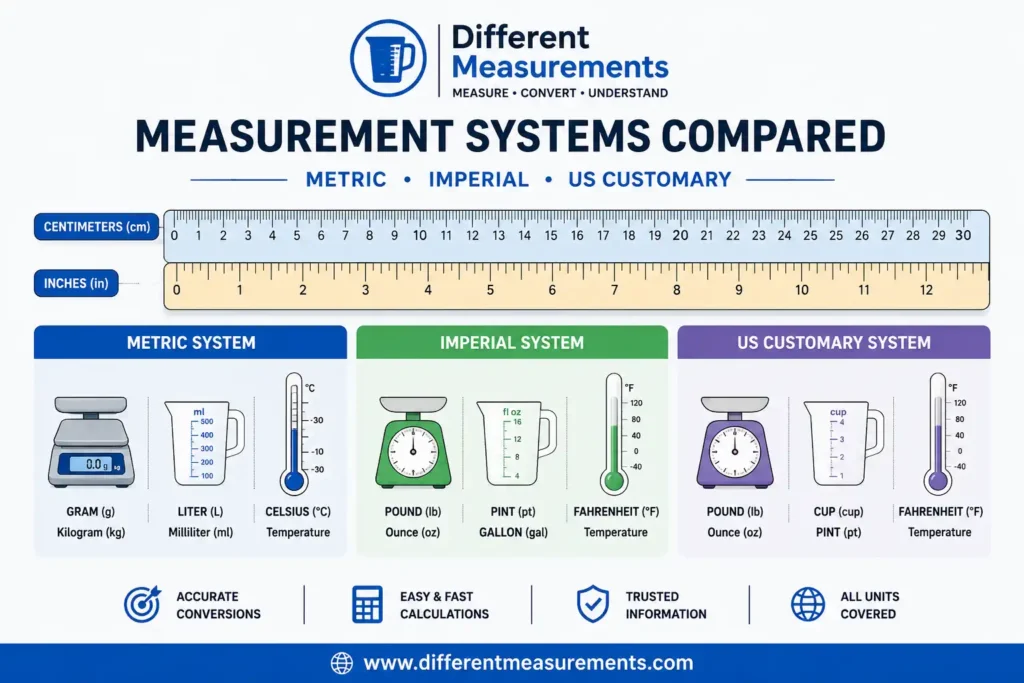
Every measurement, whether it is the length of a room or the weight of a package, relies on a unit to give it meaning. Units are the agreed-upon reference points that turn a number into something useful and understandable. Without them, “10” tells you nothing. With a unit attached, such as “10 kilograms” or “10 miles,” that same number becomes precise and actionable.
This guide explains how measurement units work, how the major systems of units, metric, Imperial, and US customary, developed and differ from one another, and how they relate to the modern SI standard used in science and international trade. It also covers common units, their symbols, and how conversion connects these systems together.
What Are Measurement Units?
A measurement unit is a defined, standardized quantity used to express a physical measurement. It provides a fixed reference so that a measurement made in one place, by one person, means exactly the same thing when read by someone else, somewhere else, at a different time.
Every measurement consists of two parts:
- A numerical value, which tells you the quantity
- A unit, which tells you what that quantity is measured in
For example, “5 liters” combines the number 5 with the unit liter, giving a complete and meaningful measurement of volume. Without the unit, the number 5 could refer to almost anything.
Units exist for every type of physical quantity, including length, mass, volume, area, temperature, time, speed, pressure, and energy. Each of these quantities has its own set of standard units, which is explored in more detail in types of measurements.
Base Units and Derived Units
Measurement units generally fall into two categories:
- Base units measure fundamental physical quantities directly, such as the meter for length or the second for time.
- Derived units are built by combining base units, such as the meter per second for speed or the square meter for area.
This distinction is central to the SI system, discussed later in this guide, where seven base units form the foundation for every other unit used in science.
Why Do We Have Different Measurement Systems?
Measurement systems developed independently across different regions and historical periods, often based on practical references available at the time, such as the length of a foot, the width of a thumb, or the distance a person could walk in a day. As trade, travel, and science became more global, the lack of a single shared system created confusion and error.
This led to the development of standardized systems designed to be consistent, reproducible, and, in the case of the metric system, based on a simple decimal structure. Today, three systems dominate global use: the metric system, the Imperial system, and US customary units, with the International System of Units (SI) serving as the modern scientific standard built on metric foundations.
Understanding how these systems differ, and where they overlap, is essential for accurate measurement, whether you are following a recipe, reading a product label, or working on an engineering project.
The Metric System
The metric system is a decimal-based system of measurement, meaning units at different scales are related to one another by powers of ten. This makes the metric system straightforward to use, since converting between units typically involves only moving a decimal point rather than applying a complex formula.
How the Metric System Works
The metric system is built around a small set of base units, one for each type of physical quantity, such as the meter for length, the gram for mass, and the liter for volume. Larger or smaller quantities are expressed by adding a prefix to the base unit rather than introducing an entirely new unit name.
This is a key difference from systems like Imperial or US customary units, where units of different sizes often have unrelated names, such as inches, feet, yards, and miles all describing length without a consistent numerical relationship.
Common Metric Units
| Quantity | Unit | Symbol |
| Length | meter | m |
| Mass | gram | g |
| Volume | liter | L |
| Temperature | Celsius | °C |
| Time | second | s |
Metric Prefixes
Metric prefixes indicate how a base unit is scaled up or down. The most commonly used prefixes include:
- milli- (one thousandth): a millimeter is one thousandth of a meter
- centi- (one hundredth): a centimeter is one hundredth of a meter
- deci- (one tenth): a deciliter is one tenth of a liter
- kilo- (one thousand): a kilogram is one thousand grams
Because every prefix represents a fixed power of ten, converting from millimeters to meters, or grams to kilograms, follows the same simple logic across every metric unit. This consistency is one of the main reasons the metric system is used officially by the vast majority of countries worldwide.
The Imperial System
The Imperial system is a system of measurement units that originated in Britain and was formally standardized in 1824 through the British Weights and Measures Act. It replaced a patchwork of earlier, inconsistent regional units with a single official standard across the British Empire.
Origins of the Imperial System
Many Imperial units trace back to older, informal measurements based on the human body or common objects. A foot, for instance, was historically related to the length of a human foot, while a yard was originally based on the distance from a person’s nose to their outstretched thumb. Over time, these informal references were replaced by fixed, standardized definitions.
Common Imperial Units
| Quantity | Unit | Symbol |
| Length | inch, foot, yard, mile | in, ft, yd, mi |
| Mass | ounce, pound, stone | oz, lb, st |
| Volume | Imperial pint, Imperial gallon | pt, gal |
| Temperature | Fahrenheit (historically) | °F |
Although the United Kingdom officially adopted the metric system for most scientific, medical, and commercial purposes, Imperial units remain common in everyday British life. Road distances are still measured in miles, and body weight is often expressed in stones and pounds.
US Customary Units
US customary units share historical roots with the British Imperial system, since both descend from earlier English units of measurement. However, the two systems diverged after the United States gained independence, and they are not identical today, a distinction that is often overlooked but genuinely matters for accuracy.
How US Customary Units Differ from Imperial
The most significant differences between US customary units and Imperial units appear in volume measurements. While units of length, such as the inch, foot, yard, and mile, are essentially the same in both systems, units like the gallon, quart, and pint have different values.
| Unit | US Customary Value | Imperial Value |
| Gallon | 3.785 liters | 4.546 liters |
| Quart | 0.946 liters | 1.137 liters |
| Pint | 0.473 liters | 0.568 liters |
This means a US gallon of fuel or milk is meaningfully smaller than an Imperial gallon, even though both use the same unit name. This is a common source of confusion for travelers, cooks, and anyone working across both systems.
Common US Customary Units
| Quantity | Unit | Symbol |
| Length | inch, foot, yard, mile | in, ft, yd, mi |
| Mass | ounce, pound, ton | oz, lb, tn |
| Volume | cup, pint, quart, gallon | c, pt, qt, gal |
| Temperature | Fahrenheit | °F |
US customary units remain the primary system used for everyday measurement in the United States, including in cooking, construction, road distances, and body weight.
SI Units: The International Standard
The International System of Units, abbreviated SI from its French name, Système International, is the modern, formally standardized version of the metric system. It is used globally in science, engineering, medicine, and international trade because it offers a single, precise, and universally recognized framework for measurement.
The Seven SI Base Units
SI is built on seven base quantities, each with a corresponding base unit and symbol:
| Base Quantity | Base Unit | Symbol |
| Length | meter | m |
| Mass | kilogram | kg |
| Time | second | s |
| Electric current | ampere | A |
| Thermodynamic temperature | kelvin | K |
| Amount of substance | mole | mol |
| Luminous intensity | candela | cd |
Derived SI Units
Every other unit used within the SI system is a derived unit, meaning it is created by combining two or more base units. Common examples include:
- Speed (meters per second, m/s): combines length and time
- Area (square meter, m²): derived from length alone
- Pressure (pascal, Pa): derived from force and area
- Energy (joule, J): derived from mass, length, and time
This layered structure, where a small set of base units supports an unlimited number of derived units, is what makes SI such a precise and adaptable system. It is also why SI is considered the authoritative reference point for scientific measurement worldwide.
Metric vs Imperial vs US Customary: Key Differences
The table below summarizes the core differences between the three most commonly referenced measurement systems.
| Feature | Metric System | Imperial System | US Customary Units |
| Structure | Decimal (base 10) | Non-decimal, historical | Non-decimal, historical |
| Primary Region | Most of the world | United Kingdom (partial use) | United States |
| Length Units | meter, kilometer | inch, foot, mile | inch, foot, mile |
| Volume Units | liter | Imperial pint, Imperial gallon | US pint, US gallon |
| Temperature | Celsius | Fahrenheit (traditionally) | Fahrenheit |
| Relation to SI | Direct foundation of SI | Related, but distinct | Related, but distinct |
It is important not to treat Imperial and US customary units as identical. While they share many unit names and a common history, key measurements, particularly for volume, differ enough to cause real errors if the two systems are confused.
Common Measurement Units by Category
While this guide focuses on measurement systems, it is useful to see how those systems apply across different categories of measurement.
| Category | Metric Units | US Customary / Imperial Units |
| Length | millimeter, centimeter, meter, kilometer | inch, foot, yard, mile |
| Mass / Weight | milligram, gram, kilogram | ounce, pound, ton |
| Volume | milliliter, liter, cubic meter | fluid ounce, cup, pint, quart, gallon |
| Area | square centimeter, square meter | square inch, square foot, acre |
| Temperature | Celsius | Fahrenheit |
Unit Symbols and Notation Rules
Unit symbols are the standardized shorthand used to represent measurement units in writing. Using correct symbols avoids ambiguity and ensures measurements are understood consistently, regardless of language or region.
A few notation rules apply across most systems:
- Unit symbols are not pluralized. Write 10 kg, not 10 kgs.
- Symbols derived from a person’s name are capitalized, such as Pa for pascal or K for kelvin, while the written-out unit name is not, such as pascal and kelvin.
- A space is typically placed between the number and the unit symbol, such as 5 m rather than 5m, although this can vary by style guide.
- Squared and cubed units use a superscript number, such as m² for square meters and m³ for cubic meters.
Following these conventions matters most in technical, scientific, and international contexts, where consistency prevents misreadings that could lead to costly errors.
Converting Between Measurement Systems
Unit conversion is the process of expressing a measurement from one system in the equivalent value of another, without changing the actual quantity being measured. Conversion is necessary anytime measurements need to move between metric, Imperial, US customary, or SI units, such as when reading a recipe from a different country or interpreting product specifications written in another system.
Conversions rely on a conversion factor, a fixed numerical relationship between two units. For example:
- 1 inch = 2.54 centimeters
- 1 mile = 1.609 kilometers
- 1 pound = 0.454 kilograms
- 1 US gallon = 3.785 liters
To convert a measurement, the original value is multiplied or divided by the appropriate conversion factor. For example, converting 10 pounds to kilograms involves multiplying 10 by 0.454, giving approximately 4.54 kilograms.
Because each category of measurement, length, mass, volume, temperature, and so on, uses its own conversion factors and, in the case of temperature, its own formulas rather than simple multiplication, Different Measurements provides dedicated conversion guides for each category. See unit conversion for a complete overview.
Which Countries Use Which System
The metric system, through its modern SI form, is the official measurement system in nearly every country in the world. The United States remains the most notable exception, continuing to use US customary units for most everyday purposes, including construction, cooking, road distances, and body weight, although the metric system is used in science, medicine, and many manufacturing sectors.
The United Kingdom occupies a middle position, having officially adopted the metric system for trade, science, and most official contexts, while still using Imperial units informally, particularly miles for road distances and stones and pounds for body weight.
This mixed usage is one of the main reasons a clear understanding of measurement units, and the ability to convert between them, remains genuinely useful in everyday life, not just in scientific or technical fields.
Conclusion
Measurement units give structure and consistency to how we describe the physical world, whether through the decimal simplicity of the metric system, the historical units of the Imperial system, or the everyday practicality of US customary units. Understanding how these systems developed, where they overlap, and where they genuinely differ, particularly in cases like US and Imperial volume units, helps prevent costly mistakes and misunderstandings.
The SI system ties these ideas together as the modern, globally recognized standard for scientific and technical measurement, built on a small set of base units that support countless derived units used across every field.
To explore any of these systems or unit categories in more depth, including detailed conversion charts and category-specific guides, Different Measurements offers dedicated resources for length, mass, volume, area, temperature, and more.
Frequently Asked Questions
Imperial and US customary units share a common historical origin and many identical unit names, such as inches, feet, and pounds. However, they differ in key areas, most notably volume, where the US gallon, quart, and pint are smaller than their Imperial counterparts.
SI is the modern, formally standardized version of the metric system, used specifically for scientific and international purposes. In everyday language, “metric system” and “SI” are often used interchangeably, though SI refers to the precise, current international standard.
The United States has historically relied on customary units for everyday measurement and infrastructure, and switching to the metric system fully would require significant cost and disruption. Metric units are used in science, medicine, and some manufacturing sectors within the US, even though customary units remain dominant in daily life.
The seven SI base units are the meter for length, kilogram for mass, second for time, ampere for electric current, kelvin for temperature, mole for amount of substance, and candela for luminous intensity.
Conversion between metric and US customary units relies on fixed conversion factors specific to each measurement type, such as 1 inch equaling 2.54 centimeters or 1 pound equaling 0.454 kilograms. Multiplying or dividing by the correct factor converts a value from one system to the other.
Different measurement systems developed independently across regions and historical periods, often based on locally practical references. As global trade and science expanded, some regions adopted standardized systems like the metric system, while others, including the United States, retained older customary units for everyday use.