Introduction
Centimeters and inches are both units used to measure length. The centimeter belongs to the metric system and is used by most countries around the world, while the inch is the standard unit in the US customary system and is also used within the Imperial system.
This article explains exactly how to convert centimeters to inches, including the precise formula, a complete conversion chart from 1 cm to 100 cm, common cm-to-inch conversions, decimal centimeter conversions, and practical examples for height, screens, and everyday measurements. Whether you need a quick answer or a detailed reference chart, everything here is calculated for accuracy.
What Is a Centimeter?
A centimeter is a unit of length in the metric system, represented by the symbol cm. It is a small, practical unit used for everyday measurements such as the dimensions of objects, height, fabric, and packaging.
Key facts about the centimeter:
- Symbol: cm
- 1 centimeter = 0.01 meter
- 100 centimeters = 1 meter
- 1 centimeter = 10 millimeters
Because the centimeter is part of the metric system, it scales in units of ten, making it easy to convert to other metric lengths like millimeters and meters.
What Is an Inch?
An inch is a unit of length used primarily in the United States, and it also appears in the Imperial system used historically in the United Kingdom and other countries. Its symbol is in, and it is often marked with a double prime symbol (“) in casual writing.
Key facts about the inch:
- Symbol: in
- 1 inch = 2.54 centimeters exactly
- 1 inch = 25.4 millimeters exactly
- 12 inches = 1 foot
Inches are commonly used to describe product dimensions, screen sizes, tools, construction measurements, and everyday items in the United States.
How Many Inches Are in 1 Centimeter?
1 centimeter is equal to approximately 0.3937007874 inches.
This comes from the exact relationship between the two units:
1 inch = 2.54 centimeters exactly
So to find how many inches are in 1 centimeter, divide 1 by 2.54:
1 cm = 1 ÷ 2.54 ≈ 0.3937007874 inches
For everyday use, this is usually rounded to 0.39 inches, but it is important to remember that 0.39 is a rounded approximation, not the exact value.
Centimeters to Inches Formula
The formula for converting centimeters to inches is:
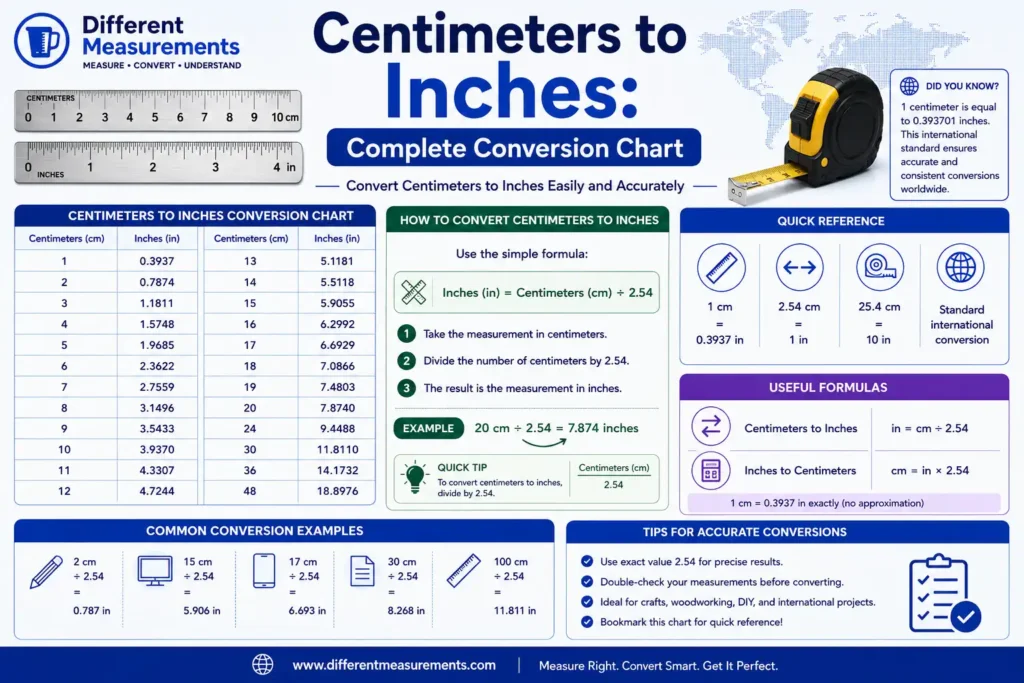
inches = centimeters ÷ 2.54
Or written more simply:
in = cm ÷ 2.54
Here, the centimeter value is divided by 2.54, since 2.54 is the exact number of centimeters in one inch. The result gives the equivalent length in inches, which can then be rounded to the level of precision needed.
Example: 10 cm ÷ 2.54 ≈ 3.937 inches
How to Convert Centimeters to Inches
Converting centimeters to inches follows a simple, repeatable process:
- Start with the measurement in centimeters.
- Divide the value by 2.54.
- Round the result if necessary, based on the precision you need.
- Add the unit “inches” to the final answer.
Example: Convert 25 cm to inches.
25 ÷ 2.54 ≈ 9.8425 inches
Rounded to two decimal places:
25 cm ≈ 9.84 inches
Complete Centimeters to Inches Conversion Chart (1 cm to 100 cm)
Below is a complete, accurate reference chart converting every centimeter value from 1 to 100 into inches, calculated using inches = centimeters ÷ 2.54.
| Centimeters | Inches | Centimeters | Inches |
|---|---|---|---|
| 1 cm | 0.3937 in | 51 cm | 20.0787 in |
| 2 cm | 0.7874 in | 52 cm | 20.4724 in |
| 3 cm | 1.1811 in | 53 cm | 20.8661 in |
| 4 cm | 1.5748 in | 54 cm | 21.2598 in |
| 5 cm | 1.9685 in | 55 cm | 21.6535 in |
| 6 cm | 2.3622 in | 56 cm | 22.0472 in |
| 7 cm | 2.7559 in | 57 cm | 22.4409 in |
| 8 cm | 3.1496 in | 58 cm | 22.8346 in |
| 9 cm | 3.5433 in | 59 cm | 23.2283 in |
| 10 cm | 3.9370 in | 60 cm | 23.6220 in |
| 11 cm | 4.3307 in | 61 cm | 24.0157 in |
| 12 cm | 4.7244 in | 62 cm | 24.4094 in |
| 13 cm | 5.1181 in | 63 cm | 24.8031 in |
| 14 cm | 5.5118 in | 64 cm | 25.1969 in |
| 15 cm | 5.9055 in | 65 cm | 25.5906 in |
| 16 cm | 6.2992 in | 66 cm | 25.9843 in |
| 17 cm | 6.6929 in | 67 cm | 26.3780 in |
| 18 cm | 7.0866 in | 68 cm | 26.7717 in |
| 19 cm | 7.4803 in | 69 cm | 27.1654 in |
| 20 cm | 7.8740 in | 70 cm | 27.5591 in |
| 21 cm | 8.2677 in | 71 cm | 27.9528 in |
| 22 cm | 8.6614 in | 72 cm | 28.3465 in |
| 23 cm | 9.0551 in | 73 cm | 28.7402 in |
| 24 cm | 9.4488 in | 74 cm | 29.1339 in |
| 25 cm | 9.8425 in | 75 cm | 29.5276 in |
| 26 cm | 10.2362 in | 76 cm | 29.9213 in |
| 27 cm | 10.6299 in | 77 cm | 30.3150 in |
| 28 cm | 11.0236 in | 78 cm | 30.7087 in |
| 29 cm | 11.4173 in | 79 cm | 31.1024 in |
| 30 cm | 11.8110 in | 80 cm | 31.4961 in |
| 31 cm | 12.2047 in | 81 cm | 31.8898 in |
| 32 cm | 12.5984 in | 82 cm | 32.2835 in |
| 33 cm | 12.9921 in | 83 cm | 32.6772 in |
| 34 cm | 13.3858 in | 84 cm | 33.0709 in |
| 35 cm | 13.7795 in | 85 cm | 33.4646 in |
| 36 cm | 14.1732 in | 86 cm | 33.8583 in |
| 37 cm | 14.5669 in | 87 cm | 34.2520 in |
| 38 cm | 14.9606 in | 88 cm | 34.6457 in |
| 39 cm | 15.3543 in | 89 cm | 35.0394 in |
| 40 cm | 15.7480 in | 90 cm | 35.4331 in |
| 41 cm | 16.1417 in | 91 cm | 35.8268 in |
| 42 cm | 16.5354 in | 92 cm | 36.2205 in |
| 43 cm | 16.9291 in | 93 cm | 36.6142 in |
| 44 cm | 17.3228 in | 94 cm | 37.0079 in |
| 45 cm | 17.7165 in | 95 cm | 37.4016 in |
| 46 cm | 18.1102 in | 96 cm | 37.7953 in |
| 47 cm | 18.5039 in | 97 cm | 38.1890 in |
| 48 cm | 18.8976 in | 98 cm | 38.5827 in |
| 49 cm | 19.2913 in | 99 cm | 38.9764 in |
| 50 cm | 19.6850 in | 100 cm | 39.3701 in |
Common Centimeters to Inches Conversion Chart
For quick reference, here are the most commonly searched centimeter-to-inch conversions:
| Centimeters | Inches |
|---|---|
| 1 cm | 0.3937 in |
| 2 cm | 0.7874 in |
| 5 cm | 1.9685 in |
| 10 cm | 3.9370 in |
| 15 cm | 5.9055 in |
| 20 cm | 7.8740 in |
| 25 cm | 9.8425 in |
| 30 cm | 11.8110 in |
| 40 cm | 15.7480 in |
| 50 cm | 19.6850 in |
| 60 cm | 23.6220 in |
| 70 cm | 27.5591 in |
| 80 cm | 31.4961 in |
| 90 cm | 35.4331 in |
| 100 cm | 39.3701 in |
| 120 cm | 47.2441 in |
| 150 cm | 59.0551 in |
| 160 cm | 62.9921 in |
| 170 cm | 66.9291 in |
| 175 cm | 68.8976 in |
| 180 cm | 70.8661 in |
| 190 cm | 74.8031 in |
| 200 cm | 78.7402 in |
Common Centimeter to Inch Conversions
1 cm to Inches
1 ÷ 2.54 ≈ 0.3937 inches
5 cm to Inches
5 ÷ 2.54 ≈ 1.9685 inches
10 cm to Inches
10 ÷ 2.54 ≈ 3.9370 inches
20 cm to Inches
20 ÷ 2.54 ≈ 7.8740 inches
25 cm to Inches
25 ÷ 2.54 ≈ 9.8425 inches
30 cm to Inches
30 ÷ 2.54 ≈ 11.8110 inches
50 cm to Inches
50 ÷ 2.54 ≈ 19.6850 inches
100 cm to Inches
100 ÷ 2.54 ≈ 39.3701 inches
Decimal Centimeters to Inches
Decimal centimeter values convert the same way as whole numbers, using the same formula:
inches = centimeters ÷ 2.54
| Centimeters | Inches |
|---|---|
| 2.5 cm | 0.9843 in |
| 5.5 cm | 2.1654 in |
| 7.5 cm | 2.9528 in |
| 10.5 cm | 4.1339 in |
| 12.5 cm | 4.9213 in |
| 15.5 cm | 6.1024 in |
| 25.5 cm | 10.0394 in |
Example: 7.5 cm ÷ 2.54 ≈ 2.9528 inches
Centimeters to Inches With Fractions
Inch measurements are often expressed as fractions rather than decimals, especially on rulers and measuring tapes. Some centimeter values convert to exact, whole fractional inches:
- 2.54 cm = 1 inch
- 5.08 cm = 2 inches
- 6.35 cm = 2.5 inches = 2 1/2 inches
- 12.7 cm = 5 inches
For most other centimeter measurements, the decimal inch result must be rounded to the nearest common fraction, such as 1/2, 1/4, 1/8, or 1/16 of an inch. For example, a decimal result of 2.95 inches is close to 3 inches, but on a ruler it would typically be rounded to the nearest 1/16 inch mark, which would be approximately 2 15/16 inches.
These fractional results are approximations unless the original decimal value already corresponds to an exact fraction. Always label a rounded fraction as approximate rather than exact.
Centimeters to Inches for Human Height
Height is one of the most common reasons people convert centimeters to inches. The process uses the same formula, and the result in inches can then be broken down into feet and remaining inches.
Example: Convert 170 cm to feet and inches.
170 ÷ 2.54 ≈ 66.93 inches
Since 1 foot = 12 inches, divide 66.93 by 12:
66.93 ÷ 12 ≈ 5 feet, with a remainder of 6.93 inches
So 170 cm is approximately 5 feet 6.93 inches.
| Height in cm | Approx. inches | Approx. feet and inches |
|---|---|---|
| 160 cm | 62.99 in | 5 ft 2.99 in |
| 165 cm | 64.96 in | 5 ft 4.96 in |
| 170 cm | 66.93 in | 5 ft 6.93 in |
| 175 cm | 68.90 in | 5 ft 8.90 in |
| 180 cm | 70.87 in | 5 ft 10.87 in |
| 185 cm | 72.83 in | 6 ft 0.83 in |
| 190 cm | 74.80 in | 6 ft 2.80 in |
Important: The feet-and-inches figures above are not decimal feet. For example, 170 cm converts to 5 feet and 6.93 inches, not 5.6.93 feet. The number after “ft” refers to the remaining inches, not a decimal fraction of a foot.
Centimeters to Inches for Screen Sizes
Screen sizes, such as those for TVs, monitors, and phones, are measured diagonally from one corner of the screen to the opposite corner, not by width or height. When a screen size is given in centimeters, the converted inch value also represents this diagonal measurement only.
| Screen size (cm) | Approx. diagonal (inches) |
|---|---|
| 10 cm | 3.94 in |
| 15 cm | 5.91 in |
| 20 cm | 7.87 in |
| 25 cm | 9.84 in |
| 30 cm | 11.81 in |
| 32 cm | 12.60 in |
| 40 cm | 15.75 in |
| 50 cm | 19.69 in |
| 55 cm | 21.65 in |
| 60 cm | 23.62 in |
| 65 cm | 25.59 in |
| 75 cm | 29.53 in |
| 100 cm | 39.37 in |
| 120 cm | 47.24 in |
| 140 cm | 55.12 in |
| 150 cm | 59.06 in |
| 165 cm | 64.96 in |
| 190 cm | 74.80 in |
These values describe diagonal screen measurements only. They should not be used to estimate the actual width or height of a screen, since aspect ratio affects those dimensions separately.
Centimeters to Inches for Everyday Measurements
Converting centimeters to inches is useful in many everyday situations, including:
- Clothing measurements, such as sleeve length, waist size, or inseam
- Product dimensions for items purchased online from metric or US retailers
- Packaging and shipping, where box dimensions may be listed differently by region
- Furniture, when checking whether a piece will fit through a doorway or into a room
- Crafts and sewing, where patterns may use either unit
- DIY and home improvement projects involving materials cut to specific lengths
- Manufacturing and engineering, where tolerances often require precise unit conversion
- Construction, especially when working with international blueprints
- School projects, where students may need to convert between metric and US customary units
- Screen sizes, as covered above
- Human height, as covered above
Centimeters vs Inches
| Feature | Centimeter | Inch |
|---|---|---|
| Symbol | cm | in |
| Measurement system | Metric | US customary / Imperial context |
| Relationship | 1 cm ≈ 0.3937 in | 1 in = 2.54 cm |
| Common uses | Metric measurements, most countries worldwide | US product dimensions and everyday measurements |
The modern inch is defined identically within both the US customary system and the Imperial system, meaning it has the same exact length of 2.54 centimeters in either context.
Centimeters to Inches vs Inches to Centimeters
Converting between centimeters and inches works in two directions, and it is easy to mix them up if you are not careful about which way you are converting.
Centimeters to inches:
inches = centimeters ÷ 2.54
Inches to centimeters:
centimeters = inches × 2.54
| Conversion direction | Formula | Example |
|---|---|---|
| cm to inches | in = cm ÷ 2.54 | 10 cm ÷ 2.54 ≈ 3.94 in |
| inches to cm | cm = in × 2.54 | 10 in × 2.54 = 25.4 cm |
Reverse Conversion: Inches to Centimeters
Since centimeters to inches and inches to centimeters are inverse operations, it is useful to know the reverse formula as well:
centimeters = inches × 2.54
Example: Convert 10 inches to centimeters.
10 × 2.54 = 25.4 cm
Why Is 1 Inch Equal to 2.54 Centimeters?
The international inch is defined exactly as 2.54 centimeters. This definition was standardized so that the inch, used in US customary and Imperial measurements, aligns precisely with the metric system, making conversions between the two consistent and exact rather than approximate.
Rounding Centimeter to Inch Conversions
When you divide centimeters by 2.54, the result often includes many decimal places. For example:
10 cm = 3.937007874… inches
Depending on how the result will be used, it is common to round it:
3.937007874… inches rounds to 3.94 inches
Different situations call for different levels of precision:
- 1 decimal place is often enough for general, everyday use.
- 2 decimal places work well for most practical measurements, such as clothing or product dimensions.
- More decimal places are appropriate for technical, engineering, or scientific calculations where accuracy matters more.
When performing multi-step calculations, avoid rounding too early, since rounding intermediate results can introduce small errors that grow larger through subsequent steps. Round only at the final step.
Centimeters to Inches Conversion Examples
Example 1
Convert 5 cm to inches. 5 ÷ 2.54 ≈ 1.9685 inches
Example 2
Convert 10 cm to inches. 10 ÷ 2.54 ≈ 3.9370 inches
Example 3
Convert 15 cm to inches. 15 ÷ 2.54 ≈ 5.9055 inches
Example 4
Convert 20 cm to inches. 20 ÷ 2.54 ≈ 7.8740 inches
Example 5
Convert 25 cm to inches. 25 ÷ 2.54 ≈ 9.8425 inches
Example 6
Convert 50 cm to inches. 50 ÷ 2.54 ≈ 19.6850 inches
Example 7
Convert 100 cm to inches. 100 ÷ 2.54 ≈ 39.3701 inches
Example 8
Convert 175 cm to inches. 175 ÷ 2.54 ≈ 68.8976 inches
Common Centimeter to Inch Conversion Mistakes
- Multiplying by 2.54 instead of dividing. Multiplying converts inches to centimeters, not the other way around. Centimeters to inches always requires division.
- Using 2.5 instead of 2.54. Rounding the conversion factor itself introduces unnecessary error, especially over larger measurements.
- Forgetting the unit. A number without “in” or “cm” attached can easily be misread or misapplied.
- Rounding too early in multi-step calculations. This can compound small errors into larger inaccuracies.
- Confusing centimeters with millimeters. There are 10 millimeters in 1 centimeter, so mixing these up leads to results that are off by a factor of 10.
- Confusing inches with feet. Since 12 inches equal 1 foot, forgetting this relationship can cause height and length errors.
- Confusing decimal inches with feet-and-inches notation. A value like 5 ft 6.93 in is not the same as 5.6.93 feet or 5.69 feet.
- Treating a screen’s diagonal size as its width. Screen sizes measured in inches or centimeters refer to the diagonal, not the width or height.
- Using a rounded conversion factor when exact precision is required. For technical work, always use the full formula with 2.54 rather than a shortcut approximation.
Common Questions About Centimeters to Inches
1 centimeter is equal to approximately 0.3937 inches. This comes from dividing 1 by 2.54, since 1 inch equals exactly 2.54 centimeters.
Divide the number of centimeters by 2.54. The result is the equivalent measurement in inches.
The formula is inches = centimeters ÷ 2.54.
5 cm is approximately 1.9685 inches.
10 cm is approximately 3.9370 inches.
20 cm is approximately 7.8740 inches.
25 cm is approximately 9.8425 inches.
30 cm is approximately 11.8110 inches.
50 cm is approximately 19.6850 inches.
100 cm is approximately 39.3701 inches.
170 cm is approximately 66.93 inches, or about 5 feet 6.93 inches.
180 cm is approximately 70.87 inches, or about 5 feet 10.87 inches.
1 inch equals exactly 2.54 centimeters.
1 cm is approximately equal to 0.39 inches when rounded to two decimal places. The more precise value is 0.3937007874 inches.
First convert centimeters to total inches by dividing by 2.54. Then divide the total inches by 12 to get the whole number of feet, and use the remainder as the leftover inches.