Volume is one of the most frequently used measurements in daily life, from cooking a recipe to filling a fuel tank to shipping a package. Despite how common it is, many people are unsure how volume differs from capacity, which units apply where, and why a US gallon is not the same as an Imperial gallon.
This guide breaks down what volume measurement actually means, the units used across the metric, US customary, and Imperial systems, how volume is measured for different types of objects, and how to convert between the units you are most likely to encounter. Volume is one of several types of measurement, closely related to length measurement and area, since volume is built from three linear dimensions multiplied together.
Quick answer: Volume measurement is the process of determining how much three-dimensional space an object or substance occupies. It is expressed in cubic units, such as cubic meters or cubic centimeters, or in liquid volume units, such as liters and gallons, depending on whether a solid or a liquid is being measured.
What Is Volume Measurement?
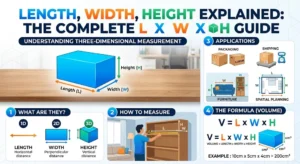
Volume describes the amount of three-dimensional space that an object or substance takes up. Unlike length, which measures a single dimension, or area, which measures two dimensions, volume accounts for three dimensions at once: length, width, and height.
To see the difference clearly:
- Length measures distance in one dimension, such as the length of a table.
- Area measures the size of a two-dimensional surface, such as the floor space of a room.
- Volume measures the three-dimensional space enclosed by an object, such as how much air fills that same room.
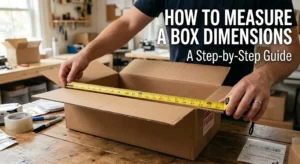
A simple example: a box that is 2 meters long, 1 meter wide, and 1 meter tall does not just have a length or a floor area. It also encloses a specific amount of space, calculated by multiplying all three dimensions together. That result is the box’s volume.
Volume vs Capacity
Volume and capacity are closely related but not always identical in meaning, and the distinction matters more in technical contexts than in casual conversation.
- Volume generally refers to the amount of space that an object or substance occupies, whether solid, liquid, or gas.
- Capacity commonly refers to how much a container can hold, particularly for liquids or pourable substances.
In everyday language, the two terms are frequently used interchangeably. Saying a bottle has a “volume of 1 liter” and saying it has a “capacity of 1 liter” both communicate essentially the same idea to most readers.
Practical examples where the distinction becomes useful:
- A bottle has a capacity that tells you how much liquid it can hold, while the glass itself also has its own material volume.
- A cup used in cooking measures capacity, since it defines how much liquid or dry ingredient fits inside.
- A storage tank is described by its capacity when discussing how much fuel or water it can contain.
- A box has a volume that reflects its total three-dimensional size, which also often defines the maximum capacity available for packing.
For most everyday and commercial purposes, using “volume” and “capacity” interchangeably causes no confusion, but understanding the subtle difference helps when precision matters, such as in engineering or manufacturing specifications.
Common Volume Units
Volume units generally fall into two broad categories:
- Cubic units, based on length measurements raised to the third power, such as cubic meters or cubic feet, typically used for solids and large spaces.
- Liquid volume units, such as liters and gallons, typically used for fluids and pourable substances.
These units are further organized across four systems: metric units, SI units, US customary units, and Imperial units, the same systems explained in detail in our guide to metric, Imperial, and US customary units. Each system has its own conventions, and some units share the same name but represent different quantities depending on the system.
Metric Volume Units
The metric system uses two related sets of volume units: cubic units and liquid volume units, which are directly connected to each other.
Cubic units:
- Cubic millimeter (mm³): Used for very small measurements, such as tiny mechanical parts.
- Cubic centimeter (cm³): Common in science, medicine, and small object measurement.
- Cubic meter (m³): The standard unit for larger volumes, such as rooms, containers, and construction materials.
- Cubic kilometer (km³): Used for extremely large volumes, such as bodies of water or geological measurements.
Liquid volume units:
- Milliliter (mL): Common for small liquid quantities, such as medicine doses or cooking ingredients.
- Liter (L): The most widely used everyday liquid volume unit, used for beverages, fuel, and household liquids.
- Kiloliter (kL): Used for large liquid volumes, such as industrial or municipal water storage.
The metric system’s strength is that these units connect cleanly:
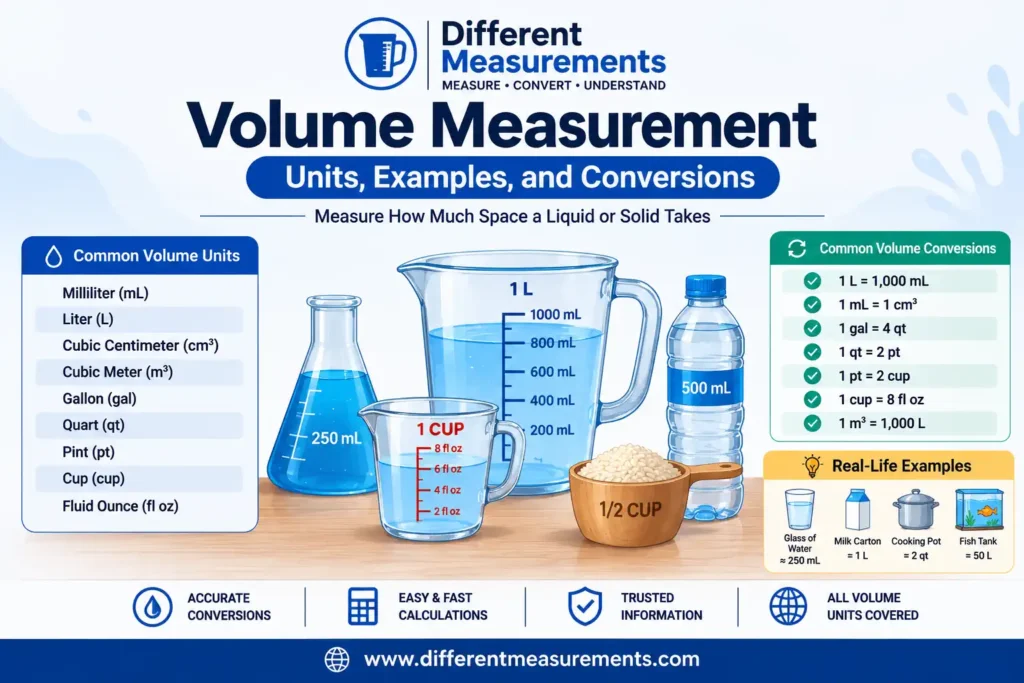
- 1 liter = 1,000 milliliters
- 1 cubic centimeter = 1 milliliter
- 1 cubic meter = 1,000 liters
These relationships make the metric system especially convenient for volume conversions, since everything scales by powers of ten.
SI Units for Volume
Within the International System of Units, the officially designated derived unit for volume is the cubic meter (m³). All other metric volume units, including the liter, are considered accepted units for use alongside SI rather than official SI base or derived units.
The liter remains extremely popular in daily use because cubic meters are inconveniently large for most everyday liquid measurements. A liter, defined as exactly one-thousandth of a cubic meter, offers a more practical scale for beverages, cooking, and household products, which is why it dominates everyday liquid measurement despite the cubic meter being the technical SI unit.
US Customary Volume Units
The US customary system uses a distinct set of volume units, most commonly encountered in cooking, beverages, and everyday liquid measurement in the United States.
- Fluid ounce (fl oz): A small volume unit commonly used for beverages and liquid medicine.
- Cup: A standard cooking measurement, widely used in US recipes.
- Pint: Commonly used for beverages, particularly in bars and packaged drinks.
- Quart: Used for larger liquid quantities, such as motor oil or food storage.
- Gallon: The largest common US customary volume unit, used for fuel, milk, and large liquid containers.
Important distinction: The fluid ounce measures volume, while the ordinary ounce measures mass. These are different physical quantities that happen to share a name, and confusing them can lead to significant measurement errors, particularly in cooking and shipping.
Imperial Volume Units
The Imperial system, historically used in the United Kingdom and other Commonwealth countries, includes its own set of volume units that share names with US customary units but represent different quantities.
- Imperial fluid ounce: Slightly smaller than a US fluid ounce.
- Imperial pint: Larger than a US pint.
- Imperial quart: Larger than a US quart.
- Imperial gallon: Notably larger than a US gallon.
It is important not to treat US customary and Imperial volume units as identical. Although the unit names match, the actual quantities they represent are different, which can cause real-world errors in recipes, fuel calculations, and product specifications if the wrong system is assumed.
US Customary vs Imperial Volume Units
| Unit | US Customary | Imperial |
| Fluid ounce | ≈ 29.57 mL | ≈ 28.41 mL |
| Pint | ≈ 473.18 mL | ≈ 568.26 mL |
| Quart | ≈ 946.35 mL | ≈ 1,136.52 mL |
| Gallon | ≈ 3.785 liters | ≈ 4.546 liters |
This is why converting a recipe or fuel measurement between a US source and a UK or Canadian source can produce noticeably different results if the correct system is not identified first. Always confirm whether a source is using US customary or Imperial volume units before converting.
How Is Volume Measured?
The method used to measure volume depends heavily on whether the object is a regular solid, an irregular solid, or a liquid.
Regular Solid Objects
For objects with well-defined geometric shapes, volume can be calculated directly using their dimensions and a known formula. Common examples include rectangular boxes, cubes, and cylinders, each covered in more detail in the formulas section below.
Irregular Solid Objects
For objects without a clean geometric shape, such as a rock or an oddly shaped tool, volume is typically determined using water displacement. The object is submerged in a container of water with a known starting volume, and the increase in water level corresponds directly to the object’s volume. This method works because the object displaces a volume of water exactly equal to its own volume.
Liquids
Liquid volume is measured using tools designed to hold and read fluid quantities accurately:
- Measuring cups: Common in kitchens for approximate liquid measurement.
- Graduated cylinders: Used in laboratories for more precise liquid measurement, with fine gradations along the side.
- Beakers: Useful for general laboratory measurement, though less precise than graduated cylinders.
- Measuring jugs: Practical for larger liquid quantities in both kitchen and industrial settings.
- Volumetric flasks: Designed for extremely precise measurement of a single specific volume, often used in chemistry.
Laboratory work generally demands far greater precision than household measurement, which is why scientific settings rely on graduated cylinders and volumetric flasks rather than standard measuring cups.
Volume Formulas
Different shapes require different formulas to calculate volume accurately.
Rectangular Prism
Volume = length × width × height
Used for boxes, rooms, containers, and any object with six rectangular faces.
Cube
Volume = side × side × side
Used for objects where all three dimensions are equal, such as a cube-shaped storage box.
Cylinder
Volume = π × radius² × height
Used for cylindrical objects such as pipes, cans, and storage tanks. The radius refers to half the diameter of the circular base, and π is approximately 3.14159.
Other shapes, such as spheres, cones, and irregular solids, require their own specific formulas or measurement techniques, but the three formulas above cover the most common everyday volume calculations.
Real-World Volume Measurement Examples
- Volume of a box: A moving box measuring 60 cm long, 40 cm wide, and 30 cm tall has a volume of 60 × 40 × 30 = 72,000 cm³, or 72 liters.
- Volume of a room: A room measuring 5 meters long, 4 meters wide, and 2.5 meters high has a volume of 5 × 4 × 2.5 = 50 cubic meters.
- Volume of a water bottle: Standard water bottles are commonly labeled at 500 mL or 1 liter, representing their liquid capacity.
- Volume of a swimming pool: A rectangular pool 10 meters long, 5 meters wide, and 1.5 meters deep holds 10 × 5 × 1.5 = 75 cubic meters of water.
- Volume of a storage tank: A cylindrical tank with a 1-meter radius and 3-meter height holds approximately π × 1² × 3 ≈ 9.42 cubic meters.
- Volume of a shipping package: Shipping companies calculate package volume using length × width × height to determine dimensional weight and shipping costs.
- Volume of an irregular object: A small irregularly shaped stone can have its volume determined by measuring how much water it displaces when submerged.
Volume Conversions
Volume conversions fall into two categories: conversions within the metric system, which are straightforward due to the base-ten structure, and conversions between metric and US customary or Imperial systems, which require specific conversion factors. The core principles follow the same logic covered in our complete guide to measurement conversions.
Within the metric system, moving between milliliters, liters, and cubic meters simply involves shifting a decimal point, since each unit relates to the others by a power of ten. Converting between metric and US customary or Imperial units requires multiplying by a fixed, non-round conversion factor, since these systems were not designed to align neatly with each other.
Using the correct conversion factor matters significantly in volume conversions, since even small errors compound quickly when working with cubic measurements.
Common Volume Conversions
- Milliliters to liters: Divide the milliliter value by 1,000.
- Liters to milliliters: Multiply the liter value by 1,000.
- Liters to gallons: Divide the liter value by approximately 3.785 for US gallons.
- Gallons to liters: Multiply the US gallon value by approximately 3.785.
- Cups to milliliters: Multiply the number of US cups by approximately 236.59.
- Milliliters to fluid ounces: Divide the milliliter value by approximately 29.57 for US fluid ounces.
- Cubic centimeters to milliliters: These are equal, so no conversion factor is needed.
- Cubic meters to liters: Multiply the cubic meter value by 1,000.
- Cubic feet to cubic meters: Multiply the cubic foot value by approximately 0.0283.
When working with gallons, pints, quarts, or fluid ounces, always confirm whether the US customary or Imperial version is intended, since using the wrong one introduces meaningful error.
Common Volume Conversion Factors
| Conversion | Value |
| 1 liter | 1,000 milliliters |
| 1 cubic meter | 1,000 liters |
| 1 cubic centimeter | 1 milliliter |
| 1 US gallon | ≈ 3.785 liters |
| 1 Imperial gallon | ≈ 4.546 liters |
| 1 US cup | ≈ 236.59 milliliters |
| 1 cubic foot | ≈ 0.0283 cubic meters |
How to Convert Volume Units Manually
- Identify the original value. Note the exact number you are starting with.
- Identify the original unit. Confirm whether it is metric, US customary, or Imperial.
- Identify the target unit. Determine what unit you need the result in.
- Find the correct conversion factor. Use a verified conversion factor between the original and target units.
- Multiply or divide as appropriate. Multiply when converting to a smaller unit, divide when converting to a larger unit.
- Check the result. Confirm the converted value makes logical sense relative to the original.
- Round only when appropriate. Keep extra decimal places for scientific work; round for everyday practical use.
Worked example 1: Convert 2 liters to milliliters. 2 liters × 1,000 = 2,000 milliliters.
Worked example 2: Convert 5 US gallons to liters. 5 gallons × 3.785 ≈ 18.93 liters.
Worked example 3: Convert 3 cubic meters to liters. 3 m³ × 1,000 = 3,000 liters.
Volume and Cubic Units
Volume units are often written with a superscript 3, such as cm³, m³, ft³, or in³. This notation reflects the fact that volume comes from multiplying three linear dimensions together: length × width × height.
This has an important consequence for conversions. Converting a linear length unit, such as meters to centimeters, only requires multiplying by 100. However, converting a cubic volume unit, such as cubic meters to cubic centimeters, requires multiplying by 100³, or 1,000,000, because all three dimensions are being scaled at once.
This is one of the most common sources of error in volume conversion. Applying a simple linear conversion factor to a cubic unit produces a result that is off by several orders of magnitude. Always confirm whether you are converting a linear unit or a cubic unit before applying a conversion factor.
Common Volume Measurement Mistakes
- Confusing volume with area: Area measures two dimensions, while volume measures three, and the two should never be used interchangeably.
- Confusing volume with capacity: While often interchangeable in casual use, volume technically refers to space occupied, while capacity refers to how much a container can hold.
- Confusing fluid ounces with ounces of mass: Fluid ounces measure volume, while regular ounces measure mass, and the two are not directly convertible without knowing the substance’s density.
- Mixing US and Imperial volume units: Using a US gallon conversion factor on an Imperial gallon value, or vice versa, produces a meaningfully incorrect result.
- Using the wrong conversion factor: Applying an outdated or incorrect factor leads to compounding errors, especially in larger-scale calculations.
- Forgetting cubic units: Failing to cube a linear conversion factor when converting cubic measurements is one of the most frequent volume conversion mistakes.
- Treating liters and cubic meters as unrelated units: These units are directly connected, with 1 cubic meter equal to exactly 1,000 liters.
- Rounding too early: Rounding intermediate values before completing a multi-step calculation can introduce unnecessary error into the final result.
- Using the wrong dimensions in a volume formula: Mixing up length, width, and height, or using a diameter instead of a radius in a cylinder formula, produces an incorrect volume.
Volume Measurement in Everyday Life
Volume measurement plays a role in nearly every industry and daily activity:
- Cooking: Recipes rely on cups, milliliters, and liters to specify ingredient quantities accurately.
- Food and beverages: Packaging labels list volume in milliliters, liters, fluid ounces, or gallons depending on the region.
- Medicine: Liquid medication doses are measured precisely in milliliters to ensure correct dosing.
- Science: Laboratories depend on graduated cylinders and volumetric flasks for accurate experimental measurements.
- Construction: Concrete, gravel, and other materials are often ordered by cubic meter or cubic yard volume.
- Manufacturing: Product design and packaging require precise volume calculations to fit components and materials.
- Shipping: Package volume determines dimensional weight, which affects shipping costs for many carriers.
- Storage: Warehouses and storage facilities plan space using cubic meter or cubic foot volume calculations.
- Fuel: Vehicles and machinery are fueled using gallons or liters, depending on regional measurement conventions.
- Water management: Reservoirs, water treatment plants, and municipal systems track water volume in liters, kiloliters, or cubic meters.
Common Questions About Volume Measurement
Volume measurement is the process of determining how much three-dimensional space an object or substance occupies, expressed in units such as cubic meters, liters, or gallons.
The SI derived unit of volume is the cubic meter (m³), though the liter is widely accepted and commonly used for everyday liquid measurement.
Volume generally refers to the space an object occupies, while capacity refers to how much a container can hold, though the two terms are often used interchangeably in everyday language.
There are 1,000 milliliters in one liter.
A US gallon contains approximately 3.785 liters, while an Imperial gallon contains approximately 4.546 liters.
A US cup contains approximately 236.59 milliliters.
Yes, 1 cubic centimeter is exactly equal to 1 milliliter.
Multiply the box’s length, width, and height together to find its volume.
Submerge the object in a container of water with a known volume and measure how much the water level rises, using the water displacement method.
A US gallon is smaller, at approximately 3.785 liters, while an Imperial gallon is larger, at approximately 4.546 liters.
A liter is technically a unit of volume, though it is very commonly used to describe the capacity of containers and bottles.
Multiply the cubic meter value by 1,000 to get the equivalent value in liters.
Volume measurement describes how much three-dimensional space an object or substance occupies, and it is expressed through cubic units for solids and liquid volume units for fluids. Understanding the difference between metric, US customary, and Imperial volume units, along with how to convert between them accurately, makes everyday tasks like cooking, shipping, and construction far easier to manage correctly.