Inches and feet are both units of length, and converting between them is one of the most common measurement tasks in everyday life. Since 12 inches make 1 foot, this conversion comes up constantly across a wide range of situations, including:
- Human height
- Construction projects
- Room dimensions
- Furniture sizing
- Product dimensions
- Manufacturing
- DIY projects
This guide covers the exact inches-to-feet conversion formula, a complete conversion chart, decimal feet, feet-and-inches notation, practical worked examples, and answers to the most common questions people have about this conversion.
How Many Inches Are in a Foot?
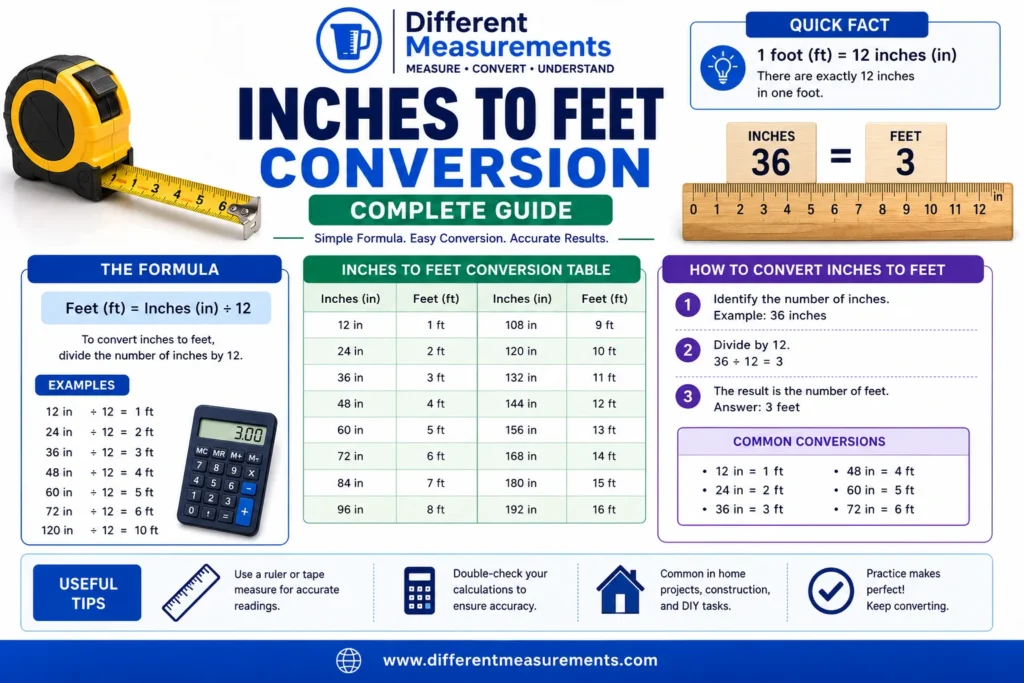
1 foot = 12 inches. Therefore, 12 inches equal exactly 1 foot. This is an exact conversion, not an approximation.
Working in the opposite direction:
1 inch = 1/12 foot = 0.083333… feet
This decimal value is a repeating decimal, meaning the “3” continues indefinitely. In practice, it is normally rounded when displayed, commonly to four decimal places (0.0833 ft) for reference charts or fewer decimal places for everyday use.
Inches to Feet Conversion Formula
The formula for converting inches to feet is:
feet = inches ÷ 12
or written with symbols:
ft = in ÷ 12
To convert a measurement from inches to feet, divide the number of inches by 12.
Example: Convert 36 inches to feet.
36 ÷ 12 = 3 feet
How to Convert Inches to Feet
Converting inches to feet follows a simple process:
- Start with the measurement in inches.
- Divide the number of inches by 12.
- Express the result in feet.
- Round the decimal result only when necessary, based on the precision required.
Example: Convert 48 inches to feet.
48 ÷ 12 = 4 feet
Example: Convert 30 inches to feet.
30 ÷ 12 = 2.5 feet
Note that 2.5 feet is equal to 2 feet 6 inches when expressed in traditional feet-and-inches notation, a distinction covered in more detail later in this guide.
Complete Inches to Feet Conversion Chart
The chart below shows every whole inch value from 1 to 120, converted to decimal feet and rounded to four decimal places.
| Inches | Feet | Inches | Feet |
|---|---|---|---|
| 1 in | 0.0833 ft | 61 in | 5.0833 ft |
| 2 in | 0.1667 ft | 62 in | 5.1667 ft |
| 3 in | 0.2500 ft | 63 in | 5.2500 ft |
| 4 in | 0.3333 ft | 64 in | 5.3333 ft |
| 5 in | 0.4167 ft | 65 in | 5.4167 ft |
| 6 in | 0.5000 ft | 66 in | 5.5000 ft |
| 7 in | 0.5833 ft | 67 in | 5.5833 ft |
| 8 in | 0.6667 ft | 68 in | 5.6667 ft |
| 9 in | 0.7500 ft | 69 in | 5.7500 ft |
| 10 in | 0.8333 ft | 70 in | 5.8333 ft |
| 11 in | 0.9167 ft | 71 in | 5.9167 ft |
| 12 in | 1.0000 ft | 72 in | 6.0000 ft |
| 13 in | 1.0833 ft | 73 in | 6.0833 ft |
| 14 in | 1.1667 ft | 74 in | 6.1667 ft |
| 15 in | 1.2500 ft | 75 in | 6.2500 ft |
| 16 in | 1.3333 ft | 76 in | 6.3333 ft |
| 17 in | 1.4167 ft | 77 in | 6.4167 ft |
| 18 in | 1.5000 ft | 78 in | 6.5000 ft |
| 19 in | 1.5833 ft | 79 in | 6.5833 ft |
| 20 in | 1.6667 ft | 80 in | 6.6667 ft |
| 21 in | 1.7500 ft | 81 in | 6.7500 ft |
| 22 in | 1.8333 ft | 82 in | 6.8333 ft |
| 23 in | 1.9167 ft | 83 in | 6.9167 ft |
| 24 in | 2.0000 ft | 84 in | 7.0000 ft |
| 25 in | 2.0833 ft | 85 in | 7.0833 ft |
| 26 in | 2.1667 ft | 86 in | 7.1667 ft |
| 27 in | 2.2500 ft | 87 in | 7.2500 ft |
| 28 in | 2.3333 ft | 88 in | 7.3333 ft |
| 29 in | 2.4167 ft | 89 in | 7.4167 ft |
| 30 in | 2.5000 ft | 90 in | 7.5000 ft |
| 31 in | 2.5833 ft | 91 in | 7.5833 ft |
| 32 in | 2.6667 ft | 92 in | 7.6667 ft |
| 33 in | 2.7500 ft | 93 in | 7.7500 ft |
| 34 in | 2.8333 ft | 94 in | 7.8333 ft |
| 35 in | 2.9167 ft | 95 in | 7.9167 ft |
| 36 in | 3.0000 ft | 96 in | 8.0000 ft |
| 37 in | 3.0833 ft | 97 in | 8.0833 ft |
| 38 in | 3.1667 ft | 98 in | 8.1667 ft |
| 39 in | 3.2500 ft | 99 in | 8.2500 ft |
| 40 in | 3.3333 ft | 100 in | 8.3333 ft |
| 41 in | 3.4167 ft | 101 in | 8.4167 ft |
| 42 in | 3.5000 ft | 102 in | 8.5000 ft |
| 43 in | 3.5833 ft | 103 in | 8.5833 ft |
| 44 in | 3.6667 ft | 104 in | 8.6667 ft |
| 45 in | 3.7500 ft | 105 in | 8.7500 ft |
| 46 in | 3.8333 ft | 106 in | 8.8333 ft |
| 47 in | 3.9167 ft | 107 in | 8.9167 ft |
| 48 in | 4.0000 ft | 108 in | 9.0000 ft |
| 49 in | 4.0833 ft | 109 in | 9.0833 ft |
| 50 in | 4.1667 ft | 110 in | 9.1667 ft |
| 51 in | 4.2500 ft | 111 in | 9.2500 ft |
| 52 in | 4.3333 ft | 112 in | 9.3333 ft |
| 53 in | 4.4167 ft | 113 in | 9.4167 ft |
| 54 in | 4.5000 ft | 114 in | 9.5000 ft |
| 55 in | 4.5833 ft | 115 in | 9.5833 ft |
| 56 in | 4.6667 ft | 116 in | 9.6667 ft |
| 57 in | 4.7500 ft | 117 in | 9.7500 ft |
| 58 in | 4.8333 ft | 118 in | 9.8333 ft |
| 59 in | 4.9167 ft | 119 in | 9.9167 ft |
| 60 in | 5.0000 ft | 120 in | 10.0000 ft |
Quick Inches to Feet Conversion Chart
For fast reference, here are the most commonly searched inch-to-foot conversions, shown in both decimal feet and feet-and-inches notation.
| Inches | Decimal Feet | Feet and Inches |
|---|---|---|
| 1 in | 0.0833 ft | 0 ft 1 in |
| 2 in | 0.1667 ft | 0 ft 2 in |
| 3 in | 0.2500 ft | 0 ft 3 in |
| 4 in | 0.3333 ft | 0 ft 4 in |
| 6 in | 0.5000 ft | 0 ft 6 in |
| 8 in | 0.6667 ft | 0 ft 8 in |
| 10 in | 0.8333 ft | 0 ft 10 in |
| 12 in | 1.0000 ft | 1 ft 0 in |
| 18 in | 1.5000 ft | 1 ft 6 in |
| 24 in | 2.0000 ft | 2 ft 0 in |
| 30 in | 2.5000 ft | 2 ft 6 in |
| 36 in | 3.0000 ft | 3 ft 0 in |
| 40 in | 3.3333 ft | 3 ft 4 in |
| 48 in | 4.0000 ft | 4 ft 0 in |
| 50 in | 4.1667 ft | 4 ft 2 in |
| 60 in | 5.0000 ft | 5 ft 0 in |
| 72 in | 6.0000 ft | 6 ft 0 in |
| 84 in | 7.0000 ft | 7 ft 0 in |
| 96 in | 8.0000 ft | 8 ft 0 in |
| 108 in | 9.0000 ft | 9 ft 0 in |
| 120 in | 10.0000 ft | 10 ft 0 in |
Common Inches to Feet Conversions
1 Inch to Feet
1 ÷ 12 ≈ 0.0833 feet
6 Inches to Feet
6 ÷ 12 = 0.5 feet
12 Inches to Feet
12 ÷ 12 = 1 foot
18 Inches to Feet
18 ÷ 12 = 1.5 feet
24 Inches to Feet
24 ÷ 12 = 2 feet
30 Inches to Feet
30 ÷ 12 = 2.5 feet
36 Inches to Feet
36 ÷ 12 = 3 feet
48 Inches to Feet
48 ÷ 12 = 4 feet
60 Inches to Feet
60 ÷ 12 = 5 feet
72 Inches to Feet
72 ÷ 12 = 6 feet
Inches to Decimal Feet
Dividing inches by 12 produces a measurement in decimal feet, which is often useful for technical and calculation-based work.
Formula: decimal feet = inches ÷ 12
| Inches | Decimal Feet |
|---|---|
| 6 in | 0.5 ft |
| 9 in | 0.75 ft |
| 15 in | 1.25 ft |
| 18 in | 1.5 ft |
| 21 in | 1.75 ft |
| 30 in | 2.5 ft |
| 42 in | 3.5 ft |
| 54 in | 4.5 ft |
Decimal feet are commonly used in construction, engineering, surveying, and other technical calculations, where a single continuous decimal value is often easier to work with in formulas than a mixed feet-and-inches format.
Inches to Feet and Inches
While decimal feet are useful for calculations, many everyday situations call for the traditional feet-and-inches format instead. For example:
30 inches = 2.5 feet
But in feet-and-inches format:
30 inches = 2 ft 6 in
Converting to this format involves a slightly different process:
- Divide the total inches by 12.
- The whole-number portion of the result is the feet.
- The remainder represents the additional inches.
Example: Convert 30 inches to feet and inches.
30 ÷ 12 = 2 remainder 6
Therefore:
30 inches = 2 ft 6 in
Examples of Inches to Feet and Inches
17 Inches
17 ÷ 12 = 1 remainder 5
17 inches = 1 ft 5 in
25 Inches
25 ÷ 12 = 2 remainder 1
25 inches = 2 ft 1 in
35 Inches
35 ÷ 12 = 2 remainder 11
35 inches = 2 ft 11 in
50 Inches
50 ÷ 12 = 4 remainder 2
50 inches = 4 ft 2 in
65 Inches
65 ÷ 12 = 5 remainder 5
65 inches = 5 ft 5 in
70 Inches
70 ÷ 12 = 5 remainder 10
70 inches = 5 ft 10 in
83 Inches
83 ÷ 12 = 6 remainder 11
83 inches = 6 ft 11 in
Inches to Feet for Human Height
Height measurements are very often recorded and communicated in feet and inches rather than decimal feet or a single inch value. Common examples include:
- 60 inches = 5 ft 0 in
- 62 inches = 5 ft 2 in
- 64 inches = 5 ft 4 in
- 66 inches = 5 ft 6 in
- 68 inches = 5 ft 8 in
- 70 inches = 5 ft 10 in
- 72 inches = 6 ft 0 in
- 74 inches = 6 ft 2 in
- 76 inches = 6 ft 4 in
| Height in Inches | Feet and Inches | Decimal Feet |
|---|---|---|
| 60 in | 5 ft 0 in | 5.00 ft |
| 62 in | 5 ft 2 in | 5.17 ft |
| 64 in | 5 ft 4 in | 5.33 ft |
| 66 in | 5 ft 6 in | 5.50 ft |
| 68 in | 5 ft 8 in | 5.67 ft |
| 70 in | 5 ft 10 in | 5.83 ft |
| 72 in | 6 ft 0 in | 6.00 ft |
Note that the decimal feet values here are rounded to two decimal places for readability.
Inches to Feet for Construction and Dimensions
Converting inches to feet is especially useful in construction and building contexts, where larger measurements are typically easier to work with in feet rather than a long inch value. Common applications include:
- Room dimensions
- Wall height
- Door dimensions
- Ceiling height
- Lumber
- Pipes
- Furniture
- Building materials
- Product dimensions
Examples:
96 inches = 8 feet
120 inches = 10 feet
144 inches = 12 feet
Converting inches into feet makes larger measurements much easier to visualize and communicate, particularly when discussing dimensions like room size or wall height, where expressing the value purely in inches would be unwieldy.
Inches to Feet for Product Dimensions
Product dimensions are frequently listed in inches, but converting to feet can make larger items easier to understand at a glance.
Examples:
- A 36-inch table = 3 feet
- A 48-inch panel = 4 feet
- A 60-inch item = 5 feet
- A 72-inch item = 6 feet
Keep in mind that a product’s full dimensions typically include length, width, and height, and each of these values should be converted separately when comparing products or checking whether an item fits a given space.
Inches to Feet With Fractions
Some measurements include fractional inches rather than whole numbers. Common examples include:
- 6 1/2 inches
- 10 1/4 inches
- 15 3/4 inches
- 24 1/2 inches
To convert these, first express the fractional inch value as a decimal, then divide by 12.
Example: Convert 6.5 inches to feet.
6.5 ÷ 12 ≈ 0.5417 ft
Example: Convert 10.25 inches to feet.
10.25 ÷ 12 ≈ 0.8542 ft
Example: Convert 15.75 inches to feet.
15.75 ÷ 12 = 1.3125 ft
The result can be expressed as decimal feet, as shown above, or converted into feet-and-inches format using the whole-number and remainder method described earlier.
Inches to Feet: Fractional Inch to Feet Table
| Fractional Inches | Decimal Inches | Decimal Feet (approx.) |
|---|---|---|
| 1/4 inch | 0.25 in | 0.0208 ft |
| 1/2 inch | 0.5 in | 0.0417 ft |
| 3/4 inch | 0.75 in | 0.0625 ft |
| 1 inch | 1 in | 0.0833 ft |
| 1 1/4 inches | 1.25 in | 0.1042 ft |
| 1 1/2 inches | 1.5 in | 0.1250 ft |
| 1 3/4 inches | 1.75 in | 0.1458 ft |
| 2 inches | 2 in | 0.1667 ft |
| 2 1/2 inches | 2.5 in | 0.2083 ft |
| 3 inches | 3 in | 0.2500 ft |
| 4 inches | 4 in | 0.3333 ft |
| 6 inches | 6 in | 0.5000 ft |
Values marked with “approx.” involve repeating decimals and are rounded for practical reference. Exact values, such as 1/2 inch equaling precisely 0.0417 feet when rounded to four decimal places, still represent a rounded approximation of the true repeating decimal.
Decimal Feet vs Feet-and-Inches
Understanding the difference between decimal feet and feet-and-inches notation is essential for avoiding measurement errors. Consider:
5.5 feet
versus:
5 ft 5 in
These are NOT the same measurement.
5.5 feet = 66 inches = 5 ft 6 in
5 ft 5 in = 65 inches
The decimal portion of a foot value represents a fraction of the entire foot, not a direct inch count. For example:
- 0.5 foot = 6 inches
- 0.25 foot = 3 inches
- 0.75 foot = 9 inches
Since 0.5 of a foot equals half of 12 inches, which is 6 inches, 5.5 feet correctly converts to 5 ft 6 in, not 5 ft 5 in. This distinction is one of the most common sources of measurement confusion, so it is worth double-checking whenever a decimal foot value needs to be expressed in feet-and-inches format.
Feet to Inches Reverse Conversion
For quick reference, converting feet back to inches uses the formula:
inches = feet × 12
Examples:
2 ft × 12 = 24 in
5 ft × 12 = 60 in
6 ft × 12 = 72 in
For mixed measurements that include both feet and inches, the formula extends slightly:
5 ft 8 in = (5 × 12) + 8 = 68 inches
Since this article focuses primarily on converting inches to feet, see Feet to Inches for a full breakdown of the reverse conversion, including its own complete chart, decimal and fractional examples, and additional worked problems.
Inches, Feet, and Centimeters
Inches and feet also relate directly to the metric system through the following exact relationships:
- 1 inch = 2.54 cm exactly
- 1 foot = 12 inches
Combining these gives:
- 1 foot = 30.48 cm exactly
Examples:
60 inches = 5 feet = 152.4 cm
72 inches = 6 feet = 182.88 cm
For a complete breakdown of converting between inches and centimeters, see inches to centimeters and centimeters to inches.
Inches vs Feet
| Feature | Inch | Foot |
|---|---|---|
| Symbol | in | ft |
| Relationship | 12 inches = 1 foot | 1 foot = 12 inches |
| Relative size | Smaller | Larger |
| Common uses | Small dimensions, detailed measurements | Height, rooms, construction |
Both inches and feet are units of length within the US customary system, and both are also used in the Imperial system. They simply serve different purposes based on scale, with the inch offering finer precision and the foot providing a more convenient unit for larger measurements.
Inches to Feet Conversion Examples
Example 1
Convert 4 inches to feet.
4 ÷ 12 ≈ 0.3333 feet
Example 2
Convert 8 inches to feet.
8 ÷ 12 ≈ 0.6667 feet
Example 3
Convert 12 inches to feet.
12 ÷ 12 = 1 foot
Example 4
Convert 18 inches to feet.
18 ÷ 12 = 1.5 feet
Example 5
Convert 24 inches to feet.
24 ÷ 12 = 2 feet
Example 6
Convert 30 inches to feet.
30 ÷ 12 = 2.5 feet
Example 7
Convert 36 inches to feet.
36 ÷ 12 = 3 feet
Example 8
Convert 48 inches to feet.
48 ÷ 12 = 4 feet
Example 9
Convert 65 inches to feet and inches.
65 ÷ 12 = 5 remainder 5, so 65 inches = 5 ft 5 in
Example 10
Convert 70 inches to feet and inches.
70 ÷ 12 = 5 remainder 10, so 70 inches = 5 ft 10 in
Example 11
Convert 5.5 inches to decimal feet.
5.5 ÷ 12 ≈ 0.4583 feet
Example 12
Convert 10.5 inches to decimal feet.
10.5 ÷ 12 = 0.875 feet
Common Inches to Feet Conversion Mistakes
- Multiplying by 12 instead of dividing. Converting inches to feet requires division. Multiplying by 12 is used for the reverse conversion, from feet to inches.
- Using 10 as the conversion factor. A foot contains 12 inches, not 10, so using 10 introduces a significant error.
- Confusing inches with feet. These are different units of length, and treating them interchangeably leads to major measurement errors.
- Confusing decimal feet with feet-and-inches. A value like 5.5 ft does not mean 5 feet 5 inches; it means 5 feet plus half a foot, which equals 5 feet 6 inches.
- Treating 5.5 feet as 5 ft 5 in. As explained above, this is incorrect. 5.5 feet equals 66 inches, while 5 ft 5 in equals only 65 inches.
- Forgetting the remainder when converting to feet and inches. When dividing inches by 12, both the whole-number quotient and the remainder must be recorded to express the result correctly.
- Rounding too early. Rounding an intermediate decimal result before completing a full calculation can introduce small but meaningful errors.
- Forgetting units. A number without “feet” or “inches” attached is an incomplete measurement.
- Using incorrect abbreviations. The standard abbreviations are “in” for inches and “ft” for feet.
- Confusing foot and feet. “Foot” is singular, and “feet” is plural, though both use the same abbreviation, “ft.”
Common Questions About Inches to Feet
There are exactly 12 inches in 1 foot.
Divide the number of inches by 12 to get the equivalent measurement in feet.
The formula is feet = inches ÷ 12.
12 inches equals 1 foot.
24 inches equals 2 feet.
36 inches equals 3 feet.
48 inches equals 4 feet.
60 inches equals 5 feet.
72 inches equals 6 feet.
30 inches equals 2.5 feet, or 2 ft 6 in in feet-and-inches notation.
Divide the total inches by 12. The whole-number result is the number of feet, and the remainder is the number of additional inches.
Divide the number of inches by 12 to get a decimal feet value.
No. 5.5 feet equals 66 inches, which is the same as 5 feet 6 inches, not 5 feet 5 inches, which equals only 65 inches.
There are exactly 12 inches in 1 foot.
There are exactly 30.48 centimeters in 1 foot.
Final Thoughts
Converting inches to feet comes down to one simple, exact rule: divide the number of inches by 12. Whether the result is needed as a decimal feet value for technical work or as traditional feet-and-inches notation for everyday use, understanding the whole-number-and-remainder method makes the conversion straightforward. Paying close attention to the difference between decimal feet and feet-and-inches notation helps avoid one of the most frequent measurement mistakes.