Feet and inches are both units of length, and together they form one of the most commonly used measurement combinations in the United States. Whether you are checking someone’s height, measuring a room, buying lumber, or reading a product’s dimensions, feet and inches show up constantly in everyday life, including:
- Human height
- Room dimensions
- Construction projects
- Furniture sizing
- Product dimensions
- Building measurements
This guide provides the exact feet-to-inches conversion formula, a complete conversion chart, decimal and fractional examples, and practical applications for converting between these two closely related units.
How Many Inches Are in a Foot?
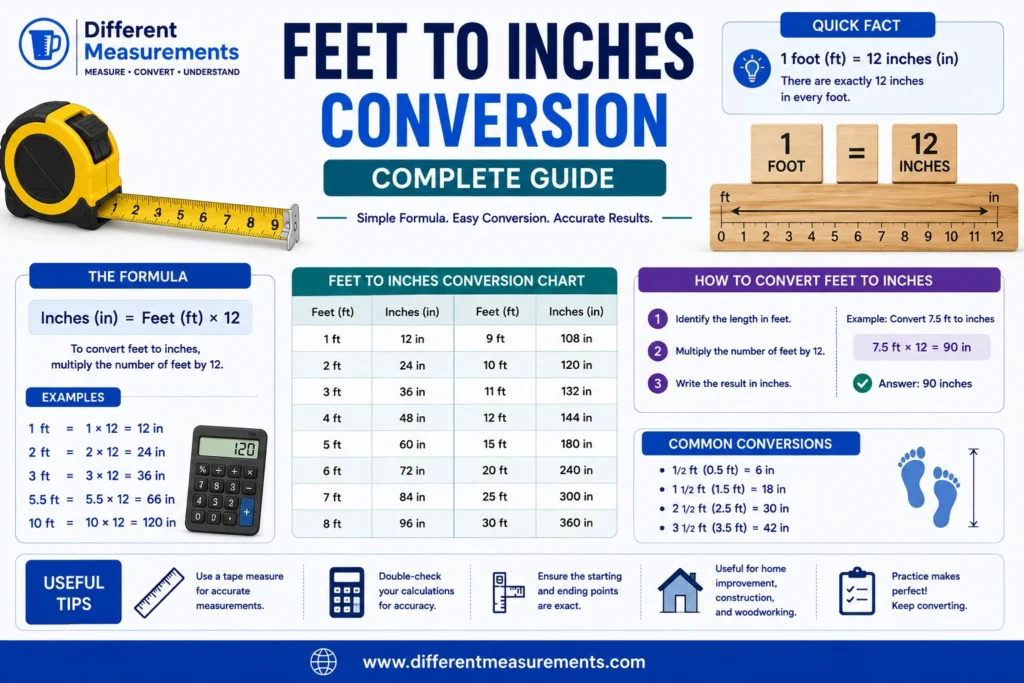
1 foot = 12 inches. This is an exact relationship, not a rounded approximation.
- 1 ft = 12 in
Note that “foot” is the singular form and “feet” is the plural form. For example:
- 1 foot = 12 inches
- 5 feet = 60 inches
Feet to Inches Conversion Formula
The formula for converting feet to inches is:
inches = feet × 12
or written with symbols:
in = ft × 12
To convert a measurement from feet to inches, multiply the number of feet by 12.
Example: Convert 5 feet to inches.
5 × 12 = 60 inches
How to Convert Feet to Inches
Converting feet to inches follows a simple, repeatable process:
- Start with the measurement in feet.
- Multiply the number of feet by 12.
- Add the unit “inches” to the final result.
- Round only if the original measurement contains a decimal and rounding is genuinely necessary.
Example: Convert 7 feet to inches.
7 × 12 = 84 inches
Since 1 foot equals exactly 12 inches, this conversion factor is exact, meaning no rounding is ever required for whole-number foot values.
Feet to Inches Conversion Chart
The chart below shows every whole foot value from 1 to 100, converted to inches.
| Feet | Inches | Feet | Inches |
|---|---|---|---|
| 1 ft | 12 in | 51 ft | 612 in |
| 2 ft | 24 in | 52 ft | 624 in |
| 3 ft | 36 in | 53 ft | 636 in |
| 4 ft | 48 in | 54 ft | 648 in |
| 5 ft | 60 in | 55 ft | 660 in |
| 6 ft | 72 in | 56 ft | 672 in |
| 7 ft | 84 in | 57 ft | 684 in |
| 8 ft | 96 in | 58 ft | 696 in |
| 9 ft | 108 in | 59 ft | 708 in |
| 10 ft | 120 in | 60 ft | 720 in |
| 11 ft | 132 in | 61 ft | 732 in |
| 12 ft | 144 in | 62 ft | 744 in |
| 13 ft | 156 in | 63 ft | 756 in |
| 14 ft | 168 in | 64 ft | 768 in |
| 15 ft | 180 in | 65 ft | 780 in |
| 16 ft | 192 in | 66 ft | 792 in |
| 17 ft | 204 in | 67 ft | 804 in |
| 18 ft | 216 in | 68 ft | 816 in |
| 19 ft | 228 in | 69 ft | 828 in |
| 20 ft | 240 in | 70 ft | 840 in |
| 21 ft | 252 in | 71 ft | 852 in |
| 22 ft | 264 in | 72 ft | 864 in |
| 23 ft | 276 in | 73 ft | 876 in |
| 24 ft | 288 in | 74 ft | 888 in |
| 25 ft | 300 in | 75 ft | 900 in |
| 26 ft | 312 in | 76 ft | 912 in |
| 27 ft | 324 in | 77 ft | 924 in |
| 28 ft | 336 in | 78 ft | 936 in |
| 29 ft | 348 in | 79 ft | 948 in |
| 30 ft | 360 in | 80 ft | 960 in |
| 31 ft | 372 in | 81 ft | 972 in |
| 32 ft | 384 in | 82 ft | 984 in |
| 33 ft | 396 in | 83 ft | 996 in |
| 34 ft | 408 in | 84 ft | 1,008 in |
| 35 ft | 420 in | 85 ft | 1,020 in |
| 36 ft | 432 in | 86 ft | 1,032 in |
| 37 ft | 444 in | 87 ft | 1,044 in |
| 38 ft | 456 in | 88 ft | 1,056 in |
| 39 ft | 468 in | 89 ft | 1,068 in |
| 40 ft | 480 in | 90 ft | 1,080 in |
| 41 ft | 492 in | 91 ft | 1,092 in |
| 42 ft | 504 in | 92 ft | 1,104 in |
| 43 ft | 516 in | 93 ft | 1,116 in |
| 44 ft | 528 in | 94 ft | 1,128 in |
| 45 ft | 540 in | 95 ft | 1,140 in |
| 46 ft | 552 in | 96 ft | 1,152 in |
| 47 ft | 564 in | 97 ft | 1,164 in |
| 48 ft | 576 in | 98 ft | 1,176 in |
| 49 ft | 588 in | 99 ft | 1,188 in |
| 50 ft | 600 in | 100 ft | 1,200 in |
Quick Feet to Inches Conversion Chart
For fast reference, here are the most commonly searched foot-to-inch conversions:
| Feet | Inches |
|---|---|
| 1 ft | 12 in |
| 2 ft | 24 in |
| 3 ft | 36 in |
| 4 ft | 48 in |
| 5 ft | 60 in |
| 6 ft | 72 in |
| 7 ft | 84 in |
| 8 ft | 96 in |
| 9 ft | 108 in |
| 10 ft | 120 in |
| 12 ft | 144 in |
| 15 ft | 180 in |
| 20 ft | 240 in |
| 25 ft | 300 in |
| 30 ft | 360 in |
| 40 ft | 480 in |
| 50 ft | 600 in |
Common Feet to Inches Conversions
1 Foot to Inches
1 × 12 = 12 inches
2 Feet to Inches
2 × 12 = 24 inches
3 Feet to Inches
3 × 12 = 36 inches
4 Feet to Inches
4 × 12 = 48 inches
5 Feet to Inches
5 × 12 = 60 inches
6 Feet to Inches
6 × 12 = 72 inches
10 Feet to Inches
10 × 12 = 120 inches
20 Feet to Inches
20 × 12 = 240 inches
Decimal Feet to Inches
Decimal feet values are converted using the same formula:
inches = decimal feet × 12
| Decimal Feet | Inches |
|---|---|
| 1.5 ft | 18 in |
| 2.5 ft | 30 in |
| 3.5 ft | 42 in |
| 4.25 ft | 51 in |
| 5.5 ft | 66 in |
| 6.25 ft | 75 in |
| 7.5 ft | 90 in |
| 10.5 ft | 126 in |
Example: Convert 4.25 feet to inches.
4.25 × 12 = 51 inches
It is important to understand that decimal feet are not the same as feet-and-inches notation, even when the results happen to line up in some cases. For example:
5.5 feet = 66 inches
And separately:
5 ft 6 in = 66 inches
These two values happen to be equivalent in this specific case because 0.5 of a foot equals exactly 6 inches (half of 12). This overlap can create confusion, since the two notations look similar but represent measurements in fundamentally different ways, one using a decimal fraction of a foot and the other using a separate, whole-number count of inches.
Feet and Inches Notation
Height and length measurements in the United States are frequently written using a combined feet-and-inches notation, such as:
5 ft 8 in
or in shorthand:
5′ 8″
In this notation:
- The first number represents feet.
- The second number represents inches.
- There are always 12 inches in each foot, so the inches portion should never exceed 11.
Examples of this notation include:
- 5 ft 8 in
- 6 ft 2 in
- 4 ft 11 in
Feet and Inches to Total Inches
To convert a measurement written in feet and inches into a single total-inches value, use the formula:
Total inches = (feet × 12) + remaining inches
Example: Convert 5 ft 8 in to total inches.
(5 × 12) + 8 = 60 + 8 = 68 inches
Additional examples:
6 ft 2 in: (6 × 12) + 2 = 72 + 2 = 74 inches
4 ft 9 in: (4 × 12) + 9 = 48 + 9 = 57 inches
7 ft 6 in: (7 × 12) + 6 = 84 + 6 = 90 inches
Human Height: Feet to Inches
Human height in the United States is very commonly expressed using feet and inches, such as:
- 5 ft 6 in
- 5 ft 8 in
- 6 ft 0 in
- 6 ft 2 in
Converting these measurements into total inches uses the same formula covered above: multiply the feet by 12, then add the remaining inches.
| Height | Total Inches |
|---|---|
| 5 ft 0 in | 60 in |
| 5 ft 1 in | 61 in |
| 5 ft 2 in | 62 in |
| 5 ft 3 in | 63 in |
| 5 ft 4 in | 64 in |
| 5 ft 5 in | 65 in |
| 5 ft 6 in | 66 in |
| 5 ft 7 in | 67 in |
| 5 ft 8 in | 68 in |
| 5 ft 9 in | 69 in |
| 5 ft 10 in | 70 in |
| 5 ft 11 in | 71 in |
| 6 ft 0 in | 72 in |
This kind of conversion is especially useful for height charts, medical records, sizing guides, and any calculation that requires a single consistent unit rather than a mixed feet-and-inches value.
Feet to Inches for Construction and Dimensions
Construction and home improvement projects frequently require converting between feet and inches:
- Room dimensions
- Wall height
- Ceiling height
- Door height
- Lumber dimensions
- Furniture dimensions
- Building measurements
- Packaging dimensions
Example: A room is 12 ft long.
12 × 12 = 144 inches
Example: A wall is 8 ft high.
8 × 12 = 96 inches
Converting to inches is often useful when working with tools, materials, or specifications that are labeled in inches rather than feet, or when precise measurements smaller than a full foot need to be expressed clearly.
Feet to Inches for Product Dimensions
Manufacturers and retailers sometimes list product dimensions in feet, particularly for larger items. Common examples include:
- A 3 ft table
- A 6 ft ladder
- An 8 ft wall panel
- A 10 ft pipe
Converting these measurements to inches can be useful when comparing products listed in different units, working with smaller sub-measurements, or fitting an item into a space measured in inches.
Fractional Feet to Inches
Feet measurements are sometimes written using fractions rather than decimals. Common examples include:
- 1 1/2 ft
- 2 1/4 ft
- 3 3/4 ft
- 5 1/2 ft
To convert a fractional foot measurement, first express the fraction as a decimal, then apply the standard formula.
Example: Convert 1 1/2 ft to inches.
1 1/2 ft = 1.5 ft 1.5 × 12 = 18 inches
Example: Convert 2 1/4 ft to inches.
2 1/4 ft = 2.25 ft 2.25 × 12 = 27 inches
The fraction represents a portion of a single foot, so converting it to a decimal first makes the multiplication straightforward.
Feet to Inches Conversion With Mixed Measurements
Mixed measurements, such as 7 ft 4 in, combine a whole number of feet with an additional number of inches. The formula remains the same as covered earlier:
(feet × 12) + inches = total inches
Example: Convert 7 ft 4 in to total inches.
(7 × 12) + 4 = 84 + 4 = 88 inches
Additional examples:
3 ft 6 in: (3 × 12) + 6 = 36 + 6 = 42 inches
4 ft 8 in: (4 × 12) + 8 = 48 + 8 = 56 inches
5 ft 10 in: (5 × 12) + 10 = 60 + 10 = 70 inches
6 ft 3 in: (6 × 12) + 3 = 72 + 3 = 75 inches
8 ft 5 in: (8 × 12) + 5 = 96 + 5 = 101 inches
Inches to Feet Reverse Conversion
For quick reference, converting inches back to feet uses the formula:
feet = inches ÷ 12
Example: Convert 24 inches to feet.
24 ÷ 12 = 2 feet
Example: Convert 60 inches to feet.
60 ÷ 12 = 5 feet
Example: Convert 72 inches to feet.
72 ÷ 12 = 6 feet
If the result is not a whole number, the remainder can be expressed as additional inches.
Example: Convert 68 inches to feet and inches.
68 ÷ 12 = 5 feet, with a remainder of 8 inches
Therefore:
68 inches = 5 ft 8 in
Feet vs Inches
| Feature | Foot | Inch |
|---|---|---|
| Symbol | ft | in |
| Relationship | 1 ft = 12 in | 1 in = 1/12 ft |
| Relative size | Larger unit | Smaller unit |
| Common uses | Height, room dimensions, construction | Smaller dimensions, detailed measurements |
Both feet and inches are units of length within the US customary system, and are also used in the Imperial system. They are simply scaled differently, with the foot serving as a more convenient unit for larger measurements and the inch offering more precision for smaller ones.
Feet, Inches, and Centimeters
Feet and inches also relate directly to the metric system through the following exact relationships:
- 1 foot = 12 inches
- 1 inch = 2.54 cm exactly
Combining these gives:
- 1 foot = 30.48 cm exactly
Example: Convert 5 feet to centimeters.
5 ft = 60 in = 152.4 cm
Example: Convert 6 feet to centimeters.
6 ft = 72 in = 182.88 cm
Converting between feet, inches, and centimeters is common when working with international measurements, comparing product specifications, or converting height between US and metric conventions.
Feet to Inches and Decimal Feet
One of the most important distinctions to understand is the difference between decimal feet and feet-and-inches notation. These are not the same thing, even though they can look similar at a glance.
Consider:
5.5 ft
versus:
5 ft 5 in
These are NOT the same measurement.
5.5 ft = 66 inches = 5 ft 6 in
5 ft 5 in = 65 inches
The decimal portion of a foot value must be multiplied by 12 to determine its equivalent in inches. In the case of 5.5 ft, the 0.5 represents half of a foot, which equals 6 inches, not 5 inches. This is why 5.5 ft converts to 5 ft 6 in, not 5 ft 5 in. Confusing these two notations is one of the most common sources of measurement errors.
Feet to Inches Conversion Examples
Example 1
Convert 3 feet to inches.
3 × 12 = 36 inches
Example 2
Convert 5 feet to inches.
5 × 12 = 60 inches
Example 3
Convert 8 feet to inches.
8 × 12 = 96 inches
Example 4
Convert 12 feet to inches.
12 × 12 = 144 inches
Example 5
Convert 2.5 feet to inches.
2.5 × 12 = 30 inches
Example 6
Convert 4.25 feet to inches.
4.25 × 12 = 51 inches
Example 7
Convert 5 ft 8 in to total inches.
(5 × 12) + 8 = 68 inches
Example 8
Convert 6 ft 2 in to total inches.
(6 × 12) + 2 = 74 inches
Example 9
Convert 10.5 feet to inches.
10.5 × 12 = 126 inches
Example 10
Convert 15 feet to inches.
15 × 12 = 180 inches
Common Feet to Inches Conversion Mistakes
- Using 10 instead of 12 as the conversion factor. Feet convert to inches using a factor of 12, not 10, since a foot contains 12 inches.
- Dividing instead of multiplying. Converting feet to inches requires multiplication. Division is used for the reverse conversion, from inches to feet.
- Confusing feet with inches. These are different units of significantly different size, and mixing them up leads to major errors.
- Confusing decimal feet with feet-and-inches. A value like 5.5 ft does not mean “5 feet 5 inches”; it means 5 feet plus half a foot, which equals 5 feet 6 inches.
- Treating 5.5 feet as 5 feet 5 inches. As shown above, this is incorrect. 5.5 feet equals 66 inches, while 5 ft 5 in equals only 65 inches.
- Forgetting the remaining inches in mixed measurements. When converting a measurement like 6 ft 3 in, both the feet and the additional inches must be included in the total.
- Forgetting units. A number without “inches” or “feet” attached is incomplete and can cause confusion.
- Rounding unnecessarily. Since 1 foot equals exactly 12 inches, whole-number foot conversions never require rounding.
- Confusing foot and feet terminology. “Foot” is singular, and “feet” is plural, though both use the same abbreviation, “ft.”
- Using the wrong notation. Mixing up decimal notation (5.5 ft) with feet-and-inches notation (5 ft 6 in) without converting correctly can lead to measurement errors.
Common Questions About Feet to Inches
There are exactly 12 inches in 1 foot.
Multiply the number of feet by 12 to get the equivalent measurement in inches.
The formula is inches = feet × 12.
2 feet equals 24 inches.
5 feet equals 60 inches.
6 feet equals 72 inches.
10 feet equals 120 inches.
12 feet equals 144 inches.
Multiply the decimal feet value by 12. For example, 4.25 feet × 12 equals 51 inches.
Multiply the whole number of feet by 12, then add the remaining inches. For example, 5 ft 8 in equals (5 × 12) + 8, which is 68 inches.
No. 5.5 feet equals 66 inches, which is the same as 5 feet 6 inches, not 5 feet 5 inches, which equals only 65 inches.
Divide the number of inches by 12 to get the equivalent measurement in feet. Any remainder can be expressed as additional inches.
There are exactly 12 inches in 1 foot.
There are 36 inches in 1 yard, since 1 yard equals 3 feet, and each foot contains 12 inches.
There are exactly 30.48 centimeters in 1 foot.
Final Thoughts
Converting feet to inches comes down to one simple, exact rule: multiply the number of feet by 12. Whether working with whole numbers, decimals, fractions, or mixed feet-and-inches measurements, this same principle applies consistently. Understanding the important distinction between decimal feet and feet-and-inches notation helps avoid one of the most common measurement mistakes.