
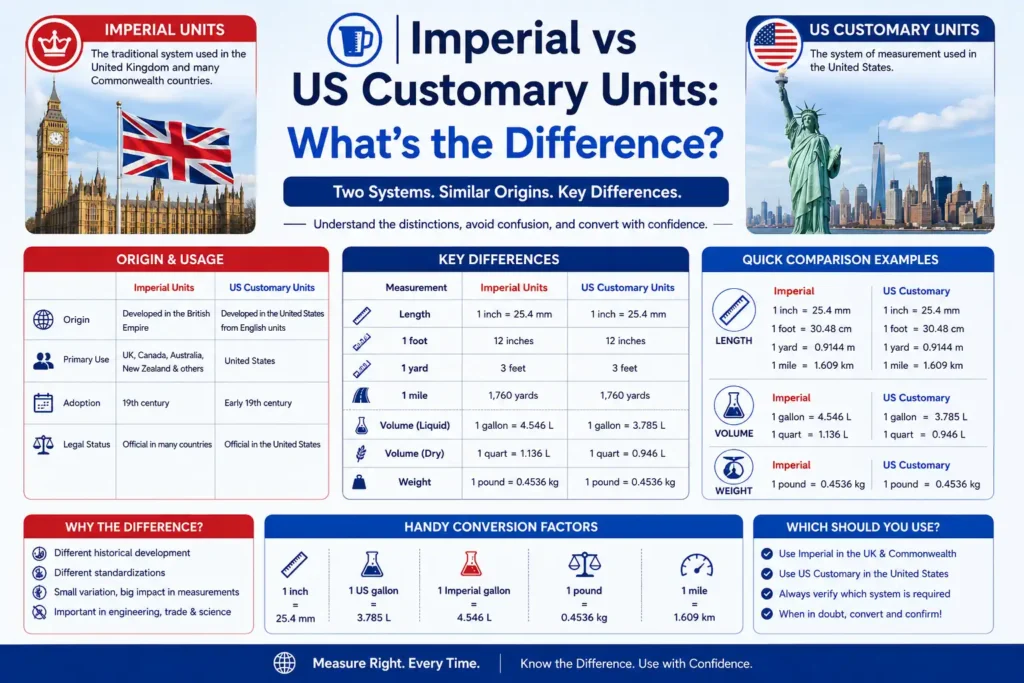
Imperial units and US customary units are often treated as if they are the same thing, but they are not. While both systems share many familiar unit names, such as inch, foot, pound, and gallon, several of these units are defined differently depending on which system you are using. This is especially true for volume measurements, where an Imperial gallon and a US gallon hold noticeably different amounts of liquid.
Many units overlap closely between the two systems:
- inch
- foot
- yard
- mile
- pound
- pint
- gallon
But despite sharing these names, some units, particularly those used to measure volume and certain weights, have different definitions and different sizes. This guide breaks down exactly where Imperial and US customary units agree, where they diverge, and why the difference matters.
What Are Imperial Units?
The Imperial system is the measurement system formally established in Britain through the Weights and Measures Act of 1824. This legislation standardized a range of earlier, inconsistent British measurement practices into a single official system used throughout the British Empire.
Common Imperial units include:
- inch
- foot
- yard
- mile
- ounce
- pound
- stone
- pint
- quart
- gallon
It is worth noting that the modern United Kingdom primarily uses the metric system for most official purposes today, including science, medicine, and most commercial trade. However, several Imperial units remain common in everyday British life, such as miles for road distances and pints for beer.
What Are US Customary Units?
US customary units are the measurement system most widely used in the United States for everyday purposes. This system developed from earlier English units of measurement, the same historical foundation that also produced the British Imperial system.
However, the United States did not adopt the Imperial system when Britain formally standardized it in 1824. By that point, the American colonies had already become independent, and earlier English measurement practices had continued to develop separately in the United States.
Common US customary units include:
- inch
- foot
- yard
- mile
- ounce
- pound
- pint
- quart
- gallon
Unlike the UK, the United States has not broadly adopted the metric system for everyday use, and US customary units remain the standard for most daily measurement in America.
Are Imperial and US Customary Units the Same?
No. Imperial and US customary units are related historically, but they are not identical systems. Many length units, such as the inch, foot, yard, and mile, are effectively the same in both systems today. However, several volume units have different definitions, meaning the same unit name can represent a different quantity depending on which system is being used.
The most significant differences appear in liquid volume measurements:
- An Imperial gallon does not equal a US gallon
- An Imperial pint does not equal a US pint
- An Imperial fluid ounce does not equal a US fluid ounce
This distinction becomes especially important when converting recipes, fuel volumes, or beverage measurements between British and American sources, since assuming the units are interchangeable can lead to meaningful errors.
Why Are Imperial and US Customary Units Different?
The divergence between these two systems comes down to timing and independent historical development. Both systems trace back to earlier English units of measurement used throughout Britain and its colonies, including colonial America.
When Britain formally standardized its measurement system in 1824 through the Weights and Measures Act, it redefined several units, including volume measurements like the gallon and pint, based on more precise and consistent scientific standards. By that time, the United States had been an independent nation for decades and continued using the earlier English measurement conventions it had inherited before formal British standardization occurred.
As a result, US customary volume units preserved older definitions, while British Imperial units reflect the newer 1824 standardization. Over time, both systems also saw further refinements, leading to the precise modern definitions used today. This explains why length units, which were less affected by the 1824 changes, remained closely aligned, while volume units diverged more significantly.
Imperial vs US Customary: Quick Comparison
| Category | Imperial | US Customary |
|---|---|---|
| Origin | Britain | United States |
| Formal development | Standardized in 1824 | Developed from earlier English units |
| Main modern use | Limited everyday use in UK and some contexts | Widely used in United States |
| Length units | inch, foot, yard, mile | inch, foot, yard, mile |
| Mass/weight units | ounce, pound, stone, long ton | ounce, pound, short ton |
| Volume units | Imperial pint, quart, gallon | US pint, quart, gallon |
| Temperature | Celsius commonly used today | Fahrenheit commonly used |
This table highlights similarities and differences, but it does not mean the two systems are interchangeable. The details below explain exactly where they align and where they diverge.
Imperial vs US Customary Length Units
Length is where Imperial and US customary units are most closely aligned. Both systems use the same basic units, and their modern definitions are effectively identical.
- inch
- foot
- yard
- mile
The standard relationships apply in both systems:
- 12 inches = 1 foot
- 3 feet = 1 yard
- 1,760 yards = 1 mile
Since 1959, both the United States and the United Kingdom have based these units on the international yard, defined in terms of the meter. This means a foot measured in the US is the same length as a foot measured in the UK. The major practical differences between Imperial and US customary systems are not found in these everyday length units.
Imperial vs US Customary Mass and Weight
Before comparing specific units, it helps to note that “mass” and “weight” are scientifically distinct concepts. Mass describes the amount of matter in an object, while weight is the force exerted on that mass by gravity. In everyday British and American usage, however, “weight” is commonly used when referring to quantities measured in pounds or stones.
Pound
The avoirdupois pound, the standard pound used for everyday weight measurement, has the same modern value in both Imperial and US customary systems:
1 lb = 453.59237 g
Ounce
The avoirdupois ounce used for ordinary weight measurement is also identical in both systems:
1 oz = 28.349523125 g
Stone
1 stone = 14 pounds
The stone is commonly used in Britain and Ireland, particularly for describing body weight, but it is not a standard everyday unit in the United States.
Ton
This is where mass and weight units diverge significantly between the two systems:
- 1 US short ton = 2,000 lb
- 1 Imperial long ton = 2,240 lb
It is also important to distinguish “ton” from “tonne.” The metric tonne, used internationally, equals exactly 1,000 kilograms, and is a different unit entirely from both the US short ton and the Imperial long ton.
Imperial vs US Customary Volume Units
Volume is where the most significant and practically important differences between Imperial and US customary units occur. The following units share the same names but represent different quantities:
- fluid ounce
- pint
- quart
- gallon
Understanding these differences is essential for anyone converting recipes, fuel measurements, or beverage volumes between British and American sources.
Imperial Gallon vs US Gallon
- 1 Imperial gallon = 4.54609 liters
- 1 US liquid gallon = 3.785411784 liters
The Imperial gallon is noticeably larger than the US liquid gallon, holding roughly 20 percent more liquid. For example, 10 Imperial gallons contain significantly more liquid than 10 US gallons, a difference worth accounting for when comparing fuel economy figures or bulk liquid measurements between British and American sources.
Imperial Pint vs US Pint
- 1 Imperial pint = 20 Imperial fluid ounces
- 1 US liquid pint = 16 US fluid ounces
In metric terms:
- 1 Imperial pint ≈ 568.261 mL
- 1 US liquid pint ≈ 473.176 mL
A British pint is larger than a US liquid pint, which is one reason a “pint” of beer served in the UK contains more liquid than a “pint” served in the United States.
Imperial Quart vs US Quart
- 1 Imperial quart = 2 Imperial pints
- 1 US liquid quart = 2 US liquid pints
In metric terms:
- 1 Imperial quart ≈ 1.13652 L
- 1 US liquid quart ≈ 0.946353 L
Imperial Fluid Ounce vs US Fluid Ounce
- 1 Imperial fluid ounce ≈ 28.4131 mL
- 1 US fluid ounce ≈ 29.5735 mL
This is where the comparison becomes counterintuitive. Although the Imperial gallon and Imperial pint are both larger than their US counterparts, the Imperial fluid ounce is actually smaller than the US fluid ounce. This happens because the Imperial pint is divided into 20 fluid ounces, while the US pint is divided into only 16 fluid ounces. Even though the Imperial pint holds more liquid overall, dividing it into more parts makes each individual Imperial fluid ounce slightly smaller than a US fluid ounce.
Imperial vs US Customary Volume Conversion Table
| Unit | Imperial | US Customary |
|---|---|---|
| Fluid ounce | ≈28.4131 mL | ≈29.5735 mL |
| Pint | ≈568.261 mL | ≈473.176 mL |
| Quart | ≈1.13652 L | ≈0.946353 L |
| Gallon | 4.54609 L | 3.785411784 L |
Despite sharing identical names, every one of these units represents a different quantity in the Imperial system compared with the US customary system.
Liquid vs Dry Measurements in the US Customary System
An added layer of complexity in the US customary system is the distinction between liquid volume and dry volume measurements. The US system technically maintains separate units for each:
- US liquid gallon
- US dry gallon
- US liquid pint
- US dry pint
Dry measurements, historically used for goods like grain and produce, are based on a different volume standard than liquid measurements. In everyday and commercial use, however, a reference to a “US gallon” almost always means the US liquid gallon, which is the unit most commonly encountered in recipes, fuel measurements, and beverage sales.
Imperial vs US Customary Temperature
Temperature does not divide neatly along Imperial versus US customary lines. Fahrenheit is widely used in the United States for everyday temperature measurement, while Celsius is the primary temperature scale used in the United Kingdom today, even though the UK historically used Fahrenheit as well.
Kelvin, meanwhile, is the SI base unit for thermodynamic temperature and is used primarily in scientific contexts worldwide, regardless of which everyday system a country uses.
The standard conversion formulas are:
- °C = (°F − 32) × 5/9
- °F = (°C × 9/5) + 32
Fahrenheit should not be thought of as simply “the Imperial temperature unit,” since the UK, which uses Imperial units in some everyday contexts, primarily uses Celsius for temperature today.
Imperial vs US Customary Area Units
Common area units, including the square inch, square foot, square yard, and acre, are used in broadly similar ways across both Imperial and US customary systems, since they are built directly from the closely aligned length units.
1 acre = 43,560 square feet
The differences between Imperial and US customary systems are far more significant for volume units than for ordinary length and area measurements, since area units are derived from the length units that are already effectively identical between the two systems.
Imperial vs US Customary Conversion Examples
Example 1: US Gallons to Liters
Convert 5 US gallons to liters.
5 × 3.785411784 = 18.927 L
Example 2: Imperial Gallons to Liters
Convert 5 Imperial gallons to liters.
5 × 4.54609 = 22.73 L
Example 3: US Pints to Liters
Convert 4 US liquid pints to liters.
4 × 0.473176 = 1.893 L
Example 4: Imperial Pints to Liters
Convert 4 Imperial pints to liters.
4 × 0.568261 = 2.273 L
Example 5: Pounds to Kilograms
Convert 150 lb to kilograms.
150 × 0.45359237 = 68.04 kg
Example 6: US Short Tons to Kilograms
Convert 2 US short tons to kilograms.
2 × 2,000 lb = 4,000 lb 4,000 × 0.45359237 = 1,814.37 kg
Example 7: Imperial Long Tons to Kilograms
Convert 2 Imperial long tons to kilograms.
2 × 2,240 lb = 4,480 lb 4,480 × 0.45359237 = 2,032.09 kg
Imperial vs US Customary vs Metric
Length
- Metric: millimeter, centimeter, meter, kilometer
- Imperial/US customary: inch, foot, yard, mile
Mass/Weight
- Metric: gram, kilogram, tonne
- Imperial: ounce, pound, stone, long ton
- US customary: ounce, pound, short ton
Volume
- Metric: milliliter, liter, cubic meter
- Imperial: Imperial fluid ounce, Imperial pint, Imperial quart, Imperial gallon
- US customary: US fluid ounce, US liquid pint, US liquid quart, US liquid gallon
Temperature
- Metric/SI: Celsius, Kelvin
- US customary: Fahrenheit
This comparison reflects common usage and general system conventions rather than a strict rule that every unit belongs exclusively to one system.
Which Countries Use Imperial Units?
Modern Imperial unit usage is more limited and specific than many people assume:
- United Kingdom: primarily uses the metric system officially, but retains certain Imperial units in everyday and legal contexts, such as miles for road distances, miles per hour for speed limits, pints for draught beer and cider, and feet and inches for describing personal height.
- Canada: officially uses the metric system, though some Imperial units, such as feet and pounds, remain common in casual daily use, real estate, and certain trades.
- Other countries and territories: some former British territories retain scattered Imperial unit usage in specific industries or informal contexts, though most have transitioned to the metric system for official purposes.
It is inaccurate to describe the UK as an “Imperial country” today, since metric units form the official basis for most measurement in science, medicine, government, and commerce, with Imperial units persisting mainly in specific, everyday situations.
Which Countries Use US Customary Units?
The United States is the primary country that extensively uses US customary units in daily life, government, industry, and commerce. While some other countries or industries may use individual units derived from the US customary system in specific contexts, such as certain aviation or shipping applications, there is no other country where US customary units serve as the dominant, everyday measurement standard.
Why Does the US Use Customary Units?
The continued use of customary units in the United States traces back to several historical factors:
- Colonial America inherited English units of measurement from British settlers.
- After independence, the newly formed United States continued using these established measurement practices rather than adopting Britain’s later 1824 standardization.
- Over time, the US government formalized its own customary standards, refining definitions for units like the pound and gallon.
- While the metric system has been legally authorized for use in the United States since the 19th century, and is used in specific scientific, medical, and industrial contexts, broad public adoption for everyday measurement has remained limited compared with most other countries.
Why Does the UK Use Both Metric and Imperial Units?
The United Kingdom has transitioned substantially toward metric measurement since the mid-20th century, particularly for science, education, medicine, and most commercial trade. However, certain Imperial units remain embedded in everyday British life and specific legal requirements.
Common examples include:
- Road distances and speed limits, still measured in miles and miles per hour
- Draught beer and cider, still commonly sold by the pint
- Height and some body measurements, often described in feet and inches in casual conversation
Legal requirements and practical usage vary depending on context, with some measurements mandated by law to use metric units while others retain traditional Imperial usage by custom rather than legal requirement.
Common Imperial and US Customary Units
Length
- inch
- foot
- yard
- mile
Weight/Mass
- ounce
- pound
- stone (primarily Imperial)
- ton (long ton in Imperial, short ton in US customary)
Volume
- fluid ounce (different values in each system)
- pint (different values in each system)
- quart (different values in each system)
- gallon (different values in each system)
Units where definitions differ significantly between systems are concentrated almost entirely in volume measurement and, to a lesser extent, in the “ton” unit for mass.
Common Mistakes
- Assuming Imperial and US gallons are the same. They differ by roughly 20 percent, with the Imperial gallon being larger.
- Assuming Imperial and US pints are the same. A British pint holds more liquid than a US liquid pint.
- Assuming all fluid ounces are the same. The US fluid ounce is actually larger than the Imperial fluid ounce, despite the Imperial pint and gallon being larger overall.
- Confusing US short tons with Imperial long tons. These differ by 240 pounds per ton.
- Confusing pounds with kilograms without applying the correct conversion factor.
- Confusing mass with weight, even though the pound is used informally for both in everyday language.
- Assuming Fahrenheit is simply “the Imperial temperature unit.” The UK, despite using some Imperial units, primarily uses Celsius today.
- Treating UK measurements as entirely Imperial. The UK’s official system is metric, with Imperial units retained in specific everyday contexts.
- Treating US customary and Imperial systems as identical. They share historical roots but differ in several important unit definitions.
- Using the wrong conversion factor when converting between Imperial and US customary volume units, since assuming they are interchangeable produces inaccurate results.
Quick Reference: Most Important Differences
| Unit | Imperial Value | US Customary Value |
|---|---|---|
| Gallon | 4.54609 L | 3.785411784 L |
| Pint | ≈568.261 mL | ≈473.176 mL |
| Quart | ≈1.13652 L | ≈0.946353 L |
| Fluid ounce | ≈28.4131 mL | ≈29.5735 mL |
| Ton | 2,240 lb (long ton) | 2,000 lb (short ton) |
| Stone | 14 lb (used in Imperial) | Not standard in US customary |
| Temperature usage | Celsius commonly used in UK today | Fahrenheit commonly used |
Common Questions About Imperial and US Customary Units
No. They share many unit names and historical roots, but several units, especially volume units like the gallon, pint, and fluid ounce, are defined differently in each system.
No. They share many unit names and historical roots, but several units, especially volume units like the gallon, pint, and fluid ounce, are defined differently in each system.
An Imperial gallon equals 4.54609 liters, while a US liquid gallon equals 3.785411784 liters, making the Imperial gallon roughly 20 percent larger.
An Imperial gallon equals 4.54609 liters.
A US liquid gallon equals 3.785411784 liters.
No. A UK (Imperial) pint equals about 568.261 mL, while a US liquid pint equals about 473.176 mL, making the UK pint larger.
An Imperial fluid ounce equals about 28.4131 mL, while a US fluid ounce equals about 29.5735 mL, making the US fluid ounce slightly larger.
Yes. The avoirdupois pound, used for standard weight measurement, equals 453.59237 grams in both systems.
A US short ton equals 2,000 pounds, while an Imperial long ton equals 2,240 pounds.
The UK primarily uses the metric system officially, but retains certain Imperial units, such as miles and pints, in everyday and specific legal contexts.
No. The United States uses its own US customary units, which are related to but not identical to the British Imperial system.
Not exactly. Fahrenheit is primarily associated with US customary usage today, while the UK, which retains some Imperial units, mainly uses Celsius for temperature.
The two systems diverged historically, with the UK standardizing its gallon definition in 1824 while the US retained an earlier, different volume standard.
The United Kingdom retains some Imperial units in everyday contexts, and a few other countries or territories use scattered Imperial units informally, though most nations rely primarily on the metric system.
The United States is the primary country where US customary units serve as the everyday measurement standard.
No. The two systems share historical origins and many unit names, but they are not identical, particularly for volume units like the gallon, pint, quart, and fluid ounce.
Final Thoughts
Imperial and US customary units look nearly identical on the surface, sharing names like gallon, pint, pound, and ton. But beneath these shared labels, the two systems diverge in ways that matter, especially for volume and certain weight measurements. Understanding these differences helps avoid costly mistakes in cooking, travel, engineering, trade, and everyday conversions.