Time is one of the most universally used measurements, yet it works differently from most other measurement categories. While a meter is always a meter and a kilogram is always a kilogram, a month can range from 28 to 31 days, and a year can contain either 365 or 366 days. Understanding these differences is essential for accurate scheduling, science, and everyday planning.
This guide covers what time measurement means, the standard units used to describe it, how time is measured and standardized, and how to convert between common time units correctly. Time is one of several types of measurement covered on this site, alongside categories like temperature and length.
Quick answer: Time measurement is the process of quantifying the duration between events or the point at which an event occurs, using standardized units such as seconds, minutes, hours, and days. Some time units, like the second and minute, have fixed, exact relationships, while others, like months and years, vary in length due to calendar conventions.
What Is Time Measurement?
Time measurement allows people to describe how long something lasts and to organize events in a consistent sequence. Without standardized units of time, it would be impossible to coordinate schedules, compare durations, or communicate when something happened relative to something else.
Everyday examples of time measurement include:
- How long a task takes to complete
- How long a trip or commute takes
- The duration of a movie or event
- The time elapsed between two events
- A work schedule broken into hours and days
What Is Time?
Time can be thought of in a few related but distinct ways:
- A point in time refers to a specific moment, such as 3:00 PM or January 1st.
- A duration refers to the length of an event, such as a 45-minute meeting.
- A time interval refers to the span between two specific points in time, such as the interval between 9:00 AM and 11:30 AM.
For practical measurement purposes, these distinctions matter because some tools and calculations focus on identifying a specific point in time, while others focus on measuring how much time has passed.
Units of Time
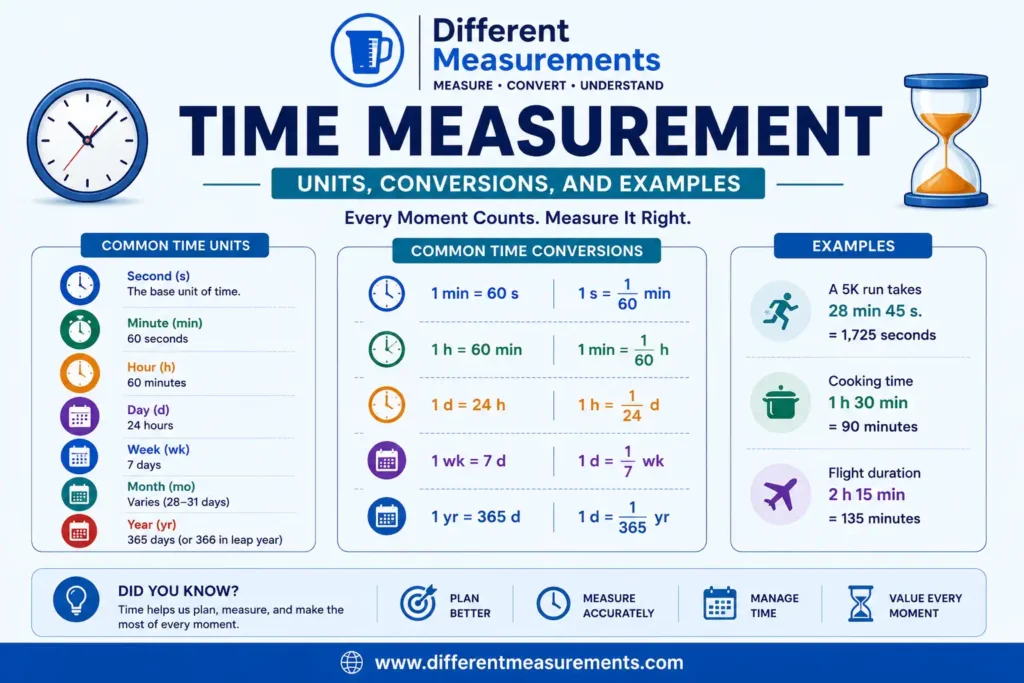
The most commonly used units of time, from smallest to largest, include:
- Second: The base unit of time measurement, used for short durations and scientific precision.
- Minute: Made up of 60 seconds, commonly used for everyday timing.
- Hour: Made up of 60 minutes, used for schedules, work, and daily planning.
- Day: Made up of 24 hours, based on one full rotation of the Earth.
- Week: Made up of 7 days, widely used for scheduling and planning.
- Month: A calendar-based unit that varies in length depending on the specific month.
- Year: Based on one orbit of the Earth around the sun, typically 365 or 366 days.
- Decade: A period of 10 years.
- Century: A period of 100 years.
- Millennium: A period of 1,000 years.
Each of these units serves a different practical purpose, from measuring brief scientific events to describing long historical periods.
The SI Unit of Time
The second (s) is the SI base unit of time. It serves as the foundation for both everyday timekeeping and scientific measurement, since larger time units, like minutes and hours, are defined as fixed multiples of the second.
The modern scientific definition of the second is based on atomic phenomena rather than any mechanical or astronomical process. Specifically, it is defined using the frequency of radiation emitted by a cesium atom under precisely controlled conditions. This atomic definition allows the second to be measured with extraordinary precision and consistency, forming the backbone of accurate global timekeeping.
Seconds
- Symbol: s
- Common uses: Measuring short events, sports timing, cooking, scientific experiments, and as the foundational unit for all other time measurements
- Relationship to minutes and hours:
60 seconds = 1 minute 3,600 seconds = 1 hour
Minutes
- Symbol: min
- Relationship to seconds and hours: 1 minute equals 60 seconds, and 60 minutes equal 1 hour
Minutes are commonly used for everyday tasks such as cooking times, short meetings, workout durations, and travel estimates. A typical coffee brew might take 4 minutes, while a short commute might take 15 minutes.
Hours
- Symbol: h
- Relationship to minutes and seconds: 1 hour equals 60 minutes, or 3,600 seconds
Hours are the standard unit for describing work schedules, travel duration, and daily activities. A full-time workday is often 8 hours, a long flight might take 10 hours, and a movie typically runs 1.5 to 2.5 hours.
Days
A day consists of 24 hours, based on one full rotation of the Earth on its axis.
In practical use, it is worth distinguishing between a calendar day, which refers to a full date from midnight to midnight, and an exact 24-hour duration, which refers strictly to a fixed span of time. In most everyday contexts, these align closely enough that the distinction rarely causes confusion, though scientific and legal contexts sometimes require more precision.
Weeks
A week consists of 7 days and is one of the most commonly used units for scheduling, planning, and organizing work and personal life. Weeks provide a consistent, fixed unit that does not vary, unlike months, making them useful for regular recurring schedules such as weekly meetings, payroll cycles, or school timetables.
Months
Unlike seconds, minutes, hours, days, and weeks, months are calendar-based units and do not all contain the same number of days. Depending on the specific month and the year, a month may have:
- 28 days (February in a common year)
- 29 days (February in a leap year)
- 30 days (April, June, September, November)
- 31 days (January, March, May, July, August, October, December)
This variability exists because the calendar system used internationally, the Gregorian calendar, divides the year into 12 months of uneven length to align with a 365 or 366-day year. Leap years, which occur roughly every 4 years, add an extra day to February to keep the calendar synchronized with Earth’s orbit around the sun.
Important: A month should never be treated as a fixed number of days or hours in precise calculations, since the actual length depends on which month and year is being referenced.
Years
A year is based on the time it takes Earth to complete one orbit around the sun. In practical calendar terms, this is expressed as:
- Common year: 365 days
- Leap year: 366 days, occurring roughly every 4 years to account for the extra fraction of a day in Earth’s actual orbital period
Because years can contain either 365 or 366 days, converting years into days is not always an exact, fixed calculation. For most everyday purposes, 365 days is used as an approximation, but precise calculations covering multiple years need to account for how many leap years fall within that span.
Decades, Centuries, and Millennia
- Decade: A period of 10 years, often used to describe cultural or historical eras, such as “the 1990s.”
- Century: A period of 100 years, commonly used in historical and scientific contexts.
- Millennium: A period of 1,000 years, used to describe very long historical or geological timeframes.
Example: The 21st century began in the year 2001 and will end in 2100, spanning 100 years, or 10 decades.
Time Units and Symbols
| Unit | Symbol | Relationship | Common Use |
| Second | s | SI base unit | Scientific measurement, short durations |
| Minute | min | 60 seconds | Everyday timing, cooking, meetings |
| Hour | h | 60 minutes | Schedules, work, travel |
| Day | day | 24 hours | Calendar planning, daily activities |
| Week | week | 7 days | Scheduling, recurring planning |
| Month | month | Varies (28 to 31 days) | Calendar planning, billing cycles |
| Year | yr | 365 or 366 days | Long-term planning, age, history |
Note that calendar-based units like month and year do not have universally standardized SI symbols in the same way seconds, minutes, and hours do, since they are calendar conventions rather than fixed physical quantities.
Common Time Conversions
Fixed, exact time relationships include:
- 60 seconds = 1 minute
- 60 minutes = 1 hour
- 24 hours = 1 day
- 7 days = 1 week
By contrast, calendar-based relationships are not fixed:
- Months vary in length, ranging from 28 to 31 days depending on the specific month and year
- Years can contain either 365 or 366 days, depending on whether it is a leap year
Any conversion involving months or years should be treated as an approximation unless the specific calendar dates involved are known.
Time Conversion Examples
Seconds to minutes Original value: 150 seconds Relationship: 60 seconds = 1 minute Calculation: 150 ÷ 60 = 2.5 Answer: 2.5 minutes
Minutes to seconds Original value: 5 minutes Relationship: 1 minute = 60 seconds Calculation: 5 × 60 = 300 Answer: 300 seconds
Minutes to hours Original value: 150 minutes Relationship: 60 minutes = 1 hour Calculation: 150 ÷ 60 = 2.5 Answer: 2.5 hours
Hours to minutes Original value: 3 hours Relationship: 1 hour = 60 minutes Calculation: 3 × 60 = 180 Answer: 180 minutes
Hours to seconds Original value: 2 hours Relationship: 1 hour = 3,600 seconds Calculation: 2 × 3,600 = 7,200 Answer: 7,200 seconds
Days to hours Original value: 3 days Relationship: 1 day = 24 hours Calculation: 3 × 24 = 72 Answer: 72 hours
Weeks to days Original value: 4 weeks Relationship: 1 week = 7 days Calculation: 4 × 7 = 28 Answer: 28 days
Years to days (approximate) Original value: 2 years Relationship: approximately 365 days per year, adjusting for any leap years within the span Calculation: 2 × 365 = 730 (approximate, and would be 731 if one leap year falls within the span) Answer: approximately 730 to 731 days, depending on leap years
How to Convert Time Units
- Identify the original unit. Confirm whether you are starting in seconds, minutes, hours, days, or another unit.
- Identify the target unit. Determine what unit you need the result in.
- Find the correct conversion relationship. Use a fixed relationship for seconds, minutes, hours, days, and weeks. For months and years, use an approximate value and note that precision may vary.
- Multiply or divide as appropriate. Multiply when converting to a smaller unit, divide when converting to a larger unit.
- Check the result. Confirm the converted value makes logical sense relative to the original.
- Round only when necessary. Fixed unit conversions rarely need rounding, but calendar-based conversions often do.
Example: Convert 250 minutes to hours and minutes. 250 ÷ 60 = 4 with a remainder of 10, meaning 250 minutes equals 4 hours and 10 minutes.
Time Measurement Tools
Timekeeping tools have evolved significantly over history, moving from natural observation to highly precise electronic instruments:
- Sundials: Among the earliest timekeeping devices, using the position of a shadow cast by the sun to estimate the time of day.
- Mechanical clocks: Use gears and a regulating mechanism, such as a pendulum, to track time through consistent mechanical motion.
- Quartz clocks: Use the precise, consistent vibration of a quartz crystal when an electric current is applied, offering significantly improved accuracy over mechanical clocks.
- Digital clocks: Display time numerically using electronic components, often based on quartz or other precise timing mechanisms.
- Stopwatches: Designed to measure elapsed time for a specific event, commonly used in sports and scientific timing.
- Timers: Used to count down a set duration, common in cooking and household use.
- Watches: Portable timekeeping devices worn on the wrist, ranging from simple mechanical designs to advanced digital and smart technology.
- Atomic clocks: The most precise timekeeping instruments available, used as the foundation for international time standards.
How Do Clocks Measure Time?
Clocks measure time by relying on a process that repeats at a consistent, predictable rate. Different types of clocks use different repeating processes:
- Pendulum oscillation: Mechanical clocks use the regular swinging motion of a pendulum, which takes a consistent amount of time to complete each swing.
- Quartz crystal vibration: Quartz clocks apply an electric current to a quartz crystal, causing it to vibrate at an extremely consistent frequency, which is then used to measure time intervals.
- Atomic transitions: Atomic clocks measure time based on the highly consistent frequency of radiation emitted during specific atomic transitions, offering far greater precision than mechanical or quartz methods.
In each case, the clock counts repetitions of a consistent physical process and translates that count into a measurement of elapsed time.
Atomic Clocks and Accurate Time
An atomic clock is a timekeeping device that measures time based on the vibration frequency of atoms, typically cesium atoms, under precisely controlled conditions. Because this frequency is extremely stable and consistent, atomic clocks are the most accurate timekeeping instruments available.
Atomic clocks are essential to modern life in ways that are not always visible. They provide the precise timing signals used in:
- Global navigation satellite systems, such as GPS
- Telecommunications networks, which rely on precise timing for data synchronization
- Scientific research requiring extremely precise time measurement
- International time standards used to coordinate clocks around the world
Atomic clocks underpin the accuracy of global timekeeping systems, ensuring that time remains consistent and synchronized across different countries, technologies, and industries.
Time Standards
Several important concepts help standardize how time is communicated globally:
- UTC (Coordinated Universal Time): The primary time standard used as a global reference point, based on atomic clock measurements.
- International timekeeping: The coordinated system of maintaining accurate, synchronized time across countries and institutions worldwide.
- Time zones: Regional offsets from UTC that allow local clock time to roughly align with the position of the sun in a given location.
- Local time: The time observed in a specific location, based on its time zone and any seasonal adjustments.
It is important to distinguish between these related but different concepts. A unit of time, such as a second or hour, measures duration. A time standard, such as UTC, provides a consistent global reference point. A time zone is a regional system for expressing local clock time relative to that global reference. None of these should be confused with one another, since they serve different functions in timekeeping.
Time Zones and Time Measurement
Time zones exist because different regions of the Earth experience daylight at different times due to the planet’s rotation. Rather than having every location use the same clock time regardless of whether it is day or night, time zones allow local clocks to roughly align with the sun’s position in the sky.
UTC serves as the global reference point from which all time zones are offset, typically expressed as a number of hours ahead or behind UTC. Local time reflects the specific time zone a location falls into, and some regions also observe daylight saving time, which temporarily shifts local clocks forward or backward, usually by one hour, during part of the year.
It is worth emphasizing that time zones are not measurement units. They are systems for expressing clock time consistently across different geographic regions, built on top of the actual units of time, such as hours and minutes.
Time Measurement in Everyday Life
Time measurement plays a central role across nearly every area of life:
- Work: Schedules, deadlines, and work hours all depend on standardized time measurement.
- School: Class periods, exam durations, and academic calendars rely on consistent time units.
- Travel: Flight durations, time zone differences, and itinerary planning all depend on accurate time measurement.
- Sports: Many sports rely on precise time measurement for scoring, race timing, and match duration.
- Cooking: Recipes specify cooking and baking times, often down to the minute.
- Exercise: Workouts are frequently measured and tracked by duration or pace over time.
- Medicine: Medication schedules and treatment durations depend on precise time tracking.
- Business: Meetings, project deadlines, and billing cycles all rely on time measurement.
- Manufacturing: Production schedules and process timing are carefully measured to maintain efficiency.
- Science: Experiments often require extremely precise time measurement, down to fractions of a second.
- Technology: Computer systems, networks, and software rely on precise time synchronization to function correctly.
Time Intervals and Duration
It helps to distinguish between a few related time concepts:
- Clock time refers to a specific point in time, such as 2:00 PM.
- Duration refers to the length of an event or period, such as 90 minutes.
- Time interval refers to the span between two specific points in time.
Example: If an event starts at 2:00 PM and ends at 3:30 PM, the time interval between these two points represents a duration of 90 minutes.
Elapsed time can generally be calculated by subtracting the starting clock time from the ending clock time, accounting for whether the times cross into a new hour, day, or, in rare cases, month or year.
Common Time Measurement Mistakes
- Confusing 12-hour and 24-hour time: Misreading 2:00 PM as 2:00 AM, or vice versa, is a common source of scheduling errors.
- Assuming every month has the same number of days: Months range from 28 to 31 days, and treating them as fixed leads to calculation errors.
- Assuming every year has exactly 365 days: Leap years add an extra day, which matters in precise multi-year calculations.
- Confusing time zones with time units: Time zones describe regional clock offsets, not units of duration.
- Using the wrong conversion factor: Applying an incorrect relationship, such as assuming 100 minutes make an hour, produces inaccurate results.
- Confusing duration with a clock time: Mistaking a specific time, like 3:00 PM, for a length of time, like 3 hours, leads to miscommunication.
- Forgetting that leap years affect calendar calculations: Ignoring leap years in multi-year date calculations introduces small but meaningful errors.
- Treating approximate calendar conversions as exact: Assuming a year always equals exactly 365 days, or a month always equals exactly 30 days, oversimplifies calendar-based time and can cause errors in scheduling or legal contexts.
Common Time Conversion Reference Table
| Conversion | Relationship | Exact or Approximate |
| Seconds to minutes | 60 seconds = 1 minute | Exact |
| Minutes to hours | 60 minutes = 1 hour | Exact |
| Hours to days | 24 hours = 1 day | Exact |
| Days to weeks | 7 days = 1 week | Exact |
| Days to months | 28 to 31 days = 1 month | Approximate, varies by month |
| Days to years | 365 or 366 days = 1 year | Approximate, depends on leap year |
Common Questions About Time Measurement
Time measurement is the process of quantifying the duration between events or identifying a specific point in time, using standardized units such as seconds, minutes, hours, and days.
The SI base unit of time is the second (s).
There are 60 seconds in one minute.
There are 60 minutes in one hour.
There are 24 hours in one day.
There are 7 days in one week.
A common year has 365 days, while a leap year has 366 days.
A leap year has 366 days, with the extra day added to February.
There are 10 years in one decade.
There are 100 years in one century.
There are 1,000 years in one millennium.
UTC is a global time standard used as a consistent reference point, while local time reflects the specific time zone and seasonal adjustments, such as daylight saving time, observed in a given location.
Time measurement combines fixed, exact units, such as seconds, minutes, and hours, with variable, calendar-based units, such as months and years, that depend on established calendar conventions. Understanding which relationships are exact and which are approximate, along with how modern timekeeping tools like atomic clocks maintain global accuracy, makes it possible to measure and communicate time confidently across science, business, and everyday life.