
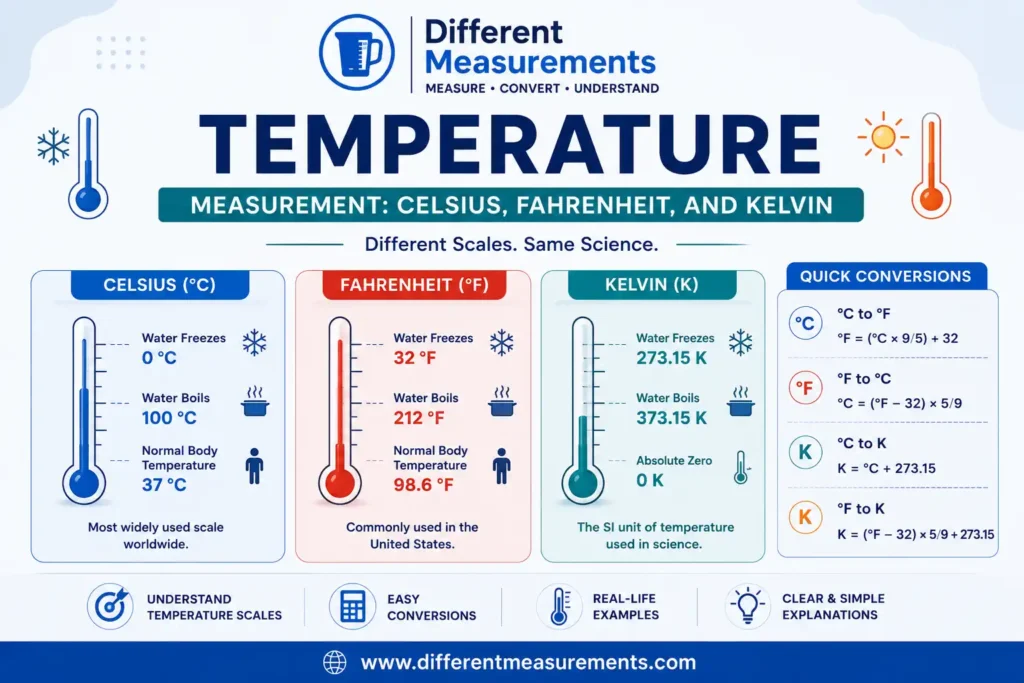
Temperature is something everyone measures constantly, whether checking the weather, cooking a meal, or reading a fever thermometer. Yet the existence of three different scales, Celsius, Fahrenheit, and Kelvin, often causes confusion about which one to use and how to convert between them accurately.
This guide explains what temperature measurement actually means, how the three major scales compare, how temperature is measured, and how to convert between Celsius, Fahrenheit, and Kelvin correctly. Temperature is one of several core types of measurement, alongside categories like length and volume, each with its own units and conversion rules.
Quick answer: Temperature measurement is the process of quantifying how hot or cold something is using a standardized scale. The three main scales, Celsius, Fahrenheit, and Kelvin, express the same physical quantity using different reference points and numerical increments, which is why converting between them requires a formula rather than a simple multiplication factor.
What Is Temperature?
Temperature describes how hot or cold something is. On a physical level, it reflects the average kinetic energy of the particles that make up a substance. Faster-moving particles correspond to a higher temperature, while slower-moving particles correspond to a lower temperature.
This connection to particle motion is also why temperature relates closely to thermal energy. As a substance gains thermal energy, its particles move faster, and its temperature rises. As it loses thermal energy, its particles slow down, and its temperature falls.
Everyday examples of temperature include:
- Weather temperature, describing how hot or cold the outside air is
- Body temperature, used to assess health
- Cooking temperature, used to safely prepare food
- Refrigerator temperature, used to keep food fresh
- Freezer temperature, used to keep food frozen
- Boiling water, a familiar high-temperature reference point
What Is Temperature Measurement?
Because temperature cannot be directly seen or touched with precision, standardized scales and instruments are needed to measure and communicate it consistently. Without agreed-upon units, a “hot day” or “warm water” would mean different things to different people.
Temperature measurement plays a critical role across many fields:
- Weather: Forecasts and climate data depend on standardized temperature readings.
- Medicine: Body temperature helps diagnose fevers and monitor patient health.
- Cooking: Recipes and food safety guidelines rely on precise temperature control.
- Science: Experiments often require exact temperature measurement and control.
- Manufacturing: Many industrial processes depend on maintaining specific temperature ranges.
- Refrigeration: Food storage safety depends on consistent, measurable cold temperatures.
- HVAC: Heating and cooling systems rely on temperature sensors to regulate indoor climates.
- Industrial processes: Chemical reactions, metalworking, and manufacturing often require tightly controlled temperatures.
Temperature Scales
Three major temperature scales are used around the world: Celsius, Fahrenheit, and Kelvin. Each scale measures the same underlying physical quantity, temperature, but uses a different reference point and a different size of increment.
| Scale | Symbol | SI Status | Common Use |
| Celsius | °C | Widely used metric-associated scale | Most countries, everyday and scientific use |
| Fahrenheit | °F | Not SI | United States, some everyday contexts |
| Kelvin | K | SI base unit | Scientific and technical fields |
Understanding how these scales relate to each other, and why they were each designed the way they were, makes temperature conversion far easier to grasp.
Celsius Scale
The Celsius scale, denoted °C, sets 0°C as the freezing point of water and 100°C as the boiling point of water under standard atmospheric pressure. This 100-degree range between freezing and boiling makes Celsius intuitive for everyday and scientific use alike.
Celsius is the standard temperature scale used across most of the world, including nearly all countries that use the metric system. It appears in weather forecasts, cooking instructions, medical contexts, and scientific research throughout the vast majority of countries.
Everyday Celsius examples include a comfortable room temperature around 20 to 22°C, a hot summer day around 30 to 35°C, and a refrigerator typically set around 4°C.
Fahrenheit Scale
The Fahrenheit scale, denoted °F, sets the freezing point of water at 32°F and the boiling point of water at 212°F under standard atmospheric pressure. This creates a 180-degree range between freezing and boiling, making each Fahrenheit degree represent a smaller temperature change than each Celsius degree.
Fahrenheit is most commonly used in the United States for everyday purposes, including weather reports, oven temperatures, and household thermostats. A few other countries and territories also use Fahrenheit in certain everyday contexts, though Celsius remains dominant internationally.
Everyday Fahrenheit examples include a comfortable room temperature around 68 to 72°F, a hot summer day around 90 to 95°F, and a typical oven baking temperature around 350°F.
Kelvin Scale
The Kelvin scale, denoted K, is the SI base unit for thermodynamic temperature. Unlike Celsius and Fahrenheit, Kelvin starts at absolute zero, the theoretical point at which particle motion reaches its minimum possible energy state.
Kelvin uses the same size increment as Celsius, meaning a change of 1 K equals a change of 1°C. The two scales differ only in where they place zero: Celsius sets zero at the freezing point of water, while Kelvin sets zero at absolute zero.
Important notation note: Kelvin values are written simply as K, not °K. This is because Kelvin measures an absolute quantity rather than a degree offset from an arbitrary reference point, so it does not use the degree symbol.
Kelvin is essential in scientific fields because it provides an absolute reference point, making it suitable for physics, chemistry, and thermodynamic calculations where negative temperature values would otherwise complicate formulas.
Celsius vs Fahrenheit vs Kelvin
| Scale | Symbol | SI Status | Common Use | Freezing Point of Water | Boiling Point of Water | Absolute Zero |
| Celsius | °C | Metric-associated, not SI base | Most countries | 0°C | 100°C | -273.15°C |
| Fahrenheit | °F | Not SI | United States, select regions | 32°F | 212°F | -459.67°F |
| Kelvin | K | SI base unit | Science and engineering | 273.15 K | 373.15 K | 0 K |
This table highlights the core distinction: Celsius and Fahrenheit use arbitrary reference points tied to water’s behavior, while Kelvin anchors its zero point to the absolute physical limit of temperature.
What Is Absolute Zero?
Absolute zero is the theoretical lowest possible temperature, the point at which particles have the minimum possible thermal energy. It corresponds to 0 K, or -273.15°C, or -459.67°F.
At absolute zero, classical physics suggests that particle motion would essentially stop. In practice, absolute zero has never been fully reached in a laboratory, though scientists have achieved temperatures extremely close to it.
Because Kelvin is built around this absolute physical limit, temperatures cannot go below 0 K in any conventional sense. This is what makes Kelvin so useful in scientific formulas, since it avoids the need to work with negative temperature values in most physical calculations.
Common Temperature Reference Points
| Reference Point | Celsius | Fahrenheit | Kelvin |
| Absolute zero | -273.15°C | -459.67°F | 0 K |
| Freezing point of water | 0°C | 32°F | 273.15 K |
| Cool room temperature | ≈ 18°C | ≈ 64°F | ≈ 291 K |
| Normal human body temperature | ≈ 37°C | ≈ 98.6°F | ≈ 310 K |
| Hot day | ≈ 35°C | ≈ 95°F | ≈ 308 K |
| Boiling point of water | 100°C | 212°F | 373.15 K |
Normal human body temperature is commonly cited as approximately 37°C or 98.6°F, but actual healthy body temperature varies by individual, time of day, and measurement method, typically ranging from about 36.1°C to 37.2°C. This value should be treated as a general reference point rather than a fixed universal number.
How Is Temperature Measured?
Several instruments are used to measure temperature, depending on the context and required precision:
- Thermometer: The general term for any device that measures temperature.
- Digital thermometer: Uses electronic sensors to provide a fast, precise numerical reading, common in medical and household use.
- Liquid-in-glass thermometer: Uses the expansion and contraction of a liquid, such as mercury or colored alcohol, within a sealed glass tube to indicate temperature.
- Infrared thermometer: Measures the infrared energy radiating from an object’s surface without needing direct contact, useful for quick readings of skin or surface temperature.
- Thermocouple: Uses the electrical voltage generated between two different metals to measure temperature, common in industrial and scientific applications requiring durability and a wide measurement range.
- Temperature sensor: A broad category of electronic components used in appliances, vehicles, and industrial equipment to continuously monitor temperature.
Each tool is suited to different needs, from quick household checks to precise scientific measurement.
Temperature Measurement Units and Symbols
Correct notation matters when writing temperature values:
- Celsius: written as °C
- Fahrenheit: written as °F
- Kelvin: written as K, without a degree symbol
It helps to distinguish between a temperature scale and a temperature unit. Celsius and Fahrenheit are often described as both a scale and a unit, since the degree symbol is part of their standard notation. Kelvin, however, is strictly a unit, since it does not include the degree symbol, reflecting its status as an SI base unit tied to an absolute reference point.
Temperature Conversion
Unlike many other measurement conversions, temperature conversion cannot be done with a single multiplication factor. This is because Celsius, Fahrenheit, and Kelvin each use a different zero point, and Fahrenheit additionally uses a different increment size. Converting between them requires a formula that accounts for both the offset and the scale.
Celsius to Fahrenheit
°F = (°C × 9/5) + 32
Example: Convert 25°C to Fahrenheit. (25 × 9/5) + 32 = 45 + 32 = 77°F
Fahrenheit to Celsius
°C = (°F – 32) × 5/9
Example: Convert 77°F to Celsius. (77 – 32) × 5/9 = 45 × 5/9 = 25°C
Celsius to Kelvin
K = °C + 273.15
Example: Convert 25°C to Kelvin. 25 + 273.15 = 298.15 K
Kelvin to Celsius
°C = K – 273.15
Example: Convert 298.15 K to Celsius. 298.15 – 273.15 = 25°C
Fahrenheit to Kelvin
K = (°F – 32) × 5/9 + 273.15
Example: Convert 77°F to Kelvin. (77 – 32) × 5/9 + 273.15 = 25 + 273.15 = 298.15 K
Kelvin to Fahrenheit
°F = (K – 273.15) × 9/5 + 32
Example: Convert 298.15 K to Fahrenheit. (298.15 – 273.15) × 9/5 + 32 = 25 × 9/5 + 32 = 45 + 32 = 77°F
Common Temperature Conversions
| Celsius | Fahrenheit | Kelvin |
| 0°C | 32°F | 273.15 K |
| 10°C | 50°F | 283.15 K |
| 20°C | 68°F | 293.15 K |
| 25°C | 77°F | 298.15 K |
| 30°C | 86°F | 303.15 K |
| 37°C | 98.6°F | 310.15 K |
| 100°C | 212°F | 373.15 K |
Values are exact based on the standard conversion formulas, though Fahrenheit and Kelvin results are commonly rounded to one or two decimal places for everyday use.
How to Convert Temperature Manually
- Identify the starting temperature scale. Confirm whether the value is in Celsius, Fahrenheit, or Kelvin.
- Identify the target scale. Determine which scale you need the result in.
- Choose the correct conversion formula. Use the specific formula that matches your starting and target scales.
- Substitute the temperature value. Insert the known value into the correct place in the formula.
- Perform the calculation. Work through the multiplication, division, and addition or subtraction in order.
- Round appropriately. Keep more decimal places for scientific work, round for everyday practical use.
- Check whether the result is reasonable. A quick sanity check, such as knowing that 0°C should equal 32°F, helps catch calculation errors.
Worked example 1: Convert 15°C to Fahrenheit. (15 × 9/5) + 32 = 27 + 32 = 59°F
Worked example 2: Convert 98.6°F to Celsius. (98.6 – 32) × 5/9 = 66.6 × 5/9 ≈ 37°C
Worked example 3: Convert 310 K to Celsius. 310 – 273.15 = 36.85°C
Temperature Difference vs Temperature Conversion
It is useful to distinguish between converting a specific temperature value and converting a temperature difference or interval.
When converting a single temperature reading, such as 25°C to Fahrenheit, the full conversion formula with its offset must be used, as shown above.
When describing a temperature change or interval, such as “the temperature rose by 10 degrees Celsius,” the calculation is different. Because Celsius and Kelvin use the same size increment, a change of 10°C is also a change of 10 K. However, since Fahrenheit uses a smaller increment, a change of 10°C corresponds to a change of 18°F, calculated using only the scale factor of 9/5 without the offset of 32.
This distinction matters in scientific and engineering contexts where temperature changes, rather than absolute readings, are being discussed.
Real-World Temperature Examples
- Weather: Daily temperatures might range from below freezing in winter to above 35°C or 95°F during a summer heat wave, depending on the climate.
- Human body temperature: Normal body temperature is typically cited around 37°C or 98.6°F, though it naturally fluctuates slightly throughout the day.
- Refrigerators: Household refrigerators are generally kept around 4°C or 39°F to safely store perishable food.
- Freezers: Standard freezer temperatures are typically set at or below -18°C or 0°F to keep food safely frozen.
- Cooking: Oven baking temperatures commonly range from 175°C to 220°C, or roughly 350°F to 425°F, depending on the recipe.
- Boiling water: Water boils at 100°C or 212°F at standard atmospheric pressure, a common reference point in cooking and science.
- Industrial processes: Manufacturing processes like metal casting or chemical production may require precisely controlled temperatures ranging from near freezing to several hundred degrees or more.
- Scientific experiments: Laboratories often use Kelvin for precision, especially in experiments involving extreme cold, such as cryogenics, or extreme heat.
Common Temperature Measurement Mistakes
- Confusing Celsius and Fahrenheit: Mistaking one scale for the other can lead to significant real-world errors, especially in cooking, weather interpretation, and medical readings.
- Using the wrong conversion formula: Applying a Celsius-to-Kelvin formula when converting Celsius to Fahrenheit, or vice versa, produces an incorrect result.
- Forgetting the 32 in Celsius/Fahrenheit conversion: Omitting the offset value in either direction leads to a consistently inaccurate conversion.
- Using °K instead of K: Kelvin does not use a degree symbol, and adding one is a common but incorrect notation habit.
- Confusing temperature values with temperature differences: Applying the full conversion formula, including the offset, to a temperature change rather than an absolute reading produces an incorrect result.
- Assuming water always freezes and boils at exactly the same conditions: These reference points depend on standard atmospheric pressure and can shift at different altitudes or pressures.
- Forgetting that boiling point changes with atmospheric pressure: Water boils at a lower temperature at high altitudes, since atmospheric pressure is reduced.
- Rounding too early: Rounding intermediate values before completing a multi-step calculation can introduce unnecessary error into the final result.
Temperature Measurement in Different Countries
- Celsius is the standard temperature scale used in most countries around the world, appearing in weather reports, cooking instructions, and general scientific and medical use.
- Fahrenheit is most commonly used in the United States for everyday purposes such as weather forecasts and household temperature settings, alongside limited use in a few other regions.
- Kelvin is used internationally within scientific and technical fields, regardless of which everyday scale a country typically uses, since it serves as the standard unit for scientific temperature measurement.
It is worth noting that even in countries where Fahrenheit or Celsius dominates everyday communication, scientific research and engineering work within that same country typically relies on Kelvin or Celsius for precision and international consistency.
Common Questions About Temperature Measurement
Temperature measurement is the process of quantifying how hot or cold something is using a standardized scale, such as Celsius, Fahrenheit, or Kelvin.
The three main temperature scales are Celsius, Fahrenheit, and Kelvin.
The SI base unit of temperature is the kelvin (K).
Celsius sets water’s freezing point at 0 and boiling point at 100, while Fahrenheit sets them at 32 and 212, meaning each Fahrenheit degree represents a smaller temperature change than each Celsius degree.
Celsius and Kelvin use the same size increment, but Celsius sets zero at water’s freezing point, while Kelvin sets zero at absolute zero, the lowest possible temperature.
Absolute zero is the theoretical lowest possible temperature, equal to 0 K, -273.15°C, or -459.67°F, at which particle motion reaches its minimum energy state.
Multiply the Celsius value by 9/5, then add 32, to get the equivalent Fahrenheit value.
Subtract 32 from the Fahrenheit value, then multiply by 5/9, to get the equivalent Celsius value.
Add 273.15 to the Celsius value to get the equivalent Kelvin value.
Kelvin measures an absolute quantity based on a fixed physical reference point, absolute zero, rather than an arbitrary offset, which is why it is written without a degree symbol.
100°C equals 212°F, the boiling point of water at standard atmospheric pressure.
Temperature measurement relies on three interconnected scales, Celsius, Fahrenheit, and Kelvin, each suited to different everyday and scientific contexts. Understanding how these scales relate through their conversion formulas, and recognizing the distinction between temperature values and temperature differences, makes it possible to move confidently between them in weather, cooking, science, and everyday life.