Distance describes how far apart two points, objects, places, or locations are. It is one of the most fundamental measurements people use every day, whether checking how far a store is from home, planning a road trip, or calculating how far a satellite orbits above Earth.
A few everyday examples show just how often distance comes into play:
- The distance between two cities
- The distance from home to work
- The distance between two points on a map
- The distance traveled by a vehicle
- The distance between two objects
Distance is a foundational measurement used across everyday life, science, engineering, transportation, geography, and navigation. This guide explains what distance measurement means, how it differs from related concepts like length and displacement, the units used to express it, and how to convert and calculate distance accurately.
What Is Distance Measurement?
Distance measurement quantifies the separation between two points or the total length of a path traveled. It answers the question “how far,” whether that refers to a straight-line gap between two locations or the full path covered during a journey.
Common examples include:
- A road is 15 km long.
- A store is 2 km from a house.
- A person walks 3 km.
- Two objects are 50 cm apart.
Distance is generally expressed using units of length, the same category of units used to describe size, length, height, and width.
What Is the SI Unit of Distance?
The SI base unit used to measure distance is the meter (m). Since distance is fundamentally a length quantity, it uses the same SI unit established for length measurement generally.
Other commonly used distance units include:
- millimeter
- centimeter
- kilometer
- inch
- foot
- yard
- mile
Distance vs Length
Distance and length are closely related, but they are typically used in different contexts.
- Length generally describes the size or extent of an object, such as how long a table or a piece of rope is.
- Distance generally describes the separation between points, or how far something travels.
Examples that illustrate the distinction:
- Length: A table is 150 cm long.
- Distance: A house is 150 m from a school.
Both quantities are dimensionally the same, meaning they use identical units and are measured the same way. Distance and length are not unrelated concepts; distance is essentially a specific application of length used to describe separation rather than an object’s own physical size.
Distance vs Displacement
This is one of the most important distinctions in physics and everyday measurement, since the two terms are frequently confused.
- Distance is the total path traveled between two points, regardless of direction.
- Displacement is the straight-line change in position from a starting point to an ending point, including direction.
Consider a simple example: a person walks 3 km east and then 3 km west, returning to the exact starting location.
- Total distance = 6 km
- Displacement = 0 km
Because the person ends up back where they started, their displacement is zero, even though they physically traveled 6 km. This distinction matters because distance is a scalar quantity, meaning it only has magnitude, while displacement is a vector quantity, meaning it has both magnitude and direction.
Distance vs Height
Height can represent a specific type of vertical distance. Examples include:
- The height of a building
- Height above sea level
- The vertical distance between two floors
Height is a specific type of dimensional measurement describing vertical extent, while distance is a broader concept that can describe separation in any direction, not just vertically.
Distance vs Width
Width and distance serve different descriptive purposes:
- Width describes how wide an object or space is.
- Distance generally describes separation between two points.
Examples:
- Room width = 5 m
- Distance from one building to another = 100 m
Distance vs Depth
Depth describes how far something extends inward or downward from a surface, while distance is a more general measurement of separation between two points, which may or may not involve depth.
Examples:
- Pool depth (how far down the water extends)
- Ocean depth (how far below the surface the seafloor lies)
- Distance between two cities (a horizontal separation, unrelated to depth)
Distance Measurement Units
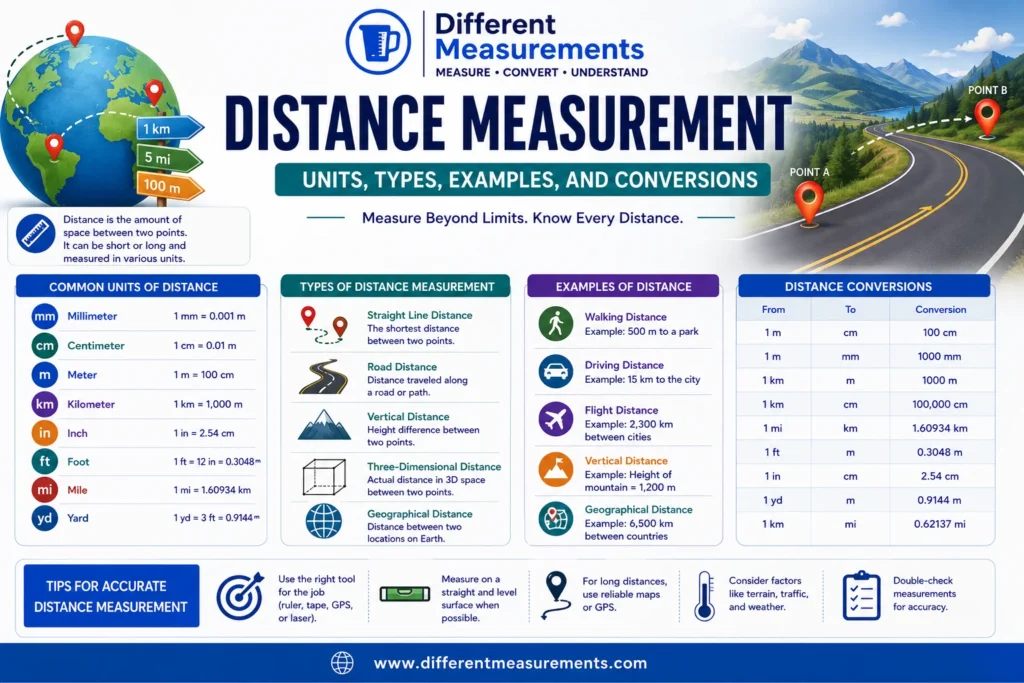
Because distance is a length-based quantity, it is measured using the same units applied to length generally.
Metric Units
- millimeter (mm): extremely short distances, precision measurements
- centimeter (cm): small distances, such as between nearby objects
- meter (m): everyday and scientific distances
- kilometer (km): roads, travel, and geographic distances
Imperial and US Customary Units
- inch (in): small distances
- foot (ft): everyday and construction measurements
- yard (yd): sports fields and larger everyday measurements
- mile (mi): roads and travel distances
Miles are commonly used for road distances in the United States and several other countries, while kilometers dominate in most of the rest of the world.
Nautical Units
- nautical mile (nmi): used in aviation and maritime navigation
The nautical mile has a precise, internationally agreed definition:
1 nautical mile = 1,852 meters exactly
Converted to statute miles (the standard mile used on land):
1 nautical mile ≈ 1.150779 statute miles
Scientific and Astronomical Distance Units
For distances too large to conveniently express in meters or kilometers, science and astronomy use specialized units.
Astronomical Unit
An astronomical unit (AU) is approximately the average distance between Earth and the Sun. The modern defined value is:
1 AU = 149,597,870,700 meters
The astronomical unit is commonly used to express distances within the Solar System, such as the distance between planets.
Light-Year
A light-year is a unit of distance, not time, despite the word “year” appearing in its name. It is defined as the distance light travels in a vacuum over the course of one Julian year.
The approximate value is:
1 light-year ≈ 9.4607 × 10¹⁵ meters
Light-years are used to express vast interstellar distances, such as the distance between stars or galaxies, where even kilometers become impractically small units to work with.
Parsec
A parsec is another astronomical distance unit, commonly used by astronomers for measuring distances to stars and galaxies. It is defined based on parallax angle measurements and relates to the light-year as follows:
1 parsec ≈ 3.26 light-years
Common Distance Units
| Unit | Symbol | Common Use |
|---|---|---|
| millimeter | mm | Very short distances |
| centimeter | cm | Small distances |
| meter | m | Everyday and scientific distances |
| kilometer | km | Roads and geographic distances |
| inch | in | Small distances |
| foot | ft | Everyday and construction measurements |
| yard | yd | Sports and larger everyday measurements |
| mile | mi | Roads and travel |
| nautical mile | nmi | Aviation and maritime navigation |
| astronomical unit | AU | Solar System distances |
| light-year | ly | Interstellar and astronomical distances |
| parsec | pc | Astronomy |
Types of Distance Measurement
Straight-Line Distance
Straight-line distance, sometimes called “as the crow flies” distance, describes the direct separation between two points, without regard to any obstacles or paths in between. Examples include the distance between two points on a diagram, the distance across a room, or the direct distance between two geographic locations.
Travel Distance
Travel distance describes the total distance covered along an actual route, which may be longer than the straight-line distance due to turns, obstacles, or indirect paths. For example, a driver traveling 120 km along a winding road covers more ground than the direct straight-line distance between the starting point and destination.
Road Distance
Road distance specifically follows the available road network between two locations. Because roads rarely run in perfectly straight lines, road distance is often longer than straight-line distance, sometimes significantly so in areas with winding routes, detours, or geographic obstacles like mountains and rivers.
Geographic Distance
Geographic distance describes the distance between locations on Earth’s surface, often calculated using map distance, great-circle distance, or geographic coordinates. Great-circle distance, in particular, accounts for Earth’s curvature and represents the shortest possible path between two points on a sphere, which is especially important for long-distance air travel routes.
Horizontal Distance
Horizontal distance refers to distance measured across a horizontal plane, commonly used in surveying, construction, and mapping applications where vertical differences are not the focus.
Vertical Distance
Vertical distance refers to distance measured upward or downward, such as building height, elevation difference between two points, or the depth of a hole or body of water.
Radial Distance
Radial distance describes distance measured outward from a central point. Common examples include the radius of a circle, distances in circular or rotational measurements, and distances used in astronomy when describing an object’s position relative to a central body.
How Is Distance Measured?
Measuring distance generally follows a consistent process:
- Identify the two points or the starting and ending positions relevant to the measurement.
- Determine whether straight-line or path distance is required, since the appropriate method depends on this distinction.
- Select the appropriate measuring method, based on the scale and context of the measurement.
- Choose a suitable unit, matching the scale of the distance being measured.
- Take or calculate the measurement, using a physical tool, formula, or technology as appropriate.
- Record the value with its unit, since a number alone is incomplete without context.
- Convert units if needed, depending on the required format or audience.
The specific method used depends heavily on scale, ranging from a simple ruler for small distances to GPS or surveying equipment for large geographic distances.
Tools Used to Measure Distance
Ruler
Rulers are suitable for measuring small distances, such as the gap between two points on paper or a small object.
Measuring Tape
Measuring tape is commonly used for rooms, furniture, construction projects, and everyday objects where a flexible tool can span the distance being measured.
Wheel Measuring Device
Measuring wheels, sometimes called surveyor’s wheels, allow users to measure longer ground distances by rolling the device along the path and reading the total distance covered.
Laser Distance Meter
Laser distance meters are widely used for measuring distances within rooms, buildings, and construction sites, offering quick and accurate readings without requiring physical contact across the entire distance.
GPS
Global Positioning System (GPS) technology estimates distances between geographic locations using satellite signals, making it useful for navigation, mapping, and tracking travel distances in real time.
Maps
Maps allow distance estimation using a map’s scale, which relates a measured distance on the map to a corresponding real-world distance.
Surveying Equipment
Professional surveying relies on specialized tools such as:
- Total stations
- Laser levels
- Other precision surveying instruments
These tools are used for highly accurate professional measurements in construction, land development, and infrastructure projects.
Distance Measurement Formulas
Straight-Line Distance in One Dimension
For two points along a single line, distance is calculated as the absolute difference between their positions:
Distance = |x₂ − x₁|
This formula ensures the result is always a positive value, since distance itself is a scalar quantity without direction.
Distance Between Two Points in a Plane
For two points on a two-dimensional plane, the distance formula is:
d = √[(x₂ − x₁)² + (y₂ − y₁)²]
Here, (x₁, y₁) and (x₂, y₂) represent the coordinates of the two points, and the formula applies the Pythagorean theorem to calculate the straight-line distance between them.
Three-Dimensional Distance
For points in three-dimensional space, the formula extends to include a third coordinate:
d = √[(x₂ − x₁)² + (y₂ − y₁)² + (z₂ − z₁)²]
This formula is useful in applications such as 3D modeling, engineering, and physics, where positions are described using three spatial coordinates.
Distance From Speed and Time
When an object moves at a known speed for a known duration, distance can be calculated as:
Distance = Speed × Time
For example, a car traveling at 80 km/h for 3 hours covers a distance of 240 km. This formula assumes the speed is constant, or that the given speed value represents an appropriate average speed over the time interval being considered.
Distance Measurement Examples
Example 1: Distance Between Two Points
Point A is at position 10 m, and Point B is at position 35 m.
Distance = |35 − 10| = 25 m
Example 2: Distance Using Speed and Time
A car travels at 60 km/h for 2 hours.
Distance = Speed × Time Distance = 60 km/h × 2 h Distance = 120 km
Example 3: Distance Between Two Points on a Coordinate Plane
Point A = (2, 3) Point B = (8, 11)
d = √[(8 − 2)² + (11 − 3)²] d = √[(6)² + (8)²] d = √[36 + 64] d = √100 d = 10
The distance between the two points is 10 units.
Example 4: Converting a Road Distance
Convert 25 km to meters.
25 × 1,000 = 25,000 m
Example 5: Travel Distance
A person travels 5 km in the morning and 7 km in the afternoon.
Total distance = 5 km + 7 km = 12 km
Metric Distance Conversions
- 1 km = 1,000 m
- 1 m = 100 cm
- 1 m = 1,000 mm
- 1 cm = 10 mm
- 1 km = 100,000 cm
- 1 km = 1,000,000 mm
Imperial and US Customary Distance Conversions
- 1 foot = 12 inches
- 1 yard = 3 feet
- 1 mile = 5,280 feet
- 1 mile = 1,760 yards
- 1 inch = 2.54 cm exactly
- 1 foot = 0.3048 m exactly
- 1 yard = 0.9144 m exactly
- 1 mile = 1.609344 km exactly
Nautical Distance Conversions
- 1 nautical mile = 1,852 m
- 1 nautical mile ≈ 1.150779 statute miles
It is important not to confuse a nautical mile with a regular statute mile or with a kilometer. A nautical mile is longer than a statute mile and is based on a different historical definition tied to Earth’s circumference, specifically one minute of latitude along a meridian, rather than the land-based definitions used for the standard mile.
Distance Conversion Chart
| From | To | Conversion |
|---|---|---|
| 1 km | m | 1,000 m |
| 1 m | cm | 100 cm |
| 1 m | mm | 1,000 mm |
| 1 mile | km | 1.609344 km |
| 1 km | miles | ≈0.621371 mi |
| 1 foot | m | 0.3048 m |
| 1 yard | m | 0.9144 m |
| 1 nautical mile | km | 1.852 km |
Distance Conversion Examples
Example 1: Kilometers to Meters
Convert 8 km to meters.
8 × 1,000 = 8,000 m
Example 2: Meters to Kilometers
Convert 3,500 m to kilometers.
3,500 ÷ 1,000 = 3.5 km
Example 3: Miles to Kilometers
Convert 10 miles to kilometers.
10 × 1.609344 = 16.09344 km
Example 4: Kilometers to Miles
Convert 25 km to miles.
25 × 0.621371 ≈ 15.53 miles
Example 5: Feet to Meters
Convert 100 feet to meters.
100 × 0.3048 = 30.48 m
Example 6: Nautical Miles to Kilometers
Convert 12 nautical miles to kilometers.
12 × 1.852 = 22.224 km
Distance on Maps
Maps allow distance to be estimated using a map’s scale, which expresses the relationship between a measured distance on the map and the corresponding real-world distance.
For example, if 1 cm on a map represents 10 km, then 4 cm on that same map represents 40 km. This proportional relationship allows users to estimate real-world distances by measuring directly on a printed or digital map.
It is worth remembering that actual road distance often differs from straight-line map distance, since roads rarely follow perfectly direct paths between two points.
Distance Between Cities
There are several distinct ways to describe the distance between two cities:
- Straight-line distance: the direct geographic separation between two points
- Driving distance: the distance along available roads
- Flight distance: the distance an aircraft travels, often closely following great-circle routes
- Rail distance: the distance along available rail lines
These values can differ significantly depending on geography, available infrastructure, and route efficiency. No single type of distance is universally “correct”; the appropriate measurement depends on the purpose, whether that is estimating travel time, calculating fuel usage, or understanding geographic separation.
Distance Traveled
Total distance traveled is calculated by adding together the lengths of individual travel segments, whether covered by walking, running, cycling, driving, or flying.
For example:
3 km + 4 km + 2 km = 9 km
This approach applies regardless of the mode of transportation, as long as each segment’s distance is measured or estimated consistently.
Distance and Speed
Distance, speed, and time are closely connected through a simple set of relationships:
- Distance = Speed × Time
- Speed = Distance ÷ Time
- Time = Distance ÷ Speed
For example, if a cyclist travels 30 km in 2 hours, their average speed is:
Speed = Distance ÷ Time Speed = 30 km ÷ 2 h Speed = 15 km/h
Distance in Science and Engineering
Distance plays a central role across many technical fields:
- Physics relies on distance to describe motion, forces, and spatial relationships between objects.
- Engineering uses distance measurements for design specifications, tolerances, and structural planning.
- Astronomy depends on specialized distance units, such as astronomical units, light-years, and parsecs, to describe the vast scales involved in space.
- Geography uses distance to describe separation between locations, geographic features, and regions.
- Surveying relies on precise distance measurement to establish property boundaries, elevations, and construction layouts.
- Construction uses distance measurements constantly, from room dimensions to material placement.
- Transportation depends on accurate distance data for route planning, fuel calculations, and logistics.
- Navigation relies on distance measurement for determining position, direction, and travel routes, whether on land, at sea, or in the air.
Distance Measurement Accuracy
Several factors can affect the accuracy of a distance measurement:
- Measuring tool precision, since different tools offer different levels of accuracy
- Uneven surfaces, which can distort ground-based measurements
- Incorrect starting point, leading to a shifted or inaccurate reading
- Incorrect ending point, producing similar errors
- GPS accuracy, which can vary based on satellite signal strength and environmental conditions
- Map scale, since inaccurate or imprecise scale readings distort estimated distances
- Curved routes, which complicate distinguishing straight-line distance from actual travel distance
- Environmental conditions, such as weather affecting laser or GPS-based tools
- Human reading error, particularly with manual tools like tape measures
- Rounding, especially when converting between unit systems
Improving accuracy generally involves using appropriately precise tools for the scale of the measurement, taking multiple readings when possible, and being clear about whether straight-line or travel distance is required.
Distance vs Travel Distance vs Straight-Line Distance
| Type | Meaning | Example |
|---|---|---|
| Straight-line distance | Direct separation between two points | 5 km between two locations |
| Travel distance | Total path traveled | 7 km walking route |
| Road distance | Distance along roads | 12 km driving distance |
| Vertical distance | Upward or downward separation | 20 m elevation difference |
Common Distance Measurement Mistakes
- Confusing distance with displacement. Distance is the total path traveled, while displacement is the straight-line change in position, including direction.
- Confusing distance with length. While related, these terms are typically used differently depending on whether the focus is an object’s size or the separation between points.
- Using miles instead of nautical miles, or vice versa, without recognizing that these are different units with different values.
- Confusing kilometers and miles, which represent significantly different distances and are not interchangeable without conversion.
- Forgetting to include units, since a number alone does not convey a complete distance measurement.
- Using a straight-line distance when road distance is required, leading to inaccurate travel time or fuel estimates.
- Using road distance when direct distance is required, which can overstate the true separation between two points.
- Confusing feet with meters, two units that differ significantly in size.
- Mixing units in the same calculation without converting them to a consistent unit first.
- Treating a light-year as a measurement of time. Despite the name, a light-year measures distance, not duration.
- Confusing nautical miles with statute miles, which represent different distances despite similar names.
- Rounding too early in multi-step calculations, which can introduce small but meaningful errors in the final result.
Common Questions About Distance Measurement
Distance measurement quantifies how far apart two points, objects, or locations are, either as a straight-line separation or as the total length of a path traveled, expressed using units of length.
Distance measurement quantifies how far apart two points, objects, or locations are, either as a straight-line separation or as the total length of a path traveled, expressed using units of length.
The SI base unit used for distance is the meter.
Common units include meters, kilometers, and centimeters in the metric system, and inches, feet, yards, and miles in the Imperial and US customary systems, along with specialized units like the nautical mile and light-year for specific contexts.
Length generally describes the size or extent of an object, while distance generally describes the separation between two points, though both are measured using the same units.
Distance is the total path traveled between two points and is always positive, while displacement is the straight-line change in position, including direction, and can be zero even if distance traveled is significant.
Distance is measured using tools such as rulers, tape measures, laser distance meters, GPS, or maps, depending on the scale involved, or calculated using mathematical formulas when positions are known.
Common distance formulas include Distance = |x₂ − x₁| for one dimension, the Pythagorean-based formula d = √[(x₂ − x₁)² + (y₂ − y₁)²] for two dimensions, and Distance = Speed × Time when speed and time are known.
Multiply speed by time, using the formula Distance = Speed × Time, ensuring the units for speed and time are compatible.
There are 1,000 meters in a kilometer.
One mile equals 1.609344 kilometers.
One mile equals 5,280 feet.
A nautical mile is a unit of distance used primarily in aviation and maritime navigation, equal to exactly 1,852 meters.
One nautical mile equals 1.852 kilometers.
A light-year is a unit of distance equal to the distance light travels in a vacuum over one Julian year, approximately 9.4607 × 10¹⁵ meters.
A light-year is a unit of distance, not time, despite the word “year” appearing in its name.
Final Thoughts
Distance measurement underlies countless everyday tasks and technical fields, from estimating a walking route to calculating the vast separations between stars. Understanding how distance differs from related concepts like length and displacement, along with knowing the appropriate units and formulas for different scales, makes it easier to interpret and communicate measurements accurately.