Height is one of the most frequently measured dimensions in everyday life, from checking a child’s growth to confirming a doorway will fit a new refrigerator. Height generally describes the vertical dimension of an object, person, structure, or space, capturing how tall something is or how far it extends upward from a reference point.
A few everyday examples show how often height comes up:
- A person’s height is 175 cm.
- A door is 2.1 m high.
- A building is 50 m high.
- A tree is 12 m tall.
- A room has a ceiling height of 2.7 m.
The exact meaning of height can shift slightly depending on the object and measurement context, which is why this guide covers not only how height is measured, but also how it differs from length, width, depth, and distance.
What Is Height Measurement?
Height measurement is a linear measurement that describes how tall something is, or the vertical distance between a reference point and a higher point. Common examples include:
- Human height
- Building height
- Ceiling height
- Door height
- Tree height
- Container height
Height is normally measured using units of length, the same category of units used for measuring distance, length, and width.
What Is the Standard Unit of Height?
Height does not have its own separate SI base unit. Because height is a length measurement, the SI base unit that applies is the meter (m). Centimeters, millimeters, kilometers, inches, feet, and yards are also commonly used to express height, depending on the size of the object and the measurement system in use.
Height should not be described as having its own unique SI unit. It simply borrows from the same unit system used for any other linear measurement.
Height vs Length
Height and length are both linear measurements, but they describe different aspects of an object.
- Length generally describes the distance from one end of an object to another, often along its longest or primary axis.
- Height generally describes vertical extent, or how tall something is.
Consider a table:
- Length = 120 cm
- Width = 60 cm
- Height = 75 cm
Terminology can shift depending on orientation and context. A plank of wood lying flat might have its longest dimension called “length,” but once that same plank is stood upright, the vertical dimension may be referred to as “height” instead. Height is not always vertical in every mathematical or technical application either. In geometry, for instance, the “height” of a triangle refers to a perpendicular distance relative to a chosen base, which may not align with a vertical direction in real space.
Height vs Width
Height and width describe two different dimensions of an object:
- Height describes the vertical dimension.
- Width describes the distance across an object, typically from side to side.
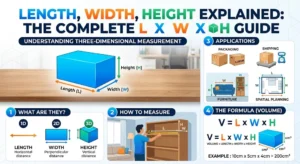
Consider a rectangular box:
- Length = 50 cm
- Width = 30 cm
- Height = 20 cm
Here, height refers specifically to how tall the box stands, while width refers to how wide it is when viewed from the front.
Height vs Depth
Height and depth are frequently confused, particularly in furniture and product descriptions.
- Height generally describes vertical extent, or how tall something is.
- Depth often describes how far something extends from front to back, or from an outer surface inward.
Examples that illustrate this distinction include:
- Cabinet height (how tall the cabinet stands) vs cabinet depth (how far it extends from the wall)
- Swimming pool depth (how far down the water goes) vs pool width (how wide the pool is)
- Box height (top to bottom) vs box depth (front to back)
Terminology can vary between industries, and some product listings use “depth” and “height” inconsistently, so checking a diagram or definition when available is often the safest approach.
Height vs Distance
Height can be considered a specific type of distance, but the two terms are not always interchangeable. Height typically refers to vertical distance, while “distance” more broadly can refer to horizontal separation, straight-line distance, or travel distance between two points.
Examples that clarify this distinction:
- The height of a building refers to its vertical dimension.
- The distance between two cities refers to horizontal or geographic separation.
- The height above sea level refers to vertical elevation relative to a reference point.
Height Measurement Units
Because height is a form of linear measurement, it is expressed using the same units used for length.
Metric Units
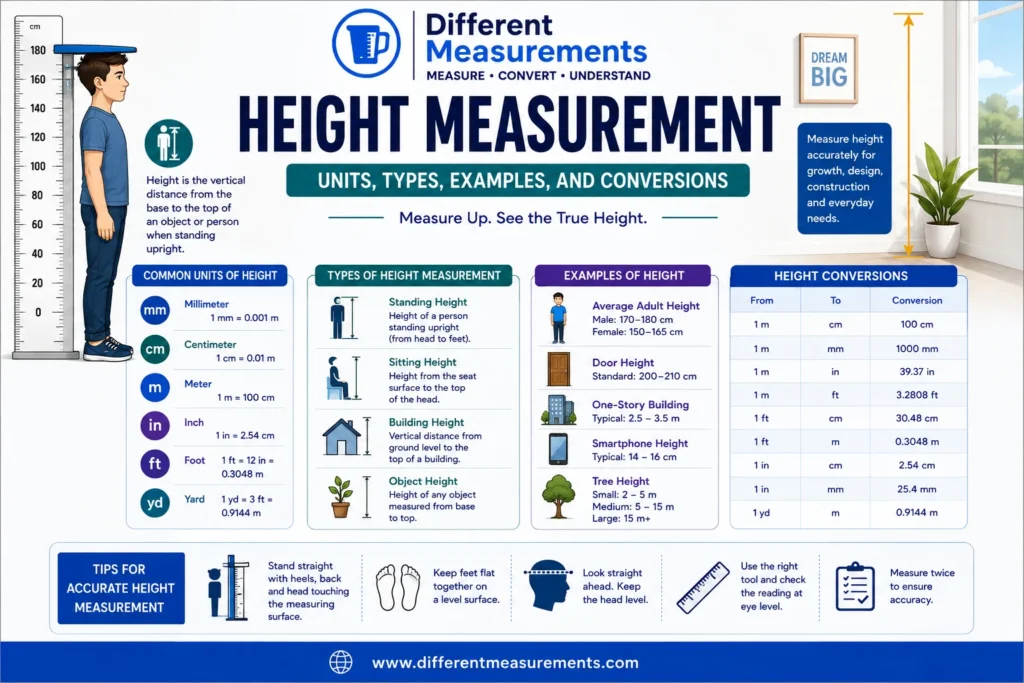
- millimeter (mm): very small objects, fine measurements
- centimeter (cm): human height, small to medium objects
- meter (m): buildings, rooms, trees, and larger structures
- kilometer (km): very large elevations or geographic height differences
Imperial and US Customary Units
- inch (in): small objects, body measurements
- foot (ft): human height, rooms, buildings
- yard (yd): larger objects or spaces
- mile (mi): rarely used for height directly, but relevant for large elevation changes
Feet and inches are especially common for expressing human height and everyday object dimensions in the United States, while centimeters and meters dominate in most other countries and in scientific contexts.
Common Height Units
| Unit | Symbol | Common Height Examples |
|---|---|---|
| millimeter | mm | Small objects |
| centimeter | cm | Human height, small objects |
| meter | m | Rooms, doors, buildings |
| kilometer | km | Large elevations or geographic distances |
| inch | in | Small objects, body measurements |
| foot | ft | Human height, rooms, buildings |
| yard | yd | Larger objects or spaces |
Not every unit is equally common for height. Millimeters are rarely used for measuring a person or a building, and kilometers are almost never used for everyday object height, but each unit has its place depending on scale.
How Is Height Measured?
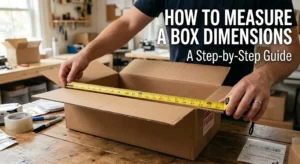
Measuring height generally follows this process:
- Identify the bottom reference point, such as the floor, ground level, or base of an object.
- Identify the highest point to be measured.
- Select the appropriate measuring tool based on the object’s size and required precision.
- Keep the measurement vertical when measuring physical height, avoiding tilted or angled readings.
- Make sure the starting point is level and consistent, since an uneven base can distort the result.
- Record the measurement.
- Include the correct unit, since a number alone is not a complete measurement.
- Convert the result if necessary, depending on the required format or audience.
Measurement methods vary depending on whether the subject is a person, an object, a building, or a natural structure like a tree.
How to Measure Human Height
Measuring human height accurately involves a simple, repeatable method:
- Stand barefoot on a flat, hard surface.
- Stand upright with heels positioned against a wall or measuring surface.
- Keep the head in a consistent, level position, looking straight ahead.
- Place a flat object, such as a book or a stadiometer’s headpiece, against the top of the head.
- Mark the wall at the point where the flat object meets it.
- Measure from the floor to the mark using a tape measure or ruler.
Posture, footwear, and measurement technique can all affect the result, which is why standardized methods like using a stadiometer are preferred in clinical or professional settings. This guide focuses on the measurement process itself rather than any medical interpretation of height results.
Tools Used to Measure Height
Stadiometer
A stadiometer is a tool designed specifically for measuring human height, commonly used in medical offices, schools, and fitness settings. It typically includes a vertical ruler and a sliding horizontal headpiece for consistent, accurate readings.
Measuring Tape
Measuring tape is versatile and commonly used for:
- People
- Doors
- Furniture
- Walls
- Construction projects
Ruler
Rulers work well for measuring the height of small objects, such as boxes, books, or craft materials.
Height Rod
Height rods are vertical measuring devices, often used in medical, educational, or livestock measurement contexts, offering a fixed and stable reference for repeatable readings.
Laser Distance Meter
Laser distance meters can measure vertical distances efficiently in suitable environments, such as measuring ceiling height or the height of a wall, particularly useful when a physical tape measure would be difficult to hold steady over a long vertical span.
Surveying Equipment
For larger-scale height measurements, professionals use tools such as:
- Total stations
- Laser levels
- Other specialized surveying instruments
These tools are used in construction and land surveying to measure building height, land elevation, and other large-scale vertical dimensions with high precision.
Types of Height Measurement
Human Height
Human height is usually measured from the floor to the top of the head, using centimeters, meters, or feet and inches depending on the region and context.
Object Height
Common examples include the height of furniture, appliances, boxes, containers, and equipment, all measured from their base to their highest point.
Room Height
Room height, often called ceiling height, refers to the vertical distance from the floor to the ceiling.
Building Height
Building height may be measured from a defined reference point, such as ground level, to the highest relevant point of the structure. Building height definitions can vary depending on building codes and specific measurement standards, which may include or exclude features like antennas, spires, or rooftop equipment.
Tree Height
Tree height can be measured directly for smaller trees using a tape measure or height rod, but larger trees often require surveying tools or trigonometric estimation methods, since climbing or extending a tape measure to the top is impractical.
Elevation or Height Above Sea Level
Elevation describes vertical position relative to a reference level, most commonly mean sea level or another defined geographic datum. Elevation and physical height are related concepts, but they are not identical in every context, since elevation is a position relative to a fixed reference, while height typically describes an object’s own vertical extent.
Height in Geometry
Rectangle
In a rectangle, height may refer to the vertical side, depending on how the shape is oriented. Since a rectangle’s dimensions are simply length and width (or equivalently, base and height), the labels applied depend on context and orientation rather than a fixed rule.
Triangle
The height of a triangle is the perpendicular distance from a vertex to the opposite side, known as the base, or to an extension of that side if needed.
The area formula for a triangle is:
Area = 1/2 × Base × Height
Rearranged to solve for height:
Height = (2 × Area) ÷ Base
For example, a triangle with an area of 24 cm² and a base of 8 cm has a height of:
Height = (2 × 24) ÷ 8 = 6 cm
Rectangular Prism
For a rectangular prism, volume is calculated as:
Volume = Length × Width × Height
Rearranged to solve for height:
Height = Volume ÷ (Length × Width)
Height Measurement Formulas
- For a rectangle: Height = Area ÷ Width
- For a triangle: Height = (2 × Area) ÷ Base
- For a rectangular prism: Height = Volume ÷ (Length × Width)
The correct formula depends on the shape involved and which measurements are already known. In most everyday situations, height is measured directly rather than calculated.
Height Measurement Examples
Example 1: Measuring a Door
A door is 210 cm high. This value is recorded directly using a tape measure, placed vertically from the floor to the top of the door frame.
Example 2: Calculating Height From Area
A rectangle has an area of 30 m² and a width of 5 m.
Height = Area ÷ Width Height = 30 m² ÷ 5 m Height = 6 m
Example 3: Calculating Height From Volume
A rectangular box has a volume of 0.36 m³, a length of 0.8 m, and a width of 0.6 m.
Height = Volume ÷ (Length × Width) Height = 0.36 m³ ÷ (0.8 m × 0.6 m) Height = 0.36 m³ ÷ 0.48 m² Height = 0.75 m
Example 4: Triangle Height
A triangle has an area of 24 cm² and a base of 8 cm.
Height = (2 × Area) ÷ Base Height = (2 × 24 cm²) ÷ 8 cm Height = 48 cm² ÷ 8 cm Height = 6 cm
Height Conversion
Height conversions are length conversions. There is no special conversion system unique to height, and the same length conversion factors used for any other linear measurement apply directly. Common conversions include:
- meters to centimeters
- centimeters to meters
- meters to millimeters
- millimeters to centimeters
- inches to centimeters
- centimeters to inches
- feet to centimeters
- feet to meters
- meters to feet
- yards to meters
- meters to yards
Metric Height Conversions
- 1 m = 100 cm
- 1 m = 1,000 mm
- 1 cm = 10 mm
- 1 km = 1,000 m
- 1 cm = 0.01 m
- 1 mm = 0.001 m
Imperial and US Customary Height Conversions
- 1 inch = 2.54 cm exactly
- 1 foot = 12 inches
- 1 yard = 3 feet
- 1 foot = 0.3048 m exactly
- 1 yard = 0.9144 m exactly
- 1 mile = 1.609344 km exactly
Feet and Inches for Human Height
Human height in the United States is commonly written using a combination of feet and inches, such as:
5 ft 10 in
or in shorthand:
5’10”
The first number represents feet, and the second represents inches. It is important not to confuse this notation with a decimal number. 5’10” is not the same as 5.10 feet.
Since 1 foot equals 12 inches, 5 ft 10 in converts to a single unit of inches as follows:
5 ft × 12 = 60 inches 60 + 10 = 70 inches
Converting inches to centimeters:
70 × 2.54 = 177.8 cm
So a height of 5 ft 10 in is equivalent to 177.8 cm.
Converting Centimeters to Feet and Inches
Converting from centimeters to feet and inches involves two steps.
Example: Convert 180 cm to feet and inches.
First, convert centimeters to total inches:
180 ÷ 2.54 ≈ 70.87 inches
Next, convert total inches to feet:
70.87 ÷ 12 ≈ 5 feet, with a remainder of approximately 10.87 inches
This gives a final result of approximately:
180 cm ≈ 5 ft 10.9 in
Rounding may vary slightly depending on the precision used at each step of the calculation.
Height Conversion Chart
| From | To | Conversion |
|---|---|---|
| 1 m | cm | 100 cm |
| 1 m | mm | 1,000 mm |
| 1 cm | mm | 10 mm |
| 1 inch | cm | 2.54 cm |
| 1 foot | cm | 30.48 cm |
| 1 foot | m | 0.3048 m |
| 1 yard | m | 0.9144 m |
| 1 mile | km | 1.609344 km |
Height Conversion Examples
Example 1: Meters to Centimeters
Convert 1.75 m to cm.
1.75 × 100 = 175 cm
Example 2: Centimeters to Meters
Convert 175 cm to m.
175 ÷ 100 = 1.75 m
Example 3: Inches to Centimeters
Convert 70 inches to cm.
70 × 2.54 = 177.8 cm
Example 4: Feet to Centimeters
Convert 6 feet to cm.
6 × 30.48 = 182.88 cm
Example 5: Feet and Inches to Centimeters
Convert 5 ft 8 in to centimeters.
5 ft × 12 = 60 inches 60 + 8 = 68 inches 68 × 2.54 = 172.72 cm
Example 6: Centimeters to Feet and Inches
Convert 170 cm to feet and inches.
170 ÷ 2.54 ≈ 66.93 inches 66.93 ÷ 12 ≈ 5 feet, with a remainder of approximately 6.93 inches
Result: 170 cm ≈ 5 ft 6.9 in
Approximate Heights of Common Objects
| Object | Approximate Height |
|---|---|
| Dining table | 75 cm |
| Kitchen counter | 90 cm |
| Interior door | 200 to 210 cm |
| Refrigerator | 170 to 180 cm |
| Desk | 70 to 75 cm |
| Chair (seat height) | 45 cm |
| Room ceiling | 240 to 270 cm |
| Basketball hoop | 305 cm (10 ft) |
| Building floor | 300 to 400 cm per story |
These values are typical or approximate and can vary based on design, region, and specific product or building standards. A basketball hoop is one of the few examples with a widely standardized height, since regulation courts set the rim at exactly 10 feet.
Human Height Measurement
Human height is commonly expressed using different units depending on the region:
Metric:
- centimeters (e.g., 170 cm)
- meters (e.g., 1.70 m)
US customary:
- feet and inches (e.g., 5 ft 7 in)
These values represent the same physical height once correctly converted between systems. For example, 170 cm, 1.70 m, and 5 ft 7 in (approximately) all describe a similar height, with minor rounding differences depending on the precision used in conversion.
Height Above Sea Level
Several related terms describe vertical position relative to a reference level:
- Elevation generally refers to the height of a point on Earth’s surface relative to sea level or another defined datum.
- Altitude generally refers to the height of an object, such as an aircraft, above a reference point, often the ground or sea level, and is commonly used in aviation contexts.
- Height above sea level is a specific way of expressing elevation using sea level as the reference point.
These terms can carry different technical meanings depending on context. Examples include:
- Mountain elevation, describing how high a peak rises above sea level
- Aircraft altitude, describing how high a plane is flying above the ground or sea level
- Building elevation, describing a structure’s height relative to a defined ground reference
- Geographic elevation, used broadly in mapping and land surveying
Height Measurement in Different Industries
Construction
Height plays a central role in ceiling height, door height, wall height, building height, and equipment clearance requirements, all of which must meet specific building codes and safety standards.
Manufacturing
Manufacturing relies on accurate height measurements for product height, machine height, component dimensions, and packaging dimensions, often requiring tight tolerances.
Architecture
Architects work extensively with floor-to-ceiling height, overall building height, and structural dimensions when designing spaces that are both functional and code-compliant.
Transportation
Vehicle height, clearance height, and bridge height are critical safety measurements that prevent collisions and ensure vehicles can safely pass beneath structures.
Sports
Height measurements appear throughout sports, from athlete height to equipment height, such as the standardized height of a basketball hoop, to jump height in athletic performance testing.
Geography
Elevation, mountain height, and land elevation are essential measurements in geography, mapping, and environmental science.
Height and Product Dimensions
Product dimensions are commonly written in the format:
Length × Width × Height
For example:
40 × 30 × 20 cm
In this convention, the third value listed is often height, but dimension order can vary depending on the manufacturer or industry. It is always worth checking the manufacturer’s stated dimension order rather than assuming which number represents height, width, or length.
Height Measurement Accuracy
Several factors can affect the accuracy of a height measurement:
- Uneven floor, which can throw off the reference point
- Incorrect posture, particularly when measuring human height
- Shoes, which add extra height if not removed
- Hair, which can affect the top reference point for human height measurements
- Measuring tool position, if not held vertically or aligned properly
- Tilted measuring tape, which produces a longer, inaccurate reading
- Uneven surfaces, affecting both the base and top reference points
- Incorrect reference point, such as measuring from the wrong starting location
- Rounding, particularly when converting between unit systems
- Instrument precision, since different tools offer different levels of accuracy
Improving accuracy generally involves using a level, consistent reference point, keeping the measuring tool vertical, and taking multiple readings when precision matters.
Measuring Height Without a Measuring Tape
Several practical alternatives exist when a measuring tape is not available:
- Ruler, useful for smaller objects
- Straight object and wall, using a flat object placed against a wall as a reference marker
- Known-size reference object, comparing an unknown height to an object of known size
- Laser measurement device, offering quick and often accurate vertical readings
- Smartphone measurement apps, which use camera and sensor technology to estimate dimensions
Smartphone and camera-based measurements can be convenient, but they may be less accurate than calibrated physical measuring tools, particularly for precise or professional applications.
Height of Irregular Objects
Irregular objects may not have a single, simple height. Common approaches for handling this include:
- Maximum height, describing the tallest point of the object
- Minimum height, describing the shortest point of the object
- Height at a defined reference point, useful when a specific location matters more than the overall shape
- Multiple height measurements, recorded when the object’s shape varies significantly
Examples include curved furniture, irregular packaging, natural objects like rocks or plants, and sculptures, all of which may require more than one height value to describe accurately.
Height vs Thickness
Height and thickness describe different physical characteristics:
- Height describes how tall something is.
- Thickness describes the distance between opposite surfaces of a material.
Examples that clarify the distinction:
- Wall height (floor to ceiling) vs wall thickness (how thick the wall material itself is)
- Glass height (top to bottom of a pane) vs glass thickness (how thick the glass is)
- Sheet height (vertical dimension of a sheet) vs sheet thickness (how thick the sheet material is)
Common Height Measurement Mistakes
- Confusing height with length. These terms can overlap depending on orientation, leading to inconsistent labeling.
- Confusing height with width. Height refers to vertical extent, while width refers to a side-to-side distance.
- Confusing height with depth. Depth typically describes a front-to-back measurement, distinct from vertical height.
- Measuring diagonally. A diagonal measurement produces an inaccurate, exaggerated height reading.
- Using the wrong unit. Mixing metric and Imperial units without converting leads to significant errors.
- Forgetting to record the unit. A number alone, such as “175,” is incomplete without specifying cm, in, or another unit.
- Confusing feet and inches. Misreading a combined feet-and-inches value can lead to substantial measurement errors.
- Treating 5’10” as a decimal number. This notation represents 5 feet and 10 inches, not 5.10 feet.
- Using area units for height. Height is a linear measurement and should use units like cm or m, not m².
- Using volume units for height. Volume units like m³ apply to three-dimensional space, not a single linear dimension.
- Measuring human height while wearing shoes. This adds extra height and produces an inaccurate reading.
- Using an uneven surface as the reference point. This introduces inconsistency into the measurement.
- Assuming the third dimension is always height. Dimension order varies by manufacturer and industry, so this assumption can lead to errors.
Common Questions About Height Measurement
Height measurement is a linear measurement that describes how tall an object, person, or structure is, expressed using units of length such as meters, centimeters, or feet and inches.
Common units for height include meters, centimeters, and millimeters in the metric system, and feet and inches in the US customary system.
Height does not have its own separate SI unit. Because height is a length measurement, the SI base unit that applies is the meter.
Height does not have its own separate SI unit. Because height is a length measurement, the SI base unit that applies is the meter.
Not exactly. Length generally describes the distance from one end of an object to another, while height specifically describes vertical extent, though the exact labeling can depend on context and orientation.
Height describes how tall something is, measured vertically, while width describes how wide something is, measured across from side to side.
Height describes vertical extent, while depth typically describes how far something extends from front to back or from an outer surface inward.
Height is measured by identifying a bottom reference point and a top point, then using a measuring tool such as a tape measure, ruler, or stadiometer to record the vertical distance between them.
Human height is typically measured by having a person stand barefoot against a flat surface, keeping the head level, and measuring from the floor to the top of the head using a stadiometer or tape measure.
Divide the centimeter value by 30.48 to get the equivalent height in feet, or divide by 2.54 to get total inches, then divide by 12 for feet and remaining inches.
Multiply the number of feet by 30.48 to get the equivalent height in centimeters, adding any additional inches converted at 2.54 cm each.
There are 30.48 centimeters in one foot.
There are 12 inches in one foot.
For a rectangle, height can be calculated by dividing area by width, using the formula Height = Area ÷ Width.
For a rectangular prism, height can be calculated by dividing volume by the product of length and width, using the formula Height = Volume ÷ (Length × Width).
Height typically describes an object’s own vertical extent, such as how tall a building is, while elevation describes a location’s vertical position relative to a fixed reference point, such as sea level.
Final Thoughts
Height is a fundamental measurement used across everyday life, science, construction, and design, but getting it right requires understanding how it relates to length, width, depth, distance, and elevation, along with using the correct tools and units for the situation. Whether measuring a person, calculating height from area or volume, or converting between feet, inches, and centimeters, the underlying principle remains consistent: height is a linear measurement of vertical extent.