Width is one of the first measurements most people learn to take, yet it is also one of the most commonly confused with other dimensions like length, height, and depth. Whether you are buying furniture, framing a doorway, cutting fabric, or designing packaging, knowing how to measure and express width correctly matters.
Width generally describes the distance from one side of an object, space, or surface to the opposite side. A few everyday examples make this concrete:
- The width of a table
- The width of a door
- The width of a road
- The width of a room
- The width of a package
- The width of a piece of fabric
The exact meaning of “width” can shift slightly depending on the object and context, which is why this guide breaks down not just how to measure width, but how it relates to and differs from length, height, depth, thickness, and diameter.
What Is Width Measurement?
Width measurement is a dimensional measurement that describes how wide an object, space, or surface is. Width is a linear measurement, meaning it is expressed using units of length rather than area or volume units.
Common examples include:
- An 80 cm wide table
- A 90 cm wide door
- A 2 m wide room
- A 10 ft wide road
Width is normally measured along a straight line between two opposite sides of an object, taken perpendicular to those sides whenever the object has a regular, rectangular shape.
What Is the Difference Between Width and Length?
Length and width are closely related but describe different dimensions of an object or space.
- Length usually describes the longest dimension of an object, or the distance from one end to another along a primary axis.
- Width generally describes the distance across an object from side to side, often perpendicular to the length.
Consider a rectangular table:
- Length = 180 cm
- Width = 90 cm
In this example, length is the longer side and width is the shorter side, but this is not a fixed rule. Rotating an object, or simply changing the reference orientation, can change which dimension is labeled length and which is labeled width. In many contexts, the terms are assigned based on convention rather than which measurement is objectively larger.
Width vs Height vs Depth
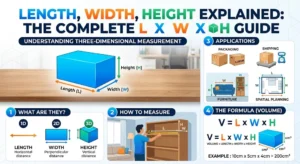
Width is one of several spatial dimensions used to describe objects and spaces, alongside length, height, and depth.
- Length: one horizontal or primary dimension, often the longest side
- Width: the distance across an object, typically perpendicular to length
- Height: the vertical dimension, measuring how tall something is
- Depth: the distance from front to back, or from an outer surface inward
A simple rectangular box illustrates all three dimensions together:
- Length = 60 cm
- Width = 40 cm
- Height = 30 cm
Terminology can vary depending on the industry or the object being described. In furniture and construction, “depth” is often used instead of “width” when describing how far a piece extends from front to back, such as the depth of a bookshelf or cabinet. Understanding the context helps clarify which term applies.
Width Measurement Units
Because width is a linear dimension, it is measured using the same units used for length. The specific unit chosen usually depends on the size of the object and the measurement system in use.
Metric Units
- kilometer (km): large distances, such as road widths in some contexts
- meter (m): rooms, buildings, furniture
- centimeter (cm): everyday objects, packaging, furniture
- millimeter (mm): small parts, materials, manufacturing tolerances
- micrometer (µm): extremely small widths, such as in materials science or manufacturing precision
Imperial and US Customary Units
- inch (in): products, screens, small furniture
- foot (ft): rooms, doors, buildings
- yard (yd): fabric, larger spaces
- mile (mi): roads and large distances
Inches and feet are especially common for width measurements in everyday US customary contexts, from furniture dimensions to door widths.
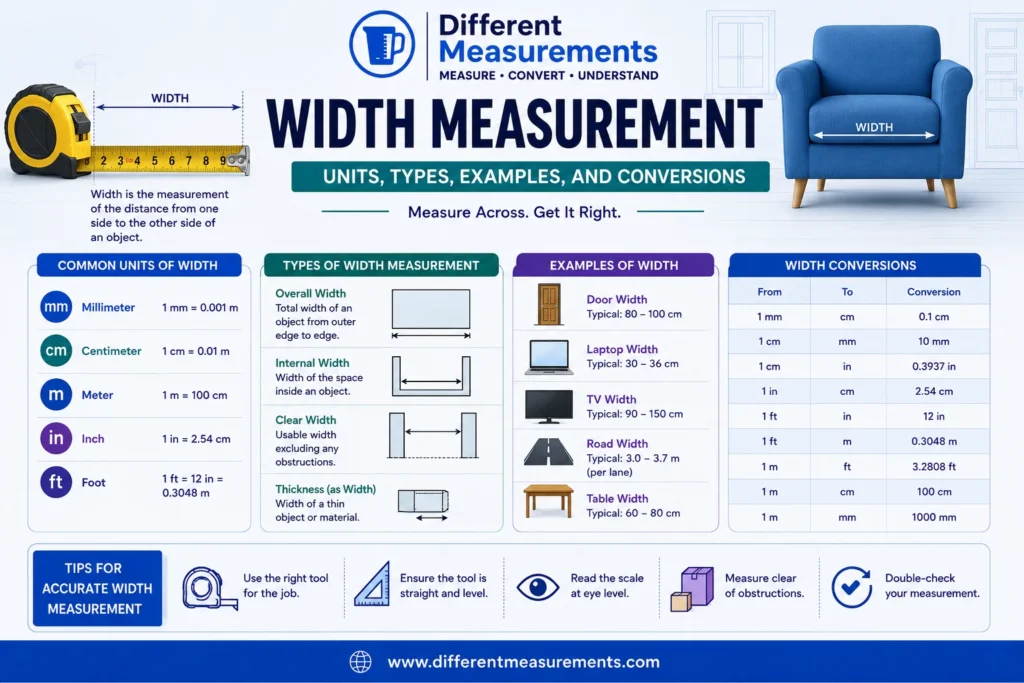
Common Width Units
| Unit | Symbol | Common Width Examples |
|---|---|---|
| kilometer | km | Roads, large geographic distances |
| meter | m | Rooms, buildings, roads |
| centimeter | cm | Furniture, objects, packaging |
| millimeter | mm | Small objects, materials, manufacturing |
| inch | in | Products, screens, furniture |
| foot | ft | Rooms, doors, buildings |
| yard | yd | Fabrics, larger spaces |
| mile | mi | Roads and large distances |
How Is Width Measured?
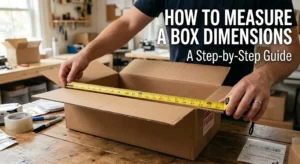
Measuring width accurately follows a consistent general process:
- Identify the two opposite sides of the object or space you are measuring.
- Decide where the width should be measured, especially if the object is irregular or tapered.
- Choose an appropriate measuring tool based on the object’s size and required precision.
- Place the tool correctly, aligning it with the two reference points.
- Keep the measurement line straight, avoiding angles that would distort the result.
- Record the measurement and unit, since a number without a unit is meaningless.
- Convert units if necessary, depending on the required format or audience.
When measuring the width of a regular rectangular object, the measurement should be taken perpendicular to the sides. Measuring at an angle produces a longer, inaccurate reading.
Tools Used to Measure Width
Ruler
Rulers work well for small, flat objects such as:
- Paper
- Books
- Small packaging
- Small craft or school projects
Tape Measure
Tape measures are the most versatile tool for everyday width measurement and are commonly used for:
- Furniture
- Rooms
- Doors
- Construction projects
- Large objects that a rigid ruler cannot span
Caliper
Calipers offer high precision and are used for:
- Small parts
- Mechanical components
- Precise manufacturing dimensions
Calipers can measure external dimensions, internal dimensions, and depth, depending on the type and design of the caliper being used, making them especially valuable in manufacturing and engineering settings.
Laser Distance Meter
Laser distance meters are useful for:
- Rooms
- Walls
- Large open spaces
- Construction sites
The suitability of a laser distance meter depends on the specific device and measurement conditions, such as surface reflectivity and distance range.
Types of Width Measurement
Object Width
Common examples include table width, chair width, box width, and book width, each measured as the distance across the object from one side to the other.
Room Width
Room width is typically measured as the distance between two opposite walls, usually taken at floor level using a tape measure or laser distance meter.
Road Width
Road width can be measured from one edge of the roadway to the other, which is important for construction, planning, and vehicle clearance calculations.
Fabric Width
Textile width is commonly measured across the fabric roll, from one selvage edge to the other, which affects how much usable material a given length of fabric provides.
Packaging Width
Width is a standard part of box and packaging dimensions, typically expressed as:
Length × Width × Height
For example:
30 cm × 20 cm × 15 cm
In this convention, width is the second dimension listed, though the exact order can vary depending on the manufacturer or industry standard being used.
Screen Width
Screen dimensions are often described using diagonal screen size rather than width alone. It is important not to confuse screen diagonal size, such as a “24-inch monitor,” with the screen’s actual width, which is a separate, smaller measurement calculated using the screen’s aspect ratio.
Width in Geometry
Rectangle
A rectangle has two key dimensions: length and width. The area of a rectangle is calculated as:
Area = Length × Width
Rearranged, this gives:
Width = Area ÷ Length
For example, a rectangle with an area of 50 m² and a length of 10 m has a width of 5 m.
Square
A square is a special case where all four sides have equal length. This means the width of a square is simply equal to its side length, since length and width are identical.
Cuboid or Rectangular Prism
A rectangular prism, or cuboid, uses three dimensions: length, width, and height. Its volume is calculated as:
Volume = Length × Width × Height
Rearranged, this gives:
Width = Volume ÷ (Length × Height)
Not every three-dimensional object uses this same length-width-height convention. Cylinders, spheres, and irregular shapes rely on different measurements, such as radius or diameter, rather than a simple width value.
Width Measurement Formulas
- For a rectangle: Width = Area ÷ Length
- For a rectangular prism: Width = Volume ÷ (Length × Height)
- For a direct measurement: Width = Distance between opposite sides
In most everyday situations, width does not require a formula at all. It is measured directly using a ruler, tape measure, or similar tool. Formulas become useful mainly when width needs to be calculated indirectly from a known area or volume.
Width Measurement Examples
Example 1: Measuring a Table
A table is 120 cm long and 60 cm wide. The width, 60 cm, is recorded as the distance across the table, measured perpendicular to its length.
Example 2: Calculating Width From Area
A rectangular floor has an area of 24 m² and a length of 6 m.
Width = Area ÷ Length Width = 24 m² ÷ 6 m Width = 4 m
Example 3: Calculating Width From Volume
A rectangular box has a volume of 0.24 m³, a length of 0.8 m, and a height of 0.3 m.
Width = Volume ÷ (Length × Height) Width = 0.24 m³ ÷ (0.8 m × 0.3 m) Width = 0.24 m³ ÷ 0.24 m² Width = 1 m
Example 4: Measuring a Door
To measure a door’s width accurately, place a tape measure across the door at a consistent height, typically near the middle, ensuring the tape is straight and perpendicular to the door’s edges. Record the measurement in inches or centimeters, depending on the required standard.
Example 5: Measuring a Package
A package has the following dimensions:
- Length = 40 cm
- Width = 25 cm
- Height = 15 cm
These values are typically recorded together in the order Length × Width × Height for shipping and packaging documentation.
Width Conversion
Because width is a linear dimension, converting width between units is identical to converting any other length measurement. No special formula is required. Common conversions include:
- meters to centimeters
- centimeters to meters
- meters to millimeters
- millimeters to centimeters
- inches to centimeters
- centimeters to inches
- feet to meters
- meters to feet
- yards to meters
- meters to yards
Metric Width Conversions
- 1 m = 100 cm
- 1 m = 1,000 mm
- 1 cm = 10 mm
- 1 km = 1,000 m
- 1 cm = 0.01 m
- 1 mm = 0.001 m
Imperial and US Customary Width Conversions
- 1 inch = 2.54 cm exactly
- 1 foot = 12 inches
- 1 yard = 3 feet
- 1 mile = 5,280 feet
Useful metric equivalents:
- 1 foot = 0.3048 m exactly
- 1 yard = 0.9144 m exactly
- 1 mile = 1.609344 km exactly
Width Conversion Chart
| From | To | Conversion |
|---|---|---|
| 1 m | cm | 100 cm |
| 1 m | mm | 1,000 mm |
| 1 cm | mm | 10 mm |
| 1 inch | cm | 2.54 cm |
| 1 foot | m | 0.3048 m |
| 1 yard | m | 0.9144 m |
| 1 mile | km | 1.609344 km |
Width Conversion Examples
Example 1: Meters to Centimeters
Convert 2.5 m to cm.
2.5 × 100 = 250 cm
Example 2: Centimeters to Meters
Convert 180 cm to m.
180 ÷ 100 = 1.8 m
Example 3: Inches to Centimeters
Convert 24 inches to centimeters.
24 × 2.54 = 60.96 cm
Example 4: Feet to Meters
Convert 8 feet to meters.
8 × 0.3048 = 2.4384 m
Example 5: Centimeters to Inches
Convert 50 cm to inches.
50 ÷ 2.54 = 19.69 in
Width of Common Objects
The following widths are typical or approximate values and can vary based on brand, region, and specific product design.
| Object | Approximate Width |
|---|---|
| Standard interior door | 80 to 90 cm (32 to 36 in) |
| Dining table | 90 to 100 cm |
| Desk | 60 to 80 cm |
| Book (paperback) | 12 to 14 cm |
| Laptop | 30 to 36 cm |
| Smartphone | 7 to 8 cm |
| Road lane | 3 to 3.7 m |
| Parking space | 2.4 to 2.7 m |
| Shipping box (small) | 20 to 30 cm |
These values are approximate and should not be treated as universal standards unless a specific regulation or product specification confirms an exact size.
Width in Different Industries
Construction
Width measurements are essential for doors, windows, rooms, walls, roads, and building materials, where accurate dimensions affect structural fit, code compliance, and material planning.
Manufacturing
Manufacturing relies on precise width measurements for machine components, sheets, panels, materials, and finished products, often requiring tolerances measured in millimeters or fractions of an inch.
Packaging
Boxes, cartons, mailers, and shipping containers all rely on standardized width measurements to ensure products fit properly and shipping costs are calculated accurately.
Textile Industry
Fabric rolls and textile sheets are measured by width to determine how much usable material is available for cutting and production.
Transportation
Roads, vehicles, and shipping containers all depend on width measurements for safety clearances, lane design, and loading logistics.
Design
Furniture, layouts, product dimensions, and digital interfaces all incorporate width as a key measurement for functionality and visual balance.
Width and Product Dimensions
Product dimensions are commonly written in the format:
Length × Width × Height
For example:
40 × 30 × 20 cm
The order in which these dimensions are listed can vary by manufacturer or industry. Some companies list width first, others list length first, and packaging conventions are not always consistent across regions or product categories. It is worth checking the specific labeling convention used by a manufacturer before assuming which number represents width.
Width Measurement Accuracy
Several factors can affect the accuracy of a width measurement:
- Incorrect tool placement, such as starting the measurement from the wrong reference point
- Measuring at an angle, which produces a longer reading than the true width
- Curved surfaces, which complicate finding a consistent straight-line width
- Flexible materials, such as fabric, which can stretch or shift during measurement
- Uneven edges, which make it harder to identify a clear starting or ending point
- Tool precision, since rulers, tape measures, and calipers offer different levels of accuracy
- Human reading error, particularly when reading fine measurement markings
- Temperature effects in precision applications, where materials can expand or contract slightly
Improving accuracy generally involves using the right tool for the object’s size, keeping the measuring device straight and properly aligned, taking multiple readings when precision matters, and accounting for any material flexibility or environmental factors.
Width of Irregular Objects
Irregular objects may not have a single, simple width. In these cases, several approaches are used:
- Measuring at the widest point, which is common for describing maximum width
- Measuring at a specified reference location, such as a defined cross-section
- Recording multiple widths, when the object’s shape changes significantly along its length
- Defining the measurement plane, to ensure consistent, repeatable results
Examples include irregular packaging shapes, natural objects like stones or produce, and curved or tapered products, all of which may require more than one width measurement to describe accurately.
Width of Curved or Circular Objects
For curved or circular objects, “width” can refer to different specific measurements depending on context:
- Diameter: the distance across a circle through its center
- Chord: a straight line connecting two points on a circle that does not necessarily pass through the center
- Overall span: the maximum straight-line distance across an object, regardless of its shape
For a circle, diameter is calculated as:
Diameter = 2 × Radius
Diameter represents the maximum straight-line width through the center of a circle. However, “width” and “diameter” should not be used as perfect synonyms in every context, since width can also refer to non-central measurements or the overall span of an irregular curved object.
Width vs Diameter
Width is a general measurement describing how wide an object or surface is, applicable to many shapes.
Diameter specifically refers to the distance across a circle or sphere, measured through its center.
For example, a circular table might have its size described by diameter (such as a 120 cm diameter table), while a rectangular table would use width instead (such as a 90 cm wide table). The two terms serve similar conceptual purposes but apply to different shapes.
Width vs Thickness
Width and thickness describe different aspects of an object’s dimensions.
Width generally describes how wide an object or surface is, measured across its face.
Thickness generally describes the distance between opposite surfaces of a material, measuring how deep or dense the material itself is.
Examples of this distinction include:
- Fabric width (how wide the fabric roll is) vs fabric thickness (how thick the woven material is)
- Sheet width (the horizontal dimension of a sheet of material) vs sheet thickness (how thick the sheet is from one face to the other)
- Glass width (the horizontal dimension of a pane) vs glass thickness (how thick the glass itself is)
Common Width Measurement Mistakes
- Confusing width with length. These terms are sometimes used inconsistently, especially when an object’s orientation is unclear.
- Confusing width with height. Width describes a horizontal, side-to-side distance, while height describes a vertical dimension.
- Confusing width with depth. Depth typically refers to a front-to-back measurement, which is distinct from width.
- Measuring diagonally instead of across. A diagonal measurement produces a longer, inaccurate width reading.
- Using the wrong unit. Mixing metric and Imperial units without converting leads to errors.
- Confusing inches and centimeters. These units differ significantly in size and are not interchangeable without conversion.
- Forgetting to record the unit. A number alone, such as “90,” is meaningless without specifying cm, in, or another unit.
- Treating screen diagonal size as screen width. A screen’s advertised size refers to its diagonal measurement, not its width.
- Using area units such as cm² for a width measurement. Width is a linear measurement and should use units like cm, not cm².
- Using volume units such as cm³ for width. Volume units apply to three-dimensional space, not a single linear dimension.
- Assuming the second number in every dimension label is width. Dimension order varies by manufacturer and industry.
- Ignoring the object’s orientation. Which dimension is called “width” can depend on how an object is positioned or displayed.
Common Questions About Width Measurement
Width measurement is a linear measurement that describes the distance across an object, space, or surface from one side to the opposite side, expressed in units of length such as meters, centimeters, or inches.
Width measurement is a linear measurement that describes the distance across an object, space, or surface from one side to the opposite side, expressed in units of length such as meters, centimeters, or inches.
Common units for width include meters, centimeters, and millimeters in the metric system, and inches, feet, and yards in the Imperial and US customary systems.
Not exactly. Length generally refers to the longest dimension of an object, while width refers to the distance across it, though the exact labeling can depend on orientation and context.
Width describes a horizontal, side-to-side distance, while height describes a vertical, top-to-bottom distance.
Width describes the distance across an object, while depth typically describes the distance from front to back or from an outer surface inward.
Width is measured by placing a measuring tool, such as a ruler or tape measure, across the two opposite sides of an object in a straight, perpendicular line, then recording the distance and its unit.
Common tools include rulers for small objects, tape measures for furniture and rooms, calipers for precise mechanical parts, and laser distance meters for large spaces.
Width can be calculated by dividing area by length, using the formula Width = Area ÷ Length.
Width can be calculated by dividing volume by the product of length and height, using the formula Width = Volume ÷ (Length × Height).
Divide the centimeter value by 2.54 to get the equivalent measurement in inches.
Multiply the inch value by 2.54 to get the equivalent measurement in centimeters.
There is no single universal unit for width. The meter is the SI base unit of length and is commonly used for width in metric contexts, while the inch and foot are commonly used in US customary contexts.
Width is measured in linear units like centimeters (cm), not square units like cm², since cm² is used for area, not a single linear dimension.
Width describes how wide an object or surface is across its face, while thickness describes the distance between opposite surfaces of a material.
Width is a general term describing how wide an object is, while diameter specifically refers to the distance across a circle or sphere measured through its center.
Final Thoughts
Width is a simple concept in principle, but getting it right requires understanding how it relates to length, height, depth, thickness, and diameter, along with using the correct tools and units for the object being measured. Whether you are measuring a doorway, calculating dimensions from area or volume, or converting between metric and Imperial units, the core principle remains the same: width is a linear measurement of the distance across something.