Speed is one of the most practical measurements in daily life, whether checking a car’s speedometer, tracking a runner’s pace, or reading an airplane’s cruising speed. Despite how familiar it feels, many people are unsure how speed is actually calculated, why so many different units exist, or how speed differs from velocity.
This guide explains what speed measurement means, the formula that connects distance, time, and speed, the most common speed units used around the world, and how to convert between them accurately. Speed builds directly on two measurement categories already covered on this site: length measurement and time measurement, since speed is fundamentally a combination of the two.
Quick answer: Speed measurement is the process of quantifying how quickly an object covers distance over a period of time. It is calculated by dividing distance traveled by the time taken, and it is expressed in units that combine a distance unit with a time unit, such as kilometers per hour or meters per second.
What Is Speed?
Speed describes how quickly an object covers distance over a given period of time. A faster object covers more distance in the same amount of time, or covers the same distance in less time, compared to a slower object.
Everyday examples of speed include:
- A car traveling on a highway at a steady pace
- A person running during a morning jog
- An airplane flying at cruising altitude
- A train traveling between two cities
- A cyclist riding along a road
In each case, speed captures a simple but essential relationship: how much distance is covered relative to how much time it takes.
What Is Speed Measurement?
Because different situations involve vastly different scales of distance and time, standardized units are needed to express speed consistently and meaningfully. Without agreed-upon units, comparing a car’s speed to an airplane’s speed, or a runner’s pace to a ship’s speed, would be difficult and error-prone.
Speed measurement plays an important role across many fields:
- Transportation: Road speed limits, vehicle performance, and traffic safety all depend on standardized speed measurement.
- Sports: Athletic performance in running, cycling, and swimming is often measured and compared using speed.
- Aviation: Aircraft speed is critical for navigation, safety, and fuel planning.
- Maritime travel: Ships rely on speed measurement for navigation and voyage planning.
- Science: Physics and engineering frequently rely on precise speed calculations.
- Engineering: Mechanical systems, from conveyor belts to rotating equipment, often require accurate speed monitoring.
- Weather: Wind speed is a key factor in forecasting and storm tracking.
- Manufacturing: Production lines and machinery often operate at controlled speeds to maintain quality and safety.
Speed Formula
The fundamental formula for speed is:
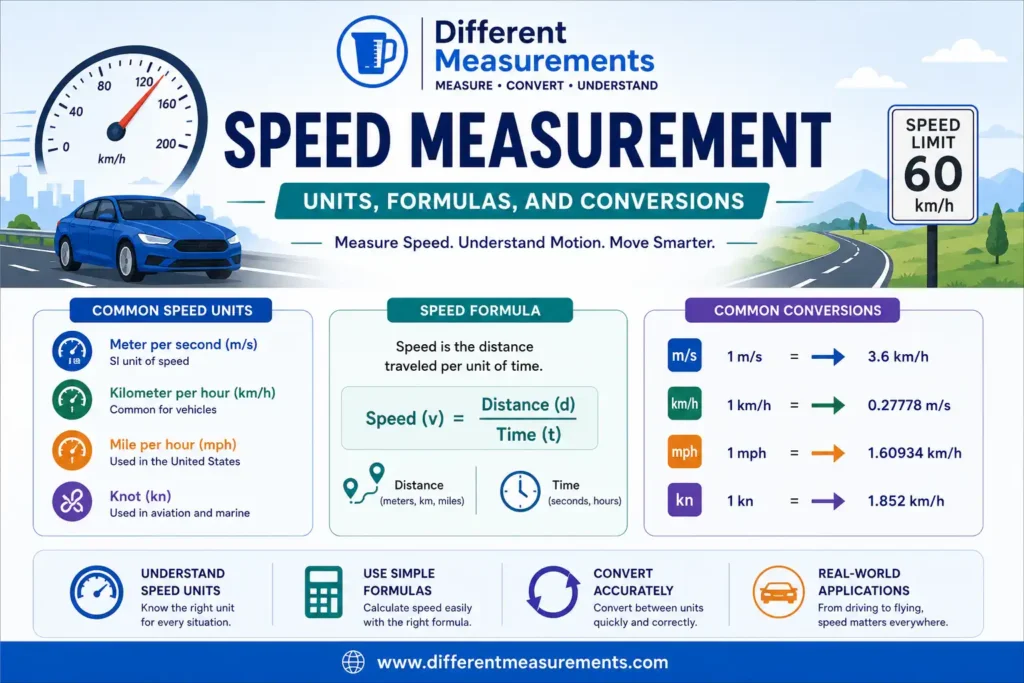
Speed = Distance ÷ Time
- Speed describes how quickly distance is covered.
- Distance refers to how far an object travels.
- Time refers to how long it takes to travel that distance.
Example: If a car travels 120 kilometers in 2 hours, its speed is calculated as follows:
Speed = 120 km ÷ 2 h = 60 km/h
This means the car covered an average of 60 kilometers for every hour of travel.
Distance, Time, and Speed Relationship
Speed, distance, and time are connected through three related formulas, each useful depending on which two values are already known:
Speed = Distance ÷ Time Used when distance and time are known and speed needs to be calculated.
Distance = Speed × Time Used when speed and time are known and distance needs to be calculated.
Example: A cyclist travels at 15 km/h for 3 hours. Distance = 15 × 3 = 45 kilometers
Time = Distance ÷ Speed Used when distance and speed are known and time needs to be calculated.
Example: A car needs to travel 200 kilometers at a speed of 100 km/h. Time = 200 ÷ 100 = 2 hours
Units of Speed
Several units are commonly used to express speed, each suited to different contexts:
- Meter per second (m/s): The SI derived unit, common in science and engineering.
- Kilometer per hour (km/h): Widely used for everyday transportation in most countries.
- Mile per hour (mph): Common in the United States and a few other countries for road speeds.
- Foot per second (ft/s): Used in some technical and scientific contexts, particularly in the United States.
- Knot (kn): Used specifically in aviation and maritime travel.
SI Unit of Speed
The SI derived unit of speed is meters per second (m/s). It is derived directly from the SI base units for length, the meter, and time, the second, reflecting speed’s core definition as distance divided by time.
This makes meters per second a natural and consistent choice for scientific work, since it integrates cleanly with other SI-based calculations in physics and engineering.
Meters per Second (m/s)
Meters per second expresses how many meters an object travels in one second. It is the standard unit in scientific and technical contexts, particularly in physics problems and engineering calculations.
Relationship to kilometers per hour:
1 m/s = 3.6 km/h
Example: An object moving at 10 m/s is traveling at 10 × 3.6 = 36 km/h.
Kilometers per Hour (km/h)
Kilometers per hour expresses how many kilometers an object travels in one hour. It is the standard everyday speed unit in most countries around the world, particularly those using the metric system.
Common everyday uses include road speed limits, vehicle speedometers, and public transportation schedules. A typical highway speed limit might be 100 to 120 km/h, while city driving speeds are often limited to 40 to 60 km/h.
Miles per Hour (mph)
Miles per hour expresses how many miles an object travels in one hour. It is the standard everyday speed unit in the United States and a small number of other countries.
Common uses include road speed limits, vehicle speedometers, and everyday references to driving speed. A typical US highway speed limit might range from 65 to 80 mph, while city streets are often limited to 25 to 35 mph.
Feet per Second (ft/s)
Feet per second expresses how many feet an object travels in one second. It appears in some technical and scientific contexts, particularly in engineering calculations involving shorter distances or higher precision within the US customary system.
Feet per second relates to both mph and m/s, though it is used far less frequently in everyday contexts compared to those two units.
Knots
A knot is a unit of speed equal to one nautical mile per hour. It is used almost exclusively in aviation and maritime contexts, rather than everyday road travel.
Important relationship:
1 knot = 1 nautical mile per hour 1 knot ≈ 1.852 km/h
Knots are used for ships and aircraft because nautical miles are directly tied to the Earth’s geographic coordinate system, making them especially useful for navigation over long distances across oceans and airspace where positioning is calculated using latitude and longitude.
Speed Units Comparison
| Unit | Symbol | Common Use | Approximate Relationship to m/s |
| Meter per second | m/s | Science, engineering | 1 m/s |
| Kilometer per hour | km/h | Everyday transportation (most countries) | ≈ 0.278 m/s |
| Mile per hour | mph | Everyday transportation (US) | ≈ 0.447 m/s |
| Foot per second | ft/s | Technical and scientific use | ≈ 0.305 m/s |
| Knot | kn | Aviation, maritime travel | ≈ 0.514 m/s |
Speed Conversion
Because speed units combine a distance component and a time component, converting between them requires accounting for both parts correctly. A conversion factor for speed reflects the combined effect of converting the distance unit and the time unit simultaneously.
Common speed conversions include:
- m/s to km/h: Multiply by 3.6
- km/h to m/s: Divide by 3.6
- km/h to mph: Multiply by approximately 0.621371
- mph to km/h: Multiply by approximately 1.60934
- mph to m/s: Multiply by approximately 0.44704
- m/s to mph: Multiply by approximately 2.23694
- knots to km/h: Multiply by 1.852
- km/h to knots: Divide by 1.852
Common Speed Conversion Factors
| Conversion | Value |
| 1 m/s | 3.6 km/h |
| 1 km/h | ≈ 0.277778 m/s |
| 1 mph | ≈ 1.60934 km/h |
| 1 km/h | ≈ 0.621371 mph |
| 1 knot | 1.852 km/h |
| 1 knot | ≈ 1.15078 mph |
The knot-to-km/h relationship is exact by definition of the international nautical mile, while most other cross-system conversions involve rounded, approximate values.
How to Convert Speed Units Manually
- Identify the original speed unit. Confirm whether the value is in m/s, km/h, mph, ft/s, or knots.
- Identify the target unit. Determine what unit the result needs to be in.
- Select the correct conversion factor. Use a verified factor between the original and target units.
- Multiply or divide as appropriate. Apply the conversion factor correctly based on the direction of conversion.
- Check the resulting unit. Confirm the final answer carries the correct unit label.
- Round appropriately. Keep more decimal places for technical work, round for everyday practical use.
Worked example 1: Convert 80 km/h to mph. 80 × 0.621371 ≈ 49.7 mph
Worked example 2: Convert 60 mph to km/h. 60 × 1.60934 ≈ 96.6 km/h
Worked example 3: Convert 25 m/s to km/h. 25 × 3.6 = 90 km/h
Average Speed
Average speed describes the overall rate of travel across an entire trip or journey, calculated as:
Average Speed = Total Distance ÷ Total Time
Important: Average speed should not automatically be calculated by simply averaging two speed values unless the time spent at each speed is equal. If a car travels at different speeds for different durations, the correct approach is to divide total distance by total time, not to average the speed values directly.
Example: A car travels 100 kilometers in 1 hour, then another 100 kilometers in 2 hours, due to traffic. Total distance = 100 + 100 = 200 kilometers Total time = 1 + 2 = 3 hours Average speed = 200 ÷ 3 ≈ 66.7 km/h
Simply averaging the two individual speeds, 100 km/h and 50 km/h, would incorrectly produce 75 km/h, since that approach ignores how much time was actually spent at each speed.
Instantaneous Speed
Instantaneous speed refers to how fast an object is moving at a specific moment in time, rather than over an entire journey.
Everyday examples include:
- A car’s speed shown on a speedometer at a particular moment during a drive
- A cyclist’s speed at a specific point during a race, such as while sprinting toward the finish line
Instantaneous speed can change constantly throughout a journey, while average speed reflects the overall trip as a single combined value.
Speed vs Velocity
Speed and velocity are closely related but represent different physical concepts:
- Speed is a scalar quantity, meaning it only has a magnitude, describing how fast something is moving without reference to direction.
- Velocity is a vector quantity, meaning it has both a magnitude and a direction, describing how fast something is moving and which way it is headed.
Example: A car traveling at 60 km/h has a speed of 60 km/h regardless of direction. If that same car is traveling 60 km/h due north, its velocity is described as 60 km/h north, incorporating both the speed and the direction of travel.
In many everyday contexts, the terms are used interchangeably, but in physics and engineering, this distinction matters, particularly when direction changes are relevant to a calculation.
How Is Speed Measured?
Several tools and methods are used to measure speed, depending on the context:
- Speedometer: A device built into vehicles that measures speed based on wheel rotation or other internal sensors.
- Radar gun: Uses radio waves to detect the speed of a moving object, commonly used by law enforcement and in sports.
- LIDAR: Uses laser light pulses to measure speed and distance with high precision, often used in traffic enforcement and surveying.
- GPS-based speed measurement: Calculates speed by tracking changes in position over time using satellite positioning data.
- Timing gates: Used in sports and testing environments to measure speed by recording the time an object takes to pass between two fixed points a known distance apart.
- Doppler radar: Measures speed by detecting the frequency shift in reflected radio waves, commonly used in weather monitoring and some speed detection systems.
Speed Measurement in Vehicles
Vehicle speed can be measured through several methods, often used together for accuracy:
- Speedometers: Traditionally calculate speed based on the rotational speed of the wheels or transmission.
- Wheel rotation: Sensors detect how quickly the wheels are turning, which is converted into a speed reading.
- Electronic sensors: Modern vehicles often use electronic sensors integrated with the vehicle’s computer system for more precise speed tracking.
- GPS: Calculates speed based on the rate of change in the vehicle’s satellite-tracked position.
Speedometer readings and GPS readings may sometimes differ slightly due to factors such as tire size variations, calibration differences, or the way each system calculates speed, though the difference is typically small under normal driving conditions.
Speed Measurement in Sports
Speed measurement plays an important role across many sports:
- Running: Timing systems and GPS-based devices track runners’ pace and speed during training and competition.
- Cycling: GPS devices and sensors mounted on bicycles measure real-time speed and average speed over a ride.
- Swimming: Timing systems calculate speed based on lap times and pool distances.
- Motorsport: Radar, GPS, and onboard telemetry systems measure vehicle speed with high precision during races.
- Baseball and other sports: Radar guns are commonly used to measure pitch speed, serve speed in tennis, or shot speed in other ball sports.
These tools allow athletes and coaches to analyze performance and track improvements over time with objective, standardized speed data.
Real-World Speed Examples
The following are approximate, illustrative examples rather than universal standards:
- Walking speed: approximately 5 km/h (about 3.1 mph)
- Running speed: approximately 10 to 15 km/h for a moderate jog (about 6 to 9 mph)
- Bicycle speed: approximately 15 to 25 km/h for casual riding (about 9 to 16 mph)
- City driving speed: approximately 30 to 50 km/h (about 19 to 31 mph)
- Highway driving speed: approximately 100 to 120 km/h (about 62 to 75 mph)
- Train speed: approximately 120 to 300 km/h depending on the type of train (about 75 to 186 mph)
- Airplane speed: approximately 800 to 900 km/h for commercial cruising speed (about 500 to 560 mph)
- Ship speed: approximately 20 to 25 knots for many commercial vessels (about 37 to 46 km/h)
Speed and Distance Calculations
Example 1: Calculate speed from distance and time A runner covers 10 kilometers in 50 minutes, or approximately 0.833 hours. Speed = 10 ÷ 0.833 ≈ 12 km/h
Example 2: Calculate distance from speed and time A car travels at 80 km/h for 2.5 hours. Distance = 80 × 2.5 = 200 kilometers
Example 3: Calculate time from distance and speed A cyclist needs to travel 45 kilometers at an average speed of 15 km/h. Time = 45 ÷ 15 = 3 hours
Example 4: Convert a speed from km/h to mph Convert 100 km/h to mph. 100 × 0.621371 ≈ 62.1 mph
Example 5: Convert mph to km/h Convert 70 mph to km/h. 70 × 1.60934 ≈ 112.7 km/h
Common Speed Measurement Mistakes
- Confusing speed with velocity: Treating direction as irrelevant when it actually matters, or vice versa, can lead to incorrect conclusions in physics and navigation contexts.
- Mixing distance and time units: Calculating speed using kilometers and minutes together, without converting to consistent units, produces an incorrect result.
- Using the wrong conversion factor: Applying an incorrect or outdated conversion factor leads to compounding errors, especially in navigation or engineering.
- Forgetting that speed combines distance and time: Treating speed as a standalone value without recognizing its dependence on both distance and time can lead to conceptual misunderstandings.
- Confusing mph with km/h: Since the numerical values differ significantly, mistaking one for the other can lead to serious real-world errors, particularly while driving in an unfamiliar country.
- Confusing knots with mph: Knots and mph represent different distances per hour, and treating them as equivalent introduces meaningful navigation errors.
- Calculating average speed incorrectly: Averaging two speed values directly, without accounting for the time spent at each speed, produces an inaccurate result.
- Rounding too early: Rounding intermediate values before completing a multi-step calculation can introduce unnecessary error into the final result.
- Forgetting to include the correct unit: Omitting or mislabeling the speed unit makes a value ambiguous or potentially misleading.
Common Questions About Speed Measurement
Speed measurement is the process of quantifying how quickly an object covers distance over a period of time, typically expressed in units such as kilometers per hour or meters per second.
The SI derived unit of speed is meters per second (m/s).
Speed is calculated by dividing distance by time: Speed = Distance ÷ Time.
Divide the total distance traveled by the total time taken to travel that distance.
Multiply the km/h value by approximately 0.621371 to get the equivalent value in mph.
Multiply the mph value by approximately 1.60934 to get the equivalent value in km/h.
1 m/s is equal to 3.6 km/h.
A knot is a unit of speed equal to one nautical mile per hour, commonly used in aviation and maritime travel.
1 knot is equal to 1.852 km/h.
Speed is a scalar quantity describing how fast something moves, while velocity is a vector quantity describing both speed and direction.
Average speed is the total distance traveled divided by the total time taken, representing the overall rate of travel across an entire journey.
Vehicle speed is commonly measured using speedometers based on wheel rotation, electronic sensors, or GPS tracking of position changes over time.
Speed measurement connects two fundamental quantities, distance and time, into a single value that describes how quickly something moves. Understanding the core formula, the differences between common speed units like km/h, mph, and knots, and how to convert between them accurately makes speed measurement practical across transportation, sports, science, and everyday life.