Meters and feet are both units of length, but they come from different measurement systems. The meter is the SI base unit of length, used throughout most of the world in science, engineering, and everyday measurement, while the foot is commonly used in the US customary system and is also used in the Imperial system. This guide provides the exact meters-to-feet conversion formula, a complete conversion chart, decimal conversions, feet-and-inches results, and practical worked examples.
Meter-to-foot conversions come up in a wide range of everyday and professional contexts, including:
- Human height
- Room dimensions
- Construction
- Sports
- Running tracks
- Swimming pools
- Building measurements
- Land and distance measurements
How Many Feet Are in 1 Meter?
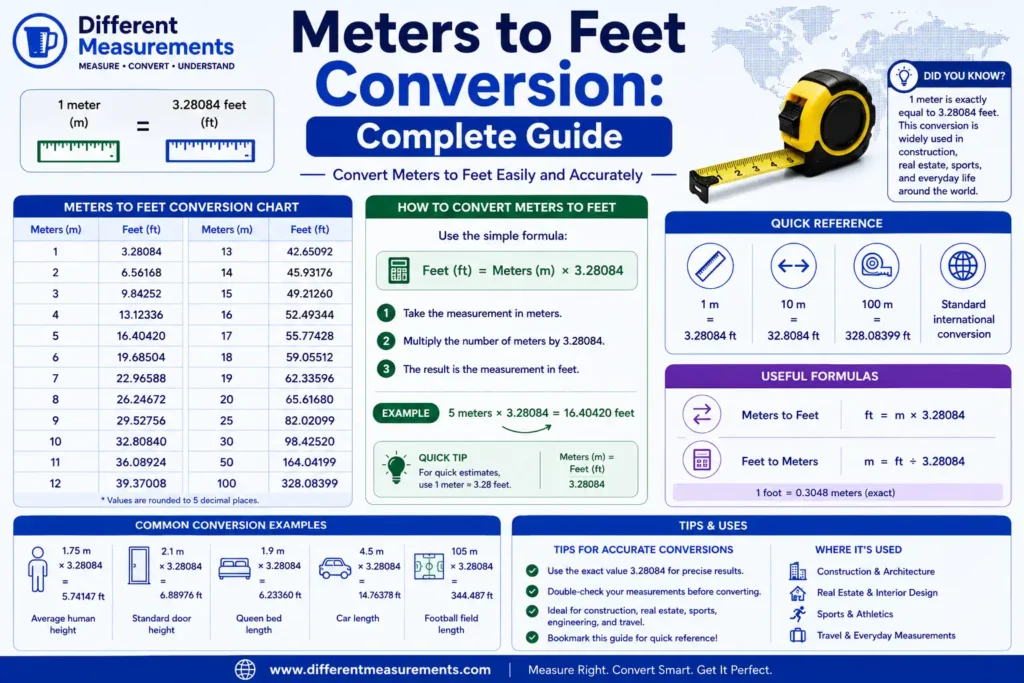
1 meter = 3.280839895 feet. For practical everyday use, this is commonly rounded to:
1 meter ≈ 3.28084 feet
This conversion is based on the exact, internationally defined relationship:
1 foot = 0.3048 meter exactly
Since 1 foot equals exactly 0.3048 meter, it follows that:
1 meter = 1 ÷ 0.3048 feet ≈ 3.280839895 feet
It is worth clearly distinguishing between the exact definition, 0.3048 meter per foot, and the rounded decimal value used for everyday feet-per-meter conversions, since the reverse relationship produces a long, non-terminating decimal.
Meters to Feet Conversion Formula
The precise formula for converting meters to feet is:
feet = meters × 3.280839895
For practical, everyday calculations, a commonly used rounded formula is:
feet ≈ meters × 3.28084
This is mathematically equivalent to:
feet = meters ÷ 0.3048
To use this formula, take a measurement in meters and multiply it by 3.28084 (or divide by 0.3048), giving the equivalent measurement in feet.
Example: Convert 5 meters to feet.
5 × 3.28084 ≈ 16.4042 feet
How to Convert Meters to Feet
Converting meters to feet follows a consistent process:
- Start with the measurement in meters.
- Multiply the value by 3.280839895 (or the rounded 3.28084 for everyday use).
- Round the result according to the precision required.
- Add the unit “feet” to the final answer.
Example: Convert 10 meters to feet.
10 × 3.280839895 ≈ 32.8084 feet
For most everyday conversions, using 3.28084 as the conversion factor provides more than sufficient accuracy. For a broader explanation of how metric and Imperial conversions work generally, see measurement conversions.
Complete Meters to Feet Conversion Chart
The chart below shows every whole meter value from 1 to 100, converted to feet and rounded to five decimal places.
| Meters | Feet | Meters | Feet |
|---|---|---|---|
| 1 m | 3.28084 ft | 51 m | 167.32283 ft |
| 2 m | 6.56168 ft | 52 m | 170.60367 ft |
| 3 m | 9.84252 ft | 53 m | 173.88451 ft |
| 4 m | 13.12336 ft | 54 m | 177.16535 ft |
| 5 m | 16.40420 ft | 55 m | 180.44619 ft |
| 6 m | 19.68504 ft | 56 m | 183.72703 ft |
| 7 m | 22.96588 ft | 57 m | 187.00787 ft |
| 8 m | 26.24672 ft | 58 m | 190.28871 ft |
| 9 m | 29.52756 ft | 59 m | 193.56955 ft |
| 10 m | 32.80840 ft | 60 m | 196.85039 ft |
| 11 m | 36.08924 ft | 61 m | 200.13123 ft |
| 12 m | 39.37008 ft | 62 m | 203.41207 ft |
| 13 m | 42.65092 ft | 63 m | 206.69291 ft |
| 14 m | 45.93176 ft | 64 m | 209.97375 ft |
| 15 m | 49.21260 ft | 65 m | 213.25459 ft |
| 16 m | 52.49344 ft | 66 m | 216.53543 ft |
| 17 m | 55.77428 ft | 67 m | 219.81627 ft |
| 18 m | 59.05512 ft | 68 m | 223.09711 ft |
| 19 m | 62.33596 ft | 69 m | 226.37795 ft |
| 20 m | 65.61680 ft | 70 m | 229.65879 ft |
| 21 m | 68.89764 ft | 71 m | 232.93963 ft |
| 22 m | 72.17848 ft | 72 m | 236.22047 ft |
| 23 m | 75.45932 ft | 73 m | 239.50131 ft |
| 24 m | 78.74016 ft | 74 m | 242.78215 ft |
| 25 m | 82.02100 ft | 75 m | 246.06299 ft |
| 26 m | 85.30184 ft | 76 m | 249.34383 ft |
| 27 m | 88.58268 ft | 77 m | 252.62467 ft |
| 28 m | 91.86352 ft | 78 m | 255.90551 ft |
| 29 m | 95.14436 ft | 79 m | 259.18635 ft |
| 30 m | 98.42520 ft | 80 m | 262.46719 ft |
| 31 m | 101.70604 ft | 81 m | 265.74803 ft |
| 32 m | 104.98688 ft | 82 m | 269.02887 ft |
| 33 m | 108.26772 ft | 83 m | 272.30971 ft |
| 34 m | 111.54856 ft | 84 m | 275.59055 ft |
| 35 m | 114.82940 ft | 85 m | 278.87139 ft |
| 36 m | 118.11024 ft | 86 m | 282.15223 ft |
| 37 m | 121.39108 ft | 87 m | 285.43307 ft |
| 38 m | 124.67192 ft | 88 m | 288.71391 ft |
| 39 m | 127.95276 ft | 89 m | 291.99475 ft |
| 40 m | 131.23360 ft | 90 m | 295.27559 ft |
| 41 m | 134.51444 ft | 91 m | 298.55643 ft |
| 42 m | 137.79528 ft | 92 m | 301.83727 ft |
| 43 m | 141.07612 ft | 93 m | 305.11811 ft |
| 44 m | 144.35696 ft | 94 m | 308.39895 ft |
| 45 m | 147.63780 ft | 95 m | 311.67979 ft |
| 46 m | 150.91864 ft | 96 m | 314.96063 ft |
| 47 m | 154.19948 ft | 97 m | 318.24147 ft |
| 48 m | 157.48031 ft | 98 m | 321.52231 ft |
| 49 m | 160.76115 ft | 99 m | 324.80315 ft |
| 50 m | 164.04199 ft | 100 m | 328.08399 ft |
Quick Meters to Feet Conversion Chart
For fast reference, here are the most commonly searched meter-to-foot conversions:
| Meters | Feet |
|---|---|
| 1 m | 3.28084 ft |
| 2 m | 6.56168 ft |
| 3 m | 9.84252 ft |
| 4 m | 13.12336 ft |
| 5 m | 16.40420 ft |
| 6 m | 19.68504 ft |
| 10 m | 32.80840 ft |
| 15 m | 49.21260 ft |
| 20 m | 65.61680 ft |
| 25 m | 82.02100 ft |
| 30 m | 98.42520 ft |
| 40 m | 131.23360 ft |
| 50 m | 164.04199 ft |
| 75 m | 246.06299 ft |
| 100 m | 328.08399 ft |
Common Meters to Feet Conversions
1 Meter to Feet
1 × 3.280839895 ≈ 3.28084 feet
2 Meters to Feet
2 × 3.280839895 ≈ 6.56168 feet
3 Meters to Feet
3 × 3.280839895 ≈ 9.84252 feet
5 Meters to Feet
5 × 3.280839895 ≈ 16.40420 feet
10 Meters to Feet
10 × 3.280839895 ≈ 32.80840 feet
20 Meters to Feet
20 × 3.280839895 ≈ 65.61680 feet
50 Meters to Feet
50 × 3.280839895 ≈ 164.04199 feet
100 Meters to Feet
100 × 3.280839895 ≈ 328.08399 feet
Decimal Meters to Feet
Decimal meter values use the exact same formula:
feet = meters × 3.280839895
| Meters | Feet |
|---|---|
| 0.5 m | 1.64042 ft |
| 1.5 m | 4.92126 ft |
| 2.5 m | 8.20210 ft |
| 3.5 m | 11.48294 ft |
| 4.5 m | 14.76378 ft |
| 7.5 m | 24.60630 ft |
| 10.5 m | 34.44882 ft |
Example: Convert 7.5 meters to feet.
7.5 × 3.280839895 ≈ 24.60630 feet
Meters to Feet and Inches
A decimal-foot result can be converted into the more familiar feet-and-inches format using the following process:
- Convert meters to decimal feet using the standard formula.
- Keep the whole-number portion as the number of feet.
- Multiply the remaining decimal portion by 12 to get the number of inches.
- Round the inches if needed for practical use.
Example: Convert 1.8 meters to feet and inches.
1.8 × 3.280839895 ≈ 5.90551 feet
Whole feet = 5 Decimal portion = 0.90551 0.90551 × 12 ≈ 10.87 inches
Therefore:
1.8 meters ≈ 5 ft 10.87 in
For practical, everyday height reporting, this is often rounded to approximately 5 ft 11 in. It is worth clearly labeling feet-and-inches results as approximate whenever rounding has been applied, since the exact value carries additional decimal precision.
Common Meter to Feet and Inches Conversions
| Meters | Decimal Feet | Approx. Feet and Inches |
|---|---|---|
| 1 m | 3.28084 ft | 3 ft 3.37 in |
| 1.5 m | 4.92126 ft | 4 ft 11.06 in |
| 1.6 m | 5.24934 ft | 5 ft 2.99 in |
| 1.7 m | 5.57743 ft | 5 ft 6.93 in |
| 1.75 m | 5.74147 ft | 5 ft 8.90 in |
| 1.8 m | 5.90551 ft | 5 ft 10.87 in |
| 1.85 m | 6.06955 ft | 6 ft 0.83 in |
| 1.9 m | 6.23360 ft | 6 ft 2.80 in |
| 2 m | 6.56168 ft | 6 ft 6.74 in |
Meters to Feet for Human Height
Many countries measure height in centimeters or meters, while height in the United States is most commonly expressed in feet and inches. This means converting meters to feet is a frequent, practical need for anyone comparing height figures across different countries or unit systems.
| Height in Meters | Approx. Feet | Approx. Feet and Inches |
|---|---|---|
| 1.50 m | 4.92 ft | 4 ft 11 in |
| 1.60 m | 5.25 ft | 5 ft 3 in |
| 1.65 m | 5.41 ft | 5 ft 5 in |
| 1.70 m | 5.58 ft | 5 ft 7 in |
| 1.75 m | 5.74 ft | 5 ft 9 in |
| 1.80 m | 5.91 ft | 5 ft 11 in |
| 1.85 m | 6.07 ft | 6 ft 1 in |
| 1.90 m | 6.23 ft | 6 ft 3 in |
| 2.00 m | 6.56 ft | 6 ft 7 in |
The feet-and-inches column above is rounded to the nearest whole inch for practical readability. For a deeper look at how height is measured and reported, including additional detail on feet-and-inches notation.
Meters to Feet for Distance
Meter-to-foot conversions are frequently used for describing distances across a wide range of contexts:
- Short distances
- Room dimensions
- Building dimensions
- Sports fields
- Track measurements
- Swimming pools
- Construction
- Engineering
Examples:
10 meters ≈ 32.81 feet
25 meters ≈ 82.02 feet
50 meters ≈ 164.04 feet
100 meters ≈ 328.08 feet
For a broader look at how distance is measured and expressed across different units and contexts.
Meters to Feet for Construction and Dimensions
Construction and building projects frequently require converting between meters and feet, particularly when working across countries that use different primary measurement systems.
Example: A room is 5 meters long.
5 × 3.280839895 ≈ 16.40 feet
Common applications include:
- Room length
- Ceiling height
- Wall height
- Building dimensions
- Furniture
- Product dimensions
- Construction materials
- Engineering measurements
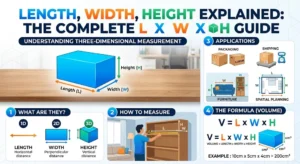
Each dimension of an object or space, whether length, width, or height, should be converted separately when working between metric and US customary or Imperial units.
Meters to Feet for Sports
Meter-based distances are common in international sports, and converting them to feet can help provide a familiar reference point for audiences accustomed to US customary units.
Examples:
- 10-meter distances ≈ 32.81 feet
- 25-meter pools ≈ 82.02 feet
- 50-meter pools ≈ 164.04 feet
- 100-meter races ≈ 328.08 feet
- 400-meter track events ≈ 1,312.34 feet
These conversions are provided for general reference. Not every sporting measurement is officially expressed in feet, since many international sports, including swimming and track and field, use meters as their official standard of measurement.
Feet to Meters Reverse Conversion
For quick reference, converting feet back to meters uses the formula:
meters = feet × 0.3048
which is equivalent to:
meters = feet ÷ 3.280839895
Examples:
1 ft = 0.3048 m
5 ft = 1.524 m
10 ft = 3.048 m
20 ft = 6.096 m
Since this article focuses primarily on converting meters to feet, a full breakdown of this reverse conversion, including its own complete chart and additional worked examples, is planned as a dedicated companion article, Feet to Meters: Complete Conversion Chart.
Meters vs Feet
| Feature | Meter | Foot |
|---|---|---|
| Symbol | m | ft |
| Measurement system | SI / Metric | US customary / Imperial context |
| Exact relationship | 1 m = 3.280839895… ft | 1 ft = 0.3048 m |
| Common uses | Most countries, science, engineering | US everyday measurements, construction, height |
The foot has the same exact modern length in both the US customary system and the Imperial system, since both are based on the internationally agreed definition of 0.3048 meter per foot. For more on how these systems compare.
Meters, Feet, and Inches
The meter, foot, and inch relate to one another through a consistent set of exact and near-exact values:
| Measurement | Equivalent |
|---|---|
| 1 meter | 3.28084 feet (approx.) |
| 1 meter | 39.3701 inches (approx.) |
| 1 foot | 0.3048 meter (exact) |
| 1 foot | 12 inches (exact) |
| 1 inch | 2.54 cm (exact) |
Values labeled “exact” are defined precisely by international agreement, while values labeled “approx.” are rounded decimal representations of a longer, non-terminating figure.
Meters to Feet Conversion Examples
Example 1
Convert 1 meter to feet.
1 × 3.280839895 ≈ 3.28084 feet
Example 2
Convert 2 meters to feet.
2 × 3.280839895 ≈ 6.56168 feet
Example 3
Convert 5 meters to feet.
5 × 3.280839895 ≈ 16.40420 feet
Example 4
Convert 10 meters to feet.
10 × 3.280839895 ≈ 32.80840 feet
Example 5
Convert 25 meters to feet.
25 × 3.280839895 ≈ 82.02100 feet
Example 6
Convert 50 meters to feet.
50 × 3.280839895 ≈ 164.04199 feet
Example 7
Convert 100 meters to feet.
100 × 3.280839895 ≈ 328.08399 feet
Example 8
Convert 1.5 meters to feet.
1.5 × 3.280839895 ≈ 4.92126 feet
Example 9
Convert 1.8 meters to feet and inches.
1.8 × 3.280839895 ≈ 5.90551 feet, which is 5 feet plus 0.90551 × 12 ≈ 10.87 inches, or approximately 5 ft 10.87 in.
Example 10
Convert 2.5 meters to feet.
2.5 × 3.280839895 ≈ 8.20210 feet
Common Meters to Feet Conversion Mistakes
- Dividing by 3.28084 when multiplying is required. Converting meters to feet requires multiplication by 3.28084, not division.
- Multiplying when converting feet back to meters. The reverse conversion requires multiplying by 0.3048, or dividing by 3.28084, not multiplying by 3.28084 again.
- Using 3 instead of 3.28084. Rounding the conversion factor too aggressively to 3 introduces a significant error, particularly for larger measurements.
- Confusing meters with centimeters. These are different units, with 1 meter equal to 100 centimeters, so mixing them up leads to major errors.
- Confusing decimal feet with feet-and-inches. A decimal feet value like 5.9 ft does not directly translate to “5 feet 9 inches” without proper conversion of the decimal portion.
- Rounding too early. Rounding an intermediate result before completing a multi-step calculation, such as a meters-to-feet-and-inches conversion, can introduce compounding errors.
- Forgetting units. A converted number without “feet” or “meters” attached is an incomplete measurement.
- Treating approximate values as exact. The commonly used factor of 3.28084 is a rounded approximation, not the exact conversion value.
- Converting height incorrectly. Height conversions require an extra step to translate the decimal portion of a foot into inches, which is a common source of error.
- Confusing distance in meters with area in square meters. These are fundamentally different types of measurement and require different conversion approaches.
Important: Meters vs Square Meters
It is worth clarifying an important distinction that can cause confusion. The meter (m) measures length, a one-dimensional quantity, while the square meter (m²) measures area, a two-dimensional quantity.
The standard meters-to-feet conversion factor should not be applied directly to area measurements. For example:
1 m = 3.28084 ft
But:
1 m² ≈ 10.7639 ft²
Area conversions require the linear conversion factor to be squared, since area involves two dimensions rather than one. Applying the linear factor directly to an area value produces an incorrect result.
Common Questions About Meters to Feet
There are approximately 3.28084 feet in 1 meter, based on the exact relationship that 1 foot equals 0.3048 meter.
Multiply the number of meters by 3.280839895, or the commonly rounded value 3.28084, to get the equivalent measurement in feet.
The formula is feet = meters × 3.280839895.
2 meters is approximately 6.56168 feet.
5 meters is approximately 16.40420 feet.
10 meters is approximately 32.80840 feet.
20 meters is approximately 65.61680 feet.
50 meters is approximately 164.04199 feet.
100 meters is approximately 328.08399 feet.
1.8 meters is approximately 5.90551 feet, or about 5 ft 10.87 in in feet-and-inches notation.
First convert meters to decimal feet, then multiply the decimal portion of that result by 12 to get the equivalent number of inches, keeping the whole-number portion as feet.
Multiply the number of feet by 0.3048 to get the equivalent measurement in meters.
Not exactly. 1 meter is approximately 3.28084 feet when rounded to five decimal places. The value 3.28 is a shorter, less precise rounding.
There are approximately 39.3701 inches in 1 meter.
Final Thoughts
Converting meters to feet comes down to a consistent formula: multiply the meter value by 3.28084. Whether converting a short distance, a room dimension, a sports measurement, or a person’s height, the same multiplication-based process applies, with an additional step needed when the result must be expressed in traditional feet-and-inches format.