Every measurement you take, whether it is a person’s height, the temperature outside, or the power rating of a light bulb, relies on a standard unit of measurement. The International System of Units, known as SI, is the modern standard used by scientists, engineers, and most countries around the world. This guide explains what SI units are, why they matter, the seven SI base units, common derived units, SI prefixes, formatting rules, and how SI compares to the broader metric system and other measurement systems.
What Are SI Units?
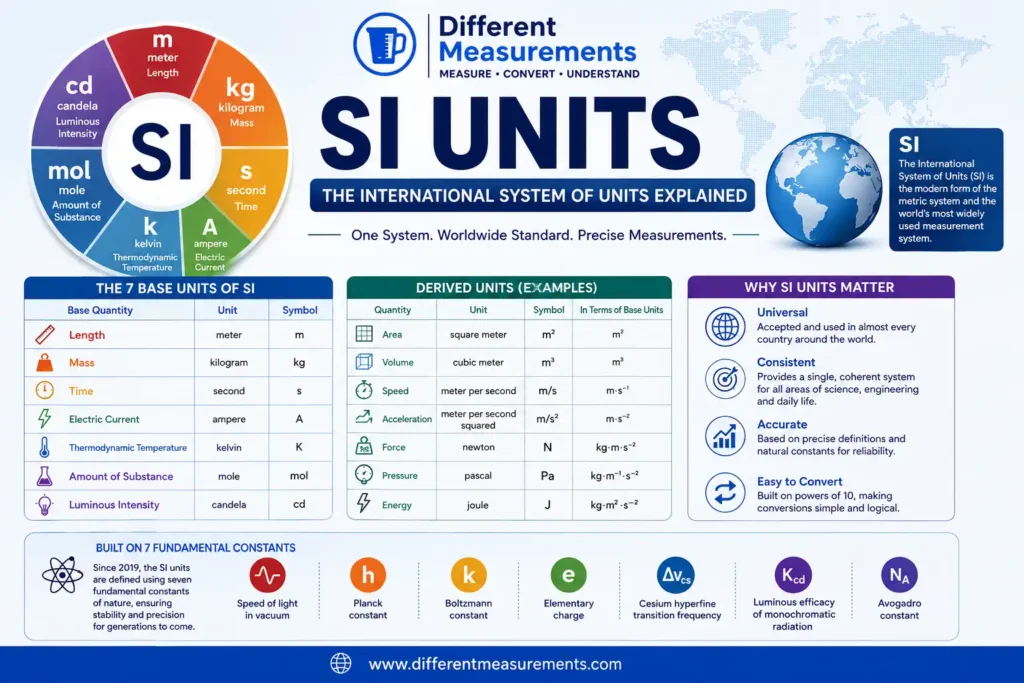
SI units are the standardized units of measurement that make up the International System of Units, the most widely used measurement system in science, industry, and everyday life. They include seven base units, such as the meter and kilogram, along with derived units built from those base units, such as the newton and pascal.
Standardized units matter because they create a shared language for measurement. Without a common system, a measurement taken in one lab, factory, or country could not be reliably compared with a measurement taken somewhere else.
Using SI units provides several practical benefits:
- Consistent measurements across industries and countries
- Clear international communication in trade and research
- Greater scientific accuracy and reproducibility
- A shared foundation for engineering standards and safety
- Simpler calculations, since units relate to each other through powers of ten
- Easier unit conversion between related quantities
- Support for global research collaboration and international commerce
What Does SI Stand For?
SI stands for Système international d’unités, a French phrase that translates to International System of Units. The name originates in French because the modern metric system was formalized largely through French scientific and governmental efforts in the 18th and 19th centuries. Today, “SI” is the official abbreviation used worldwide, regardless of language.
What Is the International System of Units?
The International System of Units is a coordinated framework for measuring physical quantities. Rather than being a single unit or a random collection of units, SI is built from several connected parts:
- Base quantities, such as length, mass, and time
- Base units, the defined unit for each base quantity
- Derived units, formed by combining base units
- Prefixes, used to express very large or very small values
- Standard unit symbols, which follow strict formatting rules
Together, these parts allow any measurable physical quantity, from the speed of a car to the energy released in a chemical reaction, to be expressed using a consistent, logically connected system.
History of SI Units
The roots of SI trace back to the French Revolution, when reformers sought a rational, decimal-based system of measurement to replace the inconsistent local units used across France. This effort led to the early metric system, based on the meter and the kilogram.
In 1875, the Metre Convention (Convention du Mètre) was signed by representatives of several nations, establishing an international framework for maintaining and improving the metric system. This treaty created the organizations that still oversee global measurement standards today.
The International System of Units was formally established in 1960 by the General Conference on Weights and Measures, building on the metric system and adding a structured set of base units, derived units, and prefixes. Since then, SI has been revised several times as scientific understanding improved. Most notably, in 2019 the definitions of the kilogram, ampere, kelvin, and mole were redefined using fundamental physical constants rather than physical artifacts, making the system more stable and precise.
The Seven SI Base Units
SI is built on seven base quantities, each with its own base unit. Every other SI unit is derived from combinations of these seven.
| Base Quantity | SI Base Unit | Symbol |
|---|---|---|
| Length | meter | m |
| Mass | kilogram | kg |
| Time | second | s |
| Electric current | ampere | A |
| Thermodynamic temperature | kelvin | K |
| Amount of substance | mole | mol |
| Luminous intensity | candela | cd |
1. Meter (m)
The meter is the SI base unit of length and is fundamental to length measurement. It is used to measure distances ranging from the width of a room to the length of a road. Common everyday uses include measuring height, room dimensions, and travel distances, usually in kilometers.
The modern definition of the meter is based on the speed of light: it is the distance light travels in a vacuum during a precise fraction of a second. This definition keeps the meter fixed and universally reproducible, without relying on a physical object.
2. Kilogram (kg)
The kilogram is the SI base unit of mass, not the gram. This is an important distinction, since the kilogram is the only SI base unit that already contains a prefix (“kilo”). It is used to measure the mass of everything from food packaging to vehicles.
Since 2019, the kilogram, the SI base unit used in weight and mass measurement, has been defined using the Planck constant, a fundamental value from quantum physics, rather than a physical metal cylinder. This change made the definition more stable and independent of any single object.
3. Second (s)
The second is the SI base unit of time and is a fundamental part of time measurement. It is used constantly in daily life, from measuring how long a task takes to timing sporting events and scientific experiments.
The modern definition of the second is based on the frequency of radiation emitted by a cesium-133 atom. Because atomic behavior is extremely consistent, this definition allows time to be measured with remarkable precision.
4. Ampere (A)
The ampere is the SI base unit of electric current. It measures the flow of electric charge through a conductor, such as a wire. Everyday devices, from phone chargers to household wiring, are rated using amperes.
The modern definition of the ampere is based on the elementary electric charge, a fundamental physical constant, which fixes the ampere to a precise and reproducible value.
5. Kelvin (K)
The kelvin is the SI base unit of thermodynamic temperature. Unlike Celsius or Fahrenheit, the kelvin scale starts at absolute zero, the theoretical point at which particles have minimal thermal motion.
An important formatting rule applies here: the correct unit name is kelvin, not “degree Kelvin.” Values are written as 300 K, not 300° K, and no degree symbol is used.
The relationship between Kelvin and Celsius is:
- °C = K − 273.15
- K = °C + 273.15
Kelvin and Celsius share the same size increment, meaning a change of 1 K equals a change of 1 °C. The only difference is where each scale starts counting from.
For a full comparison of temperature scales, see Temperature Measurement: Celsius, Fahrenheit, and Kelvin.
6. Mole (mol)
The mole is the SI base unit of amount of substance, used primarily in chemistry. One mole contains exactly 6.02214076 × 10²³ elementary entities, a number known as the Avogadro constant.
These entities can be atoms, molecules, ions, electrons, or other specified particles. The mole allows chemists to relate the microscopic scale of atoms and molecules to measurable, lab-scale quantities.
7. Candela (cd)
The candela is the SI base unit of luminous intensity, which measures how bright a light source appears in a specific direction. It is used in lighting design, photography equipment, and display technology.
It is important not to confuse luminous intensity with total light output. A light bulb’s candela rating describes brightness in a particular direction, while total output across all directions is measured differently, using units like lumens.
SI Base Units at a Glance
| Quantity | Unit | Symbol | Example Measurement |
|---|---|---|---|
| Length | meter | m | A doorway is about 2 m tall |
| Mass | kilogram | kg | An adult may weigh about 70 kg |
| Time | second | s | A heartbeat lasts about 1 s |
| Electric current | ampere | A | A phone charger may use about 2 A |
| Temperature | kelvin | K | Room temperature is about 293 K |
| Amount of substance | mole | mol | 1 mol of water is about 18 grams |
| Luminous intensity | candela | cd | A candle has an intensity near 1 cd |
What Are SI Derived Units?
SI derived units are formed by combining base units through multiplication or division. They describe quantities that are not directly one of the seven base quantities but can be calculated from them.
Common examples include:
- Area: square meter (m²)
- Volume: cubic meter (m³)
- Speed: meter per second (m/s)
- Acceleration: meter per second squared (m/s²)
- Density: kilogram per cubic meter (kg/m³)
- Force: newton (N)
- Pressure: pascal (Pa)
- Energy: joule (J)
- Power: watt (W)
Some derived units, like square meters, are simply combinations of base units written out directly. Others, like the newton or the pascal, are given their own special name and symbol for convenience, even though they can always be expressed in terms of base units.
Common SI Derived Units With Special Names
| Quantity | SI Derived Unit | Symbol | Base Unit Expression |
|---|---|---|---|
| Frequency | hertz | Hz | s⁻¹ |
| Force | newton | N | kg·m·s⁻² |
| Pressure | pascal | Pa | kg·m⁻¹·s⁻² |
| Energy/work | joule | J | kg·m²·s⁻² |
| Power | watt | W | kg·m²·s⁻³ |
| Electric charge | coulomb | C | A·s |
| Voltage | volt | V | kg·m²·s⁻³·A⁻¹ |
| Capacitance | farad | F | kg⁻¹·m⁻²·s⁴·A² |
| Electrical resistance | ohm | Ω | kg·m²·s⁻³·A⁻² |
| Conductance | siemens | S | kg⁻¹·m⁻²·s³·A² |
| Magnetic flux | weber | Wb | kg·m²·s⁻²·A⁻¹ |
| Magnetic flux density | tesla | T | kg·s⁻²·A⁻¹ |
| Inductance | henry | H | kg·m²·s⁻²·A⁻² |
| Celsius temperature | degree Celsius | °C | K |
| Luminous flux | lumen | lm | cd·sr |
| Illuminance | lux | lx | lm·m⁻² |
| Radioactivity | becquerel | Bq | s⁻¹ |
| Absorbed dose | gray | Gy | m²·s⁻² |
| Equivalent dose | sievert | Sv | m²·s⁻² |
| Catalytic activity | katal | kat | mol·s⁻¹ |
Common SI Derived Units Explained
Newton (N)
The newton measures force. One newton is the force needed to accelerate a 1 kg mass at 1 meter per second squared.
1 N = 1 kg·m/s²
Pascal (Pa)
The pascal measures pressure, defined as force applied over an area.
1 Pa = 1 N/m²
Atmospheric pressure at sea level is about 101.325 kilopascals (kPa). Learn more in Pressure Measurement: Units, Symbols, and Conversions.
Joule (J)
The joule measures energy and work.
1 J = 1 N·m
Energy values in nutrition, physics, and engineering are ultimately expressed in joules or related units. See Energy Measurement: Units, Symbols, and Conversions for more detail.
Watt (W)
The watt measures power, or the rate at which energy is used or transferred.
1 W = 1 J/s
Household appliances, light bulbs, and electric motors are commonly rated in watts or kilowatts.
Hertz (Hz)
The hertz measures frequency, or how many times an event repeats per second.
1 Hz = 1 cycle per second
Hertz is used to describe everything from electrical current cycles to processor speeds and sound wave frequencies.
Coulomb (C)
The coulomb measures electric charge.
1 C = 1 A·s
Volt (V)
The volt measures electric potential difference, often described as electrical “pressure” that drives current through a circuit. A standard household outlet in many countries supplies around 120 or 230 volts, depending on the region.
Ohm (Ω)
The ohm measures electrical resistance, describing how strongly a material opposes the flow of electric current. Higher resistance means less current flows for a given voltage.
SI Prefixes
SI prefixes allow the same base or derived unit to describe both extremely large and extremely small quantities without switching to a different unit entirely. Instead of writing awkward numbers like 0.000001 meter, a prefix allows a simpler expression such as 1 micrometer.
| Prefix | Symbol | Factor |
|---|---|---|
| quetta | Q | 10³⁰ |
| ronna | R | 10²⁷ |
| yotta | Y | 10²⁴ |
| zetta | Z | 10²¹ |
| exa | E | 10¹⁸ |
| peta | P | 10¹⁵ |
| tera | T | 10¹² |
| giga | G | 10⁹ |
| mega | M | 10⁶ |
| kilo | k | 10³ |
| hecto | h | 10² |
| deka | da | 10¹ |
| deci | d | 10⁻¹ |
| centi | c | 10⁻² |
| milli | m | 10⁻³ |
| micro | µ | 10⁻⁶ |
| nano | n | 10⁻⁹ |
| pico | p | 10⁻¹² |
| femto | f | 10⁻¹⁵ |
| atto | a | 10⁻¹⁸ |
| zepto | z | 10⁻²¹ |
| yocto | y | 10⁻²⁴ |
| ronto | r | 10⁻²⁷ |
| quecto | q | 10⁻³⁰ |
Not every prefix is used with every unit in practice. Some combinations, such as gigagram or nanosecond, appear regularly in science, while others are rarely used outside of highly specialized fields. It is also worth noting that the kilogram already includes the “kilo” prefix built into the base unit name, so prefixes for mass are applied to the gram (for example, milligram) rather than stacked onto “kilogram.”
Common everyday examples include:
- kilometer (km): road distances
- centimeter (cm): small measurements like a pencil’s length
- millimeter (mm): precise engineering and manufacturing measurements
- milligram (mg): dosages in medicine
- microsecond (µs): fast electronic timing
- nanometer (nm): wavelengths of light and nanotechnology
- megawatt (MW): large-scale power generation
- gigahertz (GHz): computer processor speeds
Common SI Unit Prefixes
For quick reference, these six prefixes cover the vast majority of everyday and technical use:
| Prefix | Symbol | Meaning | Example |
|---|---|---|---|
| kilo | k | one thousand | 1 km = 1,000 m |
| mega | M | one million | 1 MW = 1,000,000 W |
| giga | G | one billion | 1 GHz = 1,000,000,000 Hz |
| milli | m | one thousandth | 1 mm = 0.001 m |
| micro | µ | one millionth | 1 µs = 0.000001 s |
| nano | n | one billionth | 1 nm = 0.000000001 m |
SI Unit Symbols and Formatting Rules
Correct formatting keeps SI measurements clear and unambiguous. Key rules include:
- Unit symbols are not pluralized. Write “5 kg,” not “5 kgs.”
- Unit symbols are generally not followed by periods, except at the end of a sentence.
- Most unit symbols are lowercase unless the unit is named after a person, in which case only the symbol (not the full name) is capitalized. For example, the unit is “newton” but the symbol is “N.”
- Symbols named after people use uppercase letters as their first letter, such as N (newton), Pa (pascal), W (watt), and Hz (hertz).
- Liter may be written as “L” or “l.” The uppercase “L” is commonly preferred because the lowercase “l” can be confused with the number 1.
- Prefix symbols have specific capitalization. Prefixes for factors of one million and above generally use uppercase letters (M for mega, G for giga), while most smaller prefixes use lowercase letters (m for milli, µ for micro), with “k” for kilo being a lowercase exception.
- A space is generally used between a numerical value and a unit symbol, except with the degree symbol for plane angles.
Correct examples:
- 5 kg
- 20 m
- 30 °C
- 100 kPa
Incorrect examples to avoid:
- 5 kgs
- 20 m.
- 30° K
- 100KPa
SI Units in Everyday Life
SI units appear constantly in daily activities, often without much thought:
- Distance in meters and kilometers, for travel and navigation
- Mass in kilograms and grams, for food, luggage, and body weight
- Temperature in degrees Celsius, for weather and cooking
- Time in seconds, minutes, and hours, for schedules and timing
- Electricity in amperes, volts, watts, and kilowatt-hours, for appliances and utility bills
- Pressure in pascals and kilopascals, for weather forecasts and tire inflation
- Speed in meters per second or kilometers per hour, for driving and sports
It is worth noting that some widely used units, such as minutes, hours, days, liters, and tonnes, are not themselves SI base or derived units, but they are officially accepted for use alongside SI because of their practical importance.
SI Units in Science and Engineering
Consistent units are essential across technical fields:
- Physics relies on SI units to express laws of motion, energy, and electromagnetism accurately.
- Chemistry uses the mole, kelvin, and derived units to describe reactions and quantities precisely.
- Engineering depends on SI units for safe, standardized design in construction, manufacturing, and product development.
- Medicine uses SI-based units for dosing, body measurements, and diagnostic values.
- Astronomy uses SI units alongside specialized units for describing distances and energy on vast scales.
- Manufacturing and construction rely on precise SI measurements to ensure parts and structures fit and function correctly.
- Environmental science uses SI units to track emissions, temperature changes, and resource measurements.
- Research depends on SI as a common language, allowing findings to be verified and reproduced internationally.
Without a shared unit system, formulas would need constant adjustment, and results from different countries or labs could not be compared directly.
SI Units vs Metric System
SI and the metric system are closely related, but they are not exactly the same thing. The metric system is the broader, historical decimal-based approach to measurement that emerged in the late 1700s, built around units like the meter and the liter and organized using powers of ten.
SI is the modern, internationally standardized version of the metric system. It defines a specific set of base units, derived units, prefixes, and formatting rules, and it is maintained through formal international agreements. In everyday conversation, people often use “metric” and “SI” interchangeably, but SI specifically refers to the formal, regulated system, while “metric system” is a more general term that can include older or informal metric practices.
SI Units vs Imperial Units
Imperial units form a separate measurement system historically used in the United Kingdom and, in modified form, in other countries.
| SI Units | Imperial Units |
|---|---|
| meter | inch, foot |
| kilogram | pound |
| liter | gallon |
| Celsius | Fahrenheit |
Imperial units are generally not based on powers of ten, which makes conversions between Imperial units more complex than conversions within SI. It is also worth noting that the Imperial system and the US customary system, while related historically, are not identical, since some Imperial and US units differ in size, particularly for volume measurements like gallons.
SI Units vs US Customary Units
The US customary system is the measurement system most commonly used in the United States for everyday purposes. It shares historical roots with the Imperial system but includes its own specific unit definitions.
Common US customary units include:
- inch
- foot
- yard
- mile
- ounce
- pound
- gallon
- Fahrenheit
Because most of the world uses SI units for science, trade, and manufacturing, conversion between SI and US customary units is often necessary, particularly in international business, engineering, and travel.
SI vs Imperial vs US Customary: Quick Comparison
| Quantity | SI Unit | Imperial Unit | US Customary Unit |
|---|---|---|---|
| Length | meter | foot | foot |
| Mass/Weight | kilogram | pound | pound |
| Volume | liter | gallon (imperial) | gallon (US) |
| Temperature | Celsius | Fahrenheit | Fahrenheit |
SI and Non-SI Units Commonly Used With SI
Some units fall outside the official SI base and derived unit list but are still widely accepted for use with SI because of their practical value. These include:
- minute, hour, day (units of time)
- liter (unit of volume)
- tonne (unit of mass)
- degree (unit of angle)
- electronvolt, used in specific scientific contexts such as particle physics
It helps to keep these categories distinct:
- SI base units: the seven foundational units, like the meter and kilogram
- SI derived units: units built from base units, like the newton and pascal
- SI prefixes: modifiers like kilo and milli that scale a unit up or down
- Non-SI units accepted for use with SI: practical units like the liter and hour that are not formally SI units but are used alongside them
SI Unit Conversion
Because SI prefixes are based on powers of ten, converting between related SI units is generally straightforward. Examples include:
- 1 km = 1,000 m
- 1 m = 100 cm
- 1 kg = 1,000 g
- 1 MW = 1,000,000 W
- 1 mm = 0.001 m
It is important to remember that converting units only works within the same physical quantity. Converting meters to kilometers is valid because both measure length, but converting meters directly to kilograms is not meaningful, since length and mass are different physical quantities. Unit conversion changes how a quantity is expressed; it does not change the quantity itself.
Practical SI Unit Examples
- A road distance of 5 km between two towns
- A person’s mass of 70 kg
- A comfortable room temperature of 25 °C
- A jogging speed of about 10 m/s for a sprinter (elite pace)
- Standard atmospheric pressure of 101.325 kPa
- An energy value of 1,000 J, roughly the energy needed to lift a small object repeatedly
- A household appliance power rating of 1,500 W
Common SI Unit Mistakes
- Calling the kilogram a derived unit. The kilogram is one of the seven SI base units, not a derived unit.
- Writing “degree Kelvin.” The correct term is simply “kelvin,” written without a degree symbol, as in 300 K.
- Confusing mass and weight. Mass, measured in kilograms, describes the amount of matter in an object, while weight is a force influenced by gravity.
- Confusing watts and watt-hours. Watts measure power (a rate), while watt-hours measure energy used over time.
- Incorrect capitalization of unit symbols. For example, writing “Kg” instead of “kg,” or “w” instead of “W.”
- Adding plural letters to symbols. Symbols like “kg” and “m” never take an “s” for plural.
- Assuming SI and “metric” mean exactly the same thing. SI is the formally standardized version of the broader metric system.
- Treating Imperial and US customary units as identical. They share history but differ in certain unit definitions, particularly for volume.
- Using incorrect or mismatched prefixes, such as applying “kilo” where “mega” is intended.
- Mixing units within a single calculation, such as combining meters and centimeters without converting first.
- Forgetting squared or cubed units when measuring area or volume, such as writing “m” instead of “m²” for area.
Common Questions About SI Units
SI units are the standardized measurement units that make up the International System of Units, including seven base units and various derived units used across science, industry, and daily life.
SI units are the standardized measurement units that make up the International System of Units, including seven base units and various derived units used across science, industry, and daily life.
SI stands for Système international d’unités, French for International System of Units.
The seven SI base units are the meter, kilogram, second, ampere, kelvin, mole, and candela.
The SI unit of length is the meter (m).
The SI unit of mass is the kilogram (kg).
The SI unit of time is the second (s).
The SI unit of thermodynamic temperature is the kelvin (K).
The SI unit of pressure is the pascal (Pa).
The SI unit of energy is the joule (J).
The SI unit of force is the newton (N).
SI is the modern, formally standardized version of the metric system, with specific base units, derived units, prefixes, and rules, while “metric system” is a broader, more general term.
Yes, the kilogram is the SI base unit of mass.
No, the liter is not an official SI base or derived unit, but it is widely accepted for use alongside SI units.
SI units, like meters and kilograms, are based on powers of ten, while Imperial units, like feet and pounds, use non-decimal relationships and different unit definitions.
SI units provide a consistent, internationally recognized system that supports accurate science, safe engineering, clear trade, and reliable communication across countries and industries.
Final Thoughts
The International System of Units gives the world a shared, logical, and precise way to measure everything from the length of a room to the energy in a chemical reaction. Understanding the seven base units, common derived units, prefixes, and formatting rules makes it easier to read scientific information, follow engineering specifications, and make sense of everyday measurements.