Density explains why a small bar of gold feels much heavier than a similarly sized block of wood, even though both take up the same amount of space. This guide covers what density means, how it is calculated, the units and symbols used to express it, and how density is measured and applied across science, engineering, and everyday life.
What Is Density?
Density describes how much mass is packed into a given volume. It answers the question of how tightly matter is concentrated within a space, rather than simply how much matter or how much space is involved on its own.
Density = Mass ÷ Volume
Two objects can occupy exactly the same volume yet have very different densities if their masses differ. A block of wood and a block of steel cut to identical dimensions take up the same volume, but the steel block contains far more mass in that same space, giving it a much higher density.
Everyday materials illustrate a wide range of densities:
- Wood is relatively light for its size, which is why it often floats
- Water serves as a common reference point for comparing other substances
- Metal is typically dense, packing significant mass into a relatively small volume
- Oil is less dense than water, which is why it floats on top of it
- Ice is slightly less dense than liquid water, allowing ice cubes to float in a drink
What Is Density Measurement?
Density measurement is the process of determining how much mass a substance contains per unit of volume, expressed using a standardized unit such as kilograms per cubic meter or grams per cubic centimeter. Measuring density accurately allows materials to be identified, compared, and evaluated for quality and suitability in a wide range of applications.
Density measurement is useful for:
- Identifying materials, since many substances have distinct, recognizable densities
- Comparing substances, such as determining which of two liquids is heavier for its size
- Quality control, verifying that manufactured materials meet expected density specifications
- Engineering, selecting materials with appropriate strength-to-weight characteristics
- Chemistry, characterizing substances and reactions involving mass and volume
- Manufacturing, ensuring consistent material properties across production batches
- Construction, evaluating building materials for structural and weight considerations
- Food science, assessing ingredient quality and product consistency
- Geology, identifying minerals and rock types based on density characteristics
- Fluid systems, understanding how liquids and gases behave under different conditions
Density Formula
The formula for density is written as:
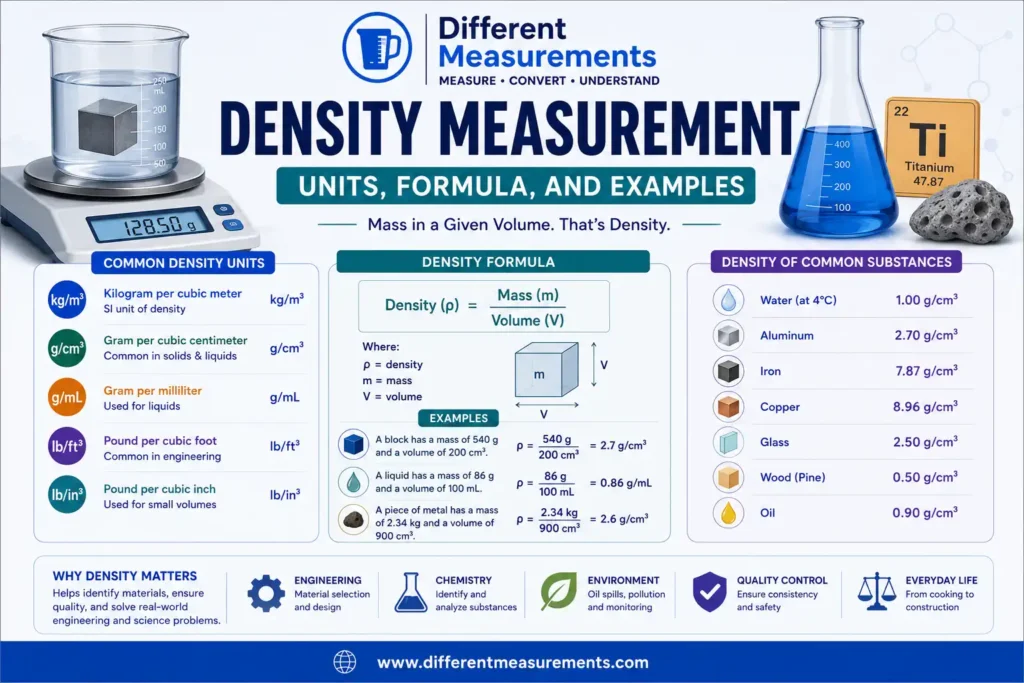
ρ = m / V
Where:
- ρ (the Greek letter rho) = density
- m = mass
- V = volume
This formula can be rearranged depending on which value needs to be calculated:
- Mass = Density × Volume
- Volume = Mass ÷ Density
For example, if a material’s density and volume are known, multiplying the two values gives the total mass. If the mass and density are known instead, dividing mass by density gives the volume the material occupies.
Mass, Volume, and Density Relationship
Mass, volume, and density are closely connected, but density is not the same thing as either mass or volume on its own.
- More mass in the same volume results in higher density, since more matter is packed into the same space.
- Less mass in the same volume results in lower density.
- The same mass occupying a larger volume results in lower density, since the matter is spread out over more space.
This relationship explains why a small object can sometimes be heavier than a much larger one. A small lead weight can outweigh a large block of foam, even though the foam occupies far more volume, because lead has a much higher density.
SI Unit of Density
The SI derived unit of density is the kilogram per cubic meter (kg/m³).
1 kg/m³ = 1 kg / 1 m³
Density uses a mass unit divided by a volume unit because it inherently describes a relationship between the two. Since neither kilograms nor cubic meters alone can express density, the combined unit is necessary to capture how mass is distributed within a given amount of space.
Common Density Units
Several density units are used depending on the substance, industry, and region.
- kg/m³: the SI unit, common in scientific and engineering contexts
- g/cm³: widely used for solid materials, particularly in chemistry and materials science
- g/mL: commonly used for liquids
- kg/L: used in some industrial and commercial contexts, particularly for liquids
- lb/ft³: used in the United States for construction materials and engineering
- lb/in³: used in the United States for smaller, denser materials and precision engineering
Density Units and Symbols
| Density Unit | Symbol | Measurement System | Common Applications |
|---|---|---|---|
| Kilogram per cubic meter | kg/m³ | SI / Metric | Science, engineering |
| Gram per cubic centimeter | g/cm³ | Metric | Solid material density |
| Gram per milliliter | g/mL | Metric | Liquid density |
| Kilogram per liter | kg/L | Metric | Industrial, commercial liquids |
| Pound per cubic foot | lb/ft³ | US Customary | Construction, engineering (US) |
| Pound per cubic inch | lb/in³ | US Customary | Precision engineering (US) |
Kilograms per Cubic Meter (kg/m³)
Kilograms per cubic meter is the SI unit of density, making it the standard reference point for scientific and engineering calculations worldwide. It is commonly used when working with large volumes or when consistency with other SI units, such as meters and kilograms, is important.
The relationship between kg/m³ and g/cm³ is:
1 g/cm³ = 1,000 kg/m³
This large numerical difference exists because a cubic meter is a much larger volume than a cubic centimeter, so the same density requires a correspondingly larger mass value when expressed in kg/m³.
Grams per Cubic Centimeter (g/cm³)
Grams per cubic centimeter is a commonly used density unit, particularly for solid materials in chemistry, geology, and materials science, since it produces conveniently sized numbers for many everyday substances.
1 g/cm³ = 1 g/mL
This equivalence exists because one cubic centimeter and one milliliter represent exactly the same volume, making g/cm³ and g/mL numerically interchangeable.
Grams per Milliliter (g/mL)
Grams per milliliter is typically used for liquids, since milliliters are a more familiar volume unit for liquid measurement than cubic centimeters, even though the two units represent identical volumes.
Because 1 cm³ equals 1 mL, g/mL and g/cm³ are numerically equivalent units of density, meaning a substance with a density of 1 g/cm³ also has a density of 1 g/mL. This makes it straightforward to compare solid and liquid densities using either unit.
Other Density Units
- kg/L: numerically equivalent to g/mL, commonly used in industrial and commercial liquid measurement
- lb/ft³: used in the United States, particularly in construction and engineering for materials like concrete, soil, and insulation
- lb/in³: used for smaller, denser materials in precision engineering and manufacturing contexts, where lb/ft³ would produce inconveniently small numbers
Density Conversion
Density conversion requires converting both the mass component and the volume component of the unit, since density is not a single, standalone quantity like length or mass alone. Converting density incorrectly using only a simple length-based factor, without accounting for the cubic nature of the volume component, is a common source of error. For a broader explanation of how unit conversion works across all measurement categories, see Measurement Conversions.
Common density conversions include:
- g/cm³ to kg/m³: multiply by 1,000
- kg/m³ to g/cm³: divide by 1,000
- g/mL to kg/m³: multiply by 1,000
- kg/m³ to g/L: divide by 1 (numerically equivalent)
- kg/L to kg/m³: multiply by 1,000
- lb/ft³ to kg/m³: multiply by 16.0185
- kg/m³ to lb/ft³: multiply by 0.062428
Common Density Conversion Factors
| Relationship | Value |
|---|---|
| 1 g/cm³ | = 1 g/mL |
| 1 g/cm³ | = 1,000 kg/m³ |
| 1 kg/m³ | = 0.001 g/cm³ |
| 1 kg/L | = 1,000 kg/m³ |
| 1 g/mL | = 1 kg/L |
| 1 lb/ft³ | ≈ 16.0185 kg/m³ |
| 1 kg/m³ | ≈ 0.062428 lb/ft³ |
How to Convert Density Units Manually
- Identify the original density unit. For example, 2.7 g/cm³.
- Identify the target density unit. For example, kg/m³.
- Separate the mass and volume components if necessary. Recognize that grams and cubic centimeters both need to scale to kilograms and cubic meters.
- Apply the appropriate conversion factors. Since 1 g/cm³ equals 1,000 kg/m³, use this direct relationship.
- Keep the correct cubic volume unit. Ensure the final answer is expressed per cubic meter, not per meter.
- Check whether the final value is reasonable. A result of 2,700 kg/m³ is consistent with a dense solid material like aluminum.
- Round appropriately. Whole numbers or one decimal place are usually sufficient for practical use.
Density Calculation Examples
Example 1: Calculate Density An object has a mass of 500 g and a volume of 250 cm³. Density = Mass ÷ Volume Calculation: 500 ÷ 250 Result: 2 g/cm³
Example 2: Calculate Mass A material has a density of 8 g/cm³ and a volume of 50 cm³. Mass = Density × Volume Calculation: 8 × 50 Result: 400 g
Example 3: Calculate Volume An object has a mass of 300 g and a density of 3 g/cm³. Volume = Mass ÷ Density Calculation: 300 ÷ 3 Result: 100 cm³
Example 4: Convert Density Convert 1.2 g/cm³ to kg/m³. Conversion factor: 1 g/cm³ = 1,000 kg/m³ Calculation: 1.2 × 1,000 Result: 1,200 kg/m³
Example 5: Liquid Density A liquid has a mass of 150 g and occupies 200 mL. Density = Mass ÷ Volume Calculation: 150 ÷ 200 Result: 0.75 g/mL
Density of Common Materials
The table below shows approximate densities for common substances. These values can vary based on temperature, pressure, purity, and other conditions, so they should be treated as general reference points rather than exact constants.
| Material | Approximate Density (g/cm³) | Approximate Density (kg/m³) |
|---|---|---|
| Air (sea level) | 0.0012 | 1.2 |
| Ice | 0.92 | 920 |
| Water | 1.0 | 1,000 |
| Aluminum | 2.7 | 2,700 |
| Iron | 7.87 | 7,870 |
| Steel | 7.85 | 7,850 |
| Copper | 8.96 | 8,960 |
| Mercury | 13.6 | 13,600 |
| Gold | 19.3 | 19,300 |
Density of Water
Water is one of the most commonly referenced substances in density measurement, largely because it serves as a convenient and familiar comparison point for other materials.
Water’s density is approximately 1 g/cm³, or 1,000 kg/m³, near standard conditions. However, this value is not exactly constant at every temperature. Water reaches its maximum density around 4°C and becomes slightly less dense both above and below that point, which is part of why ice, being less dense than liquid water, floats rather than sinks. For most everyday and educational purposes, 1 g/cm³ remains a reliable and convenient approximation.
Density vs Mass
Density and mass are related but distinct physical quantities. Mass measures the total amount of matter in an object, while density measures how much mass is packed into a given volume.
For example, a large block of foam can have more total mass than a small piece of metal if the foam is large enough, even though the metal has a much higher density. Mass depends on the total size of an object, while density depends on how tightly matter is packed within it, regardless of the object’s overall size.
Density vs Weight
Density, mass, and weight are three related but separate concepts. Weight is the force exerted on an object due to gravity, while density is mass per unit volume. Because weight depends on gravity, an object’s weight can change depending on where it is measured, such as on the Moon versus on Earth, while its density remains the same as long as its mass and volume stay constant.
It is important not to confuse weight with mass when discussing density, since density calculations rely specifically on mass, not on gravitational force.
Density vs Volume
Density and volume describe different aspects of a material. Volume measures how much space something occupies, while density measures how much mass is contained within that space.
The same material can occupy different volumes while maintaining the same density under consistent conditions. For example, a small ice cube and a large block of ice have different volumes, but both have essentially the same density, since they are made of the same substance under similar conditions.
Relative Density and Specific Gravity
Relative density, more commonly known as specific gravity, compares the density of a substance to the density of a reference substance, typically water for liquids and solids.
Specific gravity is calculated by dividing the density of a substance by the density of the reference substance. Because both values are expressed in the same units, those units cancel out, making specific gravity a dimensionless ratio rather than a measurement with its own unit.
For gases, the reference substance is often air rather than water, depending on the context and application. A specific gravity greater than 1 indicates a substance denser than the reference, while a value less than 1 indicates a substance less dense than the reference. Specific gravity is a useful comparison tool, but it should not be treated as a standalone unit of measurement.
How Is Density Measured?
Density can be determined using different methods depending on whether the material is a regular solid, an irregular solid, or a liquid.
Mass and Volume Method
The most direct approach involves measuring an object’s mass and volume separately, then applying the basic formula:
Density = Mass ÷ Volume
Measuring Regular Solids
For objects with simple geometric shapes, volume can be calculated using standard formulas before applying the density formula.
- Rectangle or rectangular prism: length × width × height
- Cube: side length cubed
- Cylinder: π × radius² × height
Once volume is calculated, it is combined with a measured mass to determine density.
Measuring Irregular Solids
For objects without a simple geometric shape, water displacement is a practical method for determining volume.
- Measure the initial water volume in a graduated container.
- Submerge the object completely in the water.
- Measure the new water volume after submersion.
- Find the difference between the two readings.
- Use the displaced volume, along with the object’s measured mass, in the density formula.
This method works because a submerged object displaces a volume of water exactly equal to its own volume.
Measuring Liquid Density
Liquid density is typically measured by determining the mass of a known volume of liquid using tools such as:
- A balance, to measure mass accurately
- A graduated cylinder, to measure a precise liquid volume
- Volumetric equipment, such as pipettes or volumetric flasks, for more precise laboratory measurements
Dividing the measured mass by the known volume then gives the liquid’s density.
Density and Floating or Sinking
Density plays a central role in whether an object floats or sinks in a fluid. As a general principle:
- Objects less dense than the surrounding fluid tend to float
- Objects more dense than the surrounding fluid tend to sink
Simple examples include:
- Wood in water: wood is generally less dense than water, so it floats
- Ice in water: ice is slightly less dense than liquid water, allowing it to float, though mostly submerged
- Metal in water: many metals are denser than water and sink, though shape can allow some metal objects, like ships, to float by displacing enough water
This last example highlights an important nuance: while density is the core principle behind floating and sinking, an object’s shape and how it displaces fluid also affect whether it floats, which is why a solid metal block sinks while a hollow metal ship does not.
Density in Everyday Life
Density influences many ordinary experiences and decisions:
- Cooking, where ingredient density affects measurements, layering of liquids, and recipe outcomes
- Food and beverages, where density differences explain why oil floats on vinegar in salad dressing
- Construction materials, where density affects weight, strength, and insulation properties
- Fuel, where density influences energy content and how fuel is measured and sold
- Shipping, where density affects how goods are packed and how shipping costs are calculated
- Packaging, where lightweight, low-density materials are often chosen to reduce shipping weight
- Manufacturing, where consistent material density supports quality and performance standards
- Water and other liquids, where density differences enable layering effects and separation techniques
- Building materials, where density affects both structural performance and material selection
Density in Science and Engineering
Density measurement is foundational across many technical fields:
- Chemistry, where density helps identify and characterize substances
- Physics, where density relates to concepts such as buoyancy and pressure
- Materials science, where density informs material selection for specific applications
- Geology, where mineral and rock density assist in identification and classification
- Fluid mechanics, where density affects how liquids and gases behave and interact
- Engineering, where density influences structural design and material choices
- Quality control, where density testing helps verify manufacturing consistency
- Manufacturing, where density measurements support process monitoring and product standards
Common Density Measurement Mistakes
- Confusing density with mass, treating a material’s total mass as if it described how tightly packed that mass is
- Confusing density with weight, overlooking that weight depends on gravity while density does not
- Confusing density with volume, treating the size of an object as if it determined its density
- Using the wrong density formula, particularly when rearranging for mass or volume
- Mixing mass and volume units, such as combining grams with cubic meters without converting first
- Forgetting that volume units are cubic, which can lead to significant errors when converting density
- Using a length conversion factor incorrectly, applying a linear conversion factor to a cubic volume unit without adjustment
- Ignoring temperature when it significantly affects density, particularly for liquids and gases
- Rounding too early in multi-step calculations, which can compound small errors
- Assuming every material has a constant density under all conditions, when in fact temperature, pressure, and composition can all cause variation
Common Questions About Density Measurement
Density measurement is the process of determining how much mass a substance contains per unit of volume, expressed in units such as kilograms per cubic meter or grams per cubic centimeter, allowing materials to be identified and compared accurately.
Density equals mass divided by volume, written as ρ = m / V.
The SI unit of density is the kilogram per cubic meter (kg/m³).
Density is calculated by dividing an object’s mass by its volume, using the formula Density = Mass ÷ Volume.
Mass measures the total amount of matter in an object, while density measures how much mass is packed into a given volume, describing how concentrated that matter is.
Density is mass per unit volume and does not depend on gravity, while weight is the force exerted on an object due to gravity and can change depending on location.
Grams per cubic centimeter and grams per milliliter are numerically equivalent units, since one cubic centimeter and one milliliter represent exactly the same volume.
Multiply the value in g/cm³ by 1,000 to get the equivalent value in kg/m³.
Water has a density of approximately 1 g/cm³, or 1,000 kg/m³, near standard conditions, though this value varies slightly with temperature.
Objects less dense than the surrounding fluid tend to float, while objects more dense than the fluid tend to sink, though shape and water displacement can also affect this behavior.
Specific gravity, also called relative density, is a dimensionless ratio comparing the density of a substance to the density of a reference substance, typically water for liquids and solids.
The density of an irregular object is typically measured using water displacement to determine its volume, then dividing its measured mass by that displaced volume.
Density connects mass and volume into a single measurement that explains why materials of the same size can weigh so differently, and why some objects float while others sink. Understanding the density formula, common units like kg/m³ and g/cm³, and how to convert between them makes it easier to compare materials accurately across science, engineering, and everyday situations.