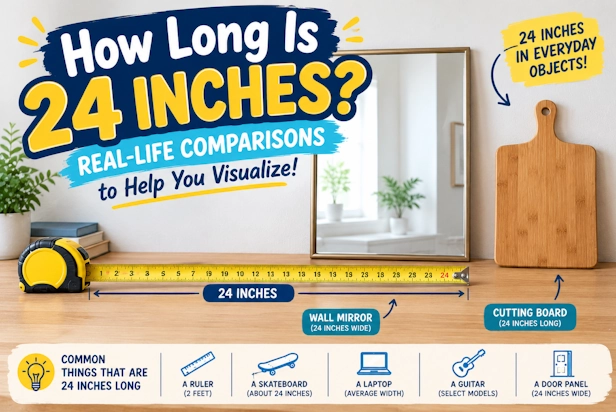
24 inches is equal to 2 feet, or about 60.96 centimeters.
It is also roughly the depth of a standard kitchen base cabinet.
If you’ve ever wondered “how long is 24 inches really?”, the fastest way to understand it is to compare it with things you already see every day. Below you’ll find the exact conversion, simple ways to estimate it without a tape measure, and 18 familiar objects that are close to 24 inches long.
Key Takeaways
- 24 inches equals exactly 2 feet, or 60.96 centimeters (609.6 mm). It’s one of the easiest inch measurements to convert since it divides evenly into feet.
- The simplest way to picture it is two standard 12-inch rulers placed end to end, or a carpenter’s 2-foot level.
- It’s a genuinely common furniture and appliance size, showing up in kitchen base cabinet depth, floating wall shelves, square floor pillows, and ottomans.
- It’s also a standard sizing point in tech and sports gear, appearing in 24-inch computer monitors (diagonal), youth bicycle wheels, and youth baseball bats.
- A quick no-tape estimate: stack two 12-inch rulers, or use a large cutting board, which is close to this length.
24 Inches in Other Units
| Unit | Value |
|---|---|
| Feet | 2 ft |
| Centimeters | 60.96 cm |
| Millimeters | 609.6 mm |
| Meters | 0.6096 m |
| Yards | 0.67 yd |
Need a different length? Try our inches to feet converter for instant results with any number.
How to Estimate 24 Inches Without a Tape Measure
You don’t always need a measuring tool to judge a size like this. Try these quick methods:
- Use two rulers. Line up two standard 12-inch rulers end to end and you’ve got 24 inches exactly.
- Use a carpenter’s level. A standard carpenter’s level is built to exactly 2 feet, making it a precise, no-guesswork reference if you have one in a toolbox.
- Measure from the wall to the counter edge. The depth of a typical kitchen base cabinet, from the front edge to the wall, is close to 24 inches.
18 Everyday Things That Are About 24 Inches
1. A Youth Bicycle Wheel
Youth mountain bikes are commonly built with wheels that measure exactly 24 inches in diameter. It’s a size parents often check when shopping for a bike that fits a growing child, since it sits between smaller kids’ bikes and full adult-size wheels.
2. A Kitchen Base Cabinet (Depth)
Standard kitchen base cabinets are built to roughly 24 inches deep, giving enough counter space for appliances and food prep while still leaving room to walk through the kitchen. If you’ve ever measured a kitchen for a remodel, this number comes up constantly.
3. A Crib Mattress (Width)
Most standard crib mattresses follow a width specification close to 24 inches, matching the interior dimensions of standard cribs. It’s a size regulated fairly tightly since a loose-fitting mattress can be a safety concern.
4. A Floating Wall Shelf
Two-foot floating shelves are sold in exact 24-inch lengths at most home goods and hardware stores. They’re a popular size for displaying books, plants, or decor without taking up too much wall space.
5. A Decorative Wall Mirror
Many wall mirrors are manufactured in a 24-inch width, large enough to create a noticeable focal point in an entryway or living room without overwhelming the wall.
6. A Folding Utility Stool
A folding utility stool commonly reaches a seat height around 24 inches, tall enough to help reach upper cabinets or shelves while still folding flat for storage.
7. An Exercise Step Platform
Fitness step platforms used for aerobic workouts typically measure approximately 24 inches in length, a size designed to comfortably fit both feet side by side during stepping exercises.
8. A Square Ottoman
Many square ottomans are built around 24 inches wide, a size that works well as a coffee table substitute or an extra footrest in a living room.
9. A Pet Gate Panel
Pet gate barrier sections often come in 24-inch-wide configurations, letting owners combine panels to fit hallways and doorways of different widths.
10. A Large Wooden Cutting Board
Chef-sized wooden cutting boards often stretch close to 24 inches long, with enough surface area for separate prep zones for meat, vegetables, and other ingredients.
11. A Folded Bath Towel
A standard American bath towel, folded in half, measures close to 24 inches wide. It’s a comparison that works well for anyone picturing linen closet storage or towel bar sizing.
12. A Square Floor Pillow
Floor pillows used for casual seating or meditation are frequently made in a 24×24-inch square size, large enough to sit on comfortably while still being easy to store.
13. A 24-Inch Computer Monitor
A 24-inch computer monitor describes the screen’s diagonal measurement, a popular middle-ground size for home offices and gaming setups that balances screen real estate with desk space.
14. Two Standard Rulers End to End
Lining up two standard 12-inch rulers end to end gives you exactly 24 inches. It’s one of the most precise, no-guesswork comparisons on this list if you happen to have two rulers on hand.
15. A Youth Baseball Bat
Baseball bats sized for young players, typically around ages five to seven, are often built close to 24 inches long, short enough for a small player to swing comfortably and safely.
16. A Carry-On Suitcase (Height)
Many carry-on suitcases measure close to 24 inches in height, a size that typically meets airline overhead-bin requirements while still offering enough packing space for a short trip.
17. A Carpenter’s Level
A standard carpenter’s level is built to exactly 2 feet, making it one of the most precise tools you can use to visualize this length if you have one in a garage or toolbox.
18. An Acoustic Guitar Neck (Scale Length)
The scale length of many acoustic guitars, the distance from the nut to the bridge, falls close to 24 to 25.5 inches depending on the model. It’s a measurement that affects string tension and playing feel, something guitarists often compare when choosing an instrument.
24 Inches vs. Other Common Lengths
Seeing 24 inches next to lengths you already know makes it easier to place:
- 24 inches is exactly double a standard 12-inch ruler
- 24 inches is about 7 times longer than a standard credit card (3.37 in)
- 24 inches is roughly the depth of a kitchen base cabinet
- 24 inches is just over twice the length of a standard sheet of paper (11 in)
Conclusion
24 inches equals 2 feet or 60.96 centimeters, and once you connect it to something familiar, like a kitchen cabinet’s depth, two rulers end to end, or a carpenter’s level, the length becomes easy to picture without ever reaching for a tape measure. Whether you’re shopping online, planning a kitchen remodel, or just curious about a size you came across, these real-world comparisons make 24 inches simple to visualize.
Frequently Asked Questions
24 inches equals exactly 2 feet.
24 inches is equal to 60.96 centimeters.
A kitchen base cabinet’s depth and a pair of 12-inch rulers placed end to end are two of the most precise, convenient comparisons.
Line up two standard 12-inch rulers, or use a carpenter’s level, which is built to exactly 2 feet.
It’s a medium length, longer than a standard sheet of paper but still well short of a yard, and common in furniture, appliances, and sporting goods sizing.