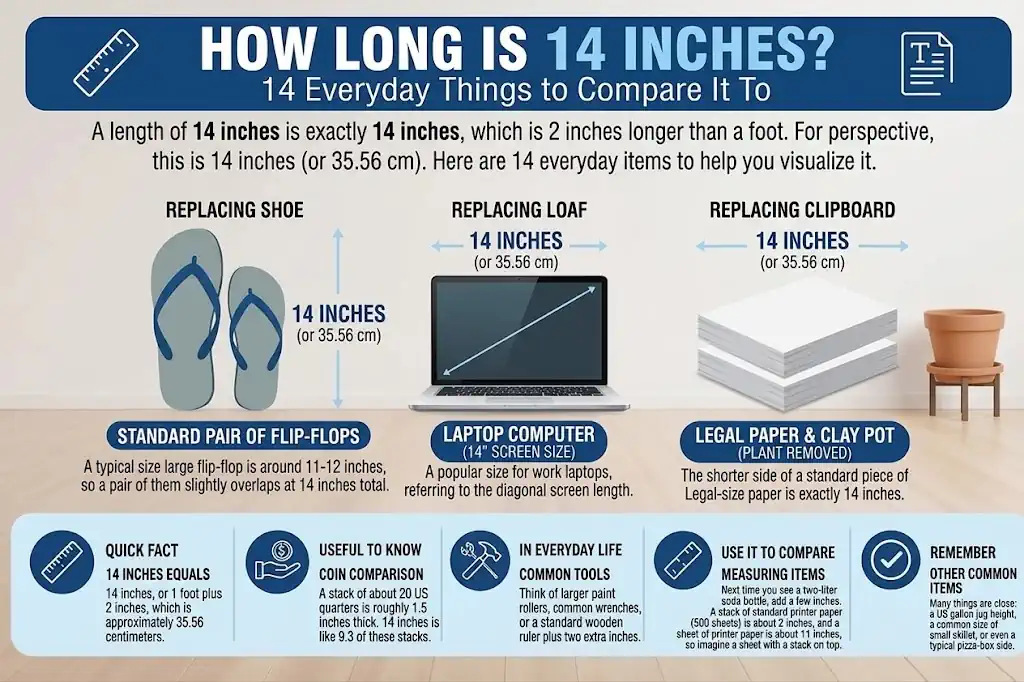
Fourteen inches is one of those in-between measurements not quite a foot, not quite huge, and just awkward enough that most people can’t picture it right away.
That’s a problem when you’re shopping for a laptop bag, checking if a shelf will fit above your desk, or trying to judge a product’s real size from a listing photo. A couple of inches off can mean the difference between something fitting perfectly and something getting sent right back.
This guide gives you a clear, practical sense of exactly how long 14 inches is, using objects you already know, plus quick ways to estimate it without ever picking up a tape measure. By the end, you’ll have a mental “ruler” for 14 inches that you can carry around for life.
Quick Answer: How Long Is 14 Inches?
14 inches = 35.56 cm = 355.6 mm = 1.17 feet = 0.356 meters
That’s a little longer than a standard ruler — about 2 inches past the 12-inch mark and roughly the size of a small laptop screen or a medium pizza.
| Unit | Value |
|---|---|
| Inches | 14 in |
| Centimeters | 35.56 cm |
| Millimeters | 355.6 mm |
| Feet | 1.17 ft |
| Meters | 0.356 m |
| Yards | 0.39 yd |
Whichever unit you think in, the underlying picture is the same: a length that’s noticeably bigger than a phone or tablet, but still small enough to hold comfortably in two hands.
What Does 14 Inches Actually Look Like?
Fourteen inches sits right past the length of a standard 12-inch ruler, which makes it easy to anchor mentally: picture a ruler, then add about two finger-widths on top of it.
It’s a size that shows up constantly in everyday products because it hits a practical sweet spot big enough to be genuinely useful, small enough to stay portable and easy to store. That’s exactly why laptops, trays, cushions, and clocks so often land near this length. Manufacturers aren’t picking 14 inches at random; it’s a size that balances usability against bulk almost perfectly for a huge range of household and office items.
If you were to hold a 14-inch object in your hands, it would typically stretch from your fingertips to somewhere just past your elbow on an average adult forearm, or roughly the width of a standard laptop bag laid flat.
Why It Helps to Know What 14 Inches Feels Like
Getting this measurement wrong isn’t just a minor inconvenience it can lead to real, avoidable problems:
- Buying a laptop sleeve, case, or bag that doesn’t actually fit your device
- Misjudging whether a shelf, tray, or cutting board will fit a tight kitchen space
- Underestimating a product’s real size when all you have is a photo and a number
- Struggling to plan layouts for desks, kitchens, or storage areas
- Ordering furniture accessories like cushions or brackets that end up too small or too large
Once 14 inches has a solid mental picture attached to it, these small sizing mistakes become much easier to avoid and you stop second-guessing yourself every time a product page lists a dimension instead of a picture.
14 Everyday Things That Are About 14 Inches Long
Here’s a reference table of common objects that are close to 14 inches, so you always have something familiar to compare against.
| # | Object | Approx. Length |
|---|---|---|
| 1 | 14-inch laptop (diagonal screen) | 14 in |
| 2 | Medium pizza (diameter) | ~14 in |
| 3 | Standard ruler + 2 extra inches | 14 in |
| 4 | Compact wireless keyboard (width) | ~14 in |
| 5 | Rectangular throw pillow (side) | ~14 in |
| 6 | Medium serving tray (length) | ~14 in |
| 7 | Wall clock (diameter) | ~14 in |
| 8 | Kitchen cutting board (length) | ~14 in |
| 9 | Compact rolling pin (handle to handle) | ~14 in |
| 10 | Baking sheet (length) | ~14 in |
| 11 | Standing desk lamp (height) | ~14 in |
| 12 | Large teddy bear (sitting height) | ~14 in |
| 13 | Small guitar gig bag (widest point) | ~14 in |
| 14 | Compact backpack (height) | ~14 in |
| 15 | Medium storage basket (width) | ~14 in |
| 16 | Bathroom mirror (width, compact style) | ~14 in |
A Closer Look at These Comparisons
14-Inch Laptop: This is the most familiar reference on the list, since laptop screens are marketed by their diagonal measurement, and the 14-inch size is one of the most common on the market today. If you’ve ever carried a laptop bag to work, school, or a coffee shop, you already have a built-in reference for this exact length.
Medium Pizza: Most medium pizzas from a standard restaurant menu measure close to 14 inches across, giving you an instantly recognizable circular reference almost everyone has seen sitting on a kitchen counter or dinner table.
Standard Ruler Plus a Bit: Since a classroom ruler is exactly 12 inches, picturing 14 inches is as simple as adding roughly two finger-widths to the end of that familiar tool. This is one of the fastest mental shortcuts you can use anywhere, anytime.
Wall Clock: Many round wall clocks sold for kitchens and living rooms measure close to 14 inches in diameter, making them a handy reference that combines both height and width in a single, easy-to-picture object.
Compact Keyboard: A slim wireless keyboard, the kind designed to save desk space, is often close to 14 inches wide. If you work at a computer daily, glancing down at your own keyboard gives you an instant, always-available comparison.
Serving Tray: Medium-sized trays used for carrying drinks, snacks, or breakfast in bed typically run close to 14 inches long, and their flat rectangular shape makes the length especially easy to visualize.
Storage Basket: Fabric or wicker storage baskets used to organize closets, toy rooms, or laundry areas are frequently sized around 14 inches wide, which is part of why this measurement feels so common once you start noticing it.
How 14 Inches Compares to Nearby Measurements
Understanding where 14 inches sits relative to other common lengths makes it much easier to place on a mental scale.
| Length | How It Compares to 14 Inches |
|---|---|
| 10 inches | Noticeably shorter — about 4 inches less |
| 12 inches | Exactly one foot, 2 inches shorter |
| 14 inches | Baseline measurement |
| 16 inches | Slightly longer, about 2 inches more |
| 18 inches | One and a half feet, noticeably longer |
| 24 inches | Exactly double, a full 2 feet |
This kind of side-by-side comparison is especially useful when you’re deciding between two similarly sized products — say a 12-inch versus a 14-inch laptop, or a 14-inch versus an 18-inch storage bin.
Where 14-Inch Measurements Commonly Show Up
Fourteen inches isn’t a random number in product design — it’s a size that keeps reappearing across very different categories because it works so well in practice.
| Category | Common 14-Inch Items |
|---|---|
| Electronics | Laptop screens, monitor stands, keyboards |
| Kitchen | Pizza pans, cutting boards, baking sheets, rolling pins |
| Home Decor | Throw pillows, wall clocks, serving trays |
| Storage | Baskets, bins, organizer boxes |
| Furniture Accessories | Shelf brackets, seat cushions |
| Travel & Bags | Backpacks, small instrument gig bags |
Seeing the spread across categories helps explain why this measurement feels so familiar even if you’ve never consciously measured anything at 14 inches before you’ve almost certainly owned or used several of these items already.
How to Measure 14 Inches Without a Ruler
No measuring tape nearby? These simple tricks will get you close enough for everyday decisions:
- Picture a standard 12-inch ruler, then add about 2 finger-widths
- Compare the object to a 14-inch laptop screen you own or have used
- Think of a medium pizza’s diameter sitting on a table
- Line the object up against a round wall clock’s width
- Use a compact wireless keyboard as a side-by-side reference
- Measure from your elbow toward your wrist and add roughly an inch, since forearm length varies by person
None of these methods are precise to the millimeter, but they’re more than accurate enough for shopping decisions, quick DIY checks, or figuring out whether something will fit before you commit to buying it.
Common Mistakes People Make With 14 Inches
Even though 14 inches seems like a straightforward number, a surprising number of small errors happen around it:
Confusing it with one foot. A foot is only 12 inches, so 14 inches always runs a couple of inches longer than people expect if they round it down mentally.
Judging size purely from photos. Product images on shopping sites often hide true scale, especially when there’s no familiar object in the frame for comparison. A tray or cushion can look much bigger or smaller than it actually is.
Mixing up screen size with total device size. A 14-inch laptop screen measurement is diagonal, not the width or height of the actual laptop body, so the device itself will always be larger than the screen number alone suggests.
Assuming all “medium” items are the same size. A “medium” pizza, tray, or basket can vary by brand, so treating 14 inches as an exact guarantee rather than a rough average can lead to mismatched expectations.
Skipping a real-world check. Even after estimating, it’s worth holding a known 14-inch object like a laptop or a ruler with extra length next to the space or item in question before finalizing a decision.
Practical Situations Where This Measurement Matters
Knowing how long 14 inches actually is becomes genuinely useful in several everyday situations:
- Online Shopping: Comparing laptop bags, cushions, or kitchen tools listed only by dimension
- Home Organization: Deciding whether a storage basket will fit a shelf or closet slot
- Travel Packing: Checking if a gig bag, laptop sleeve, or accessory case will fit a suitcase or backpack
- Kitchen Prep: Matching cutting boards, trays, or baking sheets to available counter or oven space
- Interior Design: Placing wall clocks, cushions, or decor pieces so they feel proportionate to a room
In each of these cases, having a mental image of 14 inches saves time, prevents returns, and helps you make confident decisions without needing to physically measure everything in advance.
FAQs
14 inches equals 35.56 centimeters.
Yes. One foot equals 12 inches, so 14 inches is 2 inches longer than a foot.
Compare it to a 14-inch laptop screen, a medium pizza, or a standard ruler with about 2 extra finger-widths added on.
Common examples include laptop screens, wall clocks, serving trays, cutting boards, storage baskets, and medium pizzas.
Not usually it’s a medium size, bigger than small handheld objects but smaller than large furniture or appliances.
It offers a practical balance between usefulness and portability, which is why it shows up so often in laptops, trays, and household items.
Yes. The 14-inch figure refers to the diagonal screen measurement only, so the full laptop body, including its bezels and base, will always be somewhat larger.
It’s significantly longer most smartphones measure around 6 to 7 inches diagonally, making 14 inches roughly double that length.
Tell them it’s about the length of a ruler plus two finger-widths, or the diagonal screen size of a compact laptop both are references most people immediately understand.
Conclusion
Once you connect “14 inches” to something real a laptop screen, a medium pizza, or a ruler with a couple of extra finger-widths — it stops being an abstract number and becomes a size you can picture instantly, without hesitation.
Next time you’re shopping online, checking product dimensions, or planning where something will fit in your home or bag, you’ll already know exactly what 14 inches looks like no ruler required, and no guesswork left to chance.