1 inch is equal to 2.54 centimeters (25.4 millimeters). It is also roughly the width of an adult thumb.
You have probably guessed the size of an inch a thousand times without thinking about it. It is a small unit, but it shows up in screens, screws, tape, photos, and even the weather report.
This guide gives you plenty of real objects to picture, every conversion you are likely to need, and a few practical tricks for finding an inch when there is no ruler in sight.
Key Takeaways
- 1 inch equals exactly 2.54 cm, or 25.4 mm, and this value is fixed by international agreement, not rounded.
- An adult thumb width, a standard hockey puck’s thickness, and a US dollar coin’s width are all close to 1 inch.
- 1 inch is 1/12 of a foot, 1/36 of a yard, and 0.0254 meters.
- On screens, 1 inch is not a fixed pixel count: it is 96 px in CSS, 72 pt in classic print, and 300 px at 300 DPI.
- “1 inch of rain” means a layer of water 1 inch deep over a whole area, which adds up to roughly 27,154 gallons on a single acre.
1 Inch Conversion Table
| Unit | Equal to 1 inch |
|---|---|
| Centimeters (cm) | 2.54 cm |
| Millimeters (mm) | 25.4 mm |
| Meters (m) | 0.0254 m |
| Feet (ft) | 0.0833 ft (1/12) |
| Yards (yd) | 0.0278 yd (1/36) |
| Mils / thou | 1,000 mil |
| Points (print) | 72 pt |
| Picas | 6 picas |
Pixels at Common Resolutions
| Resolution | Pixels in 1 inch |
|---|---|
| 72 DPI (older print and web default) | 72 px |
| 96 DPI (standard CSS and many displays) | 96 px |
| 300 DPI (print-quality images) | 300 px |
Fractions of an Inch in Millimeters
| Fraction | Millimeters |
|---|---|
| 1/16 in | 1.59 mm |
| 1/8 in | 3.18 mm |
| 1/4 in | 6.35 mm |
| 1/2 in | 12.7 mm |
| 3/4 in | 19.05 mm |
| 1 in | 25.4 mm |
18 Everyday Things That Are About 1 Inch
A quick note before the list: real objects vary a little from one maker to the next, so treat these as friendly estimates, not precision tools. Where an item is a bit over or under, that is mentioned.
1. The Width of an Adult Thumb
For many adults, the width of the thumb across the top joint lands close to an inch. It is the classic “no ruler” shortcut. Check yours against a ruler once, and you will have a handy measuring tool that goes everywhere with you.
2. The Tip of Your Index Finger
Measure from the fingertip down to the first knuckle. On many adults this stretch is around an inch, though hands differ. It is a good second option when your thumb is busy holding something.
3. A US Dollar Coin
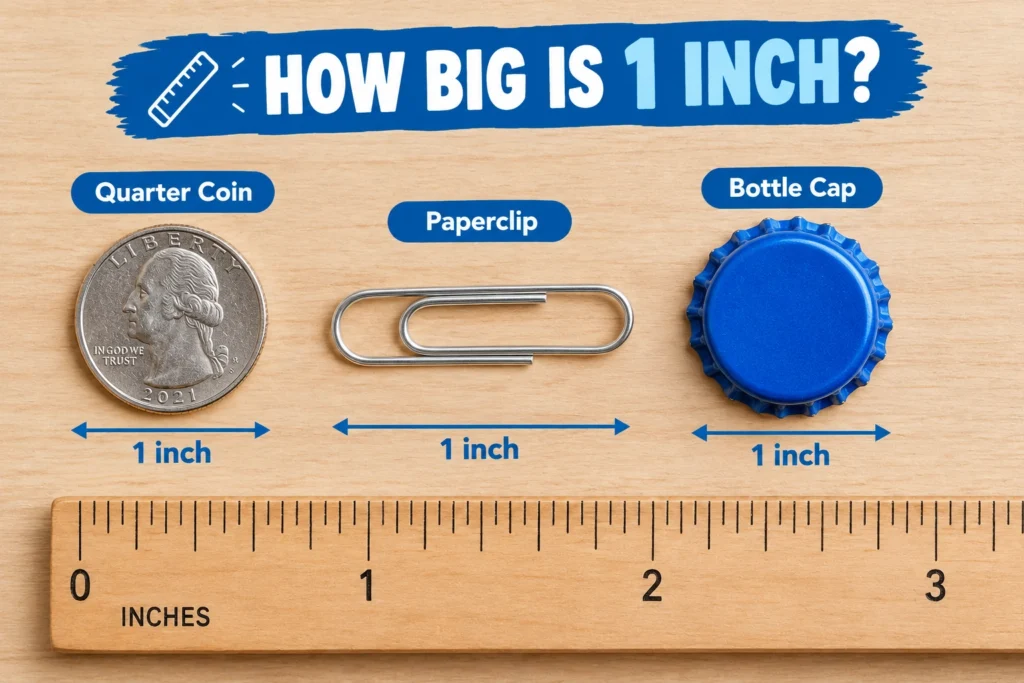
The golden dollar coin is about 1.04 inches across, so it sits just over the mark. Among US coins, it is the closest single match to a true inch.
4. A US Quarter
A quarter measures roughly 0.955 inch across. It falls just short of an inch, which makes it a useful “almost there” reference that most people can find in a pocket.
5. A Hockey Puck (Thickness)
A regulation hockey puck is 1 inch thick, and it is 3 inches across. Because the thickness is standardized, a puck is one of the few household-style objects you can trust as an exact inch.
6. A Stack of Pennies
A US penny is about 1.52 mm thick, so roughly 16 to 17 of them stacked together reach an inch. It is a slow reference to build, but a fun one, and it works with any coin if you know its thickness.
7. A Standard Wine Cork
A common wine cork is about 24 mm wide, or 0.94 inch. That is a hair under a full inch, but it is close enough for a quick mental picture.
8. A Full-Size Memory Card
The wide edge of a full-size SD-format memory card measures 24 mm, or about 0.94 inch. If you own a camera, you likely have one in a drawer.
9. A Plastic Bottle Cap
The width of a typical soda or water bottle cap is somewhere around an inch, sometimes a little more. Because caps come in slightly different sizes, hold it against a ruler once before you rely on it.
10. A Standard Paperclip
A regular paperclip is about an inch wide on its short side. Paperclips live in every office and classroom, so this is one of the easiest comparisons to grab.
11. A Shooter Marble
The large marble kids use to knock others out of a ring is close to an inch across. Ordinary marbles are noticeably smaller, so this only applies to the big “shooter” size.
12. A 1-Inch Wood Screw
A screw sold as 1 inch is measured from the tip to where the head sits flush. It is one of the most common lengths in a hardware store and a very trustworthy reference if the label says what it should.
13. Masking Tape Width
Many rolls of masking tape are sold near 1 inch wide (some are slightly narrower, such as 24 mm). Painters use this width all the time for taping trim, so your toolbox may already hold a ruler of sorts.
14. The Rings on a 1-Inch Binder
A binder labeled “1 inch” refers to the ring diameter, not the cover. It usually holds a couple hundred sheets of standard paper, which makes the inch easy to picture as a small stack.
15. Inch-Wide Ribbon
Craft and gift ribbon is commonly sold in a 1 inch width. It is wide enough to make a bold bow on a small box, so if you wrap gifts, you likely have an inch in a drawer.
16. A Plump Grape
A large, ripe grape can be about an inch across. Smaller ones fall short, so choose from the big end of the bunch.
17. A Cube from an Ice Tray
Cubes from a standard tray are often around an inch on each side. This gives you a nice three-dimensional feel for the size, not just a flat length.
18. 1 Inch of Hair
Hair grows about half an inch a month on average, so an inch takes roughly two months. That is why a trim of “just an inch” can feel like it sets you back a lot.
How to Spot 1 Inch on a Ruler
On a standard inch ruler, the longest lines are the whole-inch marks. Starting from the zero end, the first long line with the number 1 is exactly one inch away.
The marks between two long lines split the inch into smaller parts:
- The medium-long line in the middle is the half inch.
- The next shorter lines mark quarters.
- The smaller ticks after that mark eighths and sixteenths.
If your ruler has a metal cap or a blank margin before the zero, start counting from the zero line itself, not from the physical edge.
How to Measure 1 Inch Without a Ruler
- Use your thumb. Check your own thumb width against a ruler one time, then remember the result.
- Fold a sheet. A letter-size sheet is 8.5 inches wide, so folding it into halves and quarters gets you to about 2.1 inches, and splitting that in two gets you close to an inch.
- Use a coin. A dollar coin is just over an inch, and a quarter is just under. Split the difference in your head.
- Use a screw or tape roll. A 1-inch screw or a roll of 1-inch tape gives you a reliable edge to compare against.
What Does “1 Inch of Rain” Mean?
It does not mean a puddle an inch deep that you could measure with a ruler on the ground. It means that if the rain could not soak in, drain away, or evaporate, it would cover the whole area in a layer of water 1 inch deep.
Spread over a single acre, that layer amounts to about 27,154 gallons, which is well over 100 tons of water. On one square foot, it is about 0.62 gallons. That is why a slow, steady inch of rain can still flood a field or fill a rain barrel quickly.
1 Inch on a Screen
An inch is a physical length, but a screen is made of pixels, so the answer depends on the setting:
- In CSS, 1 inch is defined as 96 pixels.
- In traditional print software, 1 inch is 72 points.
- In a 300 DPI image, 1 inch holds 300 pixels.
If you ever need a true, physical inch on a display, hold a ruler against the glass. Zoom levels and screen density can make on-screen “inches” drift from real ones.
1 Inch Compared to Other Small Sizes
| Size | In inches | In millimeters |
|---|---|---|
| 1/2 inch | 0.5 in | 12.7 mm |
| 1 inch | 1 in | 25.4 mm |
| 1.5 inches | 1.5 in | 38.1 mm |
| 2 inches | 2 in | 50.8 mm |
| 1 centimeter | 0.394 in | 10 mm |
A handy rule: 1 inch is a little more than two and a half centimeters, and 4 inches is just over 10 centimeters.
Common Mistakes When Estimating 1 Inch
- Trusting body parts blindly. Hands and thumbs vary a lot from person to person, so calibrate yours once against a ruler.
- Mixing up thickness and width. A puck is 1 inch thick, but it is 3 inches wide. Make sure you are comparing the right dimension.
- Assuming all coins are the same. A quarter is just under an inch and a dollar coin is just over, so they will not line up perfectly.
- Forgetting that tape, ribbon, and screws vary. Some are sold in metric widths close to an inch (such as 24 mm), so check the label.
- Confusing pixels with inches. The number of pixels in an inch depends on the resolution, so a screen measurement can mislead you.
Conclusion
An inch is small, but you can find it almost anywhere: in a thumb, a coin, a puck, a screw, or a roll of tape. Pick one or two references that suit your daily life and you will rarely need to hunt for a ruler.
FAQs
One inch equals 2.54 centimeters and 25.4 millimeters. Both are exact values, and all other inch conversions build on them.
For many adults, the width of the thumb or the segment from fingertip to first knuckle is about an inch. Hands differ, so verify yours against a ruler.
A regulation hockey puck is 1 inch thick, and a screw sold as 1 inch is 1 inch long. These are two of the most dependable references.
There are 12 inches in a foot, so 1 inch is 1/12 of a foot, or about 0.0833 ft.
On average, hair grows about half an inch per month, so 1 inch takes roughly two months.
It is more than it sounds. One inch over an acre is about 27,154 gallons, which is enough to soak the ground and fill gutters during a steady storm.
It depends on the resolution: 72 at 72 DPI, 96 in CSS, and 300 at 300 DPI.