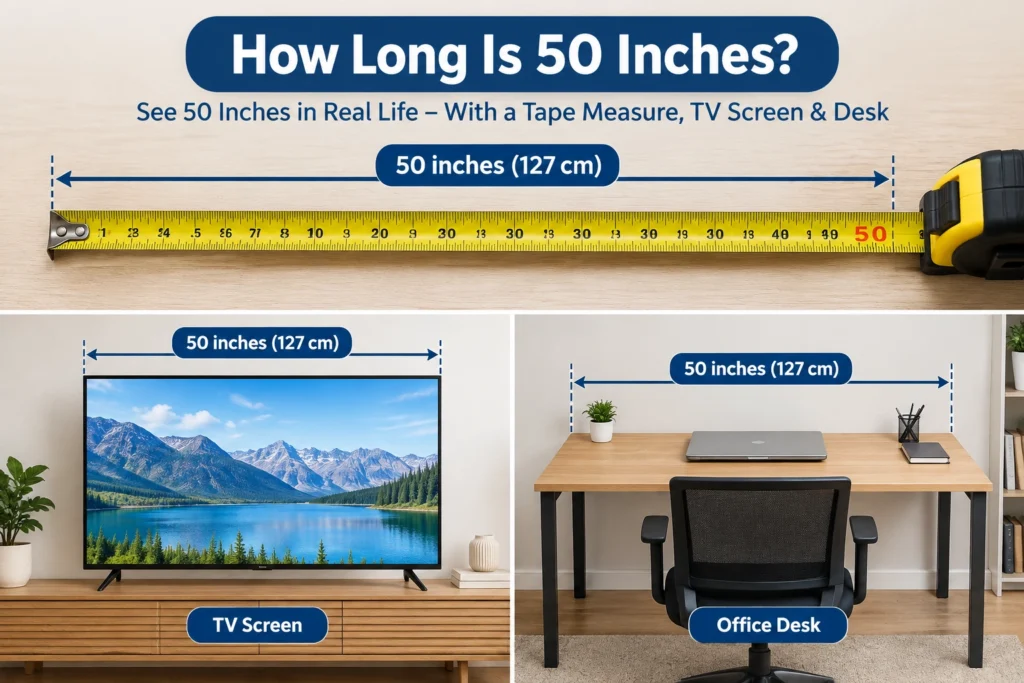
50 inches is equal to 127 centimeters (about 4.17 feet, or 4 feet 2 inches). It is also roughly the height of an average 6-year-old child.
Fifty inches sits in an odd but useful middle zone. It is too long to picture as a single small object, yet too short to compare to a room or a car. It is the number you run into most often on TV boxes, desk listings, and crib specs.
This guide breaks the size down with a full conversion table, a dozen real-world comparisons, and a few notes on where this measurement shows up most.
Key Takeaways
- 50 inches equals exactly 127 centimeters, 4.1667 feet, or 4 feet and 2 inches.
- In meters, 50 inches is 1.27 m, and in millimeters it is 1,270 mm.
- It is close to the height of an average 6-year-old child, and a common diagonal size for mid-range flat-screen TVs.
- A typical office desk (48 to 60 inches wide) and a standard baby crib (about 50 to 55 inches long) both land near this size.
- 50 inches is roughly 1.39 yards, so it is just a bit longer than a yard and a third.
50 Inches Conversion Table
| Unit | Equal to 50 inches |
|---|---|
| Millimeters (mm) | 1,270 mm |
| Centimeters (cm) | 127 cm |
| Meters (m) | 1.27 m |
| Feet (ft) | 4.1667 ft (4 ft 2 in) |
| Yards (yd) | 1.3889 yd |
| Kilometers (km) | 0.00127 km |
| Miles (mi) | 0.000789 mi |
| Nautical miles (nmi) | 0.000686 nmi |
12 Everyday Things That Are About 50 Inches
Real objects vary between brands and models, so treat these as helpful reference points rather than exact rulers.
1. A Mid-Size Flat-Screen TV (Diagonal)
TV and monitor sizes are always measured on the diagonal, corner to corner across the screen, not the width. A 50-inch TV sits in the popular mid-to-large range for living rooms, between a compact bedroom set and a full home-theater display.
2. The Height of an Average 6-Year-Old Child
Fifty inches works out to 4 feet 2 inches, which lines up closely with the average height of a 6-year-old. It is a quick way to picture the size without reaching for a tape measure.
3. Two Bicycle Wheels Side by Side
A standard adult bicycle wheel is roughly 25 inches across. Line up two of those wheels edge to edge with no gap between them, and you land right around 50 inches.
4. The Width of a Standard Office Desk
Most office desks run somewhere between 48 and 60 inches wide. Fifty inches sits near the narrow end of that range, so it describes a desk that is compact but still has real working surface.
5. The Height of a Small Refrigerator
Compact and apartment-size refrigerators often stand around 50 to 52 inches tall, noticeably shorter than a full-size kitchen fridge. That height comparison is handy when you are shopping for a small kitchen or a dorm room.
6. A Short Performance Surfboard
Shorter surfboards built for tricks and quick turns often come in around 50 inches long, well under the length of a longer cruising board. Surfers pick this shorter length specifically because it is easier to spin and maneuver on a wave.
7. Half a Sheet of Plywood
A full sheet of plywood measures 48 by 96 inches. Cut that sheet down into quarters and one of the resulting pieces lands close to 50 inches on its longer side, which is a useful reference if you work with sheet lumber.
8. A Standard Baby Crib (Length)
Most baby cribs are built to a fairly standard length of about 50 to 55 inches. That size gives an infant a safe, comfortably sized sleeping space without taking up an oversized footprint in a nursery.
9. A Classroom or Conference Room Whiteboard
Whiteboards used in classrooms and meeting rooms are frequently built around 50 inches wide. That width gives a presenter enough room to write or diagram clearly while still fitting on a standard wall.
10. A Tall Window
Typical home windows run about 36 to 48 inches tall. A 50-inch-tall window is a touch above that everyday range, so picture a normal window stretched just a little taller than usual.
11. A Large Open Golf Umbrella (Span)
Big golf umbrellas commonly open to about 60 inches across. A 50-inch span is a bit smaller than that, so think of an umbrella that is generously sized but not quite the largest one on the shelf.
12. About 1.4 Bathtubs Lined Up End to End
A standard bathtub is roughly 60 inches long. Fifty inches comes in a little short of one full tub length, which is a useful gut-check when you are picturing the size along a hallway or wall.
50 Inches in Feet and Inches
Dividing 50 by 12 gives 4 with a remainder of 2, so 50 inches converts cleanly to 4 feet 2 inches. This is the figure you will see most often on product listings that mix imperial units, such as height charts, appliance specs, and furniture dimensions.
Common Places You’ll See 50 Inches
- Television and monitor listings, where it describes the diagonal screen size.
- Furniture dimensions, especially desk widths and shelving heights.
- Appliance specs, such as compact refrigerator or washer-dryer heights.
- Nursery and baby gear, including crib and bassinet lengths.
- Sports equipment, including certain surfboard and net measurements.
Common Mistakes When Estimating 50 Inches
- Confusing screen diagonal with width. A 50-inch TV is not 50 inches wide; the width is shorter because the diagonal cuts across the corners.
- Rounding too early. 4.1667 feet rounds down to a plain “4 feet” in casual conversation, which can throw off a measurement by a couple of inches.
- Assuming every product in a category matches. Desks, cribs, and fridges all vary within a range, so 50 inches is a typical figure, not a fixed standard.
- Mixing up meters and centimeters. 50 inches is 1.27 meters, not 12.7 meters. Keep the decimal point in the right place when converting.
Conclusion
Fifty inches lands in a practical middle ground: tall enough to describe a child’s height or a TV screen, yet short enough to fit inside a desk or a crib. Keeping a couple of these comparisons in mind makes the number easy to picture the next time you see it on a spec sheet.
FAQs
50 inches equals 4 feet and 2 inches, or 4.1667 feet as a decimal.
50 inches equals exactly 127 centimeters.
50 inches equals 1.27 meters.
It is a solidly mid-to-large size for a home television, popular in living rooms and family rooms, though larger sizes exist for dedicated home theaters.
50 inches equals about 1.39 yards.
It is very close. 50 inches (4 feet 2 inches) lines up with the average height for many 6-year-old children, though individual height varies.
50 inches equals 1,270 millimeters.