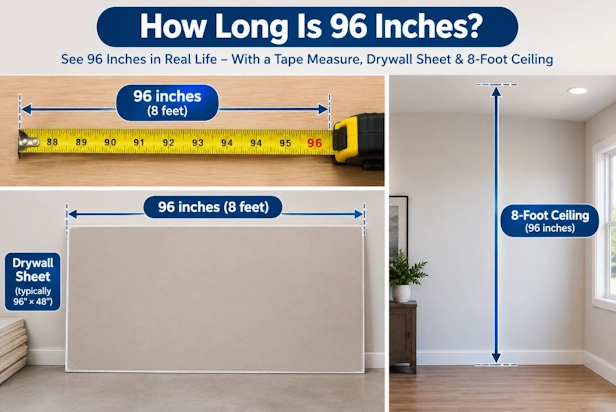
96 inches is equal to exactly 8 feet (243.84 centimeters). It is also the standard length of a framing 2×4 and the height of a typical US ceiling.
Ninety-six inches is a number that quietly runs the building trade. It is the length lumber is cut to, the size drywall sheets are made in, and the height most ceilings are built at, all without anyone needing to do the math.
This guide breaks the size down with a full conversion table and ten real comparisons so you can picture 96 inches without pulling out a tape measure.
Key Takeaways
- 96 inches equals exactly 8 feet, with no remainder, which is why it shows up so often as a standard material length.
- In centimeters, 96 inches is 243.84 cm, and in meters it is about 2.44 m.
- An 8-foot 2×4 stud and a standard drywall sheet’s long side are both built to this exact length.
- The most common residential ceiling height in the US is 8 feet (96 inches) floor to ceiling.
- 96 inches is 16 inches taller than a standard interior doorway, which is typically 80 inches high.
96 Inches Conversion Table
| Unit | Equal to 96 inches |
|---|---|
| Feet (ft) | 8 ft |
| Yards (yd) | 2.67 yd |
| Millimeters (mm) | 2,438.4 mm |
| Centimeters (cm) | 243.84 cm |
| Meters (m) | 2.4384 m |
10 Everyday Things That Are About 96 Inches Long
Real products vary a little between brands and specific jobs, so treat these as strong reference points rather than exact rulers.
1. An 8-Foot 2×4 Stud
The most common piece of framing lumber in a hardware store is cut to 96 inches, sold simply as an “8-foot 2×4.” Builders use this exact length constantly, which makes it one of the most reliable real-world matches for the measurement.
2. The Long Side of a Drywall Sheet
A standard sheet of drywall measures 4 feet by 8 feet, meaning its long edge is exactly 96 inches. Builders size walls and framing around this sheet length, which is part of why 96 inches shows up so often in home construction.
3. A Typical 8-Foot Ceiling
Many homes, especially older or more modest builds, are framed with 8-foot ceilings, meaning the floor-to-ceiling height is 96 inches. Taller “9-foot” or “10-foot” ceilings are common upgrades, which makes the standard 96-inch height an easy baseline to compare against.
4. The Width of a Standard Shipping Container
Standard ISO shipping containers, the kind stacked on cargo ships and hauled by trucks, are built to a width of 8 feet, or 96 inches. That fixed width is part of a global standard that lets the same container move between ships, trains, and trucks without being repacked.
5. A Full-Size Pickup Truck’s Long Bed
Full-size pickup trucks offered with a “long bed” option typically measure close to 96 inches from the tailgate to the cab. That length is one of the main reasons buyers choose a long bed over a standard one, since it comfortably fits full sheets of plywood or drywall flat on the floor.
6. A Classic Longboard Surfboard
Traditional longboard surfboards are commonly built close to 96 inches (8 feet) long. That extra length gives the board more stability and glide, which is exactly why longboarders choose it over a shorter, more maneuverable shortboard.
7. Standard Fence Post Spacing
A common layout for wood fence framing spaces the posts 96 inches, or 8 feet, apart on center. That spacing balances material cost against structural strength, which is why it shows up so often in residential fence plans.
8. An 8-Foot Banquet Table
Rectangular banquet tables used for events are frequently built to 96 inches long. A table this size comfortably seats around eight people, which is why it is a standard rental size for weddings, conferences, and other large gatherings.
9. An 8-Foot Step Ladder
Step ladders sold for reaching ceilings, gutters, and other elevated home projects commonly come in an 8-foot size, which measures close to 96 inches at full height. It is one of the taller consumer ladder sizes before buyers typically move up to extension ladders instead.
10. 16 Inches Taller Than a Standard Doorway
A standard interior doorway is built to 80 inches tall. Ninety-six inches is a full 16 inches taller than that, roughly the height of a typical ceiling above the same floor. Picturing a doorway with another foot and a half of extra height stacked on top is a quick way to visualize the full 96 inches.
96 Inches in Feet and Inches
Because 96 divides evenly by 12, the conversion is unusually clean: 96 inches is exactly 8 feet, with 0 inches left over. That clean division is a big part of why so many building materials, from lumber to drywall, are manufactured at this exact length.
Why 96 Inches Shows Up So Often in Construction
Ninety-six inches is not a random number in the building trade, it is a deliberate standard. Framing lumber, drywall sheets, and many ceiling heights are all built around multiples of this length because it divides cleanly into feet, keeps material waste low, and lets different building components line up with each other without extra cutting.
Common Mistakes When Estimating 96 Inches
- Confusing 96 inches with 6 feet. Six feet is only 72 inches; 96 inches is a full 2 feet taller than that.
- Assuming every pickup bed is the same length. Long beds run close to 96 inches, but standard beds are noticeably shorter, often closer to 78 inches.
- Mixing up ceiling height with wall height. An 8-foot ceiling refers to the finished floor-to-ceiling distance, not the height of the framing lumber used to build it.
- Forgetting the drywall sheet orientation. The 96-inch measurement is the long side of a 4×8 sheet; the short side is only 48 inches.
Conclusion
Ninety-six inches is one of the easiest big measurements to remember, since it lines up perfectly with 8 feet and with so many standard building materials. Once you have a 2×4, a drywall sheet, or an 8-foot ceiling in mind, the number stops feeling abstract.
FAQs
96 inches equals exactly 8 feet, with no remainder.
96 inches equals 243.84 centimeters.
No. Six feet is 72 inches; 96 inches is a full 2 feet (24 inches) longer than that.
It divides evenly into 8 feet, which is why lumber, drywall sheets, and many ceiling heights are manufactured at or around this length.
An 8-foot 2×4, a drywall sheet’s long edge, an 8-foot ceiling, and an 8-foot banquet table are all common examples.
96 inches equals about 2.67 yards.