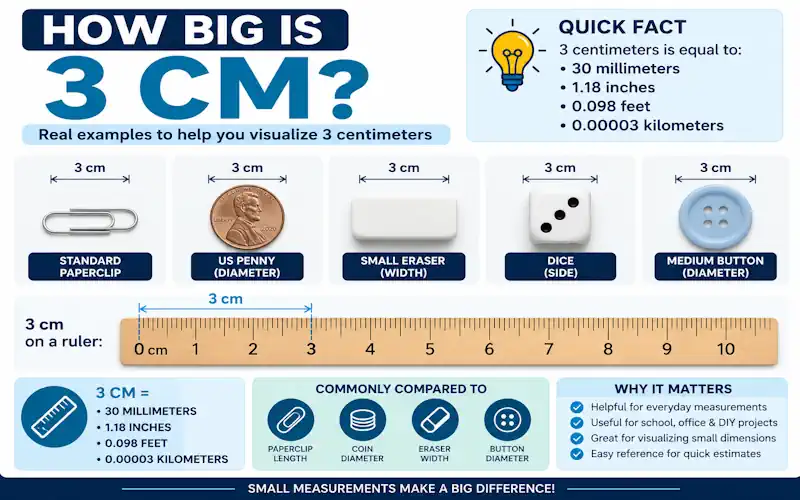
How big is 3 cm? 3 centimeters (cm) is equal to 1.18 inches or 30 millimeters. It’s a small but clearly noticeable measurement that shows up in plenty of everyday objects. Compared to 1 cm or 2 cm, 3 cm is easier to visualize because it lands closer to the width or height of many common household items.
This measurement is commonly used in product dimensions, crafts, school projects, electronics, and accessories. In this guide, you’ll learn how to easily understand and visualize 3 cm using practical, real-life examples.
3 cm in Different Units
To better understand this measurement, here’s a quick conversion table:
| Unit | Value |
|---|---|
| Centimeters | 3 cm |
| Inches | 1.18 inches |
| Millimeters | 30 mm |
| Meters | 0.03 m |
This means 3 cm is slightly bigger than 1 inch, making it a small yet easy-to-notice measurement.
What Does 3 cm Look Like?
Without a ruler nearby, you can still estimate 3 cm using common objects around you. It’s close to the width of a small cookie, the size of some watch faces, or the diameter of compact accessories.
Because it’s larger than 1 cm and 2 cm, it becomes easier to compare visually. Once you start noticing objects around this size, recognizing 3 cm becomes genuinely simple.
Why Understanding 3 cm Matters
Understanding a measurement like 3 cm is genuinely useful in daily life, since many products and objects are designed around this size. From accessories and electronics to office supplies and kitchen items, this measurement shows up frequently.
Knowing how big 3 cm is can help you better judge product dimensions while shopping online or comparing objects in real life.
How Small Measurements Help in Everyday Tasks
Small measurements matter in plenty of daily activities. Whether you’re doing crafts, arranging decorations, buying accessories, or using electronics, precise measurements help improve accuracy.
Even a small difference in size can affect how an object fits or works which is exactly why understanding measurements like 3 cm turns out to be so useful in practical situations.
Why Real-Life Comparisons Improve Understanding
Numbers alone can sometimes feel hard to picture. Most people understand measurements much faster when they compare them with familiar objects they already use every day.
Real-life comparisons create a clearer mental image, helping you estimate sizes naturally without needing measuring tools all the time.
15 Real-Life Examples of 3 cm
Understanding 3 cm becomes much easier once you compare it with everyday objects. Since it’s a small but visible size, these comparisons help you quickly recognize the measurement in real life.
1. Oreo Cookie Width
The width of a standard sandwich cookie is close to 3 cm in some sections. Cookies are easy to recognize and compare visually, and their round shape helps make the measurement clear at a glance a simple, relatable example.
2. Smartwatch Screen Width
The width of many compact smartwatch screens can measure around 3 cm. Smartwatches are used daily for fitness and notifications, and their size is easy to observe while wearing one a modern, practical example.
3. Mini Sticky Note Width
A small sticky note section can measure close to 3 cm wide. These notes are common in offices, schools, and homes, and their square shape makes visual comparison easy a natural way to understand small dimensions.
4. Tape Roll Inner Hole Diameter
The inner hole of a small tape roll often measures around 3 cm across. Tape rolls are used for school, office, and packaging tasks, and their circular shape makes them easy to compare visually a genuinely useful reference object.
5. Compact Makeup Brush Handle Width
The handle section of some compact makeup brushes can measure close to 3 cm. These are used daily for personal care, and their size is easy to notice while using them a relatable, modern example.
6. Sauce Container Height
A small fast-food sauce container can measure around 3 cm in height. These containers are common in restaurants and homes, and their compact size makes comparison easy a handy way to improve size estimation.
7. Toy Car Width
The width of some small toy cars can be close to 3 cm. Toy cars are easy to recognize because of their simple shape and size, and their dimensions help clarify small measurements a practical example.
8. Nail Cutter Width
The width of a standard nail cutter can measure around 3 cm. Nail cutters are common household items used regularly, and their metal design makes visual comparison simple a practical, real-life reference.
9. Travel Toothpaste Cap Width
The cap of a travel-size toothpaste tube can measure close to 3 cm wide. Toothpaste products are used daily, making them familiar objects, and their cylindrical shape helps make the dimensions clearer.
10. Compact Flashlight Diameter
The diameter of a small flashlight head can measure around 3 cm. Flashlights are commonly used during emergencies or travel, and their round shape makes comparison simple a useful everyday example.
11. Small Jar Lid Width
The lid of a tiny cosmetic or cream jar often measures close to 3 cm. These jars are common in skincare and personal care products, and their size is easy to recognize visually a relatable comparison.
12. Rubber Stamp Width

The width of some small office rubber stamps can be around 3 cm. These are commonly used for paperwork and labeling, and their compact design makes them easy to compare — helping build a stronger sense of the measurement.
13. Drawer Knob Diameter
The diameter of a small drawer knob can measure close to 3 cm. Drawer knobs turn up in kitchens, bedrooms, and offices, and their round shape makes them easy to visualize a practical household example.
14. Tea Spoon Bowl Width
The bowl section of a standard teaspoon can measure around 3 cm wide. Spoons are used daily in kitchens and dining areas, and their size is easy to compare visually a natural way to estimate dimensions.
15. Portable Speaker Button Area
The button area on some portable speakers can measure close to 3 cm. Speakers are commonly used at home and outdoors, and their compact controls help clarify small measurements a genuinely modern example.
3 cm in Daily Life
The 3 cm measurement shows up in plenty of everyday products and accessories. It’s commonly used in household items, office supplies, electronics, and personal care products.
Because it’s slightly larger than smaller centimeter measurements, it’s easier to recognize and compare visually.
Visualizing 3 cm Without a Ruler
You don’t always need a ruler to estimate 3 cm. By using familiar objects like drawer knobs, tape rolls, or small containers, you can quickly build a genuine sense of this measurement.
With regular practice, estimating 3 cm becomes much easier and more accurate.
Common Mistakes When Estimating 3 cm
One common mistake is assuming 3 cm is much larger than it actually is. Another frequent issue is confusing centimeters with inches.
Leaning on familiar objects for comparison, like the examples above, genuinely helps improve accuracy and reduce confusion.
3 cm Compared to Other Measurements
To place 3 cm more clearly among nearby sizes:
- 1 cm: very small
- 2 cm: small
- 3 cm: small but noticeable
- 5 cm: medium small
- 10 cm: much larger
This kind of side-by-side comparison helps you clearly see how sizes increase step by step.
How 3 cm Is Used in Product Design
Plenty of products are designed using centimeter measurements for precision and balance. 3 cm is commonly used for compact accessories, buttons, lids, and small product parts.
This size works well because it’s easy to handle while still remaining compact.
Importance of Accurate Measurement
Accurate measurement matters because even small differences can affect how products fit or function. Knowing how big 3 cm is helps improve precision in daily tasks especially useful for crafts, shopping, and product comparisons.
Improving Measurement Skills
With regular practice, estimating measurements like 3 cm becomes noticeably easier. Comparing everyday objects trains your eyes to recognize sizes more accurately, and over time, you’ll be able to estimate small measurements naturally without using any tools.
Frequently Asked Questions
3 cm equals 1.18 inches.
It’s considered a small but noticeable measurement.
Compare it with drawer knobs, tape rolls, or toy cars.
Yes, it appears in many household and electronic products.
Examples include tape roll holes, nail cutters, and small jar lids.
Conclusion
It’s a small measurement equal to 1.18 inches or 30 millimeters. Even though it’s compact, it shows up in plenty of everyday objects you already use regularly. By leaning on simple references like tape rolls, drawer knobs, or small containers, you can easily understand and estimate this size without a ruler.