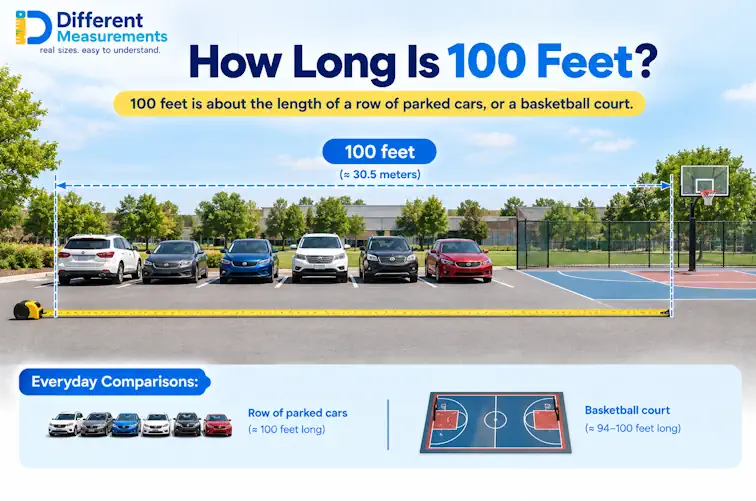
100 feet is equal to 30.48 meters (1,200 inches). It is also roughly the length of two semi-trailers parked end to end, minus a few feet.
One hundred feet is a common distance on property listings, construction plans, and outdoor layouts. It is long enough to cover a large yard, but short enough to see across in one glance. The number alone is hard to picture, so this guide shows what 100 feet looks like in real life.
You will find the exact conversions, eight real comparisons, and several ways to estimate 100 feet without a tape measure.
Key Takeaways
- 100 feet equals exactly 1,200 inches, 33.33 yards, or 30.48 meters.
- 100 feet is about 6 feet longer than an NBA basketball court, which is 94 feet long.
- A typical adult walking stride is about 2.5 to 3 feet, so 100 feet takes roughly 35 to 40 steps.
- A standard Olympic-size pool is 50 meters (164 feet), so 100 feet is a little over half its length.
- Many objects that people think are “about 100 feet” are only close, so use them as rough references and confirm with a tape for real work.
100 Feet Conversion Table
| Unit | Equal to 100 feet |
|---|---|
| Inches (in) | 1,200 in |
| Yards (yd) | 33.33 yd |
| Meters (m) | 30.48 m |
| Centimeters (cm) | 3,048 cm |
| Millimeters (mm) | 30,480 mm |
| Miles (mi) | 0.0189 mi |
Nearby Lengths in Feet and Meters
| Feet | Meters |
|---|---|
| 50 ft | 15.24 m |
| 75 ft | 22.86 m |
| 94 ft (NBA court) | 28.65 m |
| 100 ft | 30.48 m |
| 110 ft | 33.53 m |
| 120 ft | 36.58 m |
What Does 100 Feet Look Like?
One hundred feet is a clear, straight distance across a large open area. Stand at one end of an empty parking lot and look toward the far end. The row of spaces you see there is a close match, and it is the kind of distance you can judge quickly once you know what to look for.
Vertically, 100 feet rises well above most houses. It is roughly the height of a 10-story building, where each floor is planned at about 10 feet.
8 Real-World Things About 100 Feet Long
Real objects vary, so these are reference points rather than exact specifications. Items marked “about” are approximate.
1. A Blue Whale
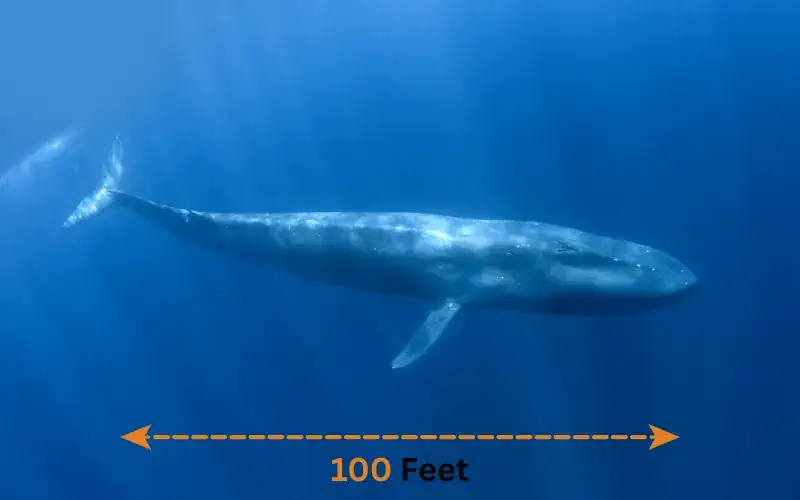
The blue whale is the largest animal known to have lived on Earth. Mature adults commonly reach about 80 to 90 feet, and the largest recorded individuals are close to 100 feet long. Museum displays and documentaries are the easiest way to see the scale.
2. A 10-Story Building
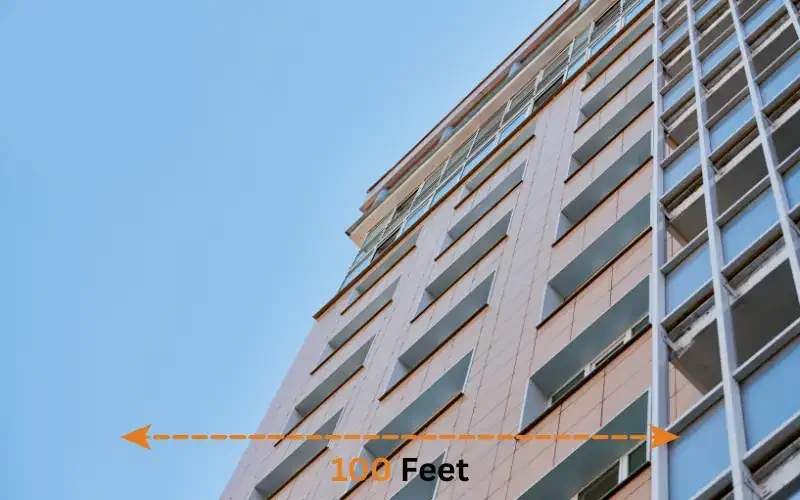
A common planning rule gives each floor about 10 feet of height, so a 10-story building is roughly 100 feet tall. Actual heights vary by building type, since offices and hotels often have taller floors than apartments. Use it as a scale reference rather than an exact measurement.
3. An NBA Basketball Court Plus 6 Feet
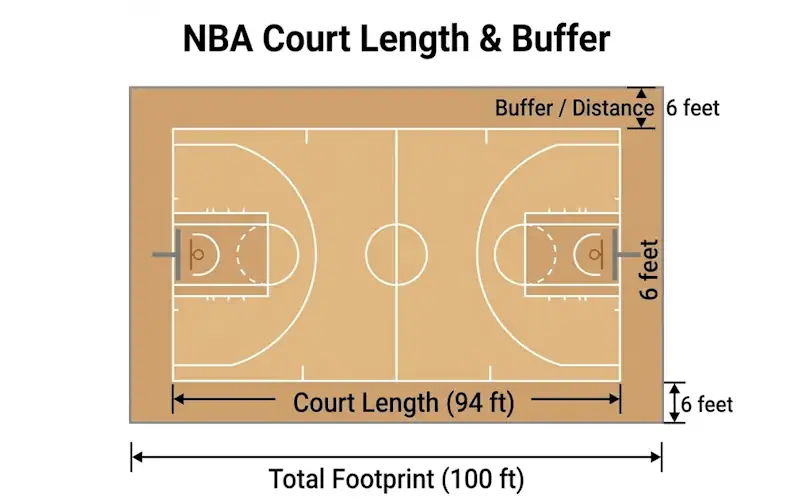
A regulation NBA court is 94 feet long, so adding 6 feet gives you 100 feet. This is one of the most reliable comparisons, because the court length is standardized. Picture the full court and then imagine one extra stride beyond the baseline.
4. Two Semi-Trailers, End to End
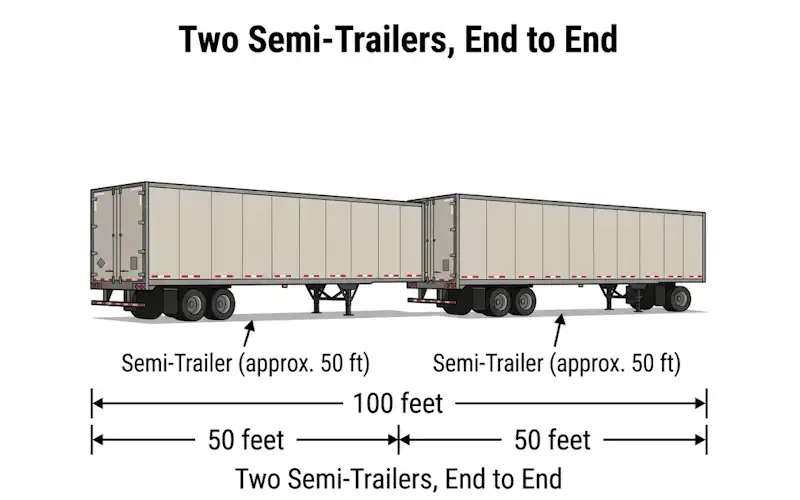
A standard semi-trailer is about 53 feet long, so two trailers placed end to end measure roughly 106 feet. That is just over 100 feet, which makes the comparison useful when you want to estimate a long, straight property boundary.
5. Ten Kayaks in a Row
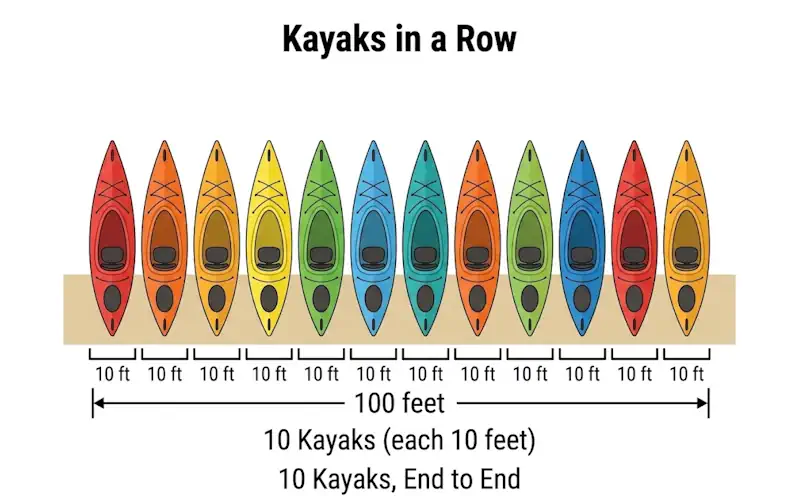
A standard touring kayak is about 10 feet long. Lining up ten of them nose to tail gives you exactly 100 feet. Because kayaks are fairly uniform, this is a dependable outdoor comparison at a lake or marina.
6. Eleven Standard Parking Spaces
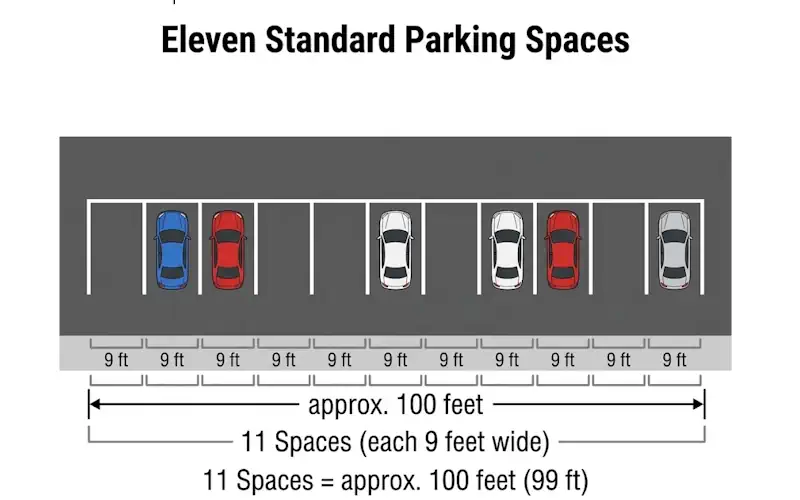
A typical parking space is about 9 feet wide. Eleven of them side by side come to about 99 feet, which is very close to 100. Parking lots are one of the easiest places to see this distance in everyday life.
7. About Two and a Half City Buses
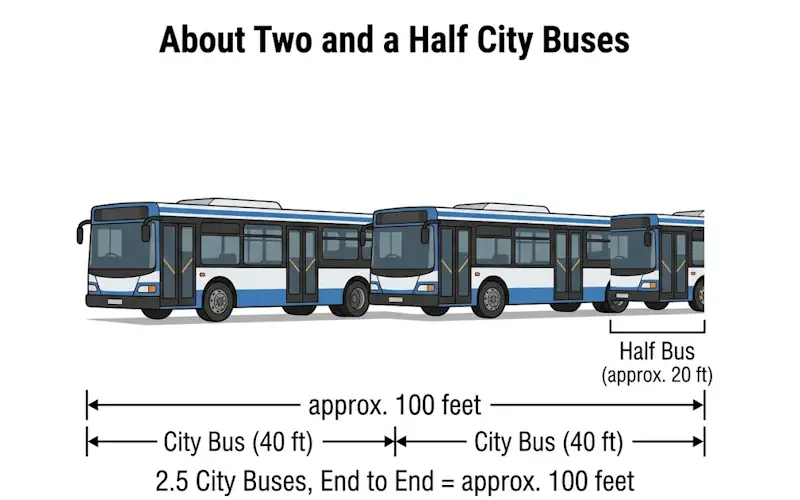
A standard transit bus is about 40 feet long, so two and a half buses equal about 100 feet. Bus lengths vary by model, so treat this as a rough comparison, but it helps when you see buses parked in a line.
8. About a Quarter of an NFL Field
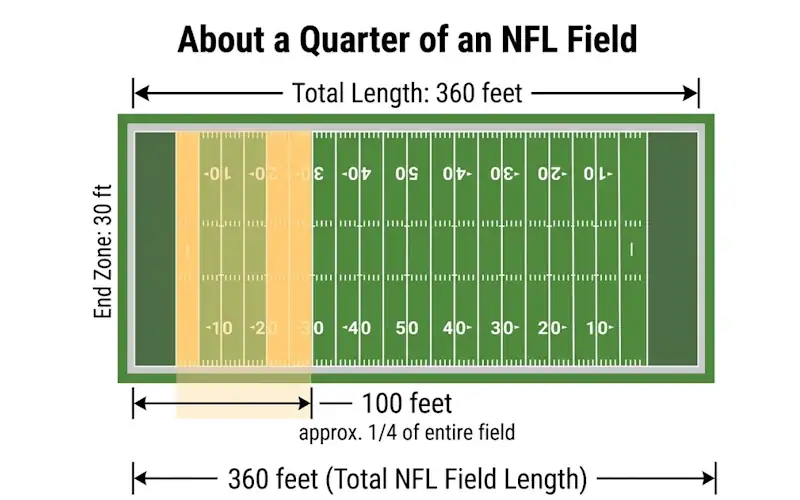
An NFL field is 360 feet long including the end zones. One hundred feet is a little more than a quarter of that. This comparison is easy to picture at a stadium, where the full field stretches out in front of you.
How to Estimate 100 Feet Without a Tape Measure
- Count your steps. Walk in a straight line with a normal stride. Most adults take about 35 to 40 steps for 100 feet, since a stride is about 2.5 to 3 feet. Measure your own stride once against a known distance.
- Use ten 10-foot lengths. If you can measure 10 feet once, mark it and repeat it ten times to reach 100 feet.
- Use the NBA court. Picture a full basketball court and add one extra stride past one end.
- Use 30 meters. Since 100 feet is 30.48 meters, a 30-meter distance is only about half a meter short.
- Use a known building. A 10-story building is roughly 100 feet tall, which helps when you judge height.
100 Feet Compared to Other Common Lengths
| Length | How it compares to 100 feet |
|---|---|
| 50 feet | Half as long |
| 94 feet (NBA court) | 6 feet shorter |
| 100 feet | Equal |
| 106 feet (two semi-trailers) | About 6 feet longer |
| 164 feet (Olympic pool) | About 64 feet longer |
| 360 feet (NFL field with end zones) | About 3.6 times as long |
Common Mistakes When Estimating 100 Feet
- Treating 100 feet as exactly 30 meters. 100 feet is 30.48 meters, so a 30-meter reference is slightly short.
- Confusing length with width or height. A 100-foot parking row, a 100-foot tower, and a 100-by-100-foot lot cover very different spaces. Always ask which dimension is meant.
- Assuming a stride is always 3 feet. Stride length depends on height and walking speed, so count your own steps before relying on the number.
- Trusting “exactly 100 feet” claims for natural objects. Trees, whales, and waterfalls vary, so use them as rough scale references.
- Mixing up 100 feet with 100 yards. 100 yards is 300 feet, three times as long.
Conclusion
One hundred feet is easiest to picture as an NBA basketball court plus about 6 feet, or as ten kayaks lined up nose to tail. Once you connect it to a familiar object, the number stops feeling abstract. For real measurements in construction or property work, always use a proper tape.
FAQs
100 feet equals 30.48 meters.
100 feet equals 1,200 inches.
100 feet equals 33.33 yards.
Yes, by about 6 feet. An NBA court is 94 feet long.
For most adults, 100 feet takes about 35 to 40 normal steps, depending on stride length.
100 feet is roughly the height of a 10-story building, assuming about 10 feet per floor.
For everyday life, yes. It is longer than most rooms and yards, but you can see across it easily in an open space.