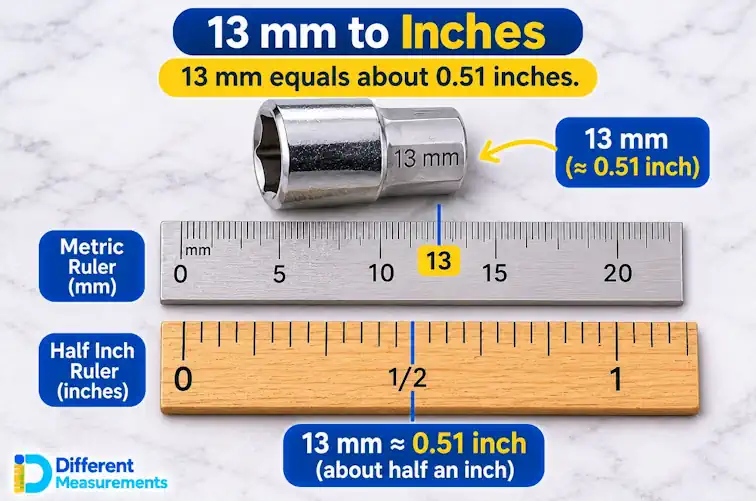
13 mm is equal to 0.5118 inches, or about 0.512 inches for everyday use. It is also slightly larger than half an inch, since half an inch is exactly 12.7 mm.
Thirteen millimeters is a common size in automotive tools, hardware, jewelry, and craft supplies. If you see a 13 mm socket, a bead, or a bolt head listed in a metric product sheet, you may need the inch value to compare it with a US tool or a dimension in inches. The conversion is one division, and this guide shows the exact value, the formula, a chart, and the most useful real-world references.
Key Takeaways
- 13 mm equals 0.511811 inches exactly, which rounds to 0.512 inches for everyday use.
- The formula is millimeters ÷ 25.4, because one inch is exactly 25.4 mm.
- 13 mm is about 0.3 mm longer than half an inch, which is 12.7 mm.
- To the nearest 32nd of an inch, 13 mm is 1/2 inch.
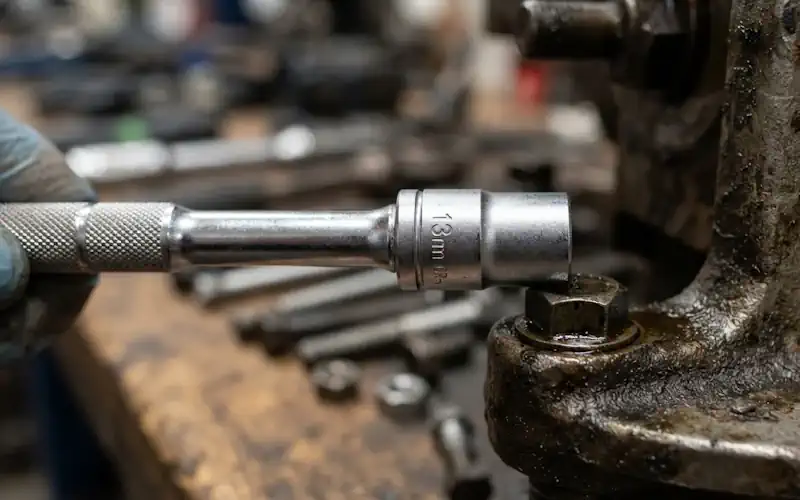
- A 13 mm wrench or socket fits a 13 mm bolt head, which is a common metric size in cars and machinery.
13mm to Inches: Quick Answer
| Measurement | Value |
|---|---|
| Exact decimal | 0.511811 inches |
| Rounded to 3 decimals | 0.512 inches |
| Rounded to 2 decimals | 0.51 inches |
| Nearest 32nd of an inch | 1/2 inch (16/32) |
| Centimeters | 1.3 cm |
The Formula for 13 mm to Inches
To convert any length from millimeters to inches, use this formula:
Inches = Millimeters ÷ 25.4
For 13 mm, the calculation is 13 ÷ 25.4 = 0.511811 inches.
Going the other way, multiply inches by 25.4 to get millimeters. For example, 1 inch × 25.4 = 25.4 mm. The number 25.4 is exact, because the inch is defined as 25.4 millimeters.
Why Not 2.54?
Some people reach for 2.54 by mistake. That number converts inches to centimeters, not millimeters to inches. Because 1 cm equals 10 mm, the millimeter version of the factor is 25.4, which is ten times larger. Using 2.54 for millimeters would give an answer that is too large by a factor of ten.
13mm to Inches Conversion Chart
| Millimeters | Inches |
|---|---|
| 8 mm | 0.315 in |
| 9 mm | 0.354 in |
| 10 mm | 0.394 in |
| 11 mm | 0.433 in |
| 12 mm | 0.472 in |
| 13 mm | 0.512 in |
| 14 mm | 0.551 in |
| 15 mm | 0.591 in |
| 16 mm | 0.630 in |
| 18 mm | 0.709 in |
| 20 mm | 0.787 in |
| 25 mm | 0.984 in |
13 mm Compared With Common Inch Fractions
Because most US tools and drawings use fractions, it helps to see where 13 mm lands among them.
| Fraction | Decimal | How it compares to 13 mm |
|---|---|---|
| 1/2 inch | 0.500 (12.7 mm) | About 0.3 mm smaller |
| 17/32 inch | 0.531 (13.5 mm) | About 0.5 mm larger |
| 9/16 inch | 0.563 (14.3 mm) | About 1.3 mm larger |
| 5/8 inch | 0.625 (15.9 mm) | About 2.9 mm larger |
For most tasks, 13 mm is close to 1/2 inch. For fitted parts such as bolts and sockets, the 0.3 mm gap matters, so use the metric tool when the drawing gives millimeters.
Practical Uses of 13 mm
Thirteen millimeters is a common size in several fields. These are the places you are most likely to meet it.
- Automotive repair. A 13 mm hex bolt head is one of the most common metric sizes in cars and small engines, and a 13 mm socket or wrench is a standard tool in many toolkits.
- Machinery. Mounting bolts and fasteners on industrial equipment often use 13 mm hardware, so the size is common in maintenance work.
- Furniture and DIY. Assembly hardware and brackets sometimes use 13 mm fasteners or drilled holes.
- Jewelry and crafts. Beads and pendants around 13 mm in diameter are popular for bracelets and necklaces.
- Electronics. Mounting holes and spacers in some enclosures are sized near 13 mm.
Everyday Things That Are About 13 mm
Items marked “about” vary by brand or manufacturer.
- A dress shirt button. Many shirt buttons measure roughly 10 to 15 mm across, so a 13 mm button is a typical size.
- A medium craft bead. Round craft beads around 13 mm are common for bracelets and jewelry projects.
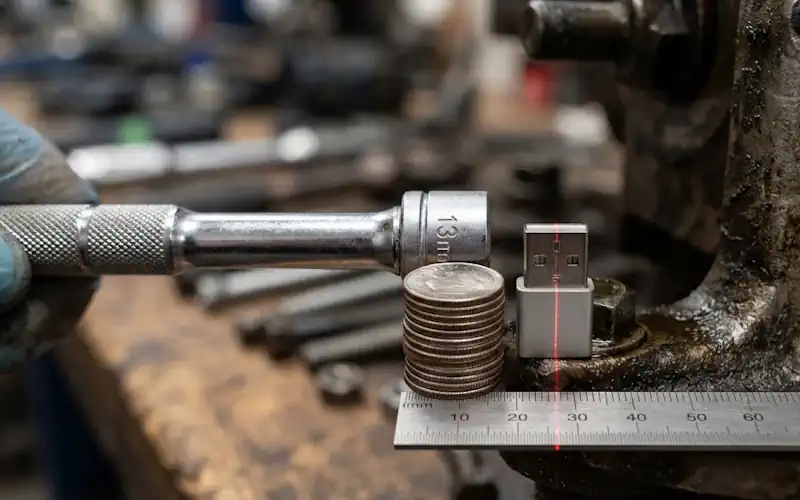
- About ten US dimes stacked. A US dime is 1.35 mm thick, so ten stacked dimes come to about 13.5 mm.
- A USB Type-A plug, width. The metal plug of a standard USB Type-A connector is about 12 mm wide, close to 13 mm.
- A 13 mm hex bolt head. The bolt’s head is 13 mm across the flats, matching a 13 mm wrench.
How to Estimate 13 mm Without a Ruler
- Use a US dime edge. A dime is 17.91 mm across, so a stack of about ten dimes gives you roughly 13 mm of height.
- Use half an inch. Half an inch is 12.7 mm, so 13 mm is just a little more.
- Use a 13 mm tool. If you have a 13 mm socket or wrench, its opening gives an exact reference.
Common Mistakes When Converting 13 mm to Inches
- Dividing by 2.54. The correct factor for millimeters is 25.4. Dividing by 2.54 gives a result ten times too large.
- Multiplying instead of dividing. Going from mm to inches means dividing, so 13 × 25.4 is wrong.
- Mixing up mm and cm. 13 mm is 1.3 cm, not 13 cm.
- Rounding too early. Round only the final answer to keep precision.
- Treating 13 mm as exactly 1/2 inch. Half an inch is 12.7 mm, so the two differ by about 0.3 mm.
Conclusion
13 mm equals 0.511811 inches, which is about 0.512 inches for everyday use. Divide millimeters by 25.4 to convert any size, and remember that 13 mm is just slightly larger than half an inch. For fitted parts and tools, use the metric size on the drawing or label.
FAQs
13 mm equals 0.511811 inches exactly, which is about 0.512 inches when rounded to three decimal places.
No. Half an inch is exactly 12.7 mm, so 13 mm is about 0.3 mm larger.
Divide 13 by 25.4. The result is 0.511811 inches.
3 mm is 1.3 cm, because 1 cm equals 10 mm.
It is about 0.51 inches to two decimal places, or 0.512 inches to three decimal places.
A 13 mm bolt head needs a 13 mm wrench or socket to fit properly.