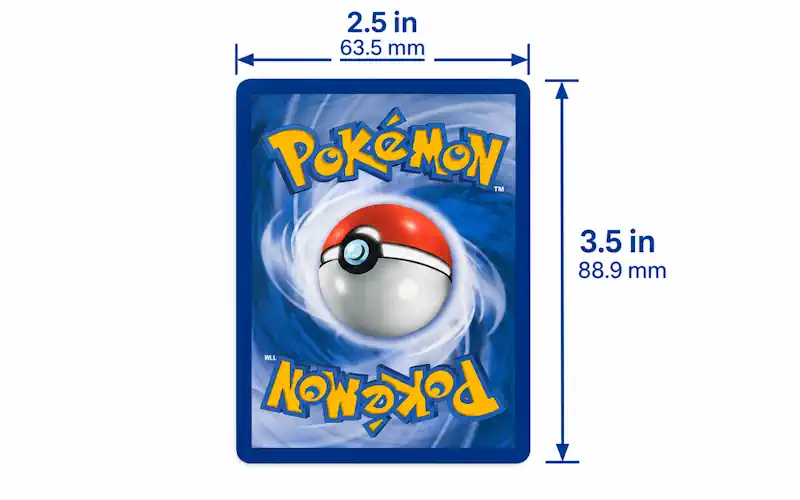
If you’ve ever slid a Pokémon card into a sleeve without measuring anything and it just fit, that’s not luck every Pokémon card ever printed has been built to the same exact size since 1996.
A standard Pokémon card measures 2.5 inches by 3.5 inches, which converts to 6.35 cm by 8.89 cm, or 63.5 mm by 88.9 mm. That’s the same footprint as a standard playing card, and it’s the number every sleeve, binder, and toploader on the market is built around.
What Are the Official Pokémon Card Dimensions?
The Pokémon Trading Card Game launched in Japan in 1996 and has kept the same card size ever since, across every set, every language, and every era of the game. That consistency is exactly why a sleeve bought decades ago still fits a card pulled from a booster pack today.
| Measurement | Inches | Centimeters | Millimeters |
|---|---|---|---|
| Width | 2.5 in | 6.35 cm | 63.5 mm |
| Height | 3.5 in | 8.89 cm | 88.9 mm |
| Corner radius | 0.125 in (1/8 in) | 0.32 cm | 3.175 mm |
| Thickness (standard) | ~0.012 in | ~0.03 cm | 0.30–0.32 mm |
| Thickness (holo/foil) | ~0.014 in | ~0.035 cm | up to 0.35 mm |
| Weight | — | — | 1.7–1.8 g |
| Aspect ratio | 5:7 (1:1.4) | — | — |
Why Millimeters Matter More Than You’d Think
Casual collectors think in inches, but grading companies like PSA and BGS work in millimeters. A card that drifts even 0.3–0.5 mm from 63.5 x 88.9 mm during centering checks can affect the final grade, which is one reason exact dimensions matter well beyond “does it fit the sleeve.”
Pokémon Card Size in CM and MM (Quick Reference)
| Unit | Width | Height |
|---|---|---|
| Inches | 2.5 in | 3.5 in |
| Centimeters | 6.35 cm | 8.89 cm |
| Millimeters | 63.5 mm | 88.9 mm |
| Feet | 0.21 ft | 0.29 ft |
Centimeters are what most European binder and sleeve manufacturers print on their packaging, while millimeters are the figures used in professional grading and manufacturing specs.
All Pokémon Card Size Variants (Standard, Jumbo & More)
Not every card that says “Pokémon” on it is the size you’re used to. Promotional and display cards come in several oversized formats, and getting the wrong one confused with your regular deck is a common storage mistake.
| Card Type | Width (in) | Height (in) | Width (mm) | Height (mm) | Typical Use |
|---|---|---|---|---|---|
| Standard | 2.5 in | 3.5 in | 63.5 mm | 88.9 mm | Booster packs, tournament play |
| Box Topper | ~3.5 in | ~5.0 in | ~90 mm | ~126 mm | Special-set promo insert |
| Jumbo L (2020–present) | 5.2 in | 7.3 in | 133 mm | 185 mm | Premium collection boxes |
| Jumbo XL (pre-2019) | 5.7 in | 7.9 in | 145 mm | 200 mm | Older promotional jumbos |
| CoroCoro XXL | 5.7 in | 8.1 in | 145 mm | 205 mm | Japan-exclusive magazine promo |
The Pokémon Company shrank its “jumbo” format slightly in 2020, so if you’re buying protective sleeves for an oversized promo card, it’s worth checking whether yours is a pre- or post-2020 print before you order.
How Big Is a Pokémon Card in Real Life? (Visual Comparisons)
Numbers are useful, but most people picture size better through comparison. Here’s how a standard Pokémon card stacks up against everyday objects.
A Standard Playing Card
This is the closest match there is. A poker-size playing card is also 2.5 x 3.5 inches identical dimensions, identical corner radius. If you’ve ever held a deck of cards, you already know exactly what a Pokémon card feels like in your hand.
A Credit Card
A credit card measures 3.37 x 2.125 inches, so a Pokémon card is slightly taller and slightly wider in both directions about 3/8 of an inch difference on the short side. If there’s a card in your wallet right now, hold it up next to a Pokémon card for an instant size check.
A Dollar Bill, Folded in Half
A US dollar bill is 6.14 x 2.61 inches. Fold it in half along the short edge and you get a rectangle roughly 3.07 x 2.61 inches — close to a Pokémon card’s footprint, just a touch shorter and wider.
A Smartphone
Most modern phones run 2.8–3.1 inches wide, making them noticeably wider than a Pokémon card’s 2.5-inch width, while the card itself is shorter than a typical phone screen. Laid side by side, it’s clear why the card feels compact enough to shuffle comfortably in one hand.
Pokémon Card Dimensions in Pixels (For Digital & Print Design)
If you’re designing custom card art, building a proxy, or setting up a print job, inches alone won’t help — you need pixel dimensions tied to a resolution.
| Resolution | Width (px) | Height (px) | Best Use |
|---|---|---|---|
| 72 DPI | 180 px | 252 px | Web thumbnails |
| 150 DPI | 375 px | 525 px | Draft prints, mockups |
| 300 DPI | 750 px | 1050 px | Standard print quality |
| 600 DPI | 1500 px | 2100 px | Archival/high-detail printing |
Print Bleed Size
Printers rarely cut with perfect precision, so artwork needs to extend past the card’s final edge. The standard Pokémon card bleed is 0.125 inches on every side, which brings your working canvas to 2.75 x 3.75 inches or 825 x 1125 px at 300 DPI. Keep essential text and artwork inside a 2.25 x 3.25-inch safe zone so nothing gets trimmed off.
Pokémon Card Sleeve & Storage Sizes
Getting sleeve sizing right is the single most practical use of these measurements.
| Sleeve Type | Internal Width | Internal Height | Best For |
|---|---|---|---|
| Standard outer sleeve | 66–67 mm | 91–92 mm | Everyday play protection |
| Perfect-fit inner sleeve | 64 mm | 89 mm | Double sleeving, archival storage |
| Japanese-size sleeve (avoid) | 62 mm | 89 mm | Yu-Gi-Oh! — not Pokémon |
| Jumbo outer sleeve | 127 mm | 178 mm | Oversized/older jumbo cards |
Don’t reach for “Japanese size” sleeves out of habit that label refers to smaller games like Yu-Gi-Oh!, not to Japanese-print Pokémon cards, which are the exact same 63.5 x 88.9 mm as any other region.
Pokémon Card vs Other Trading Cards
| Card Game | Width (in) | Height (in) | Fits Pokémon Sleeves? |
|---|---|---|---|
| Pokémon TCG | 2.5 in | 3.5 in | — |
| Magic: The Gathering | 2.5 in | 3.5 in | Yes |
| Standard playing cards | 2.5 in | 3.5 in | Yes |
| Baseball cards (US) | 2.5 in | 3.5 in | Yes |
| Yu-Gi-Oh! | 2.35 in | 3.38 in | No |
| Bridge playing cards | 2.25 in | 3.5 in | No |
Pokémon and Magic: The Gathering share identical dimensions, so collectors of both games can use the same sleeves and binders. Yu-Gi-Oh! runs a noticeably smaller “small size” format that needs its own accessories.
How to Measure a Pokémon Card Without a Ruler
No calipers on hand? A few household references get you close enough to check a card at a glance.
- Playing card method: Line the card up against any standard playing card same size exactly, so any visible gap means something’s off.
- Credit card method: A Pokémon card should extend about 3/8 inch beyond a credit card held against it on both the width and height.
- Phone ruler app: Most phones now include a built-in measuring tool accurate enough to confirm 2.5 x 3.5 inches within a small margin.
Final Takeaway
A standard Pokémon card is 2.5 inches by 3.5 inches 63.5 mm by 88.9 mm and that number hasn’t changed since 1996. Whether you’re buying sleeves, designing custom card art, or just trying to picture the size before you buy, that single measurement covers almost every real-world use case. For anything oversized, check whether your card is a pre- or post-2020 Jumbo before ordering protection for it.Frequently Asked Questions
Frequently Asked Questions
A standard Pokémon card measures 2.5 inches by 3.5 inches, or 63.5 mm by 88.9 mm. This size has stayed the same since the trading card game launched in 1996.
A standard Pokémon card is 6.35 cm wide and 8.89 cm tall.
Yes. Standard poker-size playing cards are also 2.5 x 3.5 inches, making them one of the closest everyday size comparisons for a Pokémon card.
A standard card is about 0.30–0.32 mm thick. Holographic and foil cards run slightly thicker, up to around 0.35 mm, due to the extra foil layer.
Standard outer sleeves measuring roughly 66 x 91 mm fit a Pokémon card with a small buffer for easy insertion. Perfect-fit inner sleeves at 64 x 89 mm sit flush against the card for double sleeving.
An authentic standard Pokémon card weighs between 1.7 and 1.8 grams.
A Pokémon card has an aspect ratio of 5:7, meaning it’s 1.4 times taller than it is wide.
Set your canvas to 2.75 x 3.75 inches at 300 DPI to include bleed (750 x 1050 px for the final trimmed card, 825 x 1125 px including bleed), and keep key artwork within a 2.25 x 3.25-inch safe zone.