
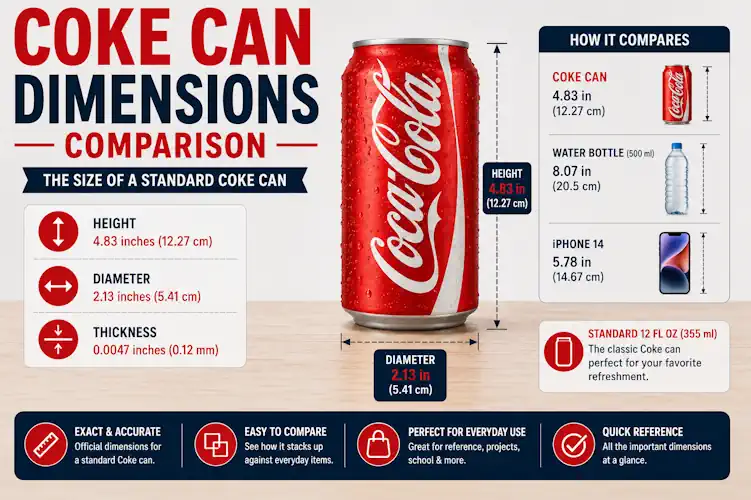
The classic 12 oz Coke can is instantly recognizable across North America, standing about 4.83 inches tall with a width of roughly 2.6 inches at its widest point.
Whether you’re planning fridge or pantry storage, organizing a party, or simply curious about the can you’re holding right now, understanding these measurements turns out to be genuinely useful.
Coca-Cola Can Dimensions Comparison
| Can Type | Height | Diameter | Volume | Best Use |
|---|---|---|---|---|
| Mini (7.5 oz) | 4.2 in (10.67 cm) | 2.6 in (6.6 cm) | 222 ml | Portion control, kids |
| Standard (12 oz) | 4.83 in (12.3 cm) | 2.6 in (6.6 cm) | 355 ml | Everyday drinking |
| Slim (12 oz) | 6.125 in (15.56 cm) | 2.25 in (5.72 cm) | 355 ml | Modern aesthetic, cup holders |
| Tall Boy (16 oz) | 6.2 in (15.75 cm) | 2.7 in (6.86 cm) | 473 ml | Extended drinking, value |
| Large (20 oz) | 7.5 in (19.05 cm) | 2.87 in (7.29 cm) | 591 ml | Maximum refreshment |
| 330ml (Europe) | 4.75 in (12.07 cm) | 2.6 in (6.6 cm) | 330 ml | International standard |
| 375ml (Australia) | 5.11 in (12.98 cm) | 2.6 in (6.6 cm) | 375 ml | Australian market |
| 250ml (Compact) | 3.94 in (10 cm) | 2.13 in (5.4 cm) | 250 ml | Travel, mixing |
This comparison shows how Coca-Cola offers a wide range of sizing options while keeping the familiar 2.6-inch diameter standard across most formats. The height differences accommodate varying volume needs without requiring an entirely separate manufacturing setup.
Standard Coke Can Dimensions in the USA
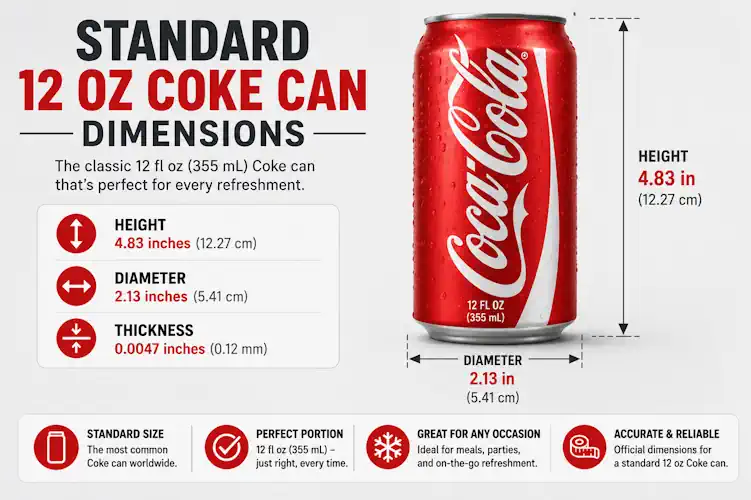
The Classic 12 oz Coke Can Size
The standard 12 fl oz (355 ml) Coke can remains the most recognizable size across North America. This iconic container measures approximately 4.83 inches (12.3 cm) in height, with a diameter of 2.6 inches (6.6 cm) at its widest point.
The lid narrows slightly to 2.13 inches (5.41 cm), creating the familiar tapered profile seen on modern soda cans.
Coca-Cola settled on this size deliberately, after years of market research and consumer testing. The 12-ounce volume hits a sweet spot a satisfying single serving without unnecessary waste.
An empty aluminum can weighs roughly 0.5 ounces, while a full can comes in at about 13 ounces total — light enough to carry easily, yet substantial enough to feel worthwhile in hand.
Anatomy of a Standard Coke Can
The top of the can features the familiar pull-tab mechanism, mounted on a scored aluminum lid. The opening it creates measures approximately 0.5 inches across sized for controlled pouring or comfortable sipping.
This tab design transformed the soft drink industry when it was introduced, eliminating the need for a separate can opener entirely.
The cylindrical body holds the beverage while keeping its structural strength despite remarkably thin aluminum walls, measuring just 0.004 inches thick. The red Coca-Cola label wraps around this section, displaying the logo and ingredient list, which typically includes carbonated water, sweetener, caramel color, phosphoric acid, natural flavors, and caffeine.
Different Coke Can Sizes and Their Dimensions
Mini Coke Can Dimensions (7.5 oz)
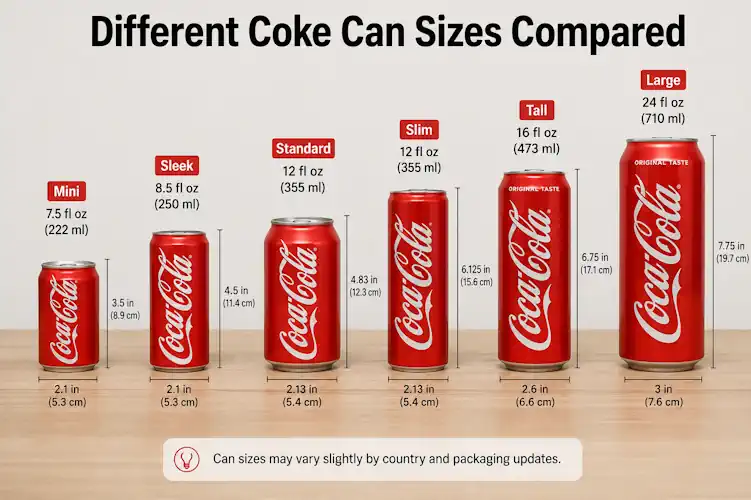
Mini cans offer a compact alternative, measuring 4.2 inches (10.67 cm) tall while keeping the same 2.6-inch diameter as standard cans. These smaller containers hold 7.5 fluid ounces (222 ml), making them a good option for anyone watching sugar or caffeine intake.
The shorter height also makes them convenient for lunch boxes, tight refrigerator shelves, or situations where a full 12 oz feels like more than you need.
Tall Boy Coke Can Size (16 oz)
The 16-ounce “tall boy” format stretches to 6.2 inches (15.75 cm) tall, with a slightly wider 2.7-inch (6.86 cm) diameter. This larger size caught on with people who wanted more beverage without buying multiple cans.
The extra volume makes it a genuinely economical option for longer activities, like watching a game or working outdoors.
Large Format Coke Cans (20 oz and 24 oz)
The 20-ounce can reaches 7.5 inches (19.05 cm) tall with a 2.87-inch (7.29 cm) diameter, bridging the gap between single-serve cans and bottle formats.
These proportions hold nearly twice the beverage of standard cans while still staying manageable for one-handed drinking. The added height does mean you’ll need deeper refrigerator shelves or cooler compartments to store them.
Slim Coke Can Dimensions

What Makes Slim Cans Different
Slim cans reflect a more modern approach to packaging, designed with both aesthetics and retail shelf efficiency in mind. Their elongated, slender profile gives off a more sophisticated look that appeals to younger consumers and premium market segments.
Coca-Cola developed this format partly to set apart certain products, like Diet Coke and specialty flavors, while also making better use of shelf space.
Slim Can Size Specifications
A standard 12 oz slim can measures 6.125 inches (15.56 cm) tall with a noticeably narrower 2.25-inch (5.72 cm) diameter. Despite the different shape, it holds the exact same 355 ml volume as a regular can.
The sleeker 330 ml variant stands 5.7 inches (14.50 cm) tall with a 2.3-inch (5.80 cm) diameter popular across European markets and gradually gaining traction in the US as well.
The taller, narrower profile fits more naturally into modern car cup holders built for slimmer containers, which makes slim cans a solid pick for commuters and travelers.
Advantages of Slim Coke Can Dimensions
Retailers benefit meaningfully from slim can dimensions through improved shelf efficiency. The narrower diameter lets stores stock 15–20% more units in the same amount of linear shelf space.
That increased density translates directly into higher sales potential per square foot, which is exactly why slim cans do well in high-traffic retail locations.
Consumers also tend to like how slim cans slide securely into vehicle cup holders that often struggle with wider standard cans. The taller, narrower grip feels more natural to many drinkers, closer to holding a glass. Temperature retention stays comparable to standard cans too, since the aluminum thickness doesn’t really change between formats.
Criticisms and Drawbacks
Not everyone loves the format, though. Some drinkers find slim cans a bit awkward to grip compared to traditional dimensions, and the taller, narrower shape can tip over more easily on uneven surfaces.
Critics also argue the format is mostly a marketing move rather than a functional upgrade, since the actual beverage volume stays exactly the same. The higher height-to-diameter ratio may lead to slightly faster warming in certain conditions, due to more surface area relative to volume, and some people find it trickier to drink from a taller can while driving or multitasking.
Even so, slim cans keep gaining market share, especially among younger demographics who value style alongside function.
International Coke Can Dimensions

330ml Coke Can Size (Common Import)
The 330 ml can stands approximately 4.75 inches (115 mm) tall with a 2.6-inch (66 mm) diameter slightly shorter than the American 12 oz standard. This European-standard size holds 11.2 fluid ounces, making it marginally smaller than US cans.
American shoppers typically run into these dimensions when buying imported Coca-Cola products or shopping at international grocery stores.
375ml Coke Can Dimensions (Australian Standard)
The 375 ml Australian standard measures 5.11 inches (12.98 cm) tall with a 2.6-inch diameter, sitting between US mini and standard sizes. This volume works out to roughly 12.7 fluid ounces slightly more than an American 12 oz can.
Specialty importers in the US occasionally stock these for Australian expats or as a bit of a novelty item.
250ml Coke Can Size (Compact International)
The compact 250 ml can stands just 3.94 inches (10 cm) tall with a 2.13-inch (5.4 cm) diameter, making it one of the smallest standard formats sold anywhere in the world.
This ultra-portable size holds about 8.5 fluid ounces — smaller than even the American mini can. Asian and European markets favor these dimensions for vending machines, airline service, and portion-conscious drinkers.
Why Coke Can Dimensions Matter
Storage and Space Planning
Coke can dimensions are genuinely useful for planning refrigerator space efficiently. A standard 12 oz can needs about 5 inches of vertical clearance including spacing, while slim cans need closer to 6.5 inches.
Most refrigerator shelves fit four to six standard cans across, depending on shelf depth. Planning around these measurements helps you maximize cold beverage storage without wasting space.
Cooler packing follows a similar logic. Standard cans stack efficiently in roughly 4×6 arrangements inside a typical 48-quart cooler, holding around 24 cans plus ice. The uniform 2.6-inch diameter allows tight packing that keeps cans from shifting during transport — handy for anyone hosting a party or event who needs to calculate exact quantities and ice needs.
Transportation and Packaging
Standard Coca-Cola cases holding 12 cans measure approximately 10.5 x 7.5 x 5 inches, a size optimized for pallet stacking and efficient truck loading. These dimensions follow industry-wide standards designed to keep logistics efficient from bottlers all the way to retail stores.
The beverage industry refined these specifications over decades to maximize shipping efficiency while still protecting cans during transit. A standard pallet typically holds around 98 cases of 12 oz cans, totaling roughly 1,176 individual cans — a figure bottlers and distributors rely on daily when optimizing distribution networks.
Recycling and Sustainability
Each standard aluminum can weighs approximately 0.5 ounces empty, containing roughly 14–15 grams of recyclable aluminum. Standardized dimensions make it easier for automated recycling equipment to sort and process millions of cans efficiently every day.
Environmental impact does vary somewhat by can size larger formats generally offer a better beverage-to-packaging ratio. A 16 oz can, for instance, uses less aluminum per ounce of drink than two separate 8 oz cans would require. Manufacturers also continue working to reduce aluminum usage generation after generation, making cans slightly lighter without sacrificing structural integrity.
How Coke Can Size Affects Your Experience
Carbonation and Freshness
Smaller cans like minis tend to offer better carbonation per serving, simply because they get finished quickly before the fizz fades. The standard 12 fl oz size strikes a solid balance between carbonation retention and satisfying volume, typically holding onto its fizz for 15–20 minutes after opening.
Larger formats can lose some carbonation toward the end if they aren’t finished promptly, though the drink’s formula is designed to help preserve bubbles as long as possible. Surface-to-volume ratio plays a role here too — wider, shorter cans expose more surface area than tall, narrow ones, which can speed up carbonation loss slightly.
Drinking Experience
The opening diameter stays consistent across nearly all Coke can sizes, at approximately 0.5 inches, which keeps the sipping experience familiar no matter which format you’re drinking from. Pour rate does shift slightly with can height due to gravity, with taller cans pouring marginally faster when tilted.
The 2.6-inch diameter of standard cans fits comfortably in most adult hands, offering a secure grip without any strain. Slim cans, with their narrower 2.25-inch diameter, tend to suit smaller hands better and feel a bit more refined while drinking. Temperature perception stays consistent across formats too, since aluminum conducts heat evenly regardless of the can’s shape.
Value Analysis by Size
Cost per ounce generally drops as can size increases, which makes 16 oz and 20 oz formats a better value overall. A standard 12 oz Coke typically costs around $0.75–$1.00 at most retail stores, working out to roughly $0.08 per ounce.
The 20 oz format often sells for $1.50–$2.00, bringing the per-ounce cost down to about $0.08–$0.10. Mini cans, on the other hand, tend to carry a premium per-ounce price due to specialized manufacturing and the added convenience of built-in portion control — a 7.5 oz mini typically runs $0.60–$0.75, or around $0.10 per ounce. In short, buying larger or in bulk generally offers better value per ounce than smaller, more convenient formats.
Conclusion
Coke can dimensions reflect decades of careful refinement, balancing engineering precision with what consumers actually want. The standard 12 oz can, measuring 4.83 x 2.6 inches, remains the gold standard across the United States, while variations like slim cans, mini cans, and international formats serve their own specific needs.
Understanding these measurements can genuinely help with storage planning, purchasing decisions, and knowing exactly what you’re getting with every can you pick up.
Frequently Asked Questions
A standard Coke can in the US measures 4.83 inches (12.3 cm) tall with a 2.6-inch (6.6 cm) diameter. This 12 oz format is the most common size found in vending machines, retail stores, and restaurants nationwide, with the lid narrowing to 2.13 inches (5.41 cm) at the drinking opening.
The 330 ml can stands approximately 4.75 inches (115 mm) tall with a 2.6-inch (66 mm) diameter. This European standard holds 11.2 fluid ounces, slightly less than American 12 oz cans, and is mostly found in imported products at international grocery stores.
A 375 ml can measures 5.11 inches (12.98 cm) tall with a 2.6-inch diameter. This Australian standard size holds 12.7 fluid ounces, falling between US mini and standard cans, with limited availability in the US through specialty import shops.
A 12 oz soda can is standardized at 4.83 inches (12.25 cm) tall with a 2.6-inch (6.6 cm) diameter at its widest point. These measurements apply across nearly all major soft drink brands in North America, ensuring compatibility with vending machines, refrigerators, and dispensing equipment.
A 250 ml Coke can stands approximately 3.94 inches (10 cm) tall with a 2.13-inch (5.4 cm) diameter. This compact international format holds about 8.5 fluid ounces, making it smaller than American mini cans, and is common in Asian and European markets.