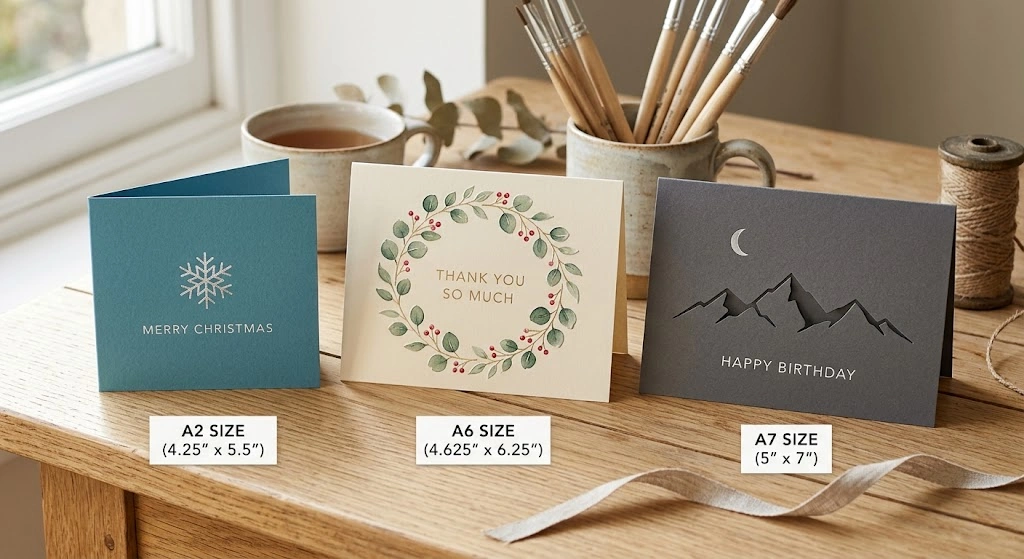
Greeting cards don’t come in just one size. The most common format is A7, at 5 x 7 inches, but smaller options like A2 (4.25 x 5.5 inches) and A6 (4.5 x 6.25 inches) are just as widely used, depending on the occasion and how the card will be mailed.
Whether you’re designing a birthday card, a holiday card, or a simple thank-you note, this guide covers every standard greeting card size in inches, centimeters, and millimeters, along with matching envelope sizes.
Why Greeting Card Dimensions Matter
Getting the size right isn’t just about looks. A card built to a standard size fits standard envelopes without triggering extra postage fees, which matters if you’re mailing even a small batch of cards. Dimensions also directly shape the design itself: how much room you have for artwork, how much space is left for a written message, and how the finished card feels in someone’s hands. A card that’s oddly sized can come across as a printing mistake rather than an intentional design choice, so sticking to a recognized standard size helps the whole card feel more polished and professional.
What Size Is a Standard Greeting Card?
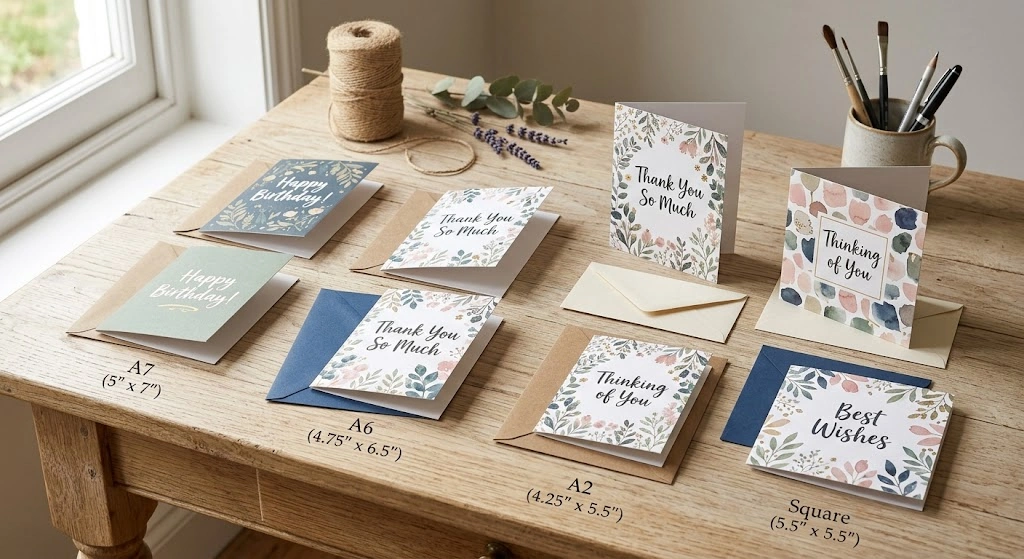
Popular greeting card formats include the versatile A2 (4.25 x 5.5 inches), the widely used A7 (5 x 7 inches), and square or near-square formats like 4 x 6 inches or 5 x 5 inches. Which size makes sense depends on whether the card is flat or folds in half, and what it’s actually being used for, from a quick thank-you note to a formal wedding invitation.
Standard Greeting Card Sizes in Inches
| Format | Dimensions |
|---|---|
| A2 | 4.25 x 5.5 in |
| A6 | 4.5 x 6.25 in |
| A7 | 5 x 7 in |
| A9 | 5.5 x 8.5 in |
A2 and A7 are the two most common sizes for folded cards, with A2 favored for everyday notes and A7 typically reserved for more formal or special-occasion cards.
Standard Greeting Card Sizes in Centimeters
| Format | Dimensions |
|---|---|
| A5 | 14.8 x 21 cm |
| A6 | 10.5 x 14.8 cm |
| A7 | 7.4 x 10.5 cm |
Need a different conversion? Try our inches to cm converter for instant results with any number.
Standard Greeting Card Sizes in Millimeters
| Format | Dimensions |
|---|---|
| A2 | 108 x 140 mm |
| A5 | 148 x 210 mm |
| A6 | 105 x 148 mm |
| A7 | 127 x 178 mm |
| DL | 99 x 210 mm |
| Small Square | 100 x 100 mm |
| Large Square | 150 x 150 mm |
Standard Birthday Card Size
The most common, versatile birthday card size is A7 (5 x 7 inches), a size that works especially well for photo cards. Square formats, typically 5 x 5 inches or 6 x 6 inches, have also become popular for more modern, stylish birthday card designs.
| Format | Dimensions |
|---|---|
| A7 | 5 x 7 in |
| A6 | 4.5 x 6.25 in |
| A2 | 4.25 x 5.5 in |
| Square | 6 x 6 in |
Standard Holiday Card Size
Holiday cards typically use A7 (5 x 7 inches) for a classic folded card, or 4 x 6 inches for a slightly smaller, postcard-style alternative. Both sizes balance visual impact with mailing practicality, offering enough room for a photo and a message while still fitting standard envelopes and postage rates.
| Format | Dimensions |
|---|---|
| A7 | 5 x 7 in |
| A2 | 4.25 x 5.5 in |
| Square | 5 x 5 in |
Standard Thank-You Card Size
Thank-you cards come in a fairly wide range of sizes, but A2 (4.25 x 5.5 inches) is the most popular choice for everyday notes, striking a good balance between a compact size and enough room for a personal message.
| Format | Dimensions |
|---|---|
| A2 | 4.25 x 5.5 in |
| A6 | 4.5 x 6.25 in |
| A7 | 5 x 7 in |
| Flat | 4 x 6 in |
Standard Note Card Dimensions
There isn’t a single universal “standard” for note cards, since the right size depends heavily on the card’s purpose, from a quick reminder to a formal piece of correspondence.
| Dimensions | Common Use |
|---|---|
| 3 x 5 in | Classic index card size, useful for studying or quick notes |
| A2 (4.25 x 5.5 in) | A versatile, popular size for personal stationery and thank-you notes |
| 4 x 6 in | Works well for recipe cards or event announcements |
| A6 (4.625 x 6.25 in) | Ideal for holiday cards and event invitations |
| A7 (5.125 x 7 in) | Used for larger invitations, weddings, and formal correspondence |
Standard Greeting Card Envelope Sizes
Envelope sizes are built to be just slightly larger than the matching card size, so the card slides in and out easily without being loose enough to shift around during mailing.
| Format | Envelope Dimensions |
|---|---|
| A2 | 4 3/8 x 5 3/4 in |
| A6 | 4 3/4 x 6 1/2 in |
| A7 | 5 1/4 x 7 1/4 in |
| A9 | 5 3/4 x 8 3/4 in |
The A2 envelope is a common choice for smaller notes, while the A7 envelope is the standard match for a 5 x 7 inch card.
Frequently Asked Questions
The most typical greeting card size in the US is 5 x 7 inches (A7). Other common sizes include the smaller A2 (4.25 x 5.5 inches), often used for general notes.
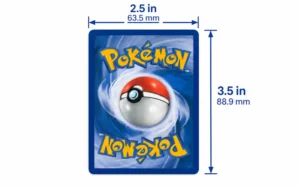
Greeting card dimensions vary by format, ranging from A2 (4.25 x 5.5 inches) up to A9 (5.5 x 8.5 inches). For comparison, standard playing or trading cards use a completely different, much smaller size, at 2.5 x 3.5 inches (63.5 x 88.9 mm).
Standard greeting card dimensions typically come as a folded size of 5 x 7 inches (A7), 4.25 x 5.5 inches (A2), or 4.5 x 6.25 inches (A6).
Birthday card dimensions vary, but the most common sizes are A2 (4.25 x 5.5 inches), the larger A7 (5 x 7 inches), and square formats like 5 x 5 inches or 6 x 6 inches.
Conclusion
Greeting cards follow a handful of well-established sizes rather than one fixed standard, with A7 (5 x 7 inches) and A2 (4.25 x 5.5 inches) covering the vast majority of birthday, holiday, and thank-you cards. Matching your card to one of these standard formats, along with its corresponding envelope size, keeps mailing simple and postage costs predictable, while still leaving plenty of room for your design and message.