Ever wondered how heavy 100 grams really feels in your hands? Whether you’re cooking a recipe, shipping a package, or tracking your nutrition, understanding this weight measurement can make everyday tasks a lot easier.
Many people see “100g” printed on food packaging, kitchen labels, or recipes, but without a scale nearby, it’s still genuinely hard to picture. That’s exactly what real-life comparisons help solve. In this guide, you’ll find 18 everyday items that weigh close to 100 grams, a full conversion chart, and several practical ways to estimate this weight without any equipment.
How Much Is 100 Grams?
100 grams equals 0.1 kilograms, 3.53 ounces, or roughly 0.22 pounds about a fifth of a pound. It’s considered a light, everyday weight commonly found in snacks, toiletries, stationery, and small electronics: heavy enough to feel noticeable in your hand, but still light enough to carry comfortably in a pocket or bag.
100 Grams in Different Units
| Unit | Equivalent of 100g |
|---|---|
| Kilograms | 0.1 kg |
| Ounces | 3.53 oz |
| Pounds | 0.22 lb (≈ 1/5 pound) |
| Milligrams | 100,000 mg |
| Flour (cups) | ~3/4 cup |
| Sugar (cups) | ~1/2 cup |
| Tablespoons | ~6.7 tbsp |
| Teaspoons | ~20 tsp |
| Water (milliliters) | 100 mL |
Need a different conversion? Try our grams to ounces converter for instant results with any number.
Common Things That Weigh About 100 Grams
| Common Item | Approximate Weight |
|---|---|
| Bar of soap | 100–150 g |
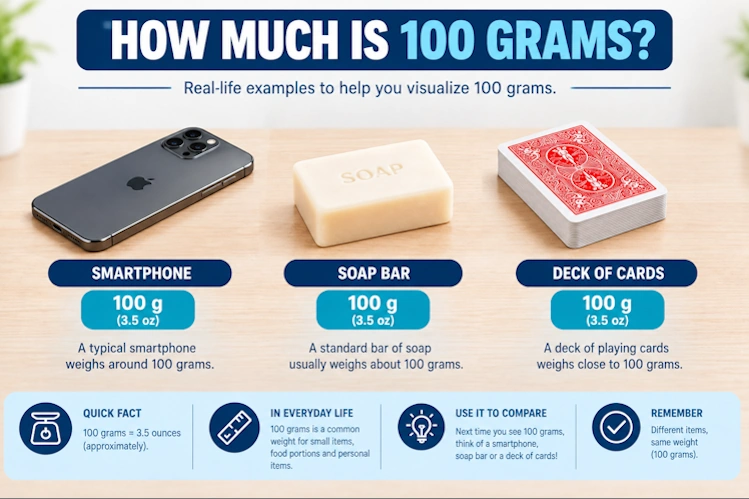
| Deck of playing cards | ~100 g |
| 100 paper clips | ~100 g + box |
| Small to medium apple | 100–200 g |
| Light bulb | ~100 g |
| Small smartphone | ~100 g |
| Standard chocolate bar | 100 g |
| Tennis ball | ~100 g |
| Travel-size toothpaste | ~100 g |
| Small candle | ~100 g |
| Pack of sticky notes | ~100 g |
| Wet kitchen sponge | ~100 g |
| Compact mirror | ~100 g |
| Stick of butter | 113 g |
| 20 US nickels / 40 pennies | Exactly 100 g |
| Four AA batteries | ~100 g |
| Two medium eggs | ~100 g |
| Medium banana | 100–150 g |
18 Everyday Things That Weigh 100 Grams
To truly understand how heavy 100 grams is, it helps to explore everyday objects you can find around your home. These reference items give you a genuinely useful visual and tactile guide for estimating this weight without any equipment.
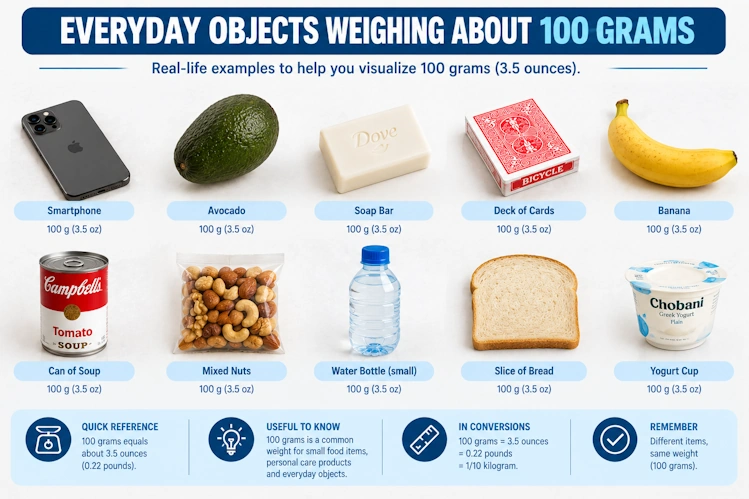
1. A Bar of Soap
A standard bar of soap weighs around 100 to 150 grams and measures approximately 3 by 2 inches the typical size you’ll find in bathrooms and kitchens across America. Because soap bars are handled daily, they offer one of the most reliable references for how 100 grams feels in your hand.
2. A Deck of Playing Cards
A standard 52-card deck, jokers included, weighs approximately 100 grams. This has been used for generations as a portion-size reference, especially for measuring meat servings. Healthcare professionals and nutritionists often recommend using a deck of cards to visualize proper protein portions a piece of meat about the same size and thickness as a card deck represents a healthy 100-gram serving.
3. A Stick of Butter
One stick of butter in the US weighs approximately 113 grams just slightly over 100g. This standard measurement equals half a cup and comes with helpful markings on the wrapper, which makes it easy to divide down into smaller 50-gram portions when a recipe calls for less.
4. 20 US Nickels (or 40 US Pennies)
Here’s a genuinely precise way to measure 100 grams: gather 20 US nickels. Each nickel weighs exactly 5 grams, making the math simple and the measurement accurate. Alternatively, 40 US pennies also equal 100 grams, since modern pennies weigh 2.5 grams each.
This method works especially well for calibrating a digital kitchen scale at home US nickels have held their 5-gram weight standard since 1866.
5. A Standard Chocolate Bar
Many chocolate bars are sold in 100-gram packages, making them a genuinely delicious weight reference. Major brands specifically package chocolate in this size because it’s considered a standard single serving, and the fixed packaging also makes it easy to calculate nutrition information for portion control.
6. Four AA Batteries
Four standard AA batteries together weigh approximately 100 grams, since each alkaline battery weighs about 25 grams. This is one of the easiest ways to estimate 100g since most homes already have batteries lying around somewhere.
7. Two Medium-Sized Eggs
Two medium chicken eggs together weigh approximately 100 grams, with each egg weighing about 50 grams. This applies to both raw and boiled eggs, though boiled eggs are easier to handle for a rough measurement. As a helpful shortcut: a 21-ounce carton of a dozen eggs typically means each egg weighs around 50 grams, while a 42-ounce carton points to eggs closer to 100 grams each.
8. 100 Paperclips
A box containing 100 standard paperclips weighs just over 100 grams once you include the packaging. Each regular-size paperclip weighs approximately 1 gram, which makes the math wonderfully simple a handy little office-desk trick.
9. A Small Smartphone
The average small smartphone weighs around 100 grams, considered by many manufacturers to be an ideal weight for comfortable one-handed use. Phone weights vary widely from around 130 grams for very compact models up past 200 grams for larger devices but compact, lightweight phones land close to this mark. Since phones are carried everywhere, they’re one of the easiest modern references for visualizing 100 grams.
10. A Medium-Sized Banana
A medium banana measuring about 7 to 8 inches long weighs approximately 100 to 150 grams. Bananas make a genuinely portable, universally recognizable weight reference, since they’re the most widely consumed fruit on the planet.
11. A Small to Medium Apple
A small to medium apple typically weighs between 100 and 200 grams, landing right around 100g for the smaller end of that range. With a diameter of about 2.5 to 3 inches, it fits comfortably in your hand and since apples are such a familiar everyday snack, they create an easy mental picture of this weight without needing any tools.
12. Half a Cup of Sugar or Salt
Half a cup of powdered light brown sugar weighs very close to 100 grams, equivalent to 3.5 ounces. The same rough measurement applies to table salt. Since these are pantry staples in virtually every kitchen, they offer a simple way to understand this weight without leaving the house.
13. A Light Bulb
Some LED or traditional household light bulbs weigh close to 100 grams. Their compact shape and solid, dense feel make them a genuinely useful example for understanding what 100g feels like in daily life.
14. A Tennis Ball
A tennis ball weighs close to 100 grams, offering a good example of how light yet noticeable this weight actually feels. Because tennis balls are soft and easy to hold, they also help illustrate the difference between an object’s size and its actual weight.
15. Travel-Size Toothpaste
A full travel-size toothpaste tube often weighs around 100 grams. This comparison is genuinely useful because travel products are specifically engineered to stay lightweight and portable for carry-on luggage.
16. A Small Candle
Some decorative or scented candles weigh approximately 100 grams. Candles make a helpful comparison because their compact shape often hides more weight than people expect at first glance.
17. A Pack of Sticky Notes
A full pack of sticky notes commonly weighs close to 100 grams. This example works particularly well for office supplies and helps visualize how much a small stack of paper can actually weigh.
18. A Compact Mirror
A small compact or makeup mirror can weigh close to 100 grams depending on its materials. Because mirrors are portable yet dense, they create a strong tactile reference for understanding this weight.
What Does 100 Grams Feel Like?
To better understand how much 100 grams really is, it helps to compare it with things you already hold every day:
- About the weight of a small smartphone
- Similar to a small apple
- Close to a bar of soap
- Roughly equal to a deck of playing cards
- About as heavy as 100 paperclips
These comparisons make it much easier to estimate weight quickly, without ever needing a kitchen scale.
How to Measure 100 Grams Without a Scale
Using Coins for Measurement
The coin method offers remarkable precision without any equipment at all. Gather 20 US nickels, and you have exactly 100 grams, since each nickel is regulated by the US Mint to weigh precisely 5 grams. Alternatively, collect 40 US pennies for the same result modern pennies minted since 1982 are copper-plated zinc and weigh 2.5 grams each. For the best accuracy, use newer, less-worn coins.
Using Measuring Cups and Spoons
For cooking ingredients, measuring cups give decent approximations. 100 grams of flour equals roughly 3/4 cup, but technique matters fluff the flour first, then spoon it gently into the cup without packing it down. 100 grams of sugar measures about half a cup. For liquids like water, the conversion is refreshingly simple: 100 milliliters equals 100 grams exactly.
Using Known Food Items
Two medium eggs together approximate 100 grams, and a standard 250-gram block of butter can be divided into five equal 50-gram portions, with two of those portions giving you 100g. One medium apple provides a close reference too. Once you’ve weighed items like these a few times, your muscle memory naturally helps you estimate this weight going forward.
Estimating With Your Hand
The palm method helps with portion control, especially for protein. A piece of meat about the size of your palm, excluding fingers, typically weighs around 100 grams once cooked a guideline that works well for both restaurant portions and home cooking. A deck of cards reinforces this same visual, since 100 grams of meat has roughly the same size and thickness as a standard card deck.
Common Misconceptions About 100 Grams
“100 grams is very heavy.” Actually, 100 grams is considered a lightweight, everyday measurement commonly used for snacks, toiletries, and small accessories.
“Bigger objects always weigh more.” Some large objects can be surprisingly light, while smaller, denser items can weigh close to 100 grams without looking like much at all.
“Grams are hard to understand.” Once grams get connected with familiar real-life objects, like a soap bar or a deck of cards, they become genuinely easy to visualize and estimate.
How Big Is a Gram?
A gram is a small metric unit used to measure weight or mass. To picture how big a single gram is, imagine:
- One paperclip weighs about 1 gram
- A raisin weighs around 1 gram
- A dollar bill weighs close to 1 gram
Because grams are such small units, they’re commonly used for food, jewelry, ingredients, and other lightweight products where precision matters.
Conclusion
Understanding how heavy 100 grams is makes everyday tasks genuinely smoother, whether you’re cooking, shipping a package, or tracking nutrition. The 18 common items covered here from soap bars and smartphones to nickels and chocolate bars give you instant visual and tactile references you can rely on any time, with or without a scale nearby.
Frequently Asked Questions
100 grams equals approximately 3.53 ounces. The conversion factor is simple: 1 gram equals 0.035274 ounces.
100 grams equals about 0.22 pounds, or roughly one-fifth of a pound. The precise factor is 1 gram equals 0.00220462 pounds.
It depends on the context. For rice or pasta, 100g is a reasonable single serving. For an expensive spice like saffron, 100g represents a substantial quantity.
The easiest method is holding a medium apple or a bar of soap in your hand and feeling the weight directly. A deck of playing cards offers another memorable, tactile reference.
40 pennies weigh 100 grams. Modern US pennies minted since 1982 are copper-plated zinc and weigh exactly 2.5 grams each 100 grams divided by 2.5 grams equals 40 pennies.
Use 20 US nickels (5 grams each) or 40 US pennies (2.5 grams each). Brand-new coins are the most accurate choice, since worn coins can lose a small amount of mass over time.
About the size of a deck of playing cards, or your palm excluding fingers. For cooked roast beef, that typically works out to 2 to 4 slices, depending on thickness.
Roughly 20 to 25 whole almonds, depending on their size about a small handful, or close to 1/4 cup.