If you’ve ever held a travel soap bar in your palm, you already know exactly how heavy 3 ounces feels.
Three ounces equals 3/8 cup (0.375 cup). Since 1 cup holds 8 fl oz, dividing 3 by 8 gets you that answer directly.
In weight terms, three ounces equals 85 grams dry, or 88.7 mL as a liquid. Both are small but genuinely common measurements in everyday American life.
What Is 3 Ounces?
Most people don’t realize there are two different types of ounces: the dry ounce used for solid foods, and the fluid ounce used for liquids. They aren’t the same thing.
Dry 3 oz measures mass used for meat, cheese, bread, and spices. 3 fluid oz measures volume used for water, juice, oil, and medicine.
| Measurement | Equivalent |
|---|---|
| 3 oz in grams | 85 grams |
| 3 fl oz in mL | 88.7 mL (≈ 89 mL) |
| 3 fl oz in cups | 3/8 cup (0.375 cup) |
| 3 fl oz in tablespoons | 6 tablespoons |
| 3 oz vs 100 mL | Not equal — 100 mL ≈ 3.38 oz |
Need a different conversion? Try our ounces to grams converter for instant results with any number.
6 Common Things That Weigh 3 Ounces
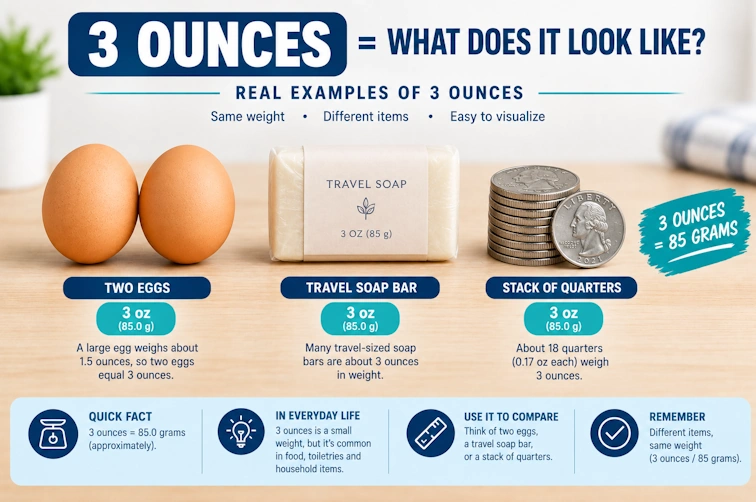
1. Two Large Eggs
One large egg weighs about 1.6 oz (45 grams), so two large eggs together land right around 3.2 oz (92 grams) extremely close to 3 oz.
Eggs are one of the most kitchen-friendly comparisons around. According to the USDA, two large eggs also deliver about 12 grams of protein, making them a genuinely useful nutritional portion-weight reference.
2. Half a Small Chicken Breast
A small chicken breast typically weighs 6 to 8 oz. Cut it in half, and you have a 3-ounce serving the standard protein portion recommended under US dietary guidelines.
Visually, 3 oz of cooked chicken is roughly the size of your palm, or about the size of a deck of cards. It contains around 25 grams of protein, making it a solid benchmark for meal prep and portion control.
3. A Bar of Soap
A standard US bar of soap weighs 3 to 5 oz. Travel-size or guest bars come in right at 3 oz which is no coincidence. The TSA 3-1-1 carry-on rule limits liquids to 3.4 oz (100 mL) containers, which is exactly why travel soap bars land right around this weight.
If you’ve ever held a travel soap bar in your palm, you already know exactly how heavy 3 ounces feels.
4. A Small Jar of Spices
Walk into any US grocery store, and the standard spice jars on the shelf typically weigh between 2 and 3 oz. Garlic powder, Italian seasoning, and ground cinnamon all fall within this range.
These jars are compact, dense, and fit comfortably in one hand a reliable visual cue when measuring ingredients by weight for recipes.
| Spice | Typical Net Weight |
|---|---|
| Garlic Powder | 3 oz |
| Italian Seasoning | 2–3 oz |
| Ground Cinnamon | 2.5–3 oz |
| Crushed Red Pepper | 2–3 oz |
5. Twelve US Quarters
This is genuinely the most precise DIY scale trick available. According to the US Mint, one quarter weighs exactly 0.2 oz (5.67 grams). Stack 12 quarters together, and you get exactly 3 oz.
No scale? No problem. This trick works well for postage estimation, science experiments, and verifying small package weights right at home.
6. A Standard Lime
A fresh lime from a US grocery store weighs between 2 and 3 oz. A lemon runs slightly heavier, at 3 to 4 oz. Both citrus fruits make a natural, everyday reference point.
They’re rich in vitamin C and citric acid, and familiar in kitchens across America. Holding a lime gives you an instant, tactile sense of 3 oz without needing any tools at all.
How Much Is 3 Ounces of Liquid?
When someone asks how much is 3 ounces of liquid, they’re really asking about fluid ounces a volume measurement. Three fluid ounces equals 88.7 mL, which comes close to, but isn’t exactly, 100 mL.
Practically, 3 fl oz looks like a small juice cup, a double shot glass, or roughly 6 tablespoons of any liquid. It’s a common measure for salad dressings, medicine doses, baby formula, and cooking oils.
Quick fact: the TSA 3-1-1 rule allows travel liquids up to 3.4 oz (100 mL) per container so 3 oz bottles fully comply with carry-on rules.
How to Measure 3 Ounces Without a Scale
Not everyone has a kitchen scale handy. Here are the most reliable methods for measuring 3 oz of food or liquid without one.
Use a Liquid Measuring Cup
Fill to the 3 fl oz line on a standard US measuring cup. This works well for water, milk, oil, and other thin liquids.
Count 6 Tablespoons
Since 1 fl oz equals 2 tablespoons, three ounces equals exactly 6 tablespoons. This is genuinely one of the easiest conversions to keep in memory.
Use the Palm Method for Proteins
For meat, fish, or poultry, 3 oz is roughly the size of your palm, excluding fingers. This is the visual trick used in many USDA portion-size guides.
Stack 12 US Quarters
As covered above, 12 quarters equals exactly 3 oz. Place them on one side of a homemade balance scale to weigh other small items.
3 Ounces in Cooking and Portion Control
Three ounces is a standard serving size for proteins under USDA MyPlate guidelines. It applies to chicken, fish, beef, and pork, making it one of the most widely used nutritional portion weights in American meal planning.
Pro tip: 3 oz of cooked pasta is roughly 1/2 cup genuinely useful for tracking carbohydrate servings on a calorie-controlled diet.
Conclusion
Now you know exactly how much 3 ounces really is whether you need it for cooking, dieting, travel, or shipping. It’s 85 grams, 89 mL, 6 tablespoons, or 3/8 of a cup.
Use the six everyday comparisons two eggs, half a chicken breast, a soap bar, a spice jar, 12 quarters, or a lime and you’ll never be left guessing again. No scale required.
Frequently Asked Questions
Three ounces equals 3/8 cup (0.375 cup). Since 1 cup holds 8 fl oz, dividing 3 by 8 gives you the answer.
No. Half a cup equals 4 fluid ounces. Three ounces is slightly less about 3/8 of a cup.
It looks like two large eggs, a small lime, 12 stacked US quarters, or a travel-size bar of soap. All fit comfortably in one hand.
3 fl oz equals 88.7 mL, often rounded to 89 mL. Note: 100 mL equals 3.38 oz, so they’re close but not the same.
Use a measuring cup filled to the 3 fl oz line, or measure out 6 tablespoons of water.
Three ounces of cooked chicken is roughly the size of your palm, or a deck of cards about half a small chicken breast.
3 oz equals 85 grams, calculated as 3 × 28.35g.
No. 3 oz equals 88.7 mL. It takes 3.38 oz to equal 100 mL close, but not interchangeable in precise recipes.
3 oz equals 6 tablespoons, one of the most genuinely useful cooking conversions to memorize.
No. 1 cup equals 8 fluid ounces. One ounce is only 1/8 of a cup.