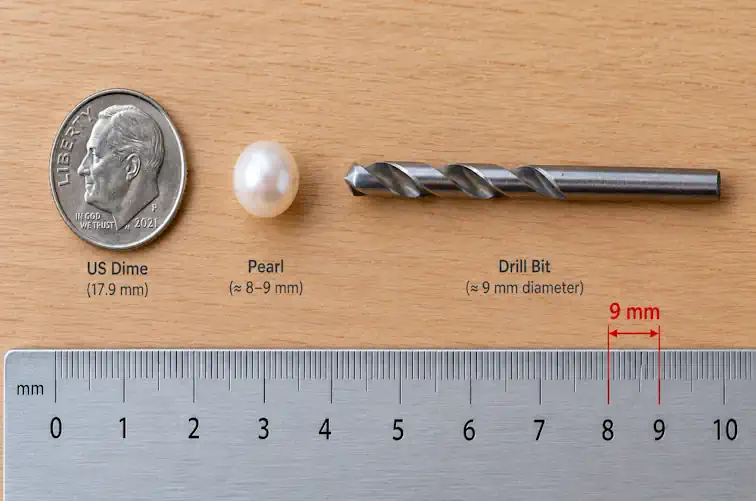
9mm is equal to 0.354 inches (0.9 centimeters). It is also roughly the width of half a US dime.
You have probably seen “9mm” on a drill bit, a pearl necklace, a socket, or in a news story, and each one means something slightly different. As a plain length, 9 millimeters is tiny: a hair under a centimeter and a bit over a third of an inch.
This guide explains the exact size, gives you real objects to picture, shows how to measure it without a ruler, and clears up the biggest source of confusion: what the “9” in the 9mm cartridge name actually measures.
Key Takeaways
- 9mm equals exactly 0.9 centimeters, 0.009 meters, or about 0.354 inches.
- On an inch ruler, 9mm sits between 11/32 and 3/8 of an inch, and the closest fraction is 23/64 inch.
- A US dime is 17.91 mm wide, so 9mm is almost exactly half a dime’s width.
- In “9mm” ammunition, the number describes the bullet’s width, not the length of the round, which is about 29.7 mm (1.17 in) overall.
- Six US pennies stacked flat measure about 9.1 mm, which makes a quick coin-based reference.
9mm Conversion Table
| Unit | Equal to 9mm |
|---|---|
| Centimeters (cm) | 0.9 cm |
| Meters (m) | 0.009 m |
| Inches (in), decimal | 0.3543 in |
| Inches (in), nearest 64th | 23/64 in (about 9.13 mm) |
| Thousandths of an inch (mils) | 354.3 mil |
| Feet (ft) | 0.0295 ft |
| Yards (yd) | 0.00984 yd |
| Micrometers (µm) | 9,000 µm |
| Pixels at 96 DPI | 34 px |
| Typographic points (72 per inch) | 25.5 pt |
Millimeters Near 9mm in Inches
| Millimeters | Inches (decimal) | Nearest fraction |
|---|---|---|
| 5 mm | 0.197 in | 13/64 in |
| 6 mm | 0.236 in | 15/64 in |
| 7 mm | 0.276 in | 9/32 in |
| 8 mm | 0.315 in | 5/16 in |
| 9 mm | 0.354 in | 23/64 in |
| 10 mm | 0.394 in | 25/64 in |
| 11 mm | 0.433 in | 7/16 in |
| 12 mm | 0.472 in | 15/32 in |
What Does “9mm” Mean in Different Places?
The same number appears in many fields, and it is not always describing the same thing.
| Where you see it | What the “9mm” describes |
|---|---|
| A ruler, bead, pearl, or jump ring | Width or diameter, exactly 9 millimeters |
| Drill bits, sockets, wrenches | The diameter of the hole or the size of the fastener it fits |
| Model railways | The distance between the rails (N gauge and several narrow-gauge scales use 9 mm track) |
| Ammunition | The approximate width of the bullet, not the length of the cartridge |
If you came here for a plain measurement, the first three rows are what you need. If you came wondering about the ammunition name, there is a full section on it below.
What Does 9mm Look Like?
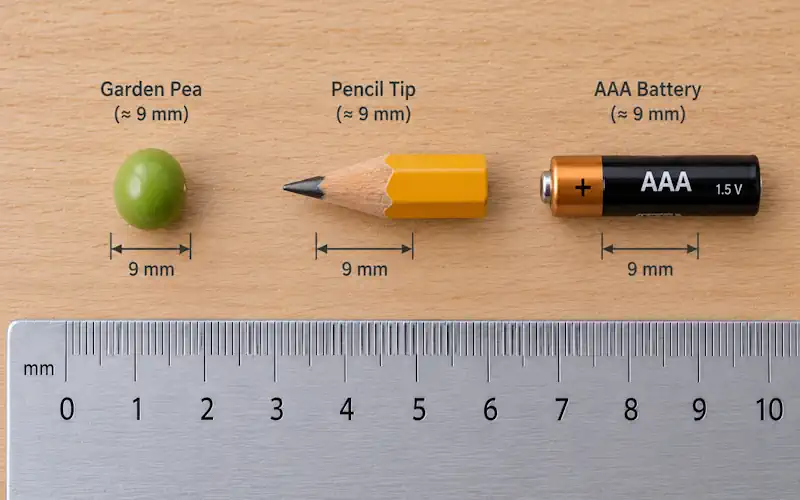
Nine millimeters is smaller than a pencil eraser and a bit wider than a standard pencil. A typical hexagonal pencil measures roughly 7 mm across, so a 9mm object looks like a slightly chunkier pencil tip. A standard AAA battery is 10.5 mm across, so 9mm is just a little narrower than the end of one.
Picture a small round dot about the width of a pea. Garden peas are commonly in the 8 to 10 mm range, which makes them a handy food comparison. It is large enough to notice clearly on a table, yet small enough to hide behind the tip of your thumb.
12 Real Things That Are About 9mm
Real products vary a little between makers, so treat these as strong reference points and not exact rulers. Items that are defined as 9 mm are marked as such.
1. Half a US Dime (Width)
A dime is 17.91 mm across, so half its width is about 8.96 mm, nearly a perfect match for 9 mm. Since dimes are in pockets and change jars everywhere, this is one of the easiest references to find.
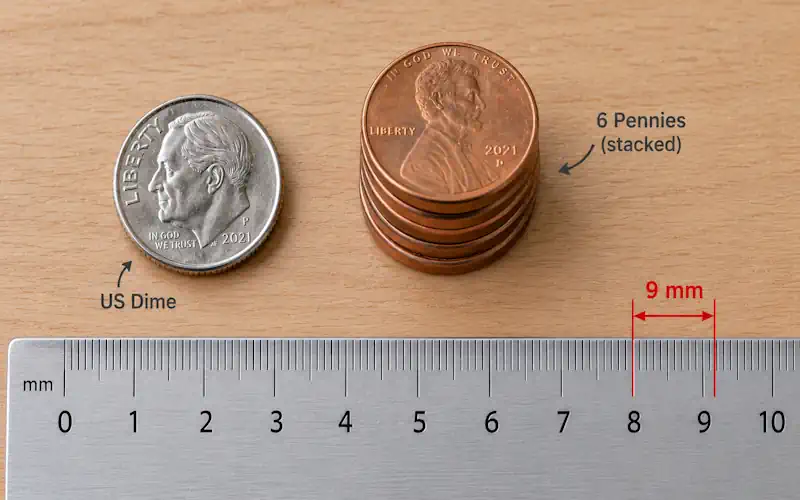
2. Six Stacked US Pennies (Thickness)
A US penny is about 1.52 mm thick, so six stacked flat come to roughly 9.1 mm. It is a tactile way to feel the size: pick up a small stack and you are holding about 9 mm.
3. Twelve Stacked Credit Cards (Thickness)
A standard bank card is 0.76 mm thick, so a stack of twelve measures about 9.1 mm. Some quick-estimate pages claim nine cards equal 9 mm, but nine cards come to only about 6.8 mm.
4. A 9mm Pearl
Pearls are sold by diameter, and 9 mm is considered a large size for jewelry. A pearl this size covers a clear, noticeable spot on a fingertip and is a lovely visual match.
5. A 9mm Bead
Round beads are commonly sold in 9 mm sizes for bracelets and necklaces. If you do any crafting, a bead of this size is a perfect pocket reference.
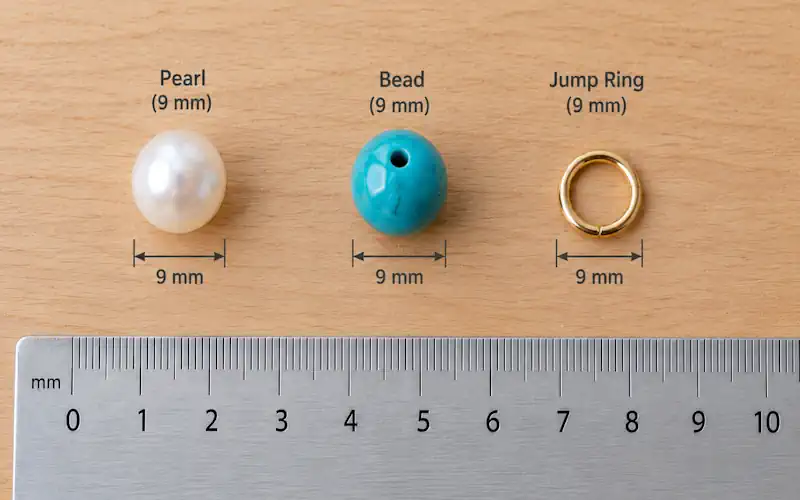
6. A 9mm Jump Ring
Jump rings are the little open loops used to connect jewelry parts, and they come in many sizes, including 9 mm outer diameter. A ring this size sits on the palm as a clear circle about as wide as a pea.
7. A 9mm Drill Bit
Metric twist drill bits are sold in 9 mm. The shaft is about as thick as a chunky pencil, which gives you a good sense of the width when you hold one up to the light.
8. A 9mm Socket or Wrench
Metric sockets and wrenches are named for the fastener they fit. A 9 mm size exists, but it is often left out of budget socket sets that jump from 8 to 10, so you may need to buy it on its own.
9. A Garden Pea
Garden peas are usually in the 8 to 10 mm range, with 9 mm a very typical size. They make an easy, edible comparison when you are in the kitchen.
10. The Gap Between Rails on N Gauge Model Track
Several model railway scales, including N gauge (1:160) and some narrow-gauge scales, run on track with the rails 9 mm apart. If you have a model train set, that gap is exactly the size you are looking for.
11. A Slim Phone’s Thickness
Many modern smartphones are in the range of about 7 to 9 mm thick without a case. It varies by model, so measure yours once before relying on it as a reference.
12. A Pinky Fingernail (Width)
An adult pinky fingernail is often somewhere around 8 to 10 mm wide, though it differs from person to person. Hold a ruler against yours once, and you will have a 9mm check that is always with you.
The 9mm Cartridge: What Is Actually 9 mm?
In the United States, “9mm” most often refers to a handgun cartridge. The name is easy to misread, so here is what the number does and does not mean. This section is a size reference only.
The “9” is the bullet’s width, not the length of the round. The widely used 9×19mm Parabellum (also called 9mm Luger) has a bullet diameter of about 9.01 mm, which is 0.355 inch. The “19” in the name refers to the case length, which is 19.15 mm (0.754 in).
The full cartridge, bullet and case together, is about 29.69 mm (1.169 inches) long. The rim at the base is about 9.96 mm (0.392 in) wide.
| Measurement | Size in mm | Size in inches | Everyday comparison |
|---|---|---|---|
| Bullet diameter | 9.01 mm | 0.355 in | About half a dime’s width |
| Case length | 19.15 mm | 0.754 in | Almost the width of a US penny (19.05 mm) |
| Overall length | 29.69 mm | 1.169 in | A little narrower than a half-dollar coin (30.61 mm) |
| Rim diameter | 9.96 mm | 0.392 in | Just under 1 cm |
Why “9mm” Is Not Exactly 9.00 mm
Cartridges are named in rounded numbers. The actual bullet is 9.01 mm, and the commonly quoted decimal is .355 inch, which is a hair above the exact conversion of 9 mm (0.3543 in). That tiny difference is why the figures you see online sometimes disagree in the third decimal place.
Other Cartridges Called 9mm
Several different cartridges use bullets of roughly 9 mm, so the name alone does not tell you which one is meant. The second number in the name, the case length, is what separates them. For example, 9×18mm Makarov and 9×21mm share the bullet width but differ in case length: the 9×21mm case is 21.15 mm compared with 19.05 mm for a standard 9×19mm case. The overall length of the two is nearly the same.
9mm Compared to Other Sizes
| Comparison | What it means |
|---|---|
| 9mm vs 5 mm | Almost twice as wide |
| 9mm vs 8 mm | 1 mm larger, a clear but small step |
| 9mm vs 10 mm (1 cm) | Just 1 mm smaller than a centimeter |
| 9mm vs 1/4 inch (6.35 mm) | About 2.65 mm larger |
| 9mm vs 3/8 inch (9.525 mm) | About half a millimeter smaller |
| 9mm vs 1 inch (25.4 mm) | Just over a third of an inch |
How to Read 9mm on a Ruler
On a metric ruler, the numbered lines mark centimeters and the small ticks between them mark millimeters. Starting at the zero line (not the physical edge of the ruler), count nine small ticks. The ninth tick is exactly 9 mm, and it sits one tick before the line labeled 1, which is 1 cm (10 mm).
On an inch ruler, 9mm lands between the 11/32 mark and the 3/8 mark. The nearest 64th is 23/64, which is about 9.13 mm, so it is not a perfect match for any common fractional mark.
How to Measure 9mm Without a Ruler
- Use a dime. Half the width of a US dime is about 9 mm. Lay one on the table and imagine cutting it in half.
- Use a stack of pennies. Six pennies stacked flat are about 9.1 mm thick.
- Use a fingernail. Compare an object with the width of your pinky nail after checking it against a ruler once.
- Use a known object. A 9 mm bead, a 9 mm pearl, or a 9 mm drill bit gives you an accurate reference you can hold next to what you are measuring.
- Use calipers. If you need real precision, a digital or dial caliper reads to a fraction of a millimeter and is the right tool for any fitting job.
Why the Difference Between 9mm and 3/8 Inch Matters
Because 9 mm (0.354 in) and 3/8 inch (0.375 in) are so close, people often assume they are interchangeable. They are not. A 3/8 inch socket is about half a millimeter larger than a 9 mm fastener needs, which can leave a loose fit that rounds off the corners of a bolt head. When a part is specified in millimeters, use the matching metric tool.
Common Mistakes When Estimating 9mm
- Confusing millimeters and centimeters. 9 mm is 0.9 cm. Reading “9” as centimeters makes an item look ten times too big.
- Assuming the “9” in ammunition is the length. It is the bullet width. The whole cartridge is about 29.7 mm long.
- Treating 9mm as exactly 3/8 inch. 3/8 inch is 9.525 mm, so it is larger by about half a millimeter.
- Using the wrong card stack. Twelve credit cards are about 9 mm, not nine.
- Rounding too early. 9mm is 0.354 inch, not 0.35 or 0.4. For fitting parts, those small gaps matter.
- Judging by photos. Close-up photos make tiny objects look larger. Always check listed dimensions.
Conclusion
Nine millimeters is easy to remember once you tie it to a few anchors: half a dime, six stacked pennies, a pea, or a 9 mm pearl. Keep one or two in mind, and the number stops feeling abstract. If you are dealing with the cartridge name, remember that the “9” is only the width of the bullet.
FAQs
9mm equals about 0.354 inches, a little more than a third of an inch.
No. 9mm is 0.9 cm, which is 1 mm shorter than 1 cm.
It looks like a small round dot about the width of a garden pea or half a US dime. It is slightly wider than a standard pencil.
Yes. A quarter inch is 6.35 mm, so 9mm is about 2.65 mm larger.
Yes, but only just. 3/8 inch is 9.525 mm, so 9mm is about half a millimeter smaller.
The “9mm” refers to the bullet’s width, not its length. A complete 9×19mm cartridge is about 29.7 mm (1.17 in) long, and its case is about 19.15 mm (0.754 in).
No. A 9 mm bit is about 0.17 mm smaller than a 3/8 inch (9.525 mm) bit, so a hole drilled with one will not fit a bolt made for the other.
Use half the width of a US dime (about 9 mm), a stack of six pennies (about 9.1 mm), or a bead, pearl, or drill bit marked 9 mm.