You’re looking at a product online, checking the dimensions, and you spot “4 inches.” It sounds small, but without a clear reference point, it’s genuinely hard to picture how big it actually is.
That’s because numbers alone rarely create a strong mental image. Once you connect a measurement to something you’ve actually held or seen, it becomes far easier to understand and remember.
In this guide, you’ll find out exactly how big 4 inches is, along with real, everyday objects that are around 3mm or 7mm, so you can recognize and estimate this size quickly in daily life.
Quick Answer: How Big Is 4 Inches?
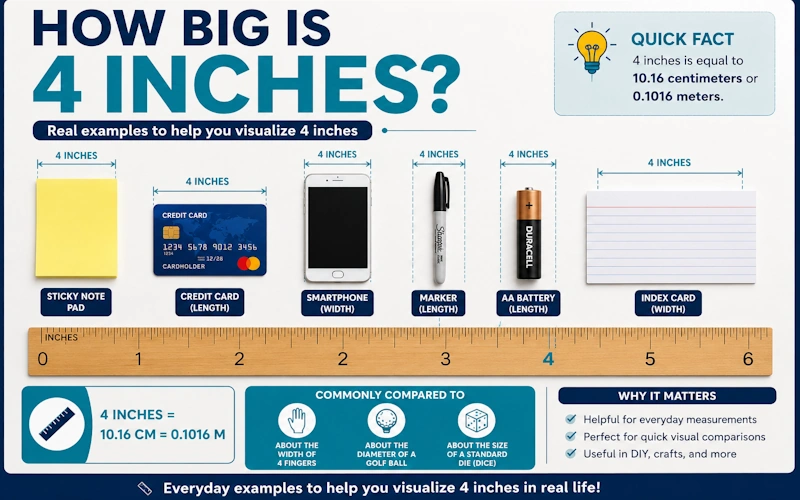
4 inches equals 10.16 centimeters, 101.6 millimeters, 0.33 feet, and 0.111 yards. It’s a small but genuinely common size, similar to a Post-it note or a square drink coaster.
| Unit | Value |
|---|---|
| Centimeters | 10.16 cm |
| Millimeters | 101.6 mm |
| Feet | 0.33 ft |
| Yards | 0.111 yd |
How Big Is 4 Inches, Really?
A measurement of 4 inches counts as small, but it shows up constantly in everyday objects. It’s a size that fits comfortably in your hand and becomes easy to compare once you’ve seen it a few times.
Instead of thinking purely in numbers, it’s far easier to understand this length through real examples. Once you connect 4 inches to familiar items, you can recognize it instantly without needing to measure anything.
What Does 4 Inches Look Like?
To picture 4 inches clearly, imagine something small enough to fit comfortably in your hand while still having a noticeable length.
It’s roughly the size of a square sticky note, or a coaster you’d place under a glass. Holding an object that size, it feels compact, easy to grip, and clearly defined at the edges.
Once you start linking this measurement to familiar items like these, estimating 4 inches becomes much faster and more accurate in everyday situations.
11 Everyday Things That Are About 4 Inches Long
To make 4 inches easy to understand, it helps to compare it with real objects you already recognize. Below are carefully chosen items that match this measurement, so you can clearly picture what 4 inches looks like in everyday life.
1. Post-it Note (4×4 Square)
A standard Post-it note is manufactured at exactly 4×4 inches. You’ll spot these in offices, classrooms, and home desks everywhere. Holding one feels light and perfectly square in your hand, and the clean, straight edges make it easy to judge length just by looking. It’s genuinely one of the best examples of a 4-inch object you’ll come across.
2. 4×4 Ceramic Tile
Ceramic tiles are produced in exact 4-inch sizes for consistency in kitchen and bathroom design. They feel solid and compact when held, and the square shape gives a clear, defined visual boundary a genuinely helpful way to visualize this size.
3. Square Drink Coaster
Standard coasters are commonly manufactured at exactly 4 inches. You’ll see them in cafes, restaurants, and homes, where they create a neat square footprint on the table. They feel balanced and easy to hold, making them a practical example of this exact size.
4. Mini Photo Print (4×4)
Square photo prints are produced at exactly 4 inches, commonly used in albums and small frames. They feel compact but still large enough to display clearly, and their sharp edges define the size perfectly a strong visual for what 4 inches looks like.
5. Mini Cake Pan (4-Inch Mold)
Baking molds designed for small desserts are commonly made at exactly 4 inches. You’ll find them in kitchens and baking supply stores. They feel small but deep enough to hold a single portion, and their shape gives a strong, tangible size reference.
6. Electrical Box Depth
Electrical boxes used inside walls for switches and outlets are manufactured at exactly 4 inches deep. You won’t always see them directly, but the measurement is a fixed construction standard a practical example of how 4 inches shows up in real-world design.
7. HVAC Vent Opening
Small HVAC vents found in ceilings and walls are commonly designed at exactly 4 inches. They look compact but stay fully functional, and the square opening gives a clear, everyday reference for this measurement.
8. Square Soap Bar
Some soap bars are manufactured at exactly 4 inches. Holding one feels smooth and compact, and its length is easy to compare directly against the size of your palm a strong, hands-on example of this measurement.
9. Pocket Mirror (4-Inch Diameter)
Compact mirrors are commonly produced in exact 4-inch diameters, and you’ll find them in makeup kits and bags. They feel balanced and perfectly circular, and the diameter clearly shows the full span of the measurement at a glance.
10. Craft Foam Square
Craft foam sheets are frequently cut into exact 4-inch squares for schools and craft stores. They feel lightweight and flexible, and their clean square shape makes measuring against them especially easy.
11. Stone Coaster Tile
Decorative stone coasters are commonly manufactured at exactly 4 inches. You’ll see them on tables and desks, where they feel solid and textured. Their well-defined edges make them a genuinely clear reference for visualizing 4 inches.
Why Knowing 4 Inches Is Useful
Understanding this measurement helps in more everyday situations than you’d expect:
Online Shopping — You can quickly judge whether a product’s actual size will suit your needs from its dimensions alone.
DIY & Home Projects — Genuinely helpful for cutting, spacing, and planning small components.
School & Office Work — Great for crafts, drawing layouts, and quick estimates without reaching for a ruler.
Everyday Estimation — No ruler on hand? No problem you now have 11 solid references to work with.
How to Measure 4 Inches Without a Ruler
1. Method: Using Your Fingers
You can estimate 4 inches using your fingers based on their average widths. An adult index finger is typically about 0.7 inches wide, so placing five index fingers side by side gets you to roughly 3.5 inches. Add your pinky finger, at about 0.6 inches wide, and the total comes to close to 4.1 inches. Line your fingers up flat, side by side without gaps, along a straight edge, and keep your hand relaxed rather than stretched stretching changes the spacing and throws off the estimate. It’s a quick, reliable visual check when you need a rough number fast.
2. Method: Using a 4×4 Post-it Note
A standard 4×4 Post-it note is exactly 4 inches on each side, making it one of the most accurate everyday tools you probably already have. Place the note directly next to the object you’re measuring, align one edge with the starting point, and check where the opposite edge lands. Keep the note flat rather than curled, since bent edges throw off accuracy. For longer objects, slide the note along in sections and measure step by step. This method works cleanly on desks, tables, or any flat surface.
3. Method: Using a Dollar Bill
A US dollar bill measures exactly 6.14 inches in length, which makes it handy for estimating smaller sizes too. Two-thirds of that length works out to about 4.09 inches very close to 4 inches. Fold the bill into three equal sections, aligning the edges carefully and pressing down to create clean creases. Two of those three sections give you your 4-inch reference. Lightly marking the fold points can help improve accuracy. It’s especially useful when you don’t have standard measuring tools nearby but still need a dependable estimate.
Common Mistakes People Make
One common mistake is mixing up inches and centimeters since 4 inches equals 10.16 cm, confusing the two easily leads to incorrect sizing.
Another frequent issue is guessing without any reference object at all. Without something known to compare against, estimates drift off quickly.
People also assume all small items are roughly the same size, which isn’t true even small differences can shift a measurement significantly.
The safest approach is to always compare against a known object rather than relying on a rough guess.
Frequently Asked Questions
4 inches equals exactly 10.16 centimeters, based on the standard conversion where 1 inch equals 2.54 centimeters.
A 4×4 Post-it note, a square coaster, and a mini cake pan are all reliable, standardized references for this size.
Yes. A standard credit card’s short side measures exactly 2.125 inches, so 4 inches is nearly double that width, making the difference easy to notice.
4 inches is very close to the width of an adult palm, which typically falls between 3.5 and 4 inches depending on hand size.
Use your fingers, a 4×4 Post-it note, or a dollar bill folding a dollar bill into thirds gives you a section close to 4.09 inches.
Conclusion
The easiest ways to picture 4 inches are a Post-it note, a square coaster, and a ceramic tile. These work well because they’re perfectly square, widely available, and manufactured to fixed dimensions, so seeing or holding one quickly locks the size into memory.
Knowing this measurement helps in everyday situations like online shopping, craft projects, small DIY work, and comparing products. Instead of guessing, you can lean on these real-world references to make quick, accurate decisions whenever “4 inches” comes up.