
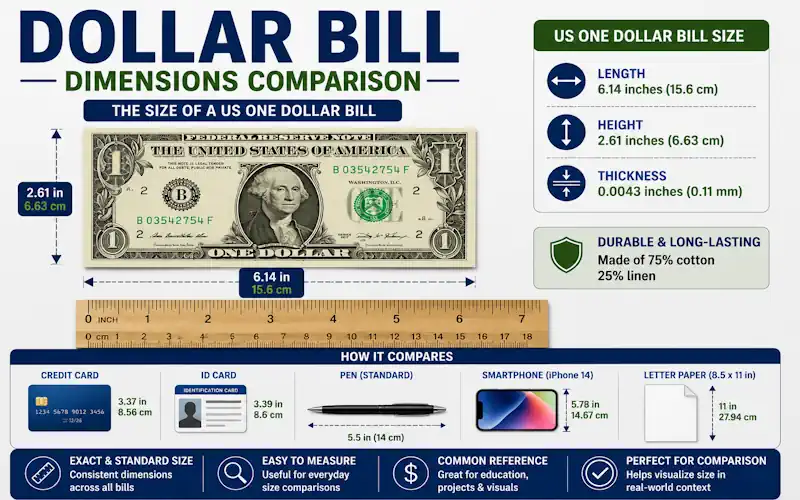
US currency has kept the same physical size for close to a century. Knowing these dimensions isn’t just a fun fact — it genuinely matters for collectors, educators, business owners, and anyone curious about the cash sitting in their wallet.
This guide breaks down everything about dollar bill dimensions: exact measurements, historical changes, thickness and stack calculations, and answers to the questions people ask most about American paper money.
Dollar Bill Dimensions in Different Units
To make these numbers easy to remember: a dollar bill is just over 6 inches long and about 2.5 inches tall. Measured with a ruler, it’s slightly longer than a credit card but a bit narrower.
In metric terms, that comes out to 15.6 cm by 6.6 cm. Stack 10 bills together and you get roughly 1 millimeter of thickness. Stack 100, and you’re looking at about half an inch. These conversions come in handy whether you’re working on a school project or setting up a display case.
Quick Reference Table
| Feature | Imperial | Metric |
|---|---|---|
| Length | 6.14 inches | 156 mm |
| Width | 2.61 inches | 66.3 mm |
| Thickness | 0.0043 inches | 0.109 mm |
| Weight | 0.035 ounces | 1 gram |
Approximate values for a standard US dollar bill. Exact measurements can vary slightly due to wear.
For an easier visual, think of a dollar bill as close to the size of a standard playing card, just a touch shorter and narrower, or roughly half a smartphone screen held in portrait mode.
Are All Dollar Bill Dimensions the Same?
One Size Fits All US Currency
The Federal Reserve settled on this approach for practical reasons. ATMs don’t need to adjust for different bill sizes, vending machines accept any denomination without special sensors, and wallets don’t need separate compartments. Uniform sizing also makes mass production simpler and cheaper.
Historical Dollar Bill Sizes
That year marked a genuine turning point. The Treasury decided to standardize the size across all currency. Smaller bills cut production costs, lasted longer in circulation, and let banks store more cash in the same amount of space. The change modernized American money almost overnight.
Dollar Bill Dimensions by Denomination
Common Denominations
$1 Bill: Measures 6.14 x 2.61 inches. Features George Washington on the front, based on Gilbert Stuart’s Athenaeum Portrait, with the Great Seal of the United States including the eagle and the unfinished pyramid with the all-seeing eye — on the back.
$5 Bill: Identical measurements, featuring Abraham Lincoln’s portrait. The Lincoln Memorial appears on the reverse, with purple accents added in recent series for added security.
$10 Bill: Same standard dimensions. Alexander Hamilton appears on the front, with the US Treasury building on the back — the only common bill that doesn’t feature a former president.
$20 Bill: No variation in physical size. Andrew Jackson’s portrait sits on front, with the White House on the reverse. It’s the most widely circulated denomination in America.
$50 Bill: Maintains the standard dimensions, featuring Ulysses S. Grant on the front and the US Capitol building on the back. Green and peach coloring helps deter counterfeiting.
$100 Bill: Despite being the highest common denomination, it’s still exactly 6.14 x 2.61 inches. Benjamin Franklin’s portrait and Independence Hall make it instantly recognizable, protected further by blue security threads and color-shifting ink.
Rare and Discontinued Bills
The $2 bill still technically circulates, though rarely, and shares the same dimensions as every other denomination. Thomas Jefferson appears on the front, with the signing of the Declaration of Independence on the back. Many people assume it’s rare — it isn’t, just uncommon.
Larger denominations like the $500, $1,000, $5,000, and $10,000 bills were discontinued in 1969. All shared the same standard 6.14 x 2.61 inch dimensions introduced in 1929. The Federal Reserve pulled them from circulation largely to combat organized crime.
The $10,000 bill featured Salmon P. Chase, who served as both Treasury Secretary and Chief Justice. Printed from 1928 to 1945, only a few hundred are believed to remain, mostly held in museums or private collections worth far more than their face value.
A $100,000 gold certificate also existed at one point, though it never entered public circulation — used only for transactions between Federal Reserve banks. Woodrow Wilson’s portrait appeared on the front, and despite its extraordinary value, the note kept the same standard size as everyday currency.
Dollar Bill Thickness and Stack Height
How Thick Is a Dollar Bill?
A single bill measures just 0.0043 inches thick thinner than two sheets of regular printer paper. Yet it feels noticeably more substantial thanks to its cotton-linen composition.
US notes aren’t made from wood pulp like standard paper. They’re woven from 75% cotton and 25% linen, a blend that creates far more durability than regular paper offers. A dollar bill can typically withstand around 4,000 folds before it tears.
Stack Calculations
Stack 10 dollar bills and you get about 0.43 millimeters barely noticeable. Stack 100 together, and the pile reaches roughly 0.43 inches, still less than half an inch tall.
Here’s where it gets more interesting: a thousand dollars in one-dollar bills creates a stack about 4.3 inches high, roughly the height of a coffee mug. Ten thousand dollars in ones reaches 43 inches, or about 3.5 feet tall.
A million dollars in $1 bills stacks up to approximately 358 feet taller than the Statue of Liberty, which stands at 305 feet. In $100 bills, though, that same million dollars shrinks to just 3.58 feet, small enough to fit comfortably in a large briefcase.
Conclusion
The US dollar bill’s 6.14 x 2.61 inch dimensions represent nearly a century of American financial history. Since 1929, these measurements have stayed constant through wars, economic shifts, and major technological changes — a stability that reflects the dollar’s role as a global financial standard.
These dimensions shape everything from wallet design to international banking systems. Uniform sizing across all denominations prioritizes efficiency and machine compatibility, and while other countries chose variable sizing to aid accessibility, the US opted for consistency for practical and economic reasons.
Frequently Asked Questions
A US dollar bill measures 6.14 inches long by 2.61 inches wide. In metric units, that’s 156mm by 66.3mm, with a thickness of 0.0043 inches (0.109mm). Every denomination shares these exact measurements.
The $100 bill is exactly the same size as all other US currency 6.14 x 2.61 inches. Despite being the highest common denomination, it shares identical dimensions with the $1 bill; only the design, colors, and security features differ.
The $20 bill measures 6.14 inches by 2.61 inches, identical to every other US currency denomination. It’s the most circulated bill in America and is used constantly in ATMs nationwide. These dimensions haven’t changed since 1929.
The $10,000 bill featured Salmon P. Chase, Treasury Secretary under Lincoln. It measured the standard 6.14 x 2.61 inches, identical to regular currency, with Chase’s portrait on the front alongside a green Treasury seal and serial numbers.