
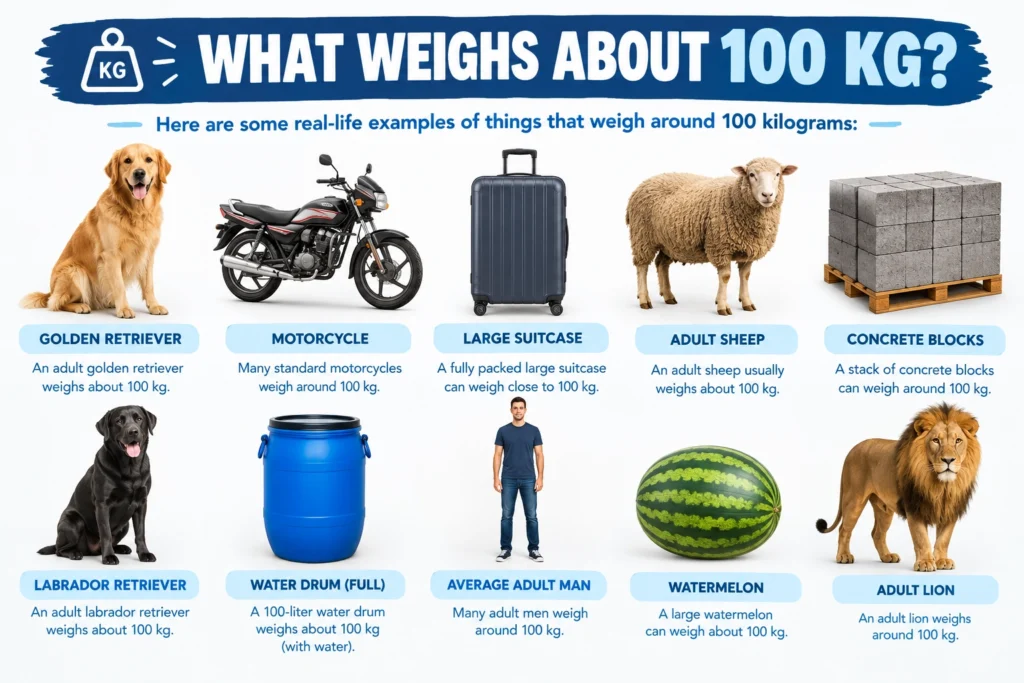
100 KG is equal to 220.46 pounds (15.75 stone). It is also roughly the weight of two standard 50 kg bags of cement stacked together.
Most of us know 100 kg is “heavy,” but the number stays abstract until you tie it to something you can actually picture. Once you line it up against a loaded barbell, a newborn elephant, or a vending machine, the weight stops being just a figure on a scale and starts making practical sense.
Below is a rundown of real things that land at or near the 100 kg mark, along with quick conversions and a few tricks for estimating this weight without a scale handy.
Key Takeaways
- 100 kg converts to about 220.46 pounds, 15.75 stone, or 100,000 grams.
- Everyday equivalents include two 50 kg cement bags, a fully loaded Olympic barbell, or roughly four to five packed suitcases.
- Several animals hover around 100 kg at specific life stages, including newborn elephant calves, market-ready pigs, and sub-adult lions.
- In construction and logistics, 100 kg is a common threshold for shipping surcharges and manual-lifting limits.
- Most safety guidelines recommend against one person lifting 100 kg alone; it’s generally treated as a two-person load.
Quick Conversion Table
| Unit | Equivalent to 100 kg |
|---|---|
| Pounds (lbs) | 220.46 lbs |
| Stone | 15.75 stone |
| Grams | 100,000 g |
| Metric tons | 0.1 metric tons |
| Ounces | 3,527 oz |
15 Things That Weigh Around 100 Kilograms
1. The Cast-Iron Plate Inside a Piano
A piano looks like it’s mostly wood, but tucked inside is a heavy cast-iron frame that anchors every string, and that single part alone weighs close to 100 kg. It needs to be that solid because it holds back roughly 18 to 20 tons of combined string tension, which would otherwise pull the whole instrument apart within days.
2. A Full-Grown Male Ostrich
An adult male ostrich typically weighs somewhere between 90 and 130 kg, putting many individuals right around the 100 kg mark. Despite that bulk, ostriches can’t fly but can still sprint at speeds approaching 70 km/h, making them one of the more surprising entries on this list.
3. An Empty Vending Machine
A standard vending machine, before it’s stocked with a single can, generally weighs between 95 and 115 kg. That weight comes from the steel housing, refrigeration components, and reinforced glass front, which is why moving companies typically treat an empty unit as a two-person job.
4. A Filled Industrial Fire-Suppression Cylinder
Large CO2 cylinders used in server rooms, industrial kitchens, and marine fire-suppression systems weigh roughly 95 to 105 kg once filled. The gas itself adds meaningfully to the total, and because these cylinders protect expensive equipment, secure mounting matters just as much as the weight itself.
5. A Mature Male Reindeer
A wild male caribou (the North American name for reindeer) in its prime typically weighs between 92 and 110 kg, though this shifts with the seasons as the animal bulks up before winter and slims down during long migrations. Researchers use this weight range as a rough health indicator for wild herds.
6. A Pallet of Ceramic Floor Tiles
A wooden shipping pallet loaded with ceramic or porcelain tiles commonly lands around 100 kg, depending on tile thickness and coverage area. This figure matters a lot in construction, since it affects freight costs, crew size for unloading, and how carefully the tiles need to be stacked to avoid cracking.
| Tile type | Approx. weight per m² | Coverage to reach ~100 kg |
|---|---|---|
| Ceramic (standard) | 15–18 kg/m² | ~6 m² |
| Porcelain | 20–22 kg/m² | ~4.5 m² |
| Natural stone | 25–30 kg/m² | ~3.5 m² |
7. A Fully Loaded Olympic Barbell
A standard Olympic bar weighs 20 kg on its own. Add four 20 kg plates and the total hits exactly 100 kg, a weight that many strength programs treat as the first real milestone separating beginners from intermediate lifters in squats, deadlifts, and bench presses.
8. A Sub-Adult Male Lion
Fully grown male lions usually weigh between 150 and 225 kg, but younger males around two to three years old, still developing their mane and full size, often sit close to 100 kg. Wildlife researchers track this figure as a marker of healthy growth toward adulthood.
9. A Heavyweight Boxer in Fighting Shape
Professional boxing’s heavyweight division starts at roughly 90.7 kg, and many top-level fighters compete in the 100–105 kg range. At that bodyweight, a trained heavyweight can generate punching forces well into the thousands of newtons, a result of years of conditioning rather than raw size alone.
10. Two Fully Packed Checked Suitcases
Airlines usually cap a single checked bag at around 23 kg, but two heavily packed, oversized suitcases together can easily reach 50 kg each. Stack a couple of travelers’ luggage together and you’re looking at roughly 100 kg on a single luggage cart, a threshold that also affects air-freight pricing for cargo shipments.
11. A Market-Ready Pig
Commercial pigs raised for pork are typically sent to market once they reach 90 to 115 kg, usually around five to six months of age. Farmers target this range specifically because it represents the best balance of muscle to fat for meat production.
| Growth stage | Approximate weight |
|---|---|
| Piglet (birth) | 1.5 kg |
| Weaned (8 weeks) | 25 kg |
| Grower (4 months) | 60 kg |
| Market weight (5–6 months) | 90–115 kg |
12. Two Standard Bags of Cement
A typical bag of cement on a construction site weighs 50 kg, so two bags together land exactly on 100 kg. It’s a simple bit of math, but it comes up constantly on job sites, and most workplace safety guidelines set manual single-person lifting limits well under this weight, making two cement bags a job for two people by the book.
13. A Newborn Elephant Calf
African elephant calves are born weighing anywhere from 85 to 115 kg, making them among the heaviest newborns in the animal kingdom. Within hours of birth, a calf at this weight is already walking alongside the herd, supported by its mother and other adult females.
| Animal | Average birth weight |
|---|---|
| Human baby | 3.3 kg |
| Giraffe calf | 70 kg |
| Elephant calf | 90–115 kg |
| Polar bear cub | 0.5 kg |
14. A Juvenile Polar Bear
Adult male polar bears can reach 350 to 700 kg, but younger bears around one and a half to two years old, right after leaving their mothers, weigh closer to 100 kg. Researchers watch this weight closely, since a cub needs enough stored fat and muscle at this stage to survive its first independent winter.
15. A Large Commercial Flat-Screen Display
A 75-inch flat-screen TV built for home use typically weighs 35 to 55 kg, but commercial-grade display panels used in airports, stadiums, and retail spaces are a different story. With their steel frames, built-in media players, and mounting hardware, these units often exceed 100 kg once packaging is included.
How to Estimate 100 Kilograms Without a Scale
If you don’t have a scale handy, a few mental anchors make it easy to gauge 100 kg on the spot:
- Two standard 50 kg cement bags stacked together
- A loaded Olympic barbell (bar plus four 20 kg plates)
- A competition-ready heavyweight boxer
- About ten average-sized dogs (using a 10 kg breed as the baseline)
- Roughly four to five fully packed carry-on suitcases
Compared to Other Familiar Weights
For more context, 100 kg sits well above a large refrigerator (150–250 kg is actually heavier, so this one’s close but can go either way depending on the model), noticeably above the average adult male (roughly 70–90 kg), and well below a small car, which typically weighs closer to 1,000 kg. It’s a weight that shows up right at the edge of what one determined person might attempt to move, which is exactly why so many safety guidelines flag it.
Common Mistakes When Estimating 100 kg
- Confusing kg and lbs on a mixed-unit scale. A reading of “100” means something very different depending on which unit is active, and warehouses that switch between the two see this mistake often.
- Assuming density doesn’t matter. A 100 kg bag of cement and a 100 kg pallet of foam packaging take up wildly different amounts of space, so volume alone is a poor guide to weight.
- Underestimating awkward loads. Powdery or liquid weight (like cement or water) shifts during transport, which changes how stable a 100 kg load feels compared to a solid, rigid object of the same weight.
Conclusion
Once you tie 100 kg to real objects and animals, instead of just a number on a scale, it stops feeling abstract. Whether you’re estimating a shipment, setting a fitness goal, or just satisfying curiosity, these comparisons make the weight easier to picture the next time it comes up.
FAQs
For most adults, 100 kg falls into the higher end of a healthy weight range or beyond it, depending on height and build. For a muscular athlete, such as a rugby player or heavyweight boxer, it can be entirely normal.
Losing roughly 10 kg of body fat generally requires a calorie deficit of about 77,000 calories, so losing 100 kg of pure fat would take a deficit in the range of 770,000 calories over time, which is why sustainable, gradual weight loss is typically recommended.
It’s not generally recommended. Most occupational safety guidelines cap safe single-person manual lifts well below 100 kg, closer to 20–25 kg, which is why heavier loads are usually handled with equipment or a second person.
100 kg converts to approximately 220.46 pounds.
Exactly two standard 50 kg bags.
A newborn African elephant calf, which is typically born weighing between 85 and 115 kg.
Yes. The kilogram is a fixed SI unit, so 100 kg represents the same mass everywhere; only the units used to describe it locally (pounds, stone) change.
Picture two 50 kg cement bags, or a fully loaded Olympic barbell with the bar plus four 20 kg plates. Both are common, tangible benchmarks.