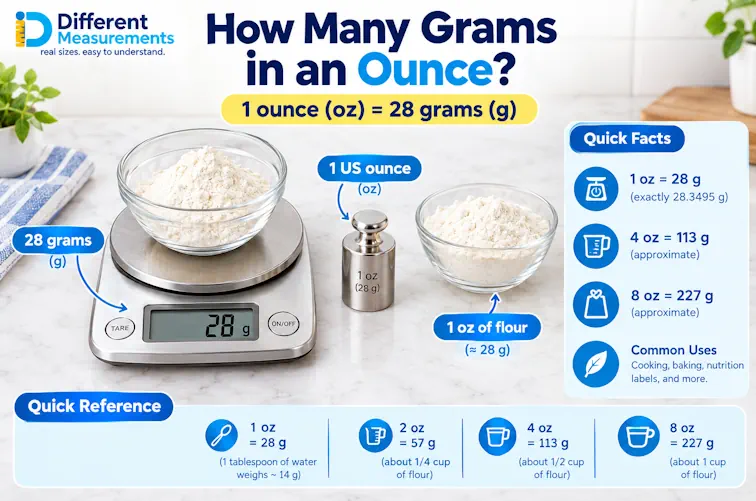
1 ounce is equal to 28.35 grams (exactly 28.349523125 g). For quick math, multiply ounces by 28.35 to get grams, and divide grams by 28.35 to get ounces.
The question seems simple, but it comes up in very different places: a cookie recipe written in grams, a supplement label listed in ounces, a package weighed for postage, or a bag of gold bought by the troy ounce. Each situation has a slightly different answer to keep in mind, and the details decide whether your result is right.
This guide covers the exact value and where it comes from, ready-to-use tables from one quarter ounce to 32 ounces, worked examples, the troy and fluid ounce differences, and the mistakes that cause most conversion errors.
Key Takeaways
- One avoirdupois ounce, the everyday ounce used in the United States, equals exactly 28.349523125 grams. Most people round this to 28.35.
- One gram equals about 0.035274 ounces, so divide grams by 28.35 to convert back.
- A pound is 16 ounces, or exactly 453.59237 grams.
- A troy ounce, used for gold, silver, and platinum, is about 31.1034768 grams, which is roughly 2.75 grams heavier than a standard ounce.
- A fluid ounce measures volume, not weight, so it cannot be converted to grams with the 28.35 factor alone.
Where the Exact Number Comes From
For most of history, the ounce was defined locally, and the same name could mean slightly different weights in different places. The word comes from the Latin uncia, meaning one-twelfth, because a Roman pound was divided into twelve ounces. Over the centuries, British and American units drifted apart, and the US customary system used different standards for different goods.
The modern exact value was set by an international agreement in 1959 between the United States, the United Kingdom, Canada, Australia, New Zealand, and South Africa. They agreed that one international pound equals exactly 0.45359237 kilograms. Since a pound is 16 avoirdupois ounces, one ounce works out to 28.349523125 grams. That is why the figure is written with so many decimals: it is defined, not measured.
The gram is defined in the metric system as one-thousandth of a kilogram. Because the ounce is defined in terms of the kilogram, the conversion is exact.
Ounce to Gram Conversion Table
| Ounces (oz) | Grams (g) |
|---|---|
| 1/4 oz | 7.09 g |
| 1/2 oz | 14.17 g |
| 3/4 oz | 21.26 g |
| 1 oz | 28.35 g |
| 2 oz | 56.70 g |
| 3 oz | 85.05 g |
| 4 oz | 113.40 g |
| 5 oz | 141.75 g |
| 6 oz | 170.10 g |
| 8 oz | 226.80 g |
| 10 oz | 283.50 g |
| 12 oz | 340.19 g |
| 16 oz (1 lb) | 453.59 g |
| 32 oz (2 lb) | 907.18 g |
Gram to Ounce Conversion Table
| Grams (g) | Ounces (oz) |
|---|---|
| 5 g | 0.18 oz |
| 10 g | 0.35 oz |
| 14 g | 0.49 oz |
| 25 g | 0.88 oz |
| 28 g | 0.99 oz |
| 30 g | 1.06 oz |
| 50 g | 1.76 oz |
| 100 g | 3.53 oz |
| 250 g | 8.82 oz |
| 500 g | 17.64 oz |
| 1,000 g (1 kg) | 35.27 oz |
The Formulas, Explained Step by Step
Ounces to grams: Grams = Ounces × 28.35
Grams to ounces: Ounces = Grams ÷ 28.35
To convert a mixed amount such as 2 and a half ounces, first turn the fraction into a decimal (2.5), then multiply: 2.5 × 28.35 = 70.875 grams. For a bigger number such as 40 ounces, multiply in two steps to check yourself: 40 × 28 = 1,120, then add 40 × 0.35 = 14, for a total of 1,134 grams, which matches the exact figure of 1,133.98 grams.
Going the other way, 300 grams is 300 ÷ 28.35 = 10.58 ounces. If you only need a rough answer, dividing by 28 is close enough for everyday cooking, but for anything where precision matters, use 28.35.
Why Rounding to 28 Causes Problems
Using 28 instead of 28.35 looks harmless, but the error grows with the amount. The difference is about 1.2 percent, which is small for one ounce but adds up quickly.
- At 1 ounce, the error is 0.35 grams.
- At 8 ounces, the error is about 2.8 grams.
- At 16 ounces, the error is about 5.6 grams.
- At 1 pound (16 ounces), a 28-gram rule gives 448 grams, while the exact value is 453.6 grams.
For a cake, a few grams of flour will not ruin the result. For a dose of medicine, a supplement, or a precious metal, the same error can matter a great deal.
Real Food Examples
Numbers are easier to trust when you compare them with something in your kitchen. These are typical values, and real weights vary by brand, size, and moisture.
- A US stick of butter weighs about 113 grams, or 4 ounces.
- A medium apple is roughly 180 grams, or about 6.3 ounces.
- A slice of sandwich bread is around 25 to 30 grams, or about 0.9 to 1 ounce.
- A large egg in its shell is about 50 to 60 grams, or roughly 1.8 to 2.1 ounces.
- A typical pound of ground meat is 453.6 grams, the same as 16 ounces.
[IMAGE: butter-stick-apple-scale-grams.webp “A stick of butter and a medium apple on a kitchen scale showing their weights in grams”]
Weight Versus Volume in the Kitchen
Ounces and grams both measure weight, which is why a scale is the most accurate tool for converting between them. Cups measure volume, and the weight of a cup depends on the ingredient. For example, one US cup of water weighs about 237 grams, while one cup of all-purpose flour is usually around 120 to 125 grams because flour is lighter and fluffier than water. Sugar, butter, and honey each have their own weight per cup.
For this reason, professional bakers prefer weighing ingredients in grams or ounces. If a recipe lists ounces, check whether it means weight (usually yes for dry ingredients) or fluid ounces (volume for liquids).
Avoirdupois Ounce Versus Troy Ounce
There are two ounces in common use, and they are not interchangeable.
The avoirdupois ounce is the ordinary ounce used for food, groceries, postage, and most consumer products. This is the one this guide covers.
The troy ounce comes from an older system used for precious metals. One troy ounce equals 480 grains, and it is about 31.10 grams, which is roughly 2.75 grams heavier than a standard ounce. Gold, silver, and platinum are priced per troy ounce, so a bullion coin or a jewelry weight given in troy ounces needs the troy conversion. Multiplying a troy ounce by 28.35 would undercount the metal by about 9 percent.
A quick way to avoid confusion: if you are buying gold, ask whether the price is per troy ounce. If you are cooking, assume avoirdupois unless the recipe says otherwise.
Fluid Ounces Are Not Weight
A fluid ounce measures volume. One US fluid ounce equals about 29.57 milliliters, and its weight depends on the liquid. Water weighs close to 29.6 grams per fluid ounce, while honey and oil are heavier and milk is only slightly heavier than water. If a recipe lists fluid ounces, measure with a liquid measuring cup, not a kitchen scale set to grams, unless the recipe specifically gives a weight.
Practical Uses Beyond the Kitchen
Shipping and postage. Postage prices are often based on weight bands in ounces. A package that is 1.1 ounces may fall into the next price band, so converting grams to ounces (divide by 28.35) before choosing a rate can save money. A 250-gram parcel is about 8.8 ounces.
Medicines and supplements. Labels may list milligrams, grams, or ounces, and the difference between them is a factor of 1,000 or more. Always confirm the unit on the label, and follow the instructions from a pharmacist or doctor rather than converting doses yourself.
Precious metals and jewelry. Use troy ounces for bullion and gold or silver prices, and check the stated purity along with the weight.
Fitness and nutrition. Food labels in the US list serving sizes in grams and ounces side by side. Converting carefully helps when you track portions.
Common Mistakes When Converting Ounces to Grams
- Using 28 instead of 28.35. The rounded figure produces noticeable errors when you multiply by larger amounts.
- Mixing up weight and volume. A fluid ounce of flour does not weigh 28 grams, because dry ingredients differ in density.
- Using the troy ounce by accident. Gold and silver prices use troy ounces, which are about 31.10 grams, not 28.35.
- Rounding too early. Round only the final answer, or small errors can add up across several steps.
- Confusing grams with milligrams. One gram is 1,000 milligrams, so reading the wrong unit can change a portion or dose by a factor of 1,000.
- Forgetting that “oz” can be ambiguous. On a food label, oz usually means weight. On a drink label, fl oz means volume.
Why Grams and Ounces Both Exist
The gram belongs to the metric system, which was created in France in the 1790s and is now used by most of the world. The ounce belongs to the imperial system, which the United States and a few other countries still use for everyday weights. Because recipes, packaging, shipping, and product labels follow different systems, converting between them is a regular task for cooks, bakers, small businesses, and anyone shopping across borders.
Conclusion
One ounce equals 28.35 grams, a figure defined exactly by international agreement. Use the tables and formulas for everyday work, keep the exact value for precise tasks, and remember the two important exceptions: troy ounces for precious metals, and fluid ounces for volume. With those three points clear, almost any ounce-to-gram question becomes simple.
FAQs
One avoirdupois ounce equals 28.35 grams, or exactly 28.349523125 grams.
Half an ounce equals 14.17 grams.
100 grams equals about 3.53 ounces.
One pound equals 16 ounces, or exactly 453.59237 grams.
No. A troy ounce is about 31.10 grams, while a regular ounce is about 28.35 grams. Troy ounces are used mainly for gold, silver, and platinum.
It depends on context. A regular ounce measures weight, while a fluid ounce measures volume.
Divide the grams by 28.35. For a rough estimate, dividing by 28 is close enough for everyday cooking.
A 2-ounce serving equals about 56.7 grams.
250 grams equals about 8.82 ounces.
Because the 1959 international agreement defined one pound as exactly 0.45359237 kilograms, and one pound is 16 ounces. Dividing that by 16 gives the exact value of one ounce in grams.