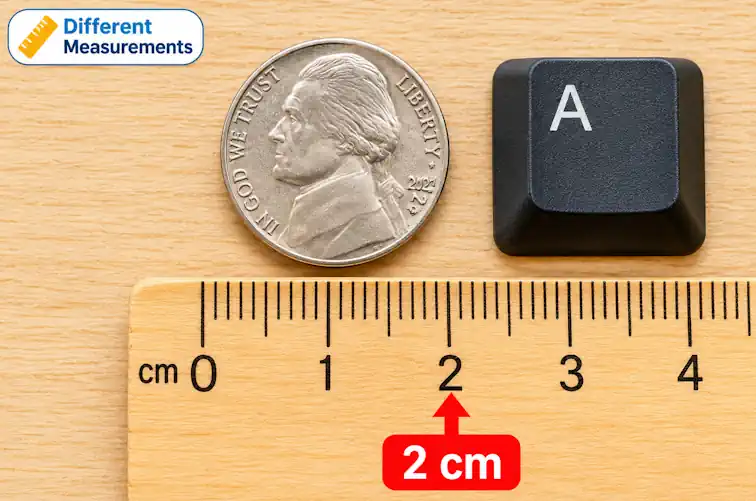
2 cm is equal to 20 millimeters, or about 0.79 inches. It is also just a little less than one inch, and about the width of a US nickel’s edge when the coin is turned sideways.
Two centimeters is a small length that most people have seen but few can picture on their own. It is smaller than a finger’s width at the fingertip and bigger than a grain of rice, which makes it easy to misjudge when a product label or a craft pattern gives it in metric.
This guide gives you the exact conversions, nine real objects close to 2 cm, and simple ways to estimate the length when no ruler is nearby.
Key Takeaways
- 2 cm equals exactly 20 millimeters, 0.02 meters, or about 0.787 inches.
- Two centimeters is a little shorter than one inch, since one inch is 2.54 cm.
- A standard computer keyboard key is about 19 mm wide, so it is one of the closest everyday references.
- A US nickel is 21.21 mm across, which is only slightly larger than 2 cm.
- Two centimeters is the same as 0.787 inches, so it is about 79 percent of an inch.
2 cm Conversion Table
| Unit | Equal to 2 cm |
|---|---|
| Millimeters (mm) | 20 mm |
| Meters (m) | 0.02 m |
| Inches (in), decimal | 0.7874 in |
| Feet (ft) | 0.0656 ft |
| Yards (yd) | 0.0219 yd |
| Pixels at 72 DPI | about 57 px |
| Pixels at 96 DPI | about 76 px |
| Pixels at 300 DPI | about 236 px |
Nearby Sizes in Centimeters and Inches
| Centimeters | Inches |
|---|---|
| 1 cm | 0.39 in |
| 1.5 cm | 0.59 in |
| 2 cm | 0.79 in |
| 2.5 cm | 0.98 in |
| 3 cm | 1.18 in |
| 5 cm | 1.97 in |
What Does 2 cm Look Like?
Two centimeters is about the width of the tip of an adult index finger, a little narrower than a standard US nickel is wide. On a ruler, it sits exactly at the second centimeter mark, and it is just short of the one-inch mark. Picture a small shirt button or a dried bean, and you have a clear visual of the length.
9 Real Objects That Are About 2 cm
Items marked “exact” are standardized or sold to a defined size. Items marked “about” vary by brand, model, or design.
1. A Keyboard Key (About 19 mm)
Standard keyboard keys are spaced at 19.05 mm, which is a standard pitch for keyboards. The keycap itself is a little smaller, but the key spacing is close to 2 cm. Look at a key straight on, and you have a dependable reference that is always nearby.
2. A Small Binder Clip (About 19 mm)
A small black binder clip is about 19 mm wide, just under 2 cm. Its size is consistent across office supply makers, so it works well as a quick check.
3. A US Nickel, Diameter (About 21 mm)
A US nickel is 21.21 mm across, which is slightly larger than 2 cm. Coins are made to exact specifications, so the comparison holds whenever you have one in your pocket. Keep in mind that the nickel is a little wider than the target length.
4. A 20 mm Watch Lug Width (Common Standard)
Many wristwatches use a 20 mm lug width, which is the distance between the two points where the strap attaches to the case. Strap makers label straps by this figure, so a 20 mm strap is a standard match for many watches.
5. A Shirt Cuff Button (About 18 to 20 mm)
Shirt cuff buttons are typically between 18 and 20 mm across. They are smaller than the main buttons down the front of a shirt, and they are a practical everyday reference you can find on most dress shirts.
6. A Shirt Button, Decorative (About 2 cm)
Many decorative buttons on jackets and sweaters measure close to 2 cm across. Their size varies by style, so compare a button against a ruler once to check.
7. A Plastic Bottle Cap (About 19 to 21 mm)
Many standard plastic bottle caps are about 19 to 21 mm across. Caps vary by brand and bottle size, but the range is narrow enough to make them a useful reference.
8. A Cherry Tomato (About 1.8 to 2.2 cm)
A typical cherry tomato is about 1.8 to 2.2 cm across. Sizes vary by variety and ripeness, so use it as a rough reference rather than an exact measurement.
9. A Large Marble (About 16 to 20 mm)
Marbles come in several standard sizes. A larger marble sits close to 2 cm across, while smaller ones are noticeably less. Check the marble’s listed diameter if you need a precise match.
How to Estimate 2 cm Without a Ruler
- Use the tip of an index finger. For many adults, the width of the index finger at the first joint is about 2 cm. Measure your own finger once against a ruler to check.
- Use a keyboard key. Its spacing is about 19 mm, which is within a millimeter of 2 cm.
- Use a US nickel. Its diameter is 21.21 mm, so it is a little wider than 2 cm. Use it to judge when a length is close to 2 cm but a little larger.
- Use a small binder clip. Hold a small clip straight on. Its width is about 19 mm.
- Use a 0.79 inch rule. If you have an inch ruler, 2 cm is a bit under the one-inch mark, at about 0.79 inches.
2 cm Compared to Other Common Lengths
| Length | How it compares to 2 cm |
|---|---|
| 1 cm | Half as long |
| 1 inch (2.54 cm) | About 0.54 cm longer |
| 2 mm | 18 mm shorter |
| 3 cm | 1 cm longer |
| 5 cm | 3 cm longer |
| 10 cm | 8 cm longer |
Common Mistakes When Estimating 2 cm
- Confusing 2 cm with 2 mm. 2 cm is 20 mm, ten times larger than 2 mm. This is one of the most common decimal errors.
- Assuming 2 cm is one inch. One inch is 2.54 cm, so 2 cm is about half a centimeter shorter.
- Treating a coin as exact. A US nickel is 21.21 mm, which is slightly over 2 cm, while a dime is about 17.9 mm and would be under it.
- Trusting natural objects as standards. Cherry tomatoes, marbles, and beans vary in size, so use them for rough estimates only.
- Measuring the wrong part of an object. A button’s diameter is different from its thickness, and a cap’s height is different from its width.
Conclusion
Two centimeters equals 20 millimeters, or about 0.79 inches. It is easiest to picture as a keyboard key, a small binder clip, or the tip of your index finger. For quick checks, use those references. When precision matters, measure with a ruler or calipers.
FAQs
2 cm equals about 0.787 inches, just under one inch.
2 cm equals exactly 20 millimeters.
No. A US nickel is 21.21 mm across, so it is slightly larger than 2 cm.
On a metric ruler, it is the second centimeter mark. On an inch ruler, it is just under the one-inch mark.
A keyboard key’s spacing, a small binder clip’s width, a shirt cuff button, and a standard plastic bottle cap are all close to 2 cm.
Use the width of your index finger at the first joint, a keyboard key, or a small binder clip.
Yes. It is small enough to hold between two fingers, but large enough to see clearly on a table.