How Big Is 40cm? 12 Everyday Objects That Help You Picture It
40 cm is equal to 15.75 inches.
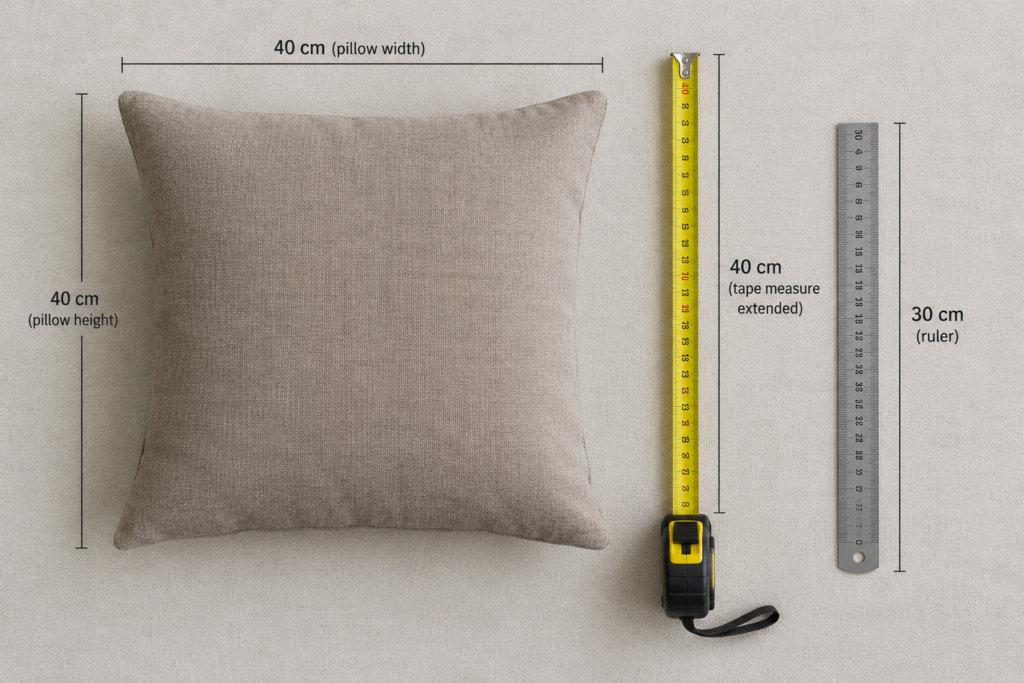
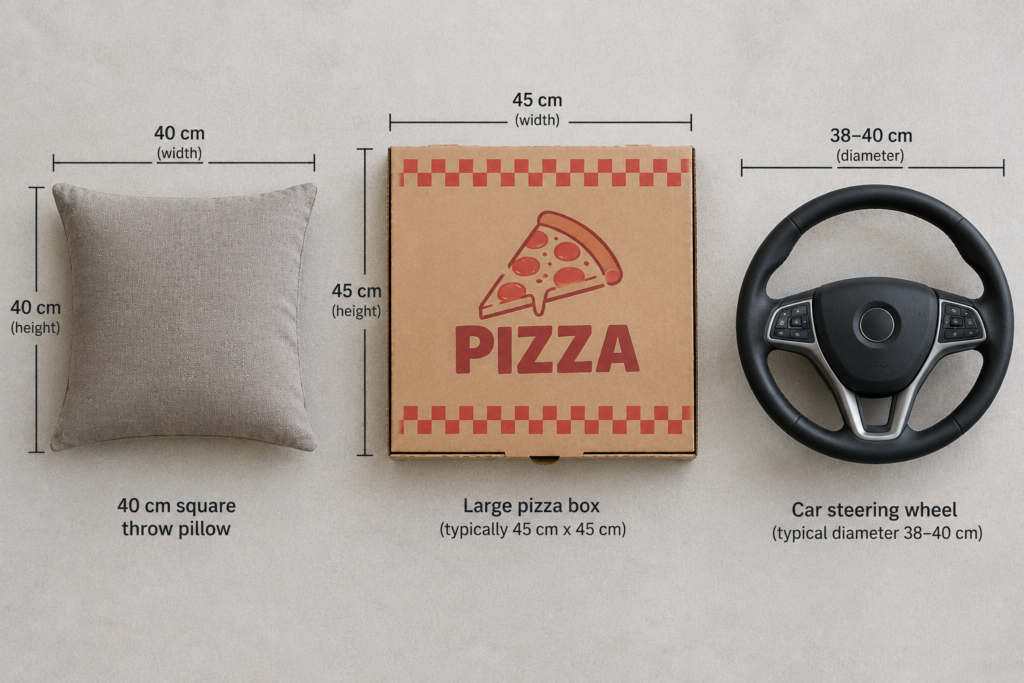
It is also roughly the width of a standard 16-inch square throw pillow.
Numbers like “40 cm” look simple on a product page, but they are surprisingly hard to picture. Is it the size of a dinner plate, a backpack, or a small table? This guide turns the figure into things you can actually see, with honest notes about which comparisons are exact and which are only close.
Key Takeaways
- 40 cm equals 400 millimeters, 0.4 meters, 15.75 inches, or about 1 foot 3.75 inches.
- It is just 0.64 cm (about a quarter of an inch) shorter than 16 inches, which makes “almost 16 inches” the easiest mental shortcut.
- A standard 30 cm school ruler plus 10 more centimeters gets you to 40 cm.
- Many household items come close to 40 cm in one direction, but very few are exactly that size, so always check a product’s listed dimensions.
- A “40 cm” label can refer to width, height, depth, length or diameter, and those are not interchangeable when you are checking whether something fits.
40 cm Conversion Table
| Unit | Value for 40 cm |
|---|---|
| Millimeters | 400 mm |
| Decimeters | 4 dm |
| Meters | 0.40 m |
| Inches | 15.75 in |
| Feet | 1.31 ft |
| Feet and inches | 1 ft 3.75 in |
| Yards | 0.44 yd |
The inch figure comes from dividing by 2.54 (40 ÷ 2.54 = 15.748), and 15.75 is the number most people round to.
40 cm Compared With Nearby Sizes
| Length | In inches | Compared with 40 cm |
|---|---|---|
| 30 cm | 11.81 in | 10 cm shorter |
| 35 cm | 13.78 in | 5 cm shorter |
| 40 cm | 15.75 in | Baseline |
| 45 cm | 17.72 in | 5 cm longer |
| 50 cm | 19.69 in | 10 cm longer |
Going the other way, a few inch values are worth knowing:
| In inches | In centimeters |
|---|---|
| 12 in (1 foot) | 30.48 cm |
| 15 in | 38.10 cm |
| 16 in | 40.64 cm |
| 18 in (1.5 feet) | 45.72 cm |
12 Everyday Things That Are Close to 40 cm
None of these are guaranteed to be exactly 40 cm, because manufacturers do not follow one standard. Think of them as friendly visual anchors, not precise rulers.
1. A Square Throw Pillow
The classic 16-inch (about 40 cm) square cushion is one of the most reliable comparisons on this list, since pillows of this size are sold as a common standard. Look at it from one edge to the other and you are seeing the real length. It is also handy because the shape shows you both the width and the height at once.
2. A Large Pizza Box
Boxes for large pizzas often have sides in the 15 to 16 inch range, which lands right around 40 cm. Picture one side of the box and you have the length. Exact sizes depend on the shop and the pizza, so treat it as a close match rather than an official dimension.
3. A Car Steering Wheel
Most passenger car steering wheels measure roughly 37 to 39 cm straight across, so they sit just under 40 cm. If you are near a parked car, glance across the wheel and add a centimeter or two in your head. It is a nice real-world example of 40 cm used as a diameter instead of a length.
4. A Large Serving Tray
Big rectangular trays for drinks or snacks often run around 40 cm along the long edge. Set one lengthwise on a table and it clearly extends past a 30 cm ruler. That extra reach is exactly the 10 cm you are trying to visualize.
5. A Wide Plastic Clothes Hanger
Adult hangers vary a lot, but wider ones stretch toward 40 cm from one shoulder tip to the other. Lay one flat and look at its widest point. Because there is no standard, it works as a rough guide only.
6. A Reusable Grocery Bag
A roomy tote or reusable shopping bag can have a side panel around 40 cm tall or wide. Smaller foldable bags will be well under that, while large ones can go well over. It gives you a feel for how much vertical space 40 cm takes up.
[IMAGE: how-big-is-40cm-serving-tray-hanger-grocery-bag.webp “A large serving tray, a plastic clothes hanger and a reusable grocery bag arranged to show roughly 40 cm”]
7. An Extra-Large Frying Pan or Paella Pan
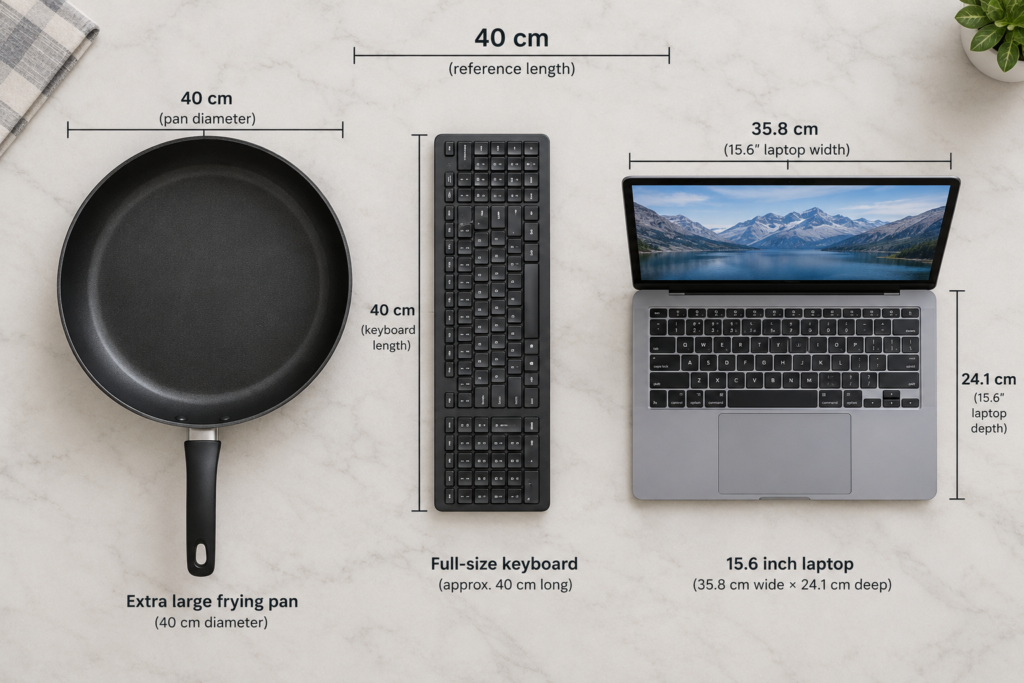
Standard frying pans are usually smaller, around 24 to 32 cm. A 40 cm pan is an extra-large family or paella style pan, so this comparison only works if you own one. When you do, the diameter across the rim is a clear picture of the measurement.
8. A Full-Size Keyboard
Keyboards with a number pad commonly measure somewhere between 42 and 45 cm wide, so they run a little longer than 40 cm. Compact keyboards without a numpad are shorter, often around 35 to 36 cm. Together they bracket 40 cm nicely, which makes a desk setup a handy reference.
9. A 15 to 16 Inch Laptop
This one is a common trap. The “15.6 inch” label describes the screen diagonal, not the width. A typical laptop of that class is around 35 to 38 cm wide, so it is a nearby size, not a true 40 cm object. Check the manufacturer’s width spec if you need to be sure.
10. A Cabin Bag Width
Many airlines list a carry-on size limit with a width of about 40 cm (often written as 55 x 40 x 20 cm). That makes the width of a small cabin suitcase a useful, relatable match. Airline rules differ, so check yours before you fly.
11. A Full-Size Countertop Blender
A large blender, with jar and base together, can reach about 40 cm in height, and some models go beyond that. Smaller personal blenders fall well short. Use this comparison for a rough idea only, and rely on the product listing for the real figure.
12. An Adult Forearm (Elbow to Fingertips)
For many adults, the distance from the elbow to the tip of the middle finger falls somewhere in the low to mid 40s of centimeters, so it can be a little longer than 40 cm. It differs from person to person, which makes it a personal measuring stick rather than a precise one.
How to Estimate 40 cm Without a Ruler
No tape measure nearby? These quick tricks get you reasonably close.
- Ruler plus a bit: Take a standard 30 cm ruler and imagine another 10 cm continuing in the same line.
- Four blocks of 10 cm: Break the length into four equal chunks and picture them end to end.
- Two hand spans: An adult hand is about 18 to 20 cm from wrist to middle fingertip, so two of them end to end land close to 40 cm.
- Printer paper: A sheet of A4 paper is 29.7 cm on its long side, so you need roughly 10 more centimeters on top to match 40 cm.
- Think 16 inches: Picture something just shy of 16 inches, and you are within a centimeter.
These are fine for quick decisions. When fit or accuracy matters, use a proper measuring tool.
How to Measure 40 cm Correctly
- Place the zero mark of your ruler or tape at the start point.
- Keep the tool straight and flat along the surface.
- Read the number at the end point and mark it if you need to transfer it.
- For round objects, measure straight across the center to get the diameter.
- For boxes and appliances, measure the specific side that the label refers to (width, height, depth or length).
Why a Single 40 cm Figure Can Mislead
A length of 40 cm is always the same distance, but objects that include it can look very different. A round fan guard that is 40 cm across has a completely different footprint than a tray that is 40 cm long. A square that is 40 cm on both sides covers 1,600 square centimeters, while a single 40 cm line tells you only one direction.
That is why it pays to read product listings carefully. Without a label like “width” or “depth,” the number alone does not tell you whether something will fit your shelf, cupboard, car boot or desk.
Common Mistakes to Avoid
- Assuming 40 cm and 16 inches are identical. They are close, but 16 inches is 40.64 cm.
- Confusing screen size with width. A 15.6 inch laptop is not 15.6 inches wide.
- Trusting an object comparison as an exact measurement. Household items vary widely between brands and models.
- Ignoring which dimension is listed. Width, height, depth and diameter are different things.
- Using body parts for precision work. Hands and forearms are great for estimates but not for cutting, fitting or buying.
Where You Are Likely to See 40 cm
Forty centimeters pops up often in shopping and home projects, including storage boxes, shelves and organizers, furniture dimensions, kitchen equipment, appliances, luggage and bags, tools, craft supplies, home decor items and pet accessories. Since photos online rarely show scale, learning to picture 40 cm helps you avoid ordering something that is too big or too small.
FAQs
How many inches is 40 cm?
40 cm is about 15.75 inches, which is just under 16 inches.
How many feet is 40 cm?
It is roughly 1.31 feet, or 1 foot 3.75 inches.
Is 40 cm the same as 16 inches?
Not exactly, but it is very close. Sixteen inches equals 40.64 cm, so 40 cm is only about 0.64 cm shorter.
How many millimeters and meters are in 40 cm?
There are 400 millimeters in 40 cm, and it equals 0.40 meters.
Is 40 cm longer than a standard ruler?
Yes. A typical school ruler is 30 cm, so 40 cm is 10 cm longer.
What does 40 cm look like in real life?
It is about the width of a 16-inch square throw pillow, the side of a large pizza box, or a bit more than the width of a car steering wheel.
Can I measure 40 cm without a ruler?
You can estimate it using a 30 cm ruler plus 10 cm, two adult hand lengths, or an object you already know is close to that size. For accurate work, use a real measuring tool.
Is 40 cm considered big or small?
It is a mid-sized everyday measurement. It is clearly longer than a ruler but still well short of half a meter.
Conclusion
So, how big is 40cm? It is 15.75 inches, 400 mm, 0.40 meters, or about 1.31 feet. The easiest picture is a 30 cm ruler with another 10 cm added, or a length just short of 16 inches. Everyday objects can make that size easier to imagine, but their dimensions vary, so treat them as helpful anchors and not exact standards. Need to switch between units quickly? Try our centimeters to inches converter for any length.