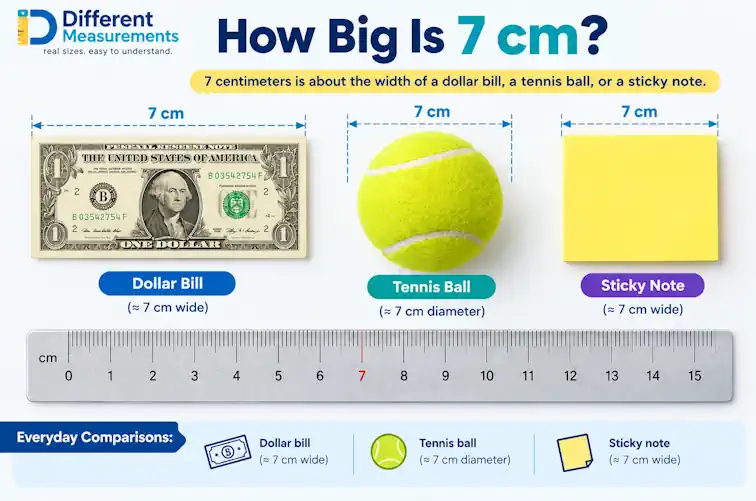
7 cm is equal to 70 millimeters (about 2.76 inches). It is also roughly the width of a US dollar bill.
Seven centimeters is a small length you can hold between your fingers, yet it is large enough to notice at a glance. It shows up in craft instructions, packaging specs, and product listings, and it is easy to get wrong because it sits just under 3 inches.
This guide gives you the exact conversions, ten everyday comparisons that actually check out, and several ways to estimate 7 cm without a ruler.
Key Takeaways
- 7 cm equals exactly 70 millimeters, 0.07 meters, or about 2.76 inches.
- On an inch ruler, 7 cm lands almost exactly on the 2 3/4 inch mark (2.75 inches is 6.985 cm).
- A US dollar bill is 6.63 cm wide, so 7 cm is only about 3.7 mm wider than the bill’s short edge.
- 7 cm is not 3 inches: 3 inches is 7.62 cm, which is 6.2 mm longer than 7 cm.
- Two standard small paper clips placed end to end measure about 6.6 cm, close to 7 cm.
7 cm Conversion Table
| Unit | Equal to 7 cm |
|---|---|
| Millimeters (mm) | 70 mm |
| Meters (m) | 0.07 m |
| Kilometers (km) | 0.00007 km |
| Inches (in), decimal | 2.76 in |
| Inches (in), nearest 16th | 2 3/4 in |
| Feet (ft) | 0.230 ft |
| Yards (yd) | 0.0766 yd |
| Miles (mi) | 0.0000435 mi |
| Micrometers (µm) | 70,000 µm |
Nearby Sizes in Inches
| Centimeters | Inches |
|---|---|
| 5 cm | 1.97 in |
| 6 cm | 2.36 in |
| 7 cm | 2.76 in |
| 8 cm | 3.15 in |
| 9 cm | 3.54 in |
| 10 cm | 3.94 in |
What Does 7 cm Look Like?
Seven centimeters is a little shorter than the long edge of a credit card (8.56 cm), and a bit longer than the width of a tennis ball. It is wide enough to span most of a small palm, and small enough to hide inside a closed fist.
Most people find it easiest to think of 7 cm as “just under 3 inches” or, more precisely, “about 2 3/4 inches.”
10 Everyday Things That Are About 7 cm
Real products vary a little from one maker to the next, so use these as helpful reference points, not exact rulers. Where an item runs slightly over or under, that is noted.
1. A US Dollar Bill (Short Edge)
A US bill is 6.63 cm tall (its short side) and 15.6 cm wide. The short edge is only about 3.7 mm under 7 cm, so it is one of the closest comparisons you can find in a wallet.
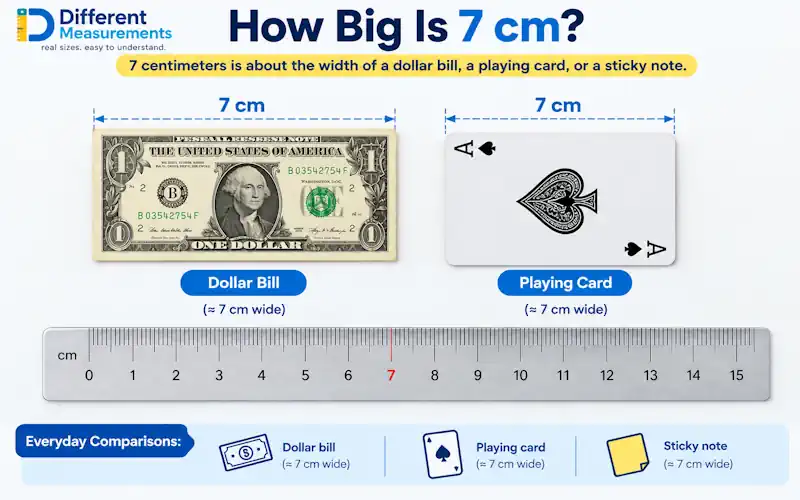
2. A Poker-Size Playing Card (Width)
The short edge of a standard poker-size playing card is 2.5 inches, or 6.35 cm. That is 6.5 mm under 7 cm, so picture the card with a thin strip added to one side.
3. A 3-Inch Sticky Note
The most common sticky note pad is 3 by 3 inches, or 7.62 cm square. It is a little over 7 cm, which makes it a good “just past” desk reference.
4. Three Quarters Side by Side
A US quarter is 24.26 mm wide, so three laid in a row come to about 72.8 mm, or 7.3 cm. Four dimes (17.91 mm each) in a row come to about 71.6 mm, which is even closer to 7 cm.
5. A Tennis Ball (Diameter)
Regulation tennis balls measure about 6.5 to 6.9 cm across. That makes a tennis ball a round, easy-to-picture version of 7 cm.
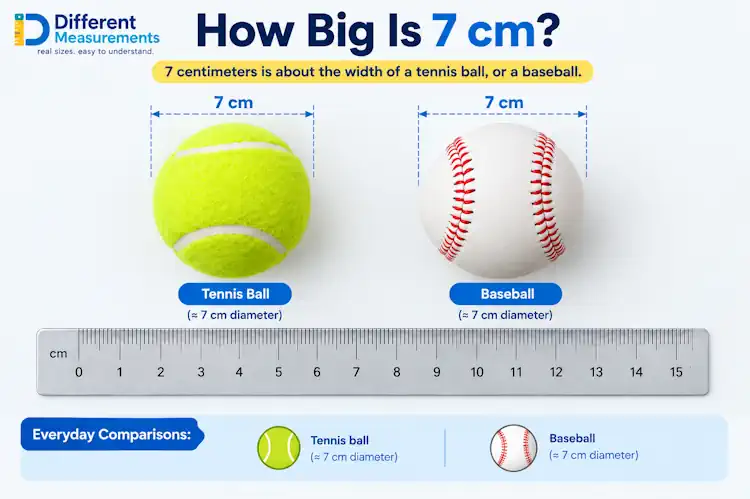
6. A Baseball (Diameter)
A baseball is about 7.3 to 7.5 cm across. It is just over 7 cm, so a tennis ball and a baseball together bracket the measurement nicely.
7. A Hockey Puck (Diameter)
A regulation hockey puck is 3 inches (7.62 cm) in diameter and 1 inch thick. Like the sticky note, it is a touch over 7 cm.
8. A Soda Can (Diameter)
A standard 12-ounce soda can is about 6.6 cm across. It is slightly under 7 cm, and almost everyone has seen one.
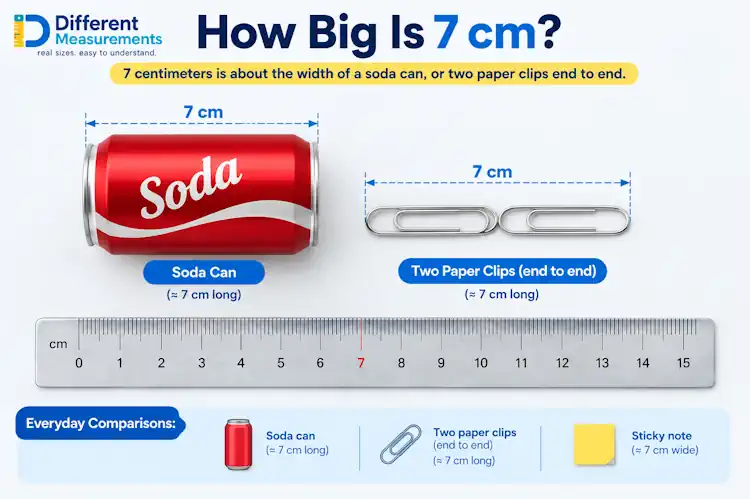
9. Two Small Paper Clips End to End
A standard small paper clip is about 3.3 cm long, so two lined up end to end measure roughly 6.6 cm. It is a handy desk trick when nothing else is nearby.
10. Four Adult Fingers Side by Side
The width of four adult fingers placed together is usually around 7 to 8.5 cm, depending on hand size. It is not exact, but it is always with you. Measure yours once against a ruler and remember the result.
How to Read 7 cm on a Ruler
On a metric ruler, start at the zero line (not the physical edge) and count to the numbered mark 7. That mark is exactly 7 cm, and there are 70 small millimeter ticks between zero and it.
On an inch ruler, 7 cm sits almost exactly on the 2 3/4 inch mark, about 3 mm beyond the 2 5/8 inch mark. It is clearly shy of the 3 inch line.
How to Estimate 7 cm Without a Ruler
- Use a dollar bill. Look at the short edge (6.63 cm) and imagine slightly more.
- Use coins. Line up three quarters, or four dimes, for about 7.2 cm.
- Use two small paper clips. End to end, they measure about 6.6 cm.
- Use a sticky note. A 3-inch note is 7.62 cm, so trim in your mind about 6 mm.
- Use your hand. Compare the width of four fingers or your palm against a ruler once, then reuse that knowledge.
7 cm vs 3 Inches
It is easy to treat these as the same, but they are not. Three inches is 7.62 cm, which is 6.2 mm longer than 7 cm. That gap is about eight stacked credit cards, since each card is only 0.76 mm thick.
For casual estimates, “about 3 inches” is fine. For sewing patterns, packaging, or anything that needs to fit, use the exact number: 7 cm is 2.76 inches, closer to 2 3/4 than to 3.
7 cm Compared to Other Common Sizes
| Size | How it compares to 7 cm |
|---|---|
| 6 cm | 1 cm shorter |
| 6.35 cm (playing card width) | About 6.5 mm shorter |
| 6.63 cm (dollar bill height) | About 3.7 mm shorter |
| 7.62 cm (3 inches) | 6.2 mm longer |
| 8 cm | 1 cm longer |
| 10 cm | 3 cm longer |
Common Mistakes When Estimating 7 cm
- Rounding 7 cm up to 3 inches. 3 inches is 7.62 cm, so you will overshoot by over 6 mm.
- Mixing up centimeters and millimeters. 7 cm is 70 mm. Reading a label wrong can make a part look ten times too big or too small.
- Using a teaspoon as a guide. A teaspoon is usually 13 to 15 cm long overall, so it is about twice as long as 7 cm.
- Trusting product photos. Camera angles can make small items look bigger, so always check the listed dimensions.
- Assuming all keys are the same length. Key lengths vary by lock type and car model, so use a key only as a rough guide.
Conclusion
Seven centimeters is easy to remember as “a little under 3 inches” or, more precisely, “about 2 3/4 inches.” Pair it with a dollar bill, a tennis ball, or a few coins, and the size stops feeling abstract.
FAQs
7 cm equals about 2.76 inches, which is very close to 2 3/4 inches.
7 cm equals exactly 70 millimeters.
No. 3 inches is 7.62 cm, so 7 cm is about 6.2 mm shorter.
The short edge of a US dollar bill (6.63 cm) and the diameter of a tennis ball (6.5 to 6.9 cm) are both very close. A 3-inch sticky note is just over at 7.62 cm.
Use the short edge of a dollar bill, line up three quarters or four dimes, or lay two small paper clips end to end.
It is the numbered mark 7 on a metric ruler, and on an inch ruler it sits almost exactly at the 2 3/4 inch mark.
Yes, by exactly 1 cm, or 10 millimeters.
7 cm is about 0.23 feet.