5 inches is equal to 12.7 centimeters, or about 0.42 feet.
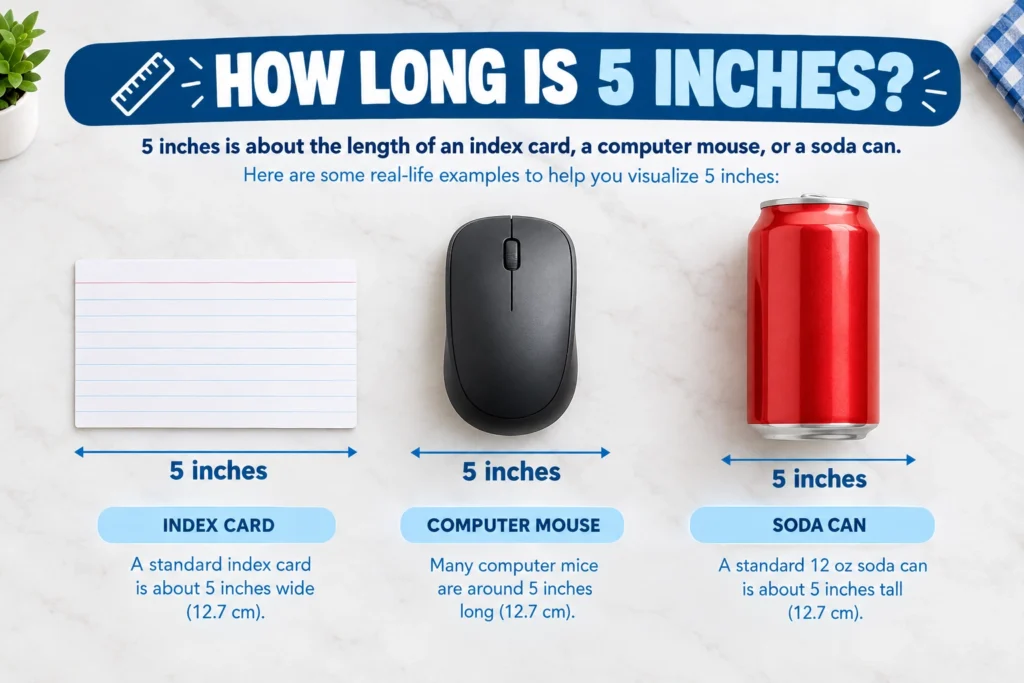
It is also roughly the length of a standard index card, or the length of a computer mouse.
If you’ve ever ordered something online and it arrived either way smaller or bigger than you expected, you already know the problem. Measurements written on a screen just don’t translate well in your head. Five inches is one of those sizes that sounds perfectly clear until someone asks you to actually point to it in real life, and suddenly you’re not so sure anymore.
Most people don’t naturally think in inches. They think in objects: “about the size of my phone,” or “roughly half the length of my forearm.” That’s actually a smarter way to understand measurements, and once you connect 5 inches to things already sitting on your desk, in your kitchen, or in your bag, the number becomes real and genuinely easy to remember.
Key Takeaways
- 5 inches equals 12.7 centimeters, 127 millimeters, or 0.42 feet. It’s slightly less than half a foot (which is 6 inches).The easiest visual reference is a standard 3×5 index card, its long side measures exactly 5 inches.
- Your own hand works as a built-in ruler. For most adults, palm width from the base of the pinky to the base of the thumb runs close to 5 inches.
- Plenty of everyday tech lands at this size, including a computer mouse, a compact TV remote, and many slim power banks.
- A quick no-ruler trick: line up 5 standard paper clips end to end, or hold up a passport, which stands just under 5 inches tall.
How Long Is 5 Inches, Exactly?
Five inches is not a huge measurement, but it’s also not tiny. It sits right in that comfortable middle zone, big enough to hold in one hand, small enough to fit in a pocket.
| Unit | Value |
|---|---|
| Inches | 5 inches |
| Centimeters | 12.7 cm |
| Millimeters | 127 mm |
| Feet | 0.42 ft |
| Yards | 0.14 yd |
| Meters | 0.127 m |
In plain terms, 5 inches is about 12.7 centimeters, slightly less than half a foot. Picture a standard 12-inch ruler and imagine cutting it just past the halfway point; you’re looking at roughly 5 inches. It’s close to half a ruler, but not quite there, and that small gap between the 5-inch and 6-inch marks is exactly the difference between “5 inches” and “half a foot.”
What Does 5 Inches Look Like on Your Hand?
Here’s a trick that costs nothing and needs no tools. Hold up your hand, palm facing you. For most adults, the width of the palm from the base of the pinky finger to the base of the thumb falls somewhere between 4 and 5 inches. It’s not a perfect measurement, but it gets you very close, and it means you always have a rough 5-inch reference right on your own hand.
Here’s another way to think about it: if you pick up any object and it fits comfortably in one hand without feeling too short or too long, there’s a good chance it’s somewhere near 5 inches. Designers and manufacturers actually lean on this logic when creating everyday products; they want things to feel natural in the hand, and 5 inches tends to land right in that sweet spot.
Quick Reference: 20 Objects Close to 5 Inches
| Item | Approximate Length | How Close to 5 Inches |
|---|---|---|
| Standard index card (long side) | 5 in | Exact |
| Computer mouse | ~5 in | Very close |
| Compact smartphone | 5 to 5.5 in | Very close |
| Standard soda can (height) | ~4.8 in | Nearly exact |
| Nail file | ~5 in | Very close |
| Five paper clips lined up | Exactly 5 in | Exact |
| Teaspoon (handle to bowl tip) | ~5 in | Close |
| Travel or foldable toothbrush | ~5 in | Very close |
| Mini TV remote (streaming stick) | ~5 in | Very close |
| Slim USB power bank | ~5 in | Close |
| Small hardcover book spine | ~5 in | Close |
| Hard-shell sunglasses case | ~5 in | Close |
| Mini serving tongs | ~5 in | Close |
| Passport (height) | Just under 5 in | Very close |
| Eyeglasses temple arm | ~5 in | Close |
| Compact flashlight | ~5 in | Close |
| Closed wallet (long side) | ~5 in | Close |
| Kitchen spatula head (width) | ~5 in | Close |
| Coffee mug (height) | 4 to 5 in | Close |
| Small pocket notepad | ~5 in | Very close |
20 Everyday Objects That Are About 5 Inches Long
1. A Standard Index Card
If you’ve ever used flashcards in school or kept notes on little cards at work, you’ve already held 5 inches in your hand without realizing it. The most common index card size, 3×5, is exactly 5 inches along its long side. This measurement wasn’t chosen randomly; it’s been the standard for decades because it’s wide enough to write on comfortably but small enough to shuffle through quickly.
2. A Computer Mouse
Most standard computer mice are designed to be right around 5 inches from the front tip to the back edge. This isn’t a coincidence; it’s the result of years of ergonomic research into what size fits the average human hand best. When a mouse feels just right in your palm, that comfort is partly because the length matches your hand’s natural resting size.
3. A Compact Smartphone
Smartphones have gotten bigger over the years, but older or compact models often land right around 5 to 5.5 inches tall. Many budget and mid-range phones fall in this range, and some newer compact models are deliberately designed to stay close to this size because plenty of people prefer a phone that fits easily in one hand.
4. A Standard Soda Can
A standard aluminum soda can, the kind you’d get at a grocery store or vending machine, stands about 4.8 inches tall. That’s just a sliver under 5 inches, which makes it one of the most reliable everyday comparisons available. Set one on a flat surface and look at it from the side; that height is almost exactly 5 inches.
5. A Nail File
A standard nail file is typically around 5 inches long, and this size isn’t accidental. It needs to be long enough to give good control while filing, but short enough to fit comfortably in a purse, makeup bag, or travel kit.
6. Five Paper Clips Lined Up
This one is more of a measurement trick than a single object, but it’s genuinely useful. A standard paper clip is just about 1 inch long. Put five of them end to end in a straight line, and you get almost exactly 5 inches, a simple, reliable way to measure something without picking up a ruler.
7. A Teaspoon
This surprises a lot of people. A regular teaspoon, the kind sitting in your kitchen drawer, measures around 5 inches from the tip of the handle to the end of the spoon bowl. Because teaspoons are so common, this is one of the easiest references to grab when you need to estimate 5 inches on the spot.
8. A Travel or Foldable Toothbrush
Compact toothbrushes designed for travel, the kind that fold in half or come in a small case, are usually around 5 inches when closed. The whole point of the design is portability, and 5 inches is the sweet spot where the brush stays short enough for a toiletry bag while remaining a real, functional toothbrush.
9. A Mini TV Remote
Mini streaming remotes, like the kind that come with Roku, Fire Stick, or Android TV devices, usually measure close to 5 inches long. They’re designed to sit comfortably in one hand while still fitting all the essential buttons, which makes the size feel natural when you’re flipping channels.
10. A Slim USB Power Bank
Slim USB power banks are often built around the 5-inch mark. This keeps them portable while still leaving room for a strong battery inside, small enough to slip into a pocket or backpack without adding noticeable weight.
11. A Small Hardcover Book Spine
Small hardcover books, like pocket dictionaries or slim poetry collections, often have spines close to 5 inches tall. Their compact size makes them easy to store, carry, and read anywhere, and holding one upright gives a clear, immediate sense of this length.
12. A Hard-Shell Sunglasses Case
A hard-shell sunglasses case usually measures close to 5 inches when closed, just long enough to protect folded glasses without taking up much space. Most people carry one during travel or keep it in a car’s glove compartment.
13. Mini Serving Tongs
Small serving tongs used for sugar cubes, pickles, or ice are often about 5 inches long. Their shorter size makes them easy to control when handling small foods, and they show up constantly in kitchens and tea setups.
14. A Passport
A standard passport stands just under 5 inches tall. Its compact size makes it easy to carry in travel wallets, small bags, or jacket pockets, and because passports get handled constantly during trips and airport check-ins, their dimensions become genuinely familiar over time.
15. An Eyeglasses Temple Arm
The temple arm of most eyeglasses, the part that rests over your ear, is roughly 5 inches long. This length allows glasses to sit securely without slipping, and folding one arm of your own glasses gives you an instant, tactile reference for this measurement.
16. A Compact Flashlight
Small handheld flashlights are commonly about 5 inches long, built to fit inside drawers, glove compartments, or emergency kits while staying portable and easy to grip.
17. A Closed Wallet
Many wallets measure close to 5 inches along their longest side when folded, a size that fits comfortably into pockets while still holding everything you need. Since most people handle their wallet several times a day, the length becomes an effortless reference point.
18. A Kitchen Spatula Head
The flat head of a kitchen spatula often measures about 5 inches wide. That width helps support food while flipping without making the tool feel heavy, and the measurement is right in front of you every time you’re making pancakes or burgers.
19. A Coffee Mug
Most standard coffee mugs stand between 4 and 5 inches tall, depending on the design. Shorter mugs lean toward 4 inches, taller ones can reach just past 5, and the average lands right around this mark, since mugs are designed to fit comfortably under most drip coffee machines.
20. A Small Pocket Notepad
Those tiny notebooks people keep in a jacket pocket or toss in a bag for quick notes are usually around 5 inches on their longer side, wide enough to write a full sentence without cramping everything together, but small enough to barely notice in a pocket.
How to Measure 5 Inches Without a Ruler
Sometimes you need a quick estimate and there’s no measuring tape in sight. A few practical tricks can help:
- Palm width is your most portable tool. For most adults, the palm from pinky side to thumb side runs close to 4.5 to 5 inches.
- A standard smartphone, especially an older or compact model, sits right around 5 inches tall.
- Five paper clips end to end gets you very close to exactly 5 inches.
- A soda can standing upright is about 4.8 inches tall, close enough for most everyday estimates.
- An index card held sideways gives you exactly 5 inches, if you happen to have one nearby.
- One credit card plus about half of another also lands close to the mark.
Why Knowing This Measurement Actually Matters
Understanding what 5 inches looks like isn’t just a fun fact, it genuinely helps in a handful of everyday situations.
Online shopping is the big one. When you’re buying a phone case, a wallet, a picture frame, or a storage container, dimensions listed on a product page can feel meaningless. But once you know that 5 inches is roughly the length of a computer mouse or a soda can’s height, you can instantly judge whether a product will be too big, too small, or just right, without pulling out a ruler.
DIY and home projects benefit too. When you’re measuring a shelf, figuring out where to hang something, or checking whether a drawer gap is wide enough for an item, estimating in 5-inch chunks saves a lot of back-and-forth trips for a tape measure.
Packing and storage is another area where this genuinely helps. Knowing that 5 inches is roughly the length of a travel toothbrush or a small notepad gives you an instant mental model for whether something will fit in a bag, box, or drawer.
Conclusion
Five inches is one of those measurements that feels vague until you connect it to something real. The moment you realize your computer mouse, your coffee mug, your nail file, and your kitchen teaspoon are all sitting right around this length, the number stops being abstract and starts being something you can picture instantly. From now on, whenever you see “5 inches” written somewhere, you won’t have to guess, you’ll already know exactly what that looks like.
Frequently Asked Questions
Five inches equals 12.7 centimeters, based on the standard conversion where 1 inch equals 2.54 cm.
Not quite. Half a foot is 6 inches, making 5 inches one inch shorter.
For most adults, it’s close to the width of the palm when the hand is relaxed with fingers together.
Index cards, computer mice, soda cans, passports, compact TV remotes, and slim power banks are all close to this size.
Use your palm width, a stack of five paper clips, an index card held sideways, or a standard soda can as a quick reference.