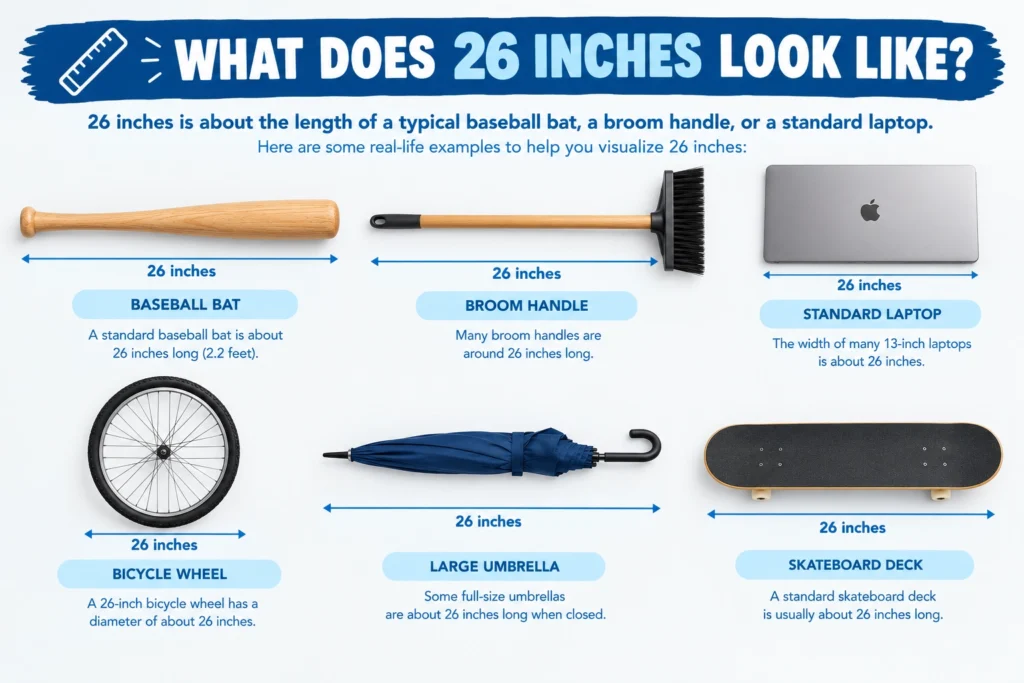
26 INCHES is equal to 66.04 centimeters (2 feet 2 inches). It is also roughly the diameter of a classic 26-inch bicycle wheel.
Twenty-six inches sits in an odd middle ground. It’s too long to picture as “small” but not long enough to instantly bring a familiar object to mind the way a foot or a yard does. The easiest fix is to line it up against things people actually own and use, from bike wheels to suitcases to countertops.
Here’s a practical rundown of everyday items that land right around the 26-inch mark, along with quick conversions and a few tricks for estimating this length without a tape measure.
Key Takeaways
- 26 inches converts to about 66.04 cm, 2 feet 2 inches, or 0.66 meters.
- The classic “26-inch” bicycle wheel is named for its approximate diameter, making it one of the most direct real-world matches for this length.
- Large checked suitcases are commonly sold in a “26-inch” size category, measured along the case’s longest edge.
- Standard kitchen countertops are typically about 25 to 26 inches deep.
- Counter-height bar stools usually have a seat height in the 24 to 26 inch range.
Quick Conversion Table
| Unit | Equivalent to 26 inches |
|---|---|
| Centimeters | 66.04 cm |
| Millimeters | 660.4 mm |
| Meters | 0.66 m |
| Feet and inches | 2 ft 2 in |
8 Things That Are About 26 Inches Long
1. A Classic 26-Inch Bicycle Wheel
This one is almost too easy: the “26-inch” wheel size gets its name directly from its approximate diameter. For decades it was the standard size for adult mountain and hybrid bikes, and while 27.5-inch and 29-inch wheels have become common too, 26-inch wheels are still widely used on commuter and kids’ bikes.
2. A Large Checked Suitcase
Luggage brands commonly sell a “26-inch” size as their large checked bag, with the measurement typically referring to the case’s height along its longest side, not including wheels or handles. This size sits between a mid-size 24-inch case and an extra-large 28 to 30-inch case, and it’s a popular choice for longer trips or family travel.
3. Standard Kitchen Countertop Depth
Most kitchen countertops are built to a standard depth of about 25 to 26 inches, measured from the front edge to the wall. That depth is chosen to comfortably fit standard base cabinets and appliances underneath while leaving enough counter surface to work on.
4. A Counter-Height Bar Stool
Bar stools made to match counter-height surfaces typically have a seat sitting 24 to 26 inches off the floor, a few inches shorter than stools designed for taller pub-height counters. That range keeps the seat at a comfortable height relative to a standard 36-inch counter.
5. The Average Length of a Six-Month-Old Baby
According to standard pediatric growth charts, the average baby is around 26 inches long by roughly six months of age, though individual babies vary quite a bit. It’s a useful reference point for parents comparing crib sizes, car seats, or clothing to their child’s current length.
6. A 26-Inch Computer or TV Screen
Screen sizes are measured diagonally, and while 24-inch and 27-inch monitors are more common today, 26-inch displays still show up as a middle-ground option for desktop monitors and smaller bedroom televisions. At that size, a screen offers noticeably more visible area than a 20 to 22-inch monitor without needing a particularly deep desk.
7. A Petite-Length Pants Inseam
Clothing brands that offer petite sizing commonly use an inseam of around 26 inches, compared to a regular inseam that often runs closer to 30 to 32 inches. It’s one of the more practical everyday references for this length, since it’s built directly into how pants are sized and sold.
8. An Extra-Wide Yoga Mat
Standard yoga mats are usually about 24 inches wide, but extra-wide mats made for taller users or more space-hungry poses often measure closer to 26 inches across. The extra width matters most for anyone who tends to roll off the edge of a standard mat during wider stances.
How to Estimate 26 Inches Without a Tape Measure
A few quick mental anchors make it easier to judge 26 inches on the spot:
- A little over two standard 12-inch rulers placed end to end
- Roughly the height of a kitchen counter’s depth from front to back
- About the diameter of a classic mountain bike’s front wheel
- Just over 2 feet, or about the height from the floor to a doorknob plus a few inches
Compared to Other Familiar Lengths
For context, 26 inches is longer than a standard 12-inch ruler doubled, shorter than a typical yardstick (36 inches), and close to the height of a large dog standing at the shoulder. It also lands just above 2 feet, making it easy to picture as “about two rulers and a bit more.”
Common Mistakes When Estimating 26 Inches
- Mixing up screen size with screen width. A “26-inch” monitor refers to the diagonal measurement, not the width or height of the screen itself.
- Confusing suitcase size categories. Luggage sizing isn’t fully standardized across brands, so a “26-inch” bag from one company may differ slightly from another’s.
- Forgetting units when reading specs. Countertop, furniture, and clothing measurements sometimes mix inches and centimeters on the same spec sheet, which can lead to a length being misread by a factor of roughly 2.54.
Conclusion
Once you tie 26 inches to things you already know, like a bike wheel, a suitcase, or a kitchen counter, it becomes much easier to picture accurately. Whether you’re shopping for luggage, sizing furniture, or just curious about the conversion, these comparisons make the length easier to visualize the next time it comes up.
FAQs
26 inches equals approximately 66.04 centimeters.
26 inches is equal to 2 feet 2 inches, or about 2.17 feet.
Yes, though less dominant than it once was. It remains a standard size for many commuter, hybrid, and kids’ bikes, even as 27.5-inch and 29-inch wheels have become more common for mountain bikes.
A 26-inch suitcase is typically classified as a large checked bag, sized for longer trips, sitting between mid-size and extra-large luggage categories.
An average baby reaches around 26 inches in length by about six months old, though this varies by individual growth pattern, so it isn’t unusually tall or short on its own.
A yard is 36 inches, so 26 inches is a little under three-quarters of a yard.