Ever tried to picture 4 cm and drawn a blank? A number alone never really tells you the true size but hold your index and middle fingers together, and that gap is almost exactly 4 cm.
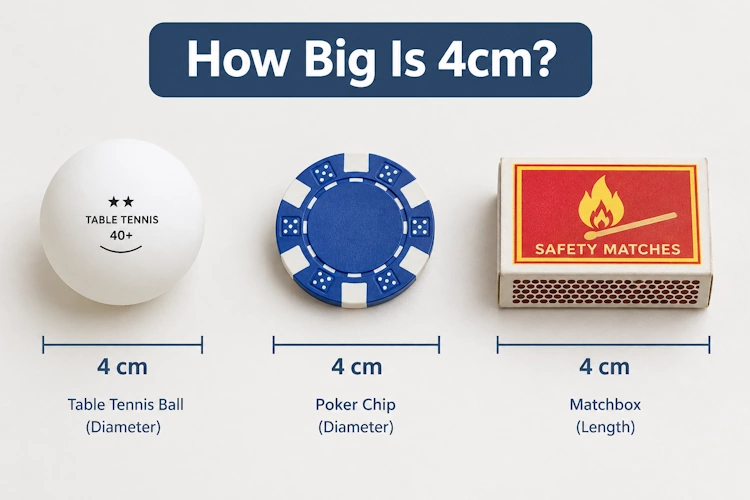
4 cm equals 40 mm, or about 1.57 inches a hair over one and a half inches. The cleanest object to picture is a regulation table tennis ball, which measures exactly 40 mm across by international rule. It’s a small-to-medium measurement, compact enough to disappear in your palm, yet noticeable enough to compare confidently against everyday objects.
Below, you’ll find 20 real-world comparisons some exact to the millimeter, some everyday approximations plus full conversion tables and a few tricks for judging this size with nothing but your own hands.
4 cm in Different Units
| Unit | Value |
|---|---|
| Millimeters | 40 mm |
| Centimeters | 4 cm |
| Inches | ≈ 1.57 in |
| Feet | ≈ 0.13 ft |
| Yards | ≈ 0.044 yd |
| Meters | 0.04 m |
Two conversions are worth memorizing because they never change: 4 cm = 40 mm exactly, and 4 cm ≈ 1.57 inches. Everything else follows from those two.
What Does 4 cm Actually Feel Like?
Four centimeters is genuinely smaller than most people guess when they hear “four” of anything. It’s a bit more than one and a half inches, not quite two. Held between your thumb and forefinger, 4 cm is roughly the gap you’d leave to grip a thick marker the diameter of a small round object you could close your whole hand around, like a large gumball or a chunky bead.
Because it’s not extremely small, 4 cm is easier to recognize than tinier measurements like 1 or 2 cm. Once you compare it against a few familiar objects, estimating this size starts to feel genuinely natural.
Every Reference at a Glance
| Object | Real Measurement | How It Compares to 4cm |
|---|---|---|
| Table tennis ball (diameter) | 40 mm | Exactly 4 cm |
| Poker chip (diameter) | ≈ 39 mm | ~1 mm under |
| Two pennies side by side | 38.1 mm | ~2 mm under |
| Golf ball (diameter) | 42.67 mm | ~3 mm over |
| AAA battery (length) | 44.5 mm | ~4–5 mm over |
| Wooden safety match (length) | ≈ 40–45 mm | About right |
| LEGO minifigure (height) | ≈ 40 mm | About right |
| French macaron (diameter) | ≈ 40–45 mm | About right to slightly over |
| Two adult fingers (width) | ≈ 40 mm | About right (varies by hand) |
| Matchbox (width) | ≈ 40 mm | About right |
| Credit card (height) | ≈ 40 mm | About right |
| Standard playing card (width) | ≈ 40 mm | About right |
20 Everyday Things That Are About 4 cm
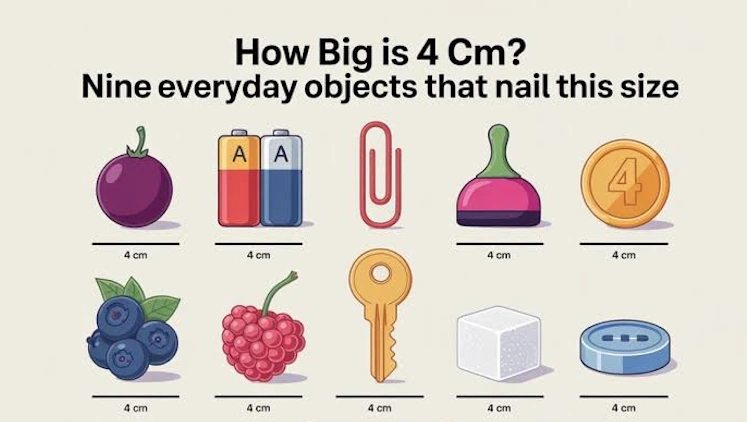
I’ve ordered the first nine from most exact to most approximate, since these come from official specs or precise physical standards. The remaining items are everyday household objects that land close to this size.
1. A Regulation Table Tennis Ball
A modern table tennis ball measures exactly 40 mm across, with no rounding needed. The International Table Tennis Federation fixed this size, so every tournament-legal ball is identical to the millimeter making it the single most precise everyday stand-in for 4 cm you can physically hold. Roll one into your palm, and you’re feeling 4 cm directly.
2. A Standard Casino Poker Chip
A casino-grade poker chip runs about 39 mm in diameter a whisker under 4 cm, close enough that the one-millimeter gap is invisible to the naked eye. The flat disc shape makes a chip easy to picture from memory, and stacking a few also gives you a feel for small thicknesses.

3. A Golf Ball
Golf rules set a minimum diameter of 42.67 mm, and manufacturers build right to that floor, so a golf ball measures about 4.3 cm — a touch over 4 cm rather than exactly on it. Think of it as “4 cm plus a sliver.” If an object is clearly smaller than a golf ball but bigger than a ping pong ball, it’s parked almost exactly at the 4 cm mark.
4. A AAA Battery, Standing Upright
Stand a AAA battery on end, and it’s about 44.5 mm tall roughly 4.4 cm, a little longer than 4 cm (note: its diameter is only about 10.5 mm, nowhere close). Nearly every household has one within arm’s reach, which is exactly what makes it such a convenient reference.
5. Two US Pennies Side by Side
A single penny is 19.05 mm wide, so two of them touching edge to edge span 38.1 mm about 3.8 cm, just shy of the full 4 cm. Coins are the ultimate no-excuses reference, since there’s almost always loose change in a pocket or drawer.
6. A Wooden Safety Match
A standard wooden safety match runs roughly 4 cm long, though most fall in the 40–45 mm range depending on the brand. Unlike the round objects on this list, a match measures a straight length, making it a useful complement lay one flat, and you’ve got a quick horizontal reference for short spans.
7. A LEGO Minifigure
A classic LEGO minifigure stands right around 4 cm tall, measured from the soles of its feet to the top of its head (hair and hats excluded). The height stays remarkably consistent from set to set, which makes it a genuinely handy, kid-friendly gauge if there’s a LEGO bin nearby.
8. A French Macaron
A classic Parisian macaron typically runs 4 to 4.5 cm across, with many bakeries piping their shells to land right around 4 cm. Sizes shift by pastry chef, so treat this as a friendly estimate but food references genuinely stick in memory better than bare numbers.

9. Two Adult Fingers Held Together
Press your index and middle fingers flat and together, and the width across the pair is roughly 4 cm for most adults. Since hand sizes vary, measure yours once against a real ruler, and you’ll always carry a personal 4 cm gauge with you no object required.
10. A Matchbox’s Width
The width of a standard matchbox often lands close to 4 cm. Since matchboxes are common in kitchens and used for outdoor activities, their rectangular shape makes for a genuinely easy visual comparison.
11. A Credit Card’s Height
The shorter side of a standard credit card measures around 4 cm. Since cards get handled daily for shopping and payments, they’re a relatable, always-available reference for this measurement.
12. A Medium Garlic Clove
A medium-sized garlic clove can measure close to 4 cm in length. Since garlic is a kitchen staple used constantly, its natural shape offers a genuinely easy way to estimate small measurements while cooking.
13. A Small Sticky Note’s Width
The width of some compact sticky notes can measure around 4 cm. Common in schools, offices, and homes for quick reminders, their square shape makes size comparison genuinely straightforward.
14. A Car Key’s Width
The width of a standard car key head can land close to 4 cm. Since car keys are handled every single day, they’re easy to recognize instantly and offer a solid, practical everyday example.
15. A Medium Egg’s Width
The width of a medium-sized egg often measures around 4 cm. Since eggs are used in kitchens worldwide, they’re a highly relatable object, and their rounded shape helps illustrate this dimension naturally.
16. A Small Cookie’s Diameter
The diameter of a small cookie can land close to 4 cm. Food items are naturally easy to visualize since people interact with them constantly, and a cookie’s round shape makes the comparison genuinely simple.
17. A Small Tape Roll’s Width
The width of a small tape roll can measure around 4 cm. Common in schools, offices, and packaging tasks, its circular design helps make the comparison quick and easy to picture.
18. A Compact Perfume Bottle’s Width
Some travel-size perfume bottles have a width close to 4 cm. Since these are commonly carried in bags and used daily, their compact shape makes for an easy, modern comparison.
19. A Standard Playing Card’s Width
The width of a standard playing card is close to 4 cm. Since cards are handled during games and entertainment constantly, their straight edges make measurement comparisons genuinely clear.
20. A Small Toy Car
A small toy car can measure around 4 cm in length. Common in homes with children, their compact size is easy to compare visually against other small objects on this list.
Judging 4 cm With Just Your Hands
No ruler, no coins, nothing in the drawer? You still have a few reliable ways to gauge 4 cm.
The first is the two-finger method covered above index and middle fingers pressed together read about 4 cm for most adults. The second is your thumb: the width across an adult thumbnail is close to 2 cm, so two thumbnail-widths stacked gets you near 4 cm. The third is coins but remember that most everyday coins sit between 2 and 2.5 cm across, so a single coin isn’t enough; you need roughly a coin-and-three-quarters, which is exactly why “two pennies” is the cleaner shortcut. Calibrate one of these against a real ruler once, and you’ll carry a trustworthy 4 cm estimate everywhere you go.
Where 4 cm Actually Comes Up
This size shows up more often than you’d expect once you start noticing it. Cabinet and drawer hardware is frequently sized around 40 mm for knob diameters and screw lengths. Jewelry makers work in this range constantly a 4 cm pendant drop or hoop earring is a common, wearable size. In crafting and sewing, 4 cm often equals a doubled seam allowance or the diameter of a large button. Phone and camera lenses, watch faces, jar lids, and bottle caps all cluster near this figure. If you’re packing or shipping something fragile, 4 cm is also a typical clearance to leave around delicate items enough padding to matter, but small enough not to waste box space.
4 cm Between Its Neighbors: 3 cm vs 5 cm
Sizes make more sense in company, so here’s 4 cm flanked by the centimeter on each side.
3 cm (≈ 1.18 in) is noticeably smaller. A good picture is a US half-dollar coin, about 30.6 mm across, or a large grape. Drop from 4 cm to 3 cm, and a ping pong ball shrinks to roughly half-dollar width.
4 cm (≈ 1.57 in) is our subject here the ping pong ball, the poker chip, two fingers pressed together.
5 cm (≈ 1.97 in) is almost exactly two inches. The easy reference is a AA battery, standing about 50.5 mm tall, or a jumbo paperclip. Going from 4 cm to 5 cm is the visible jump from a ping pong ball to a AA battery standing on end.
Where People Get 4 cm Wrong
A few honest mistakes trip people up again and again. Sidestep these, and your estimates stay sharp.
Mixing up 4 cm and 4 inches. These aren’t close at all. Four inches equals 10.16 cm more than two and a half times bigger. If a listing says “4 cm” and the object looks palm-filling in the photo, someone likely swapped the unit.
Dropping a decimal between cm and mm. 4 cm is 40 mm, while 4 mm is only 0.4 cm a tenfold error that sneaks into DIY measurements constantly.
Rounding 4 cm up to “about 2 inches.” It’s tempting, but 4 cm is 1.57 inches closer to one and a half than to two. Calling it 2 inches overshoots by nearly 27%.
Assuming a single coin covers it. A US quarter is only about 24.26 mm across, roughly 2.4 cm well under 4 cm. One coin always undershoots; you need close to two.
Treating a golf ball as “exactly 4 cm.” It’s actually 42.67 mm, or about 4.3 cm great for a rough upper bound, but not precise. Reach for the table tennis ball instead when you need exact.
Frequently Asked Questions
4 cm equals 1.57 inches.
It looks like a small round object about the width of a table tennis ball 40 mm, or roughly 1.57 inches.
It’s considered a small-to-medium measurement noticeable, but still genuinely compact.
It looks like a small round object about the width of a table tennis ball 40 mm, or roughly 1.57 inches.
It’s close to the width of a large grape or a small strawberry. A cherry tomato about 4 cm across is a near-perfect match.
Compare it with objects like a matchbox, a playing card’s width, or two pennies side by side. You can also press your index and middle fingers together for an instant estimate.
Yes, it appears frequently in household and everyday items from matchboxes and sticky notes to jewelry, cabinet hardware, and bottle caps.
Not exactly a golf ball measures about 4.3 cm, slightly larger than 4 cm. A table tennis ball is the more precise match, at exactly 40 mm.
Conclusion
So, how big is 4 cm?
It’s a small-to-medium measurement equal to 1.57 inches or 40 millimeters. A table tennis ball shows it best, since it measures exactly 4 cm across by international regulation a poker chip and a golf ball come very close too. You can also press two fingers together for an instant, tool-free estimate. Once you connect this number to objects like these, 4 cm stops being abstract and starts being something you can spot anywhere.