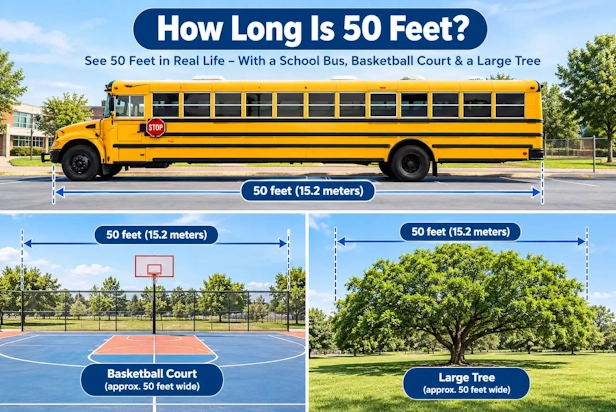
50 feet is equal to 600 inches, 16.67 yards, or 15.24 meters. It is also roughly the length of a school bus or a railroad boxcar.
Fifty feet is big enough that you rarely see all of it at once indoors, yet it shows up constantly outdoors: in buses, courts, trees, and even a few surprisingly large animals.
This guide runs through every conversion you might need and 15 real comparisons that make the distance easy to picture, whether you are looking at it stretched out on the ground or standing straight up.
Key Takeaways
- 50 feet equals exactly 600 inches, 16.67 yards, and 15.24 meters.
- In smaller metric units, 50 feet is 1,524 centimeters or 15,240 millimeters.
- A school bus, a railroad boxcar, and an NYC subway car are all close to 50 feet long.
- Stacked vertically, 50 feet is about five stories of a building, or roughly nine adults standing head to toe.
- On foot, 50 feet takes about 20 average steps, or roughly 11 to 17 seconds to walk depending on your pace.
50 Feet Conversion Table
| Unit | Equal to 50 feet |
|---|---|
| Inches (in) | 600 in |
| Yards (yd) | 16.67 yd |
| Centimeters (cm) | 1,524 cm |
| Millimeters (mm) | 15,240 mm |
| Meters (m) | 15.24 m |
| Kilometers (km) | 0.01524 km |
| Miles (mi) | 0.00947 mi |
| Fathoms | 8.33 |
15 Real Things That Are About 50 Feet Long
Sizes vary a little between specific models and individual specimens, so treat these as strong reference points rather than exact rulers.
1. A School Bus
A standard school bus runs close to 45 to 50 feet from bumper to bumper. Because school bus sizing is regulated, this is one of the most consistent visual references for the distance.
2. A Railroad Boxcar
The classic railroad boxcar holds about 50 feet of interior cargo space, a size that stuck because it hauls plenty of freight while still fitting through tight yards and tunnels. Count the boxcars rattling past a crossing, and each one is roughly your fifty-foot yardstick.
3. A New York City Subway Car
The older, narrower subway cars used on some New York lines run about 51 feet long. They were built to that length because the original tunnels were dug tightly more than a century ago, so newer, longer cars from other lines cannot use the same tracks.
4. A Semi-Truck Trailer
Semi-truck trailers typically range from about 48 to 53 feet long, putting 50 feet squarely in the middle of what you see hauling freight on the highway or backed up to a loading dock.
5. Three to Four Parked Cars in a Row
An average car measures about 15 feet from bumper to bumper. Line up three or four of them nose to tail in a parking lot, and that row adds up to roughly 50 feet.
6. An NBA Basketball Court’s Width
An NBA court measures 50 feet wide by official rule, even though its length runs much longer. Watching a game gives an easy, flat, open sense of just how far 50 feet spans from sideline to sideline.
7. A Beach Volleyball Court
A regulation beach volleyball court runs about 52 feet from end to end, just past the fifty-foot mark. With only two players covering that entire stretch of sand per side, it is part of why beach doubles is such a demanding game.
8. An NHL Hockey Neutral Zone
The neutral zone between the two blue lines on an NHL rink measures exactly 50 feet. It is the stretch where a team builds up speed before attacking, and a clean pass from one blue line to the other covers the whole distance.
9. A Residential Swimming Pool
Many backyard swimming pools run around 45 to 50 feet long, a size chosen to balance real swimming distance against the space available in a typical yard. Standing at one end and looking down the length gives a strong, grounded sense of the distance.
10. A Five-Story Building
Each story of a typical building averages about 10 feet in height, so five stories stacked on top of each other reach roughly 50 feet tall. Because it is vertical, this comparison tends to feel bigger than the same distance laid flat on the ground.
11. A Flagpole
Flagpoles outside schools, dealerships, and city halls are frequently built to a clean 50 feet tall, with a flag sized to match. Standing at the base and looking up to where the flag snaps in the wind is a quick way to feel out the height.
12. A Mature Shade Tree
Many fully grown oak and pine trees reach heights close to 50 feet. Looking straight up at one of these trees is a natural, everyday way to picture the vertical version of this distance.
13. A Blue Whale
A blue whale can grow to around 50 feet long or more, making it longer than most city buses despite being a single living animal. It is one of the most dramatic ways to grasp just how much length 50 feet actually covers.
[IMAGE: tree-whale-50-feet.webp “A mature tree and a blue whale scale illustration, both around 50 feet”]
14. A 50-Foot Roll of Chain-Link Fence or LED Strip Lights
Chain-link fencing and LED strip lighting are both commonly sold in 50-foot retail rolls. Unrolled, a 50-foot roll of fencing will often stretch the full side of an average backyard, which makes it one of the easiest ways to physically lay the distance out flat and look at it.
15. A City Building Lot’s Width
Many older city neighborhoods were platted with building lots 50 feet wide at the street. It became a popular standard width because it fits a modest house with a driveway down one side, though setback rules usually make the usable space feel narrower than the number suggests.
What 50 Feet Feels Like on Foot
The average adult stride covers about 2.5 feet, so it takes roughly 20 normal steps to cover 50 feet. Walking it at a brisk pace takes about 11 seconds, and closer to 17 seconds at a relaxed stroll.
Indoors, 50 feet rarely fits inside a single room, since most rooms run only 10 to 15 feet across. Picturing 50 feet indoors usually means stringing three or four average rooms together, or pacing the length of a long hallway.
50 Feet Compared to a Person
An average adult stands around 5.5 feet tall, which makes 50 feet roughly equal to nine people standing head to toe in a single stack. It is also close to five building stories, since each story averages about 10 feet.
Common Mistakes When Estimating 50 Feet
- Assuming every “50-foot” object is exact. School buses, pools, and trees are described as ranges (45 to 55 feet is common), not fixed universal sizes.
- Confusing boxcar length with total train car length. A boxcar’s interior is close to 50 feet, but its outer length with couplers runs closer to 55 feet.
- Mixing up feet and yards. Since 3 feet equals 1 yard, 50 feet works out to 16.67 yards rather than a round number, which trips up quick mental math.
- Underestimating vertical distance. Fifty feet stacked up (five stories, a mature tree, a flagpole) tends to feel far more dramatic than the same distance laid flat on the ground.
Conclusion
Fifty feet is easiest to grasp once you connect it to something you already picture clearly, whether that is a school bus rolling down the street or a mature tree towering over a yard. Keep one or two of these in mind, and any spec sheet or sign quoting “50 feet” will click into place instantly.
FAQs
Picture a school bus, a railroad boxcar, or an NBA court’s width. Any of these lands within a few feet of the true distance and makes for an easy mental image.
An average car is about 15 feet long, so 50 feet equals roughly three to four cars parked nose to tail.
About 20 average adult steps, since a typical stride covers roughly 2.5 feet.
Since a building story averages about 10 feet, 50 feet works out to roughly five stories.
Blue whales are the best-known example, commonly reaching around 50 feet or more in length.
50 feet equals 15.24 meters and 600 inches exactly.
About 11 seconds at a brisk pace, or up to 17 seconds at a slow stroll.