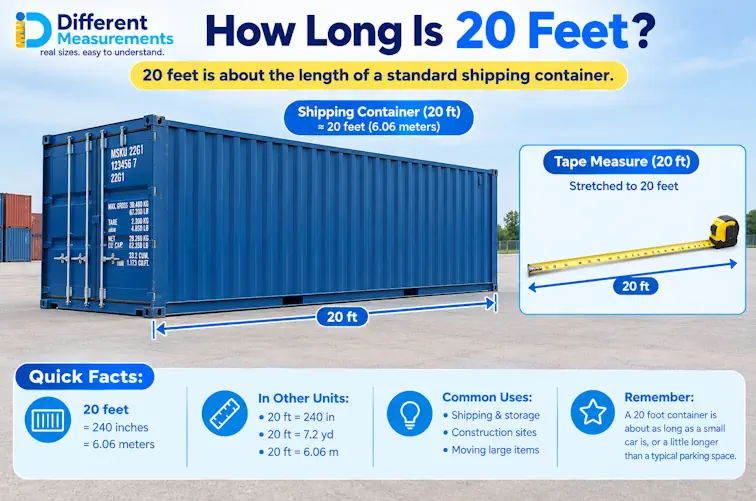
20 feet is equal to 240 inches (6.096 meters). It is also about the length of a standard shipping container, and twice the height of a regulation basketball rim.
Twenty feet is a length you meet in driveways, garages, cable spools, and construction yards. It is long enough to feel substantial when you walk it, but short enough to picture once you have a few real objects to compare it with.
This guide gives you the exact conversions, twelve objects and spaces close to 20 feet, a comparison table, and simple ways to estimate 20 feet without a tape measure.
Key Takeaways
- 20 feet equals exactly 240 inches, 609.6 centimeters, or 6.096 meters.
- 20 feet is 6.67 yards, which is a little more than six yards.
- A standard shipping container is nominally 20 feet long, making it one of the most reliable real-world references.
- Two regulation basketball rims stacked on top of each other reach about 20 feet high, since each rim sits 10 feet off the ground.
- For most adults, 20 feet takes about 8 normal steps, so counting your stride is a quick way to estimate.
20 Feet Conversion Table
| Unit | 20 feet equals |
|---|---|
| Inches (in) | 240 in |
| Centimeters (cm) | 609.6 cm |
| Millimeters (mm) | 6,096 mm |
| Meters (m) | 6.096 m |
| Yards (yd) | 6.667 yd |
| Miles (mi) | 0.00379 mi |
Nearby Lengths in Feet and Meters
| Feet | Meters |
|---|---|
| 10 ft | 3.048 m |
| 15 ft | 4.572 m |
| 20 ft | 6.096 m |
| 25 ft | 7.620 m |
| 30 ft | 9.144 m |
What Does 20 Feet Look Like?
Twenty feet is a clear distance across a driveway or a room. Lay a tape measure out in a straight line and you can see it come up to roughly the end of a typical one-car garage. Vertically, it is about the height of a two-story house from the ground to the roofline, which is why it can feel tall when you stand beneath it.
12 Real Objects and Spaces Near 20 Feet
Items marked “exact” are standardized or sold in exact lengths. Items marked “about” vary by brand, model, or design.
1. A Shipping Container (Nominal 20 Feet)
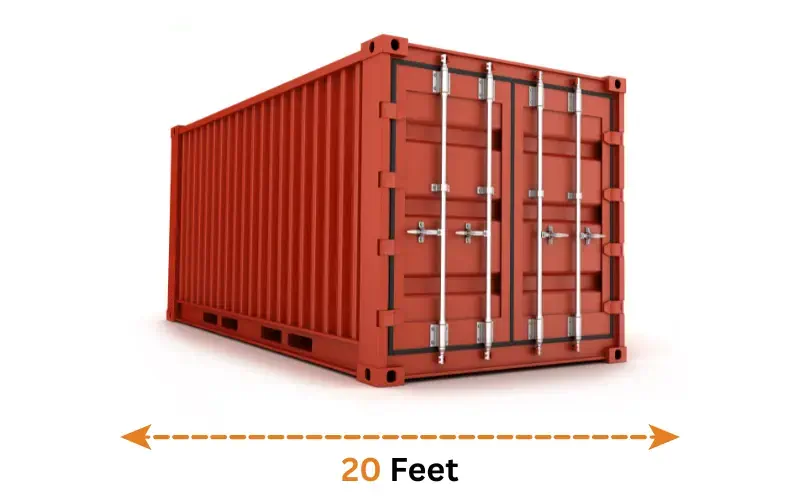
A standard 20-foot shipping container is the most widely used freight container in the world. Its name refers to the nominal length, which is close to 20 feet on the outside. Containers are used for shipping, storage, and sometimes as small buildings, so they are easy to find in port areas and construction sites.
2. A Professional Extension Ladder, Fully Extended (About)
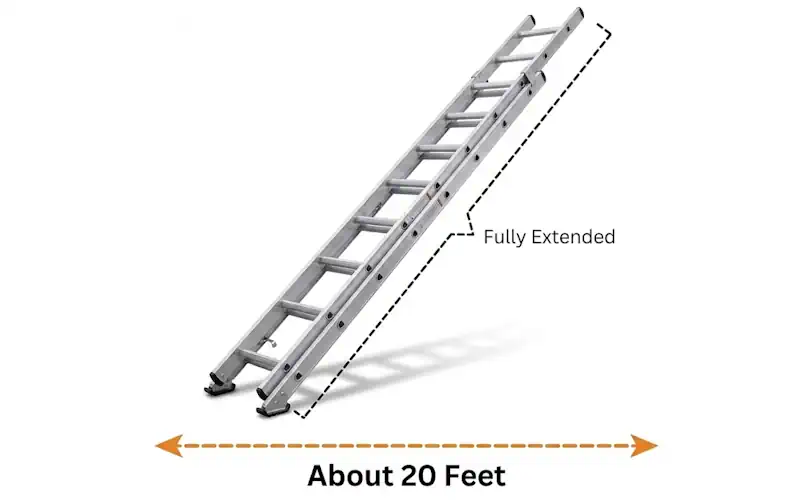
Professional extension ladders commonly extend to about 20 feet. When fully raised, the ladder reaches the height of a second story, so it is a good reference for vertical length as well as horizontal.
3. Two Regulation Basketball Rims Stacked (Exact in Principle)
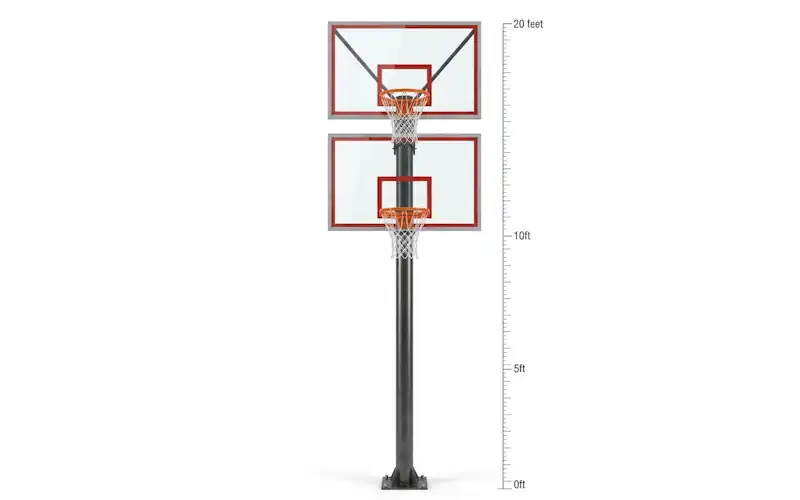
A regulation basketball rim sits 10 feet above the floor. Stack two rims on top of each other in your imagination and you reach 20 feet. It is one of the best vertical references because the rim height is standardized in the rules of the sport.
4. Four Park Benches End to End (About)
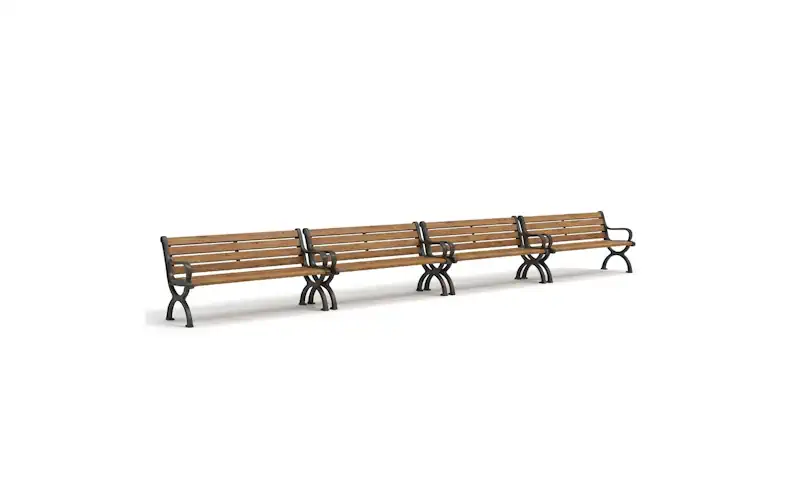
A standard park bench is about 5 feet long, so four benches laid end to end cover roughly 20 feet. This is a useful outdoor comparison, since benches are common in parks, schools, and plazas.
5. A 20-Foot Extension Cord (Exact)
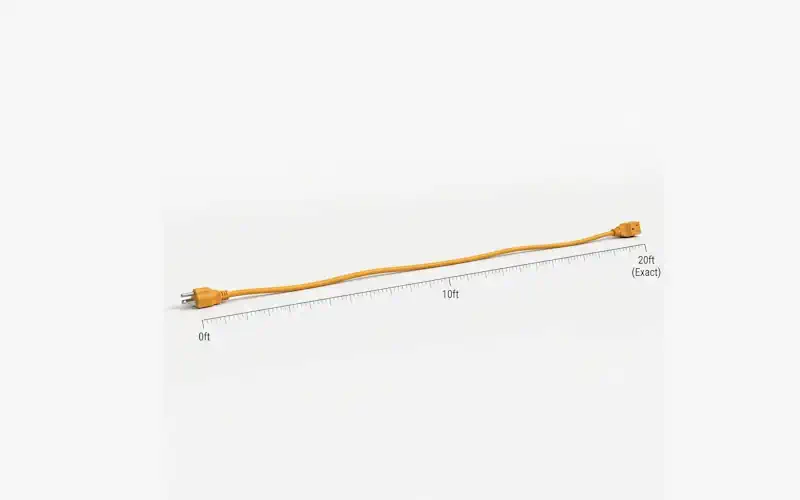
Extension cords are sold in exact 20-foot lengths. Unrolling one across a room or down a hallway gives you a clear, physical sense of the distance. Because cords are everywhere in homes, this is one of the easiest references to find.
6. A 20-Foot PVC Pipe Section (Exact)
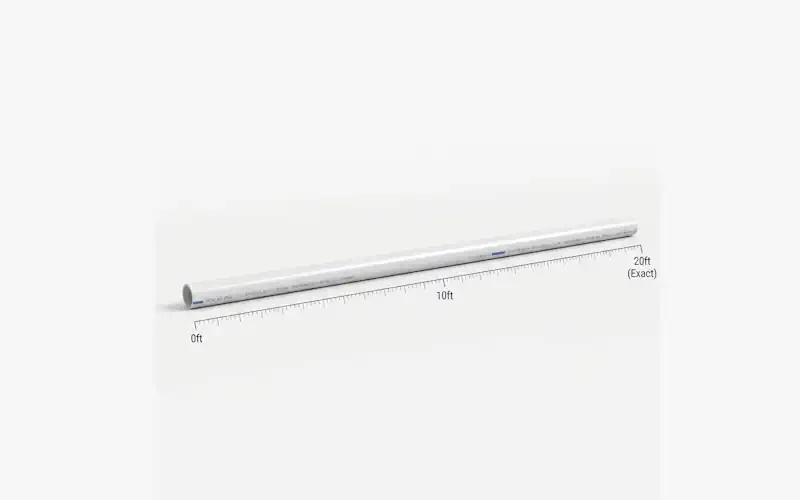
PVC pipe is sold in standard lengths, and 20-foot sections are common in plumbing, irrigation, and drainage work. Since pipe is straight and rigid, it gives a very accurate sense of the full length when you lay it on the ground.
7. A 20-Foot Steel Pipe Section (Exact)
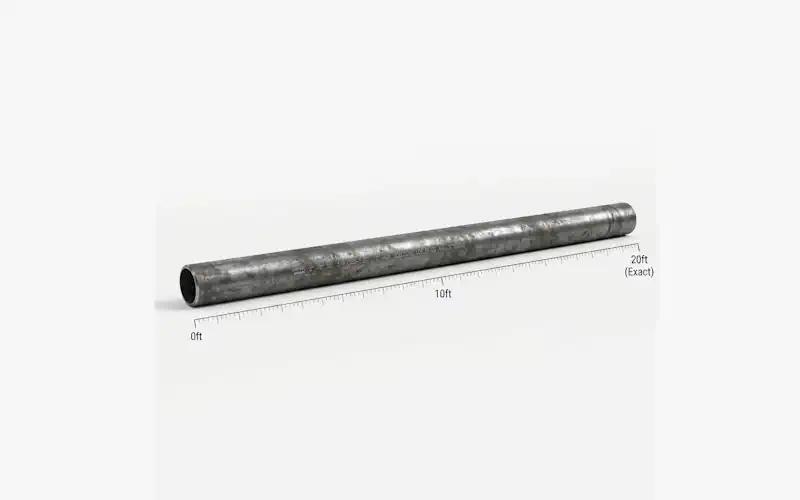
Steel pipes are also made in 20-foot sections for construction, fencing, and support structures. A single steel section is heavy and clearly long, so it leaves little doubt about the distance.
8. A 20-Foot Tow Strap (Exact)
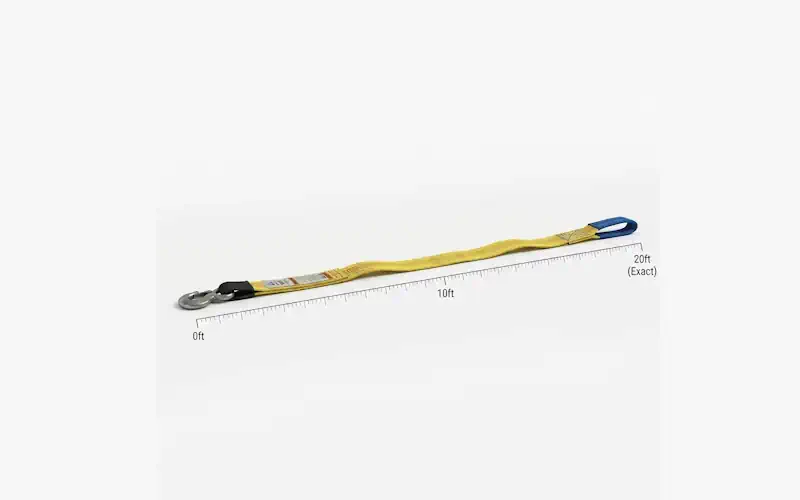
Tow straps and recovery straps are sold in lengths including 20 feet. They are used for towing and off-road recovery, so the strap is a practical reference for reach between two vehicles.
9. A 20-Foot Ethernet Cable (Exact)
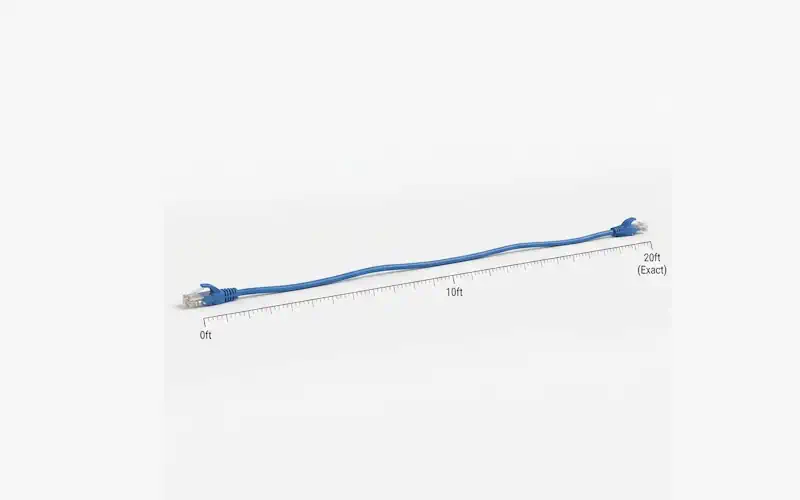
Network cables are sold in 20-foot versions for routers, gaming setups, and offices. When you run one along a wall or behind furniture, you see how far 20 feet covers in a home.
10. A 20-Foot Dog Training Leash (Exact)
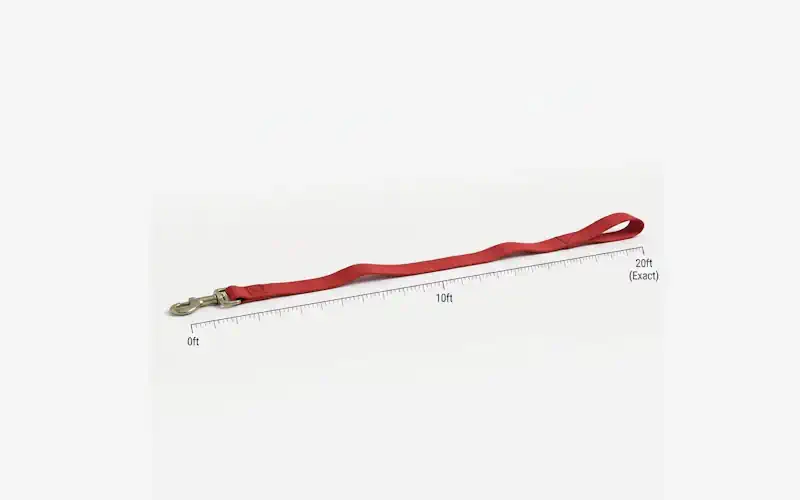
Long training leashes are sold in 20-foot lengths, so pet owners can use them for recall and practice. When extended on a lawn, the leash shows the distance clearly.
11. A Two-Car Garage Width (About)
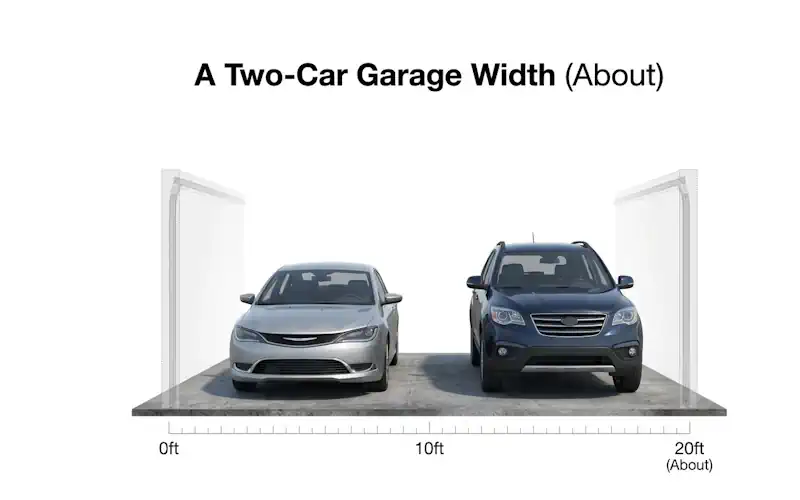
Many two-car garages measure close to 20 feet wide from wall to wall, although the exact width varies by home. Picture the width of your own garage door opening, and you have a reference that is part of many homes.
12. A Round Above-Ground Pool (About)
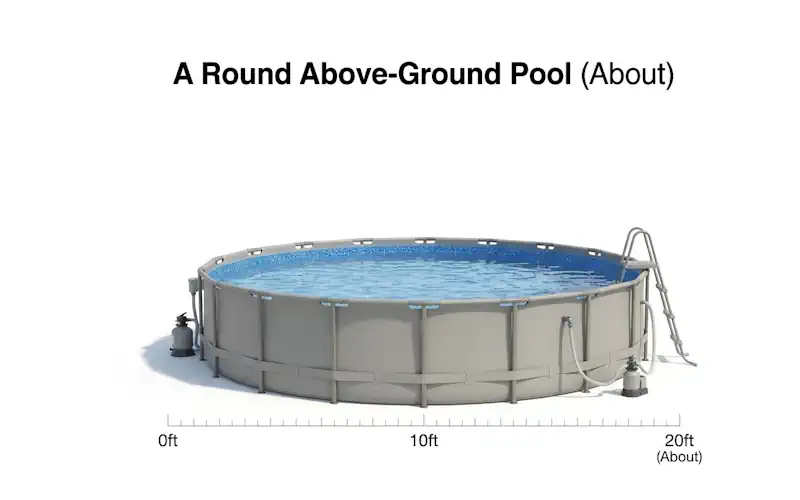
Round above-ground pools come in several sizes, and many common models are in the 18 to 24 foot diameter range. A pool about 20 feet across is a large backyard feature and a good way to see the size on open ground.
20 Feet Compared to Other Common Lengths
| Length | How it compares to 20 feet |
|---|---|
| 10 feet | Half as long |
| 15 feet | 5 feet shorter |
| 25 feet | 5 feet longer |
| 30 feet | 10 feet longer |
| 50 feet | Two and a half times as long |
| 100 feet | Five times as long |
Note that a mid-size car is about 15 feet long, so 20 feet is about one and a third cars. Two cars parked bumper to bumper come to about 30 feet, not 20.
How to Estimate 20 Feet Without a Tape Measure
- Count your steps. Walk in a straight line with a normal stride. Most adults take about 8 steps for 20 feet, since a stride is about 2.5 feet. Measure your own stride once against a known distance.
- Use four people. Four people who are each about 5 feet tall, lying head to toe, cover roughly 20 feet.
- Use four park benches. If you can picture a standard 5-foot bench, four of them end to end is about 20 feet.
- Use two 10-foot lengths. If you know something that is about 10 feet long, place two of them end to end.
- Use floor tiles. If your floor tiles are 1 foot square, count 20 tiles in a straight line.
Common Mistakes When Estimating 20 Feet
- Treating 20 feet as 20 meters. 20 feet is 6.096 meters, so it is less than a third of 20 meters.
- Comparing it to two cars. A mid-size car is about 15 feet long, so two cars end to end come to about 30 feet.
- Forgetting that stride length varies. A taller person takes longer steps, so the step count for 20 feet changes from person to person.
- Assuming a 20-foot container is exactly 20 feet. The name is nominal. Actual outside lengths are close to 20 feet but not identical to the inch.
- Mixing up feet and inches. 20 feet is 240 inches. Reading the wrong unit can make a measurement twelve times too small.
Conclusion
Twenty feet equals 240 inches or 6.096 meters, and it is easiest to picture as a shipping container, a fully extended ladder, or two basketball rims stacked on top of each other. For a quick estimate, count about 8 steps or use four benches. For real work, use a tape measure.
FAQs
20 feet equals 240 inches.
20 feet equals 6.096 meters.
20 feet equals 6.67 yards, or 6 yards and 2 feet.
It is exactly twice as tall, because a regulation basketball rim sits 10 feet off the ground.
For most adults, about 8 normal steps. Shorter or longer strides will change the count.
Yes. A mid-size car is about 15 feet long, so 20 feet is roughly one and a third cars.
A shipping container, a fully extended extension ladder, and a set of four park benches are all close to 20 feet.